Riparia riparia
Type: bird
Status: special concern
Tom Johnson
Species Guide
Bank swallow
Riparia riparia
Species Type: bird
Conservation Status: special concern
Identification
Bank swallows are small swallows with white underparts and a brown head, back, and wings. Males and females look similar. They are distinguished from other small brown swallows by the dark brown band that stretches across their chest.
Distribution & Habitat
The breeding range for the bank swallow extends across the Northern Hemisphere, spanning from Alaska, through Canada, to the Atlantic coast, and south through most of the U.S. to northern Mexico.
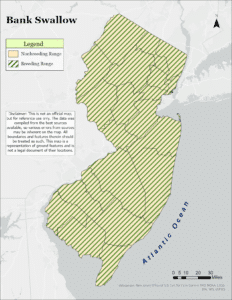
In New Jersey, the bank swallow can be found breeding throughout the state in areas with suitable habitat and nest sites. They can also be seen throughout the state during migration.
Bank swallows breed in colonies and can be found nesting near water such as rivers, streams, lakes, and ocean coasts. They also can be found utilizing human-made features such as road cuts and quarries. They can be found foraging in open areas.
Diet
Bank swallows feed on flying insects such as ants, bees, wasps, flies, and moths. They feed almost exclusively in flight, rarely taking insects from water or the ground.
Life Cycle
Breeding season for the bank swallow begins in early May through July. The bank swallows burrow is built by the males in the side of a bank composed of sand or loose soil They use their feet, wings, and bill to excavate their burrows. The female then builds the nest inside the burrow. The nest is made of leaves, grasses, and roots. 3-5 eggs are typically laid. Incubation lasts 13-15 days and fledging occurs by 18-21 days.
Current Threats, Status, and Conservation
The bank swallow is listed in New Jersey as a species of Special Concern (not yet endangered or threatened but possibly on its way). They are threatened by habitat loss, particularly suitable nesting sites due to erosion and flood control projects. They are impacted by declines in flying insect populations, which are their primary food source.
Conservation of New Jersey bank swallows requires long-term monitoring of nest sites.
References
https://dep.nj.gov/swap/sgcn/profile/?wdt_md_p_t_id=10&wdt_md_p_t_col_name=species_for_url&wdt_md_col_value=bank-swallow
Scientific Classification
- Kingdom: Animalia
- Phylum: Chordata
- Class: Aves
- Order: Passeriformes
- Family: Hirundinidae
- Genus: Riparia
- Species: R. riparia