Vermivora cyanoptera
Type: bird
Status: special concern
Bob Cunningham
Species Guide
Blue-winged warbler
Vermivora cyanoptera
Species Type: bird
Conservation Status: special concern
Identification
The blue-winged warbler is a small migratory songbird that is yellow with gray wings, each of which has 2 white wing bars. They also have a distinct black line going through their eye. Males and females look quite similar, although females appear duller overall with a faded black eyeline.
Distribution & Habitat
The breeding range of the blue-winged warbler extends from east central Nebraska in the west to southern Ontario in the north down to northern Alabama. The winter range for this species is the Yucatan Peninsula, Central America, and the Caribbean.
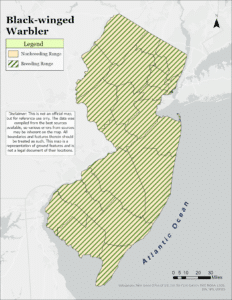
In New Jersey, the blue-winged warblers may be observed as a migrant throughout the state. They breed throughout the state but have a higher density in the northern part of NJ with scattered populations south of Trenton.
Blue-winged warblers breed in shrubby early successional habitats such as shrublands, thickets, and forest edges. They can be found to use habitat that has been altered by humans, and will readily breed in regenerated clearcuts, power lines, and abandoned agricultural fields and typically do not breed in wetlands.
Diet
Blue-winged warblers feed primarily on insects such as caterpillars, spiders, crickets, flies and ants. They generally forage through gleaning and probing on vegetation and will occasionally forage on the ground.
Life Cycle
Breeding season for the blue-winged warbler begin in early May and ends in July. The blue-winged warbler nest is built by the female. The nest is a small cup built by the female out of grasses, leaves, and bark strips usually on the ground under clumps of grasses and shrubs. 2-7 eggs are typically laid and only the female incubates them, which may last 10-11 days. The young are cared for by both parents and will leave the nest after 8-10 days.
Current Threats, Status, and Conservation
The blue-winged warbler is listed in New Jersey as a Species of Special Concern (not yet endangered or threatened but possibly on its way). They have experienced as decline in their range since 1970. Potential threats are habitat loss as reforestation from natural succession, urban sprawl, fire suppression, lack of active forest management, and nest parasitism by brown-headed cowbirds (Molothrus ater).
Conservation of New Jersey’s warbler species requires long-term monitoring and research, habitat preservation and restoration, reduction in mortality caused by humans, cowbird control, and incentives to promote habitat preservation within their wintering areas.
References
https://dep.nj.gov/swap/sgcn/profile/?wdt_md_p_t_id=10&wdt_md_p_t_col_name=species_for_url&wdt_md_col_value=blue-winged-warbler
Scientific Classification
- Kingdom: Animalia
- Phylum: Chordata
- Class: Aves
- Order: Passeriformes
- Family: Parulidae
- Genus: Vermivora
- Species: V. cyanoptera