Spizella pusilla
Type: bird
Status: special concern
Melissa Roach
Species Guide
Field sparrow
Spizella pusilla
Species Type: bird
Conservation Status: special concern
Identification
The field sparrow is a small sparrow with plain gray underparts, a rusty brown back and wings with black streaks, an a rufous crown. Other identifying features include a white eye ring, pink bill, and thick rufous line behind the eye.
The male’s song is easily recognizable, and often said to sound like a ping pong ball bouncing as the bounces go from a high height to low.
Distribution & Habitat
Field sparrows nest in brushy, shrubby fields across eastern North America. They can be found in abandoned pastures, power lines, forest edges, landfills, and airports. They are a shy species and prefer not to nest closely with human development, though they will occasionally be found in Christmas tree farms, orchards, and nurseries. They will not utilize large expanses of grasslands that lack shrubs and avoid closed-canopy mature forests.
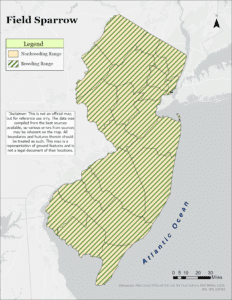
Field Sparrows occur across New Jersey throughout the year, but breeding and winter populations are notably lower in heavily urbanized areas of the Piedmont Region and in the closed-canopy forests of the Pinelands and Highlands. During spring and fall migration, however, transient birds are more frequently observed in urban and developed landscapes.
Diet
Field sparrows eat a mix of seeds and insects. They hunt insects low to the ground, while seeds are picked from the ground or directly from the tops of native grasses. They forage for weevils, beetles, butterflies, and grasshoppers. In the winter they will switch over to mainly seeds.
Life Cycle
Field sparrows are year-round residents in New Jersey. They begin breeding in early April. Nests are built either on the ground, under vegetation in the early season, while second nesting attempts will be higher up to allow for greater safety. Nests are built by the female and are made up of grasses weaved together and lined with finer material. 3-5 eggs are laid and the female will incubate them for 10-17 days. Both sexes feed the young and the young will fledge after 5-8 days. Field sparrows may have multiple broods per season, and females may begin laying eggs as soon as 6 days after fledging young.
Current Threats, Status, and Conservation
In New Jersey, field sparrows are a species of special concern. Habitat loss, fire suppression, and reforestation through natural succession are the main causes of their decline. Urban sprawl and industrial agriculture has pushed them out of their natural habitats. Field sparrows also breed near agricultural areas and are at risk of nest parasitism by brown-headed cowbirds which can cause death to the nestlings.
References
https://dep.nj.gov/swap/sgcn/profile/?wdt_md_p_t_id=10&wdt_md_p_t_col_name=species_for_url&wdt_md_col_value=field-sparrow
Scientific Classification
- Kingdom: Animalia
- Phylum: Chordata
- Class: Aves
- Order: Passeriformes
- Family: Passerellidae
- Genus: Spizella
- Species: S. pusilla