New Jersey Osprey Project // Nest Monitoring Portal
Eric Hance
Introduction + Background
From the 1970s through 2009, New Jersey osprey populations were monitored using standardized aerial surveys conducted twice each breeding season—during incubation in mid-May and again in mid-June when young were visible in nests. Surveys were initially flown using fixed-wing aircraft and later helicopters, covering major coastal colonies from northern Barnegat Bay south to Cape May and along the Delaware Bayshore. These surveys, supplemented by ground checks by staff and volunteers, were used to estimate population size, distribution, nest success, and productivity. Since 2009, aerial surveys have been replaced by ground-based monitoring and online reporting through Osprey-Watch.org, where staff, partners, and citizen scientists document nesting activity statewide. Today, most colonies are surveyed by boat in late June and early July, when nestlings are old enough to observe and band. Surveyors assess occupancy and nesting outcome through behavioral observations and direct nest inspections using ladders, cameras, poles, mirrors, GoPros, or permitted drones. Multiple surveys conducted throughout the nesting season help improve the accuracy of determining nest success and failure.
With your help, we aim to continue these efforts to ensure that this vital indicator species remains stable. On this page, which is devoted to providing information and updates to our NJ Osprey Watchers, you will find a map of osprey nests in New Jersey, guidelines for monitoring nests, past recordings from virtual info and training sessions, a PDF handbook and important links.
Important Links + Resources
Osprey Watch, Global Osprey Watching Community: osprey-watch.org
Link to custom google map with all known osprey nests.
Report Environmental Crimes (24/7): https://dep.nj.gov/warndep/ or 1877-WARN-DEP
Download the NJ OSPREY WATCH / Monitoring Guide 2026
About Ospreys
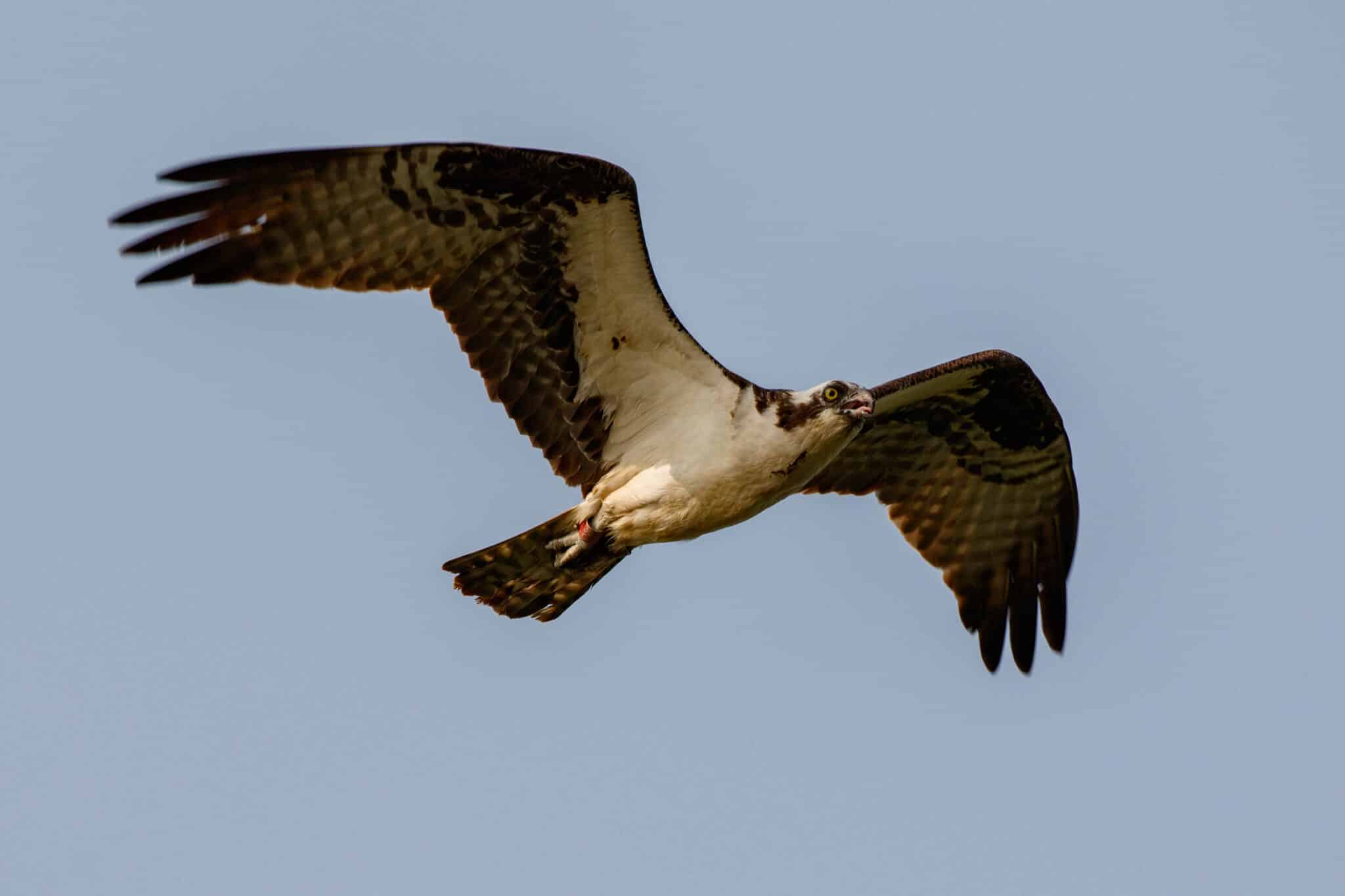
The osprey, formally known as the “fish hawk,” is one of New Jersey’s largest raptors. They are well known and highly visible in coastal areas. The bird is distinguished by its dark underwing patches and the crook at the wrist joint of the long, narrow wing, which is always bent. Adult birds have dark brown body feathers on its back and wings contrasting with their white crown, neck and undersides. Broad dark stripes appear on either side of the head, running through the eye. The eye color changes from red to orange to yellow as they mature. The tail is light with fine dark bands and a broad terminal bar edged in white. Both sexes have similar plumage. The female is slightly larger than the male and exhibits a more prominent “necklace” of dark feathers on their chest. Females also have more brown flecking on their underwing coverts, while males do not. Osprey’s average wingspan is 63 inches and weighs about 3 pounds.
To learn more, visit our online field guide
Project Goal
To record accurate outcomes at all osprey nests, confirm the status of existing nests and map new nest locations to determine overall population status.
Nest Monitoring Protocol
How to survey osprey nests
Equipment needed
- Binoculars, spotting scope, digital camera with telephoto lens
- Field datasheet and/or notebook and writing tool
- Smartphone/computer to enter data and view nest locations
Desired data
- Status of nest structure — Does the structure still exist? If so, is the nest occupied by a pair of ospreys?
- # ospreys on the nest (male/female present?)
- Nesting behavior to determine the status of nest (occupied, active – with eggs or young, failed nest, unoccupied nest, gone nest)
- Fledgling status
- Visible presence of plastic in nest
Survey methods
Using your own vehicle, you will drive to a known osprey nest. You can use Osprey-Watch.org or a shared map on this page to locate nests and plan your route. When arriving at the site, identify a location where you have a clear view of the nest. For taller structures, you may need to be positioned further from the nest, to see activity. Please make sure that you park in an area that does not put you in danger. Often times, you may be able to remain in your vehicle to observe the nest at a distance and use it as a blind. Make sure that you do not trespass or walk onto private property without permission from the landowner. You may find it necessary to talk to people to let them know what you are doing, so they can be reassured that you are only there to observe wildlife. We can mail you small brochures that you can use to handout to people in these circumstances (reach out to Ben if you would like some).
Using a visual aid, like binoculars, a spotting scope or a digital camera with a telephoto lens, you look at the nest for signs of activity. Plan to watch the nest for as long as 30 minutes to confirm the nest activity. Given the time of year, less time may be adequate to determine nest status, especially if you have surveyed it multiple times. During incubation, the incubating adult often sits very low, with a flat back, 24/7. They do move or adjust sitting position depending on wind direction and other factors. They can be observed enfluffing eggs (shifting them to ensure proper development) and the pair performing incubation exchanges, often after the male delivers food, which the female takes to a perch nearby to eat away from the nest (to not attract predators).
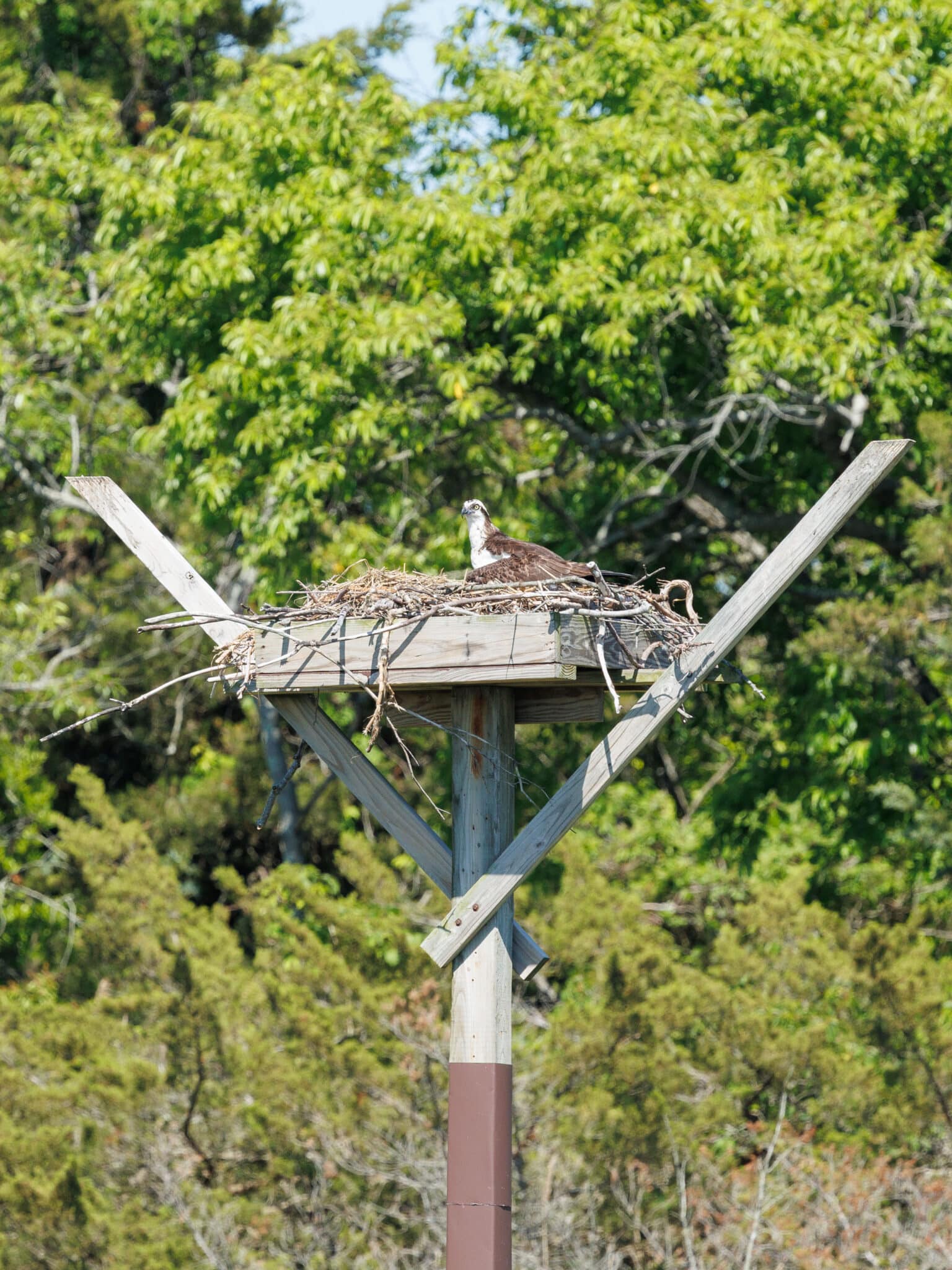 Once the eggs start to hatch, you will see the female body position change, with her front lifted more. You may see feeding behavior and eventually the heads of the nestlings, especially once they get larger (at around 2 weeks old) This is more difficult when looking at a very tall structure (communications tower). In these situations you may observe more food deliveries, which is a sign of young present. If you cannot actually see young or determine how many, please record as unknown (UNK). It is very important that the data you collect is accurate. We never want to assume there is young in the nest when there is not. NOTE: Around 25% of nests surveyed annually are reported as occupied and the outcome was unable to be determined.
If a nest that you observed was active, with eggs (incubation observed), and later inactive (no young), this means that the nest attempt failed. There are many factors that could cause a nest to fail, including predation by ground/aerial predators, nest structure failure, weather/storms, entanglement/suffocation from plastic marine debris, adult experience, and food stress. A nest is only considered to be failed when it did have eggs or young and lost them.
In recent years, we have been seeing more signs of food stress in coastal colonies and if this appears earlier in the season, some females have not been laying eggs, laying reduced or late clutches, as they are not able to get into egg laying condition. This is more difficult to determine unless observations have been conducted throughout the spring to document whether the nesting female did or did not actually lay eggs.
Another important behavior to watch for is sibling aggression. This is where the older, often larger nestling outcompetes its younger siblings for food. It is most often observed when prey is brought into the nest but can also be observed at other times. This is where the older nestling will repeatedly peck or “bonk” the other nestling(s) into submission. This is another sign of food stress when this is observed at nests.
Later on in the nesting season, watching or counting the young produced is important. With food stress, we see brood reduction. This is where the younger nestlings perish from starvation. In times when there is more food scarcity, all young may not survive and the adults may abandon the nest entirely. In recent years, this has even been observed during the incubation period, as incubating females often have to leave their nest with eggs to try and find food, if the male is unable to find prey.
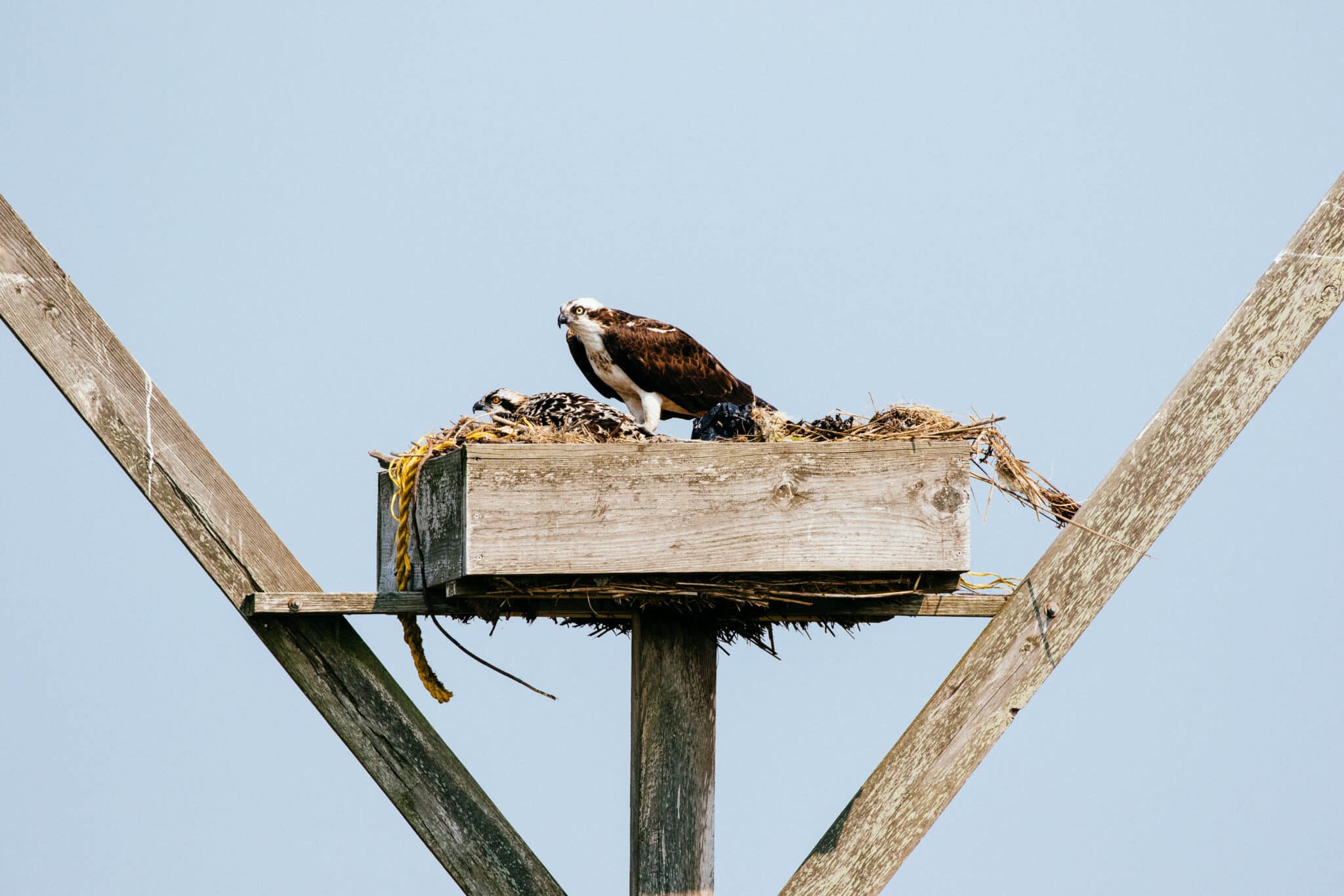
Otherwise, young are mostly downy until they get to around 3 weeks or 21 days in age. After that then they appear more buff colored, with body and flight feathers emerging and orange eyes.
Observation timeline
- One survey once a week (four times a month), if possible. At a minimum, once every two weeks.
- April 1 through September 1
Late March – April — Adult arrival. Nest construction and courtship displays occur. Egg laying begins.
May — Incubation underway. Hatching begins towards end of month. Earlier at inland locations. Record presence of adults and whether incubation behavior is observed. Watch for food delivery and incubation exchange. *difficult on very tall structures as adults may not be visible sitting low.
June — nestlings present. Note # observed of both young and adults. If unknown, record as observation until known. Do not guess. Behavior to watch for and record include food/fish deliveries, feeding of young. Chicks become visible when around two weeks old.
July — young are close to full grown but still unable to fly until later in the month. Note # observed of both young and adults. If unknown, record as UNK. Continue to watch for fish deliveries and feedings. Watch for nestling heads moving. Wings stretching and muscles strengthened by flapping, jumping on nest.
August — young fledge. Note # young observed on the nest. Some young may not be visible on nest after they fledge. Females begin fall migration. Young disperse and often continue resting on nest. Male supplements diet of young as they gain experience foraging.
September – some young remain on nests while adult male provides supplemental food.
Nest assignments
Current nest monitors can continue watching nests.
New new monitors will be assigned nests that are closest to their homes or where they are willing to travel to, if not located near their homes. Reach out to Ben Wurst to be assigned nests at: ben.wurst@conservewildlifenj.org
Nest monitors will be invited to join our GroupMe group with seasonal updates and answers to questions.
Tips
- Park in a safe area that is away from traffic.
- Find a good vantage point that is not in a busy area and gives you a good view of the nest. Some taller nests may require viewing from more of a distance.
- Do not trespass on private property without asking for permission from the landowner.
- All ospreys are different and some are more aggressive than others! Do not approach a nest so close as to cause disturbance! Adults react by calling, which tells young to lay low, making them less visible. You know you are too close when an osprey is looking at you.
- Be quiet and courteous when observing nests. If a casual observer is asking what you are doing, explain that you are monitoring the osprey nest.
- Spotting scopes and digital cameras with telephoto lenses (400mm focal length) are great tools. With digital cameras, when mounted on a tripod, you can often digitally zoom and see details that you can’t see with binoculars.
- If you can’t view the nestlings right away, do not be concerned. Look for other behaviors like feeding. Record that observation and wait until you can see their heads to get an accurate count.
- How to tell the difference from adults and nestlings – young have a more buff/brown appearance with scalloped or buff feather tips. They also have orange eyes. Adults have yellow eyes and their body feathers on wings and back are dark.
Thank you for your dedication and contributions to monitoring New Jersey’s ospreys.
If you ever have any questions about a nest or ospreys in general. Contact Ben Wurst via email at ben.wurst@conservewildlifenj.org or call/text: 609-713-4464.
New Jersey Osprey Project // Volunteer Nest Monitoring Form
This form is for volunteers to sign up to learn more about monitoring osprey nests in New Jersey.