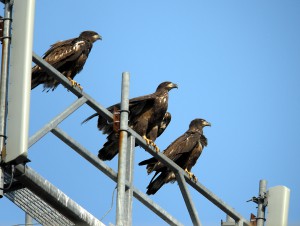
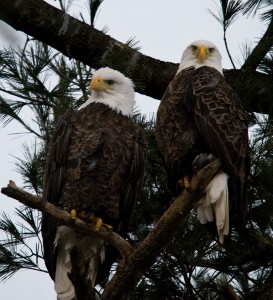
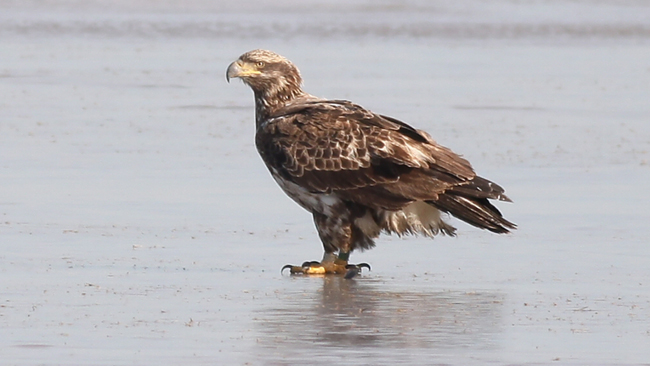
In 2012 a new record high of 135 eagle pairs were monitored during the nesting season. One hundred and nineteen of those were active which means they laid eggs. A total of 165 young were produced this year and fledged (left the nest). That is 46 more than 2011’s 119 young produced. Twenty-seven new eagle pairs were found this season, 15 in the south, 2 in central and 10 in northern NJ. While all of these numbers are good news for NJ eagles they still need protection. The two major threats that bald eagles in NJ face today are disturbance and habitat loss.
The NJ Bald Eagle Project has a dedicated group of volunteers who monitor nests throughout New Jersey. They help to prevent disturbance at nest sites by educating the public about eagles. The success of the eagle project is directly related to these wonderful volunteers.
Since 2009, we’ve been active in helping to restore wildlife habitat to a former golf course in lower Cape May County. In place of the large lodge on the site we are building a “Backyard Habitat Demonstration Site.” It will feature several different habitat treatments that homeowners can use to provide habitat for wildlife in their own backyards. It includes the creation of scrub-shrub habitat, forested habitat, nectar producing plants, wildflower meadows, a pond, and a brush pile.
The site was designed by landscape designer Jeanne Marcucci with greenjean gardens LLC. Last week the site was prepped by NJ Fish & Wildlife. After the site was plowed we laid out paths that run throughout the site. Next compost will be spread to some areas (wildflower beds) and plants will be delivered on October 9th. The team at Planet Earth Landscaping will be assisting us the the compost spreading and planting.
Volunteers are needed to help plant the many native plants that were ordered on October 10-11th from 10-2pm each day. For more information or to volunteer contact Ben Wurst.
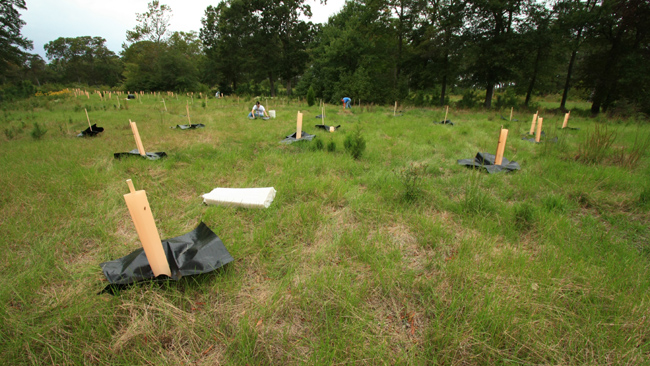
The site where 2,700 native trees, shrubs, wildflowers, and grasses will be planted for wildlife near Villas, NJ.
for his contributions to the NJ Bald Eagle Project
by: Larissa Smith, Biologist/Volunteer Manager
Landowner Robert Johnson with Eagle Project volunteers Earl and Mary Ellen Holton.
Landowners are an important component of the NJ Bald Eagle Project since fifty-six percent of eagle nests are found on private property in NJ. This year we recognized a landowner for his contributions to the project over the years. Mr. Robert Johnson has had a pair of eagles nesting on his property in Cumberland County since 2003. He has always been very protective of the pair and makes sure that they aren’t disturbed during the nesting season as well as keeping the nest observers updated on any activity that he has seen or any problems. He helps the volunteers by cutting the grass in his field so that they can drive in and park when monitoring the nest. This year when the volunteers truck got stuck in the mud at another close by nest Mr. Johnson came with his backhoe and pulled them out.
Mr. Johnson received a certificate of appreciation and an eagle frame handmade by CWF biologist Ben Wurst www.reclaimednj.com. The photo in the frame was of Mr. Johnson holding an eagle chick during a eagle banding on his property.
On behalf of the NJ Bald Eagle Project we thank Mr. Johnson for his dedication to NJ eagles.
Volunteers help install innovative new barrier to reduce terrapin road kills
by Ben Wurst, Habitat Program Manager
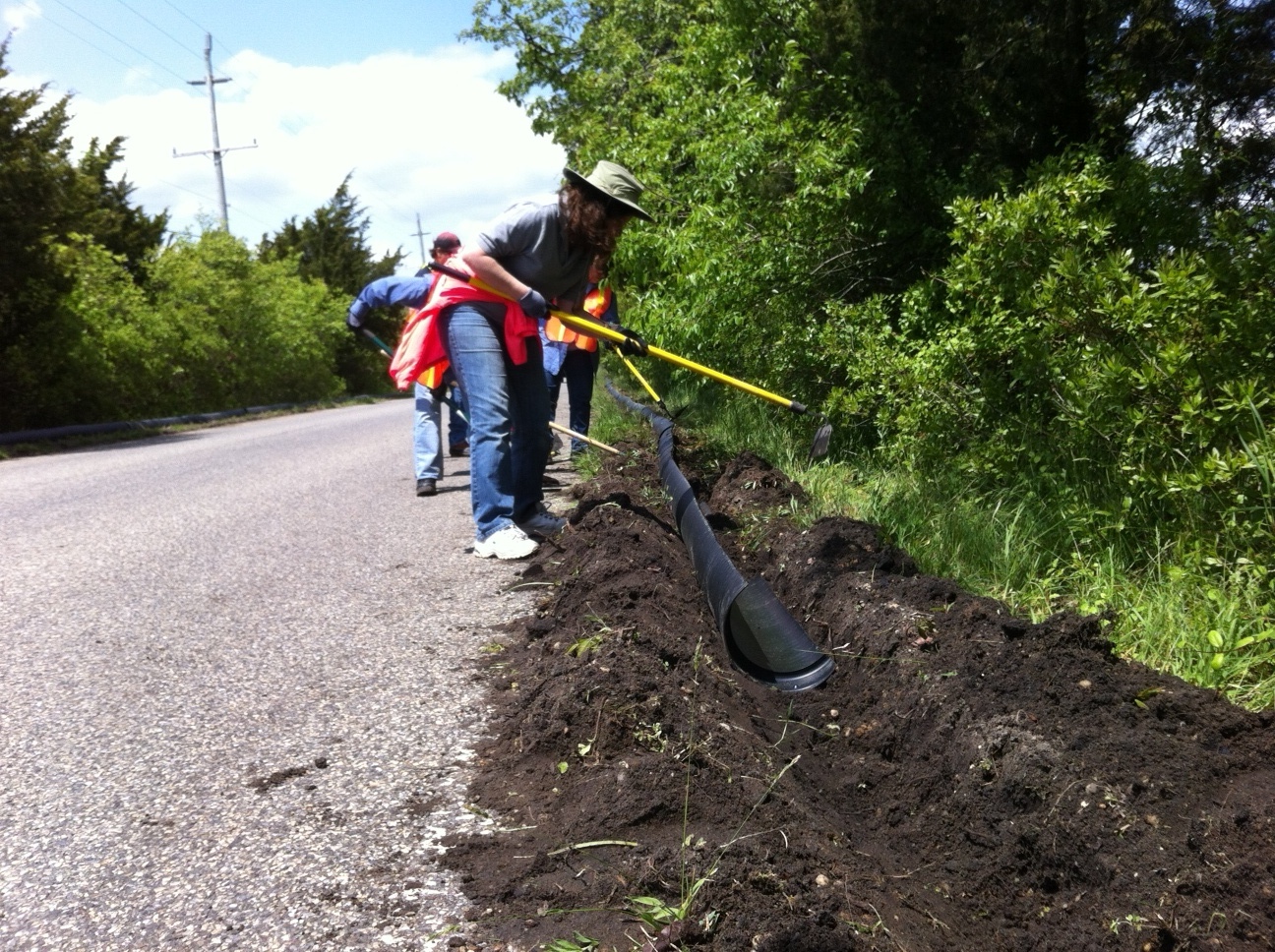
Last week volunteers from CWF and Exelon-Oyster Creek Generating Station helped to install 1,000 feet of barrier “fencing” along the first stretch of Great Bay Blvd inside Great Bay Blvd Wildlife Management Area. The new barrier is a new design and concept for reptile conservation here in NJ and possibly the rest of N. America. While many other types of barriers have been used by other organizations this type has not. It is a corrugated rigid plastic drainage pipe that was cut in half. It was made in NJ by ADS (Advanced Drainage Solutions) and was purchased through Caterina Supply, a local supplier of the pipe. Funding was provided through a Partners Agreement between Little Egg Harbor Twp. and the U.S. Fish & Wildlife Service (who purchased the pipe). The pipe came pre-cut from ADS and was transported by Eric Schrading with USFWS. To install the pipe we trenched a ditch and then hand dug it to the width of the 10″ pipe. It was then backfilled and screwed together where two pieces met. The main reason from switching from a traditional fence type barrier to this was to reduce future maintenance. Fences are easily damaged by motor vehicles and posts have been stolen or ripped out of the ground, so they take more time to repair throughout the year. This pipe should be maintenance free and hopefully if a car drives over it only minor damage will occur…we hope!!
If you’re interested in using this in your own reptile/amphibian conservation project email me and I’d be happy to help in any way possible!
Thank you to all the volunteers, vendors, and partners who help make this project a success!! To name a few: Home Depot of Manahawkin for donating the trencher for an afternoon, USFWS & Eric Schrading for purchasing and transporting the pipe, and Little Egg Harbor Twp. for their continued support of this project.
In January 43 states participated in the Midwinter Bald Eagle Count including New Jersey which has participated since 1979. This year in NJ ~70 volunteers surveyed for eagles the weekend of January 14th & 15th. The purpose of the survey is to monitor bald eagle populations. Since the survey takes place at the start of the NJ eagle nesting season possible new pairs and nests are often found. New Jersey volunteers also map eagle activity and these data are used to delineate critical eagle wintering habitat.
PRELIMINARY RESULTS
273 eagles in Southern NJ
44 eagles in Northern NJ
317 eagles total
This is a great time of year to get out and see some eagles. Not only are the resident nesting eagle pairs around but also wintering eagles.
2011 was a great year for bald eagles in NJ. This season a record high of 118 chicks fledged from nests throughout New Jersey. A total of 111 eagle pairs were monitored of these 95 were active which means that they laid eggs. Seventy-one of these were successful in producing the 118 fledges. This is especially good news after 2010’s less than stellar nesting season where only 69 young chicks fledged.
The success of the NJ Bald Eagle Project is directly due to the dedicated volunteers. Every eagle nest that can be viewed is monitored by a volunteer/s. Volunteers report on important dates such as incubation, hatching and fledging. They also help to protect the nest by reporting disturbance and educating the public about eagles. We can’t thank our eagle project volunteers enough for all the time and energy which they put into this project.
More details on the the 2011 nesting season will be available later this year in the 2011 NJ Bald Eagle Project report.
For the past 3 years Conserve Wildlife Foundation of NJ has been working to restore habitat at an old golf course in lower Cape May County. We have concentrated on reforesting many of the old fairways at the site, now known as Cape Island Wildlife Management Area. This past week we planted around 300 native tree seedlings from Pinelands Nursery there. All of the species planted will benefit wildlife by providing food and cover. It will increase biodiversity and reduce fragmentation of forested habitat. We planted white and scarlet oak, pitch pine, gray birch, bayberry, serviceberry, persimmon, beach plum, and tulip poplar. Seedlings are protected by tree tubes (help reduce light browse by deer and rabbits) and weed mats (reduce competition from cool season grasses) to help increase survival rates.
Trees also benefit you and I. They capture carbon dioxide and release oxygen. Planting trees is one of the most effective and least expensive ways to reduce carbon in the atmosphere. They can reduce heating and cooling costs if planted around your home. They can also help increase your home’s property value. Fall is the best time to plant trees. When planting a tree make sure to dig the hole twice as deep and twice as wide as the root ball. Plant to a depth where the collar of the truck is not below ground level. Amend the soil if necessary and only put up to 2″ of mulch against the trunk. Here are my picks for best native trees to plant for wildlife (and you) in your yard:
Shade trees: Sweet gum (awesome fall foliage!), tulip poplar (great pyramidal shape when mature, great shade tree), oak spp. (produce acorns and good shade trees, scarlet oaks have stunning fall foliage). Plant these on the south side of your house to reduce cooling costs in summer.
Conifers: red cedar (good wind break, dense cover for wildlife, provide berries for songbirds), american holly (beautiful red berries in winter, good cover for wildlife from heavy snow). Plant these along the NW side of your house to act as a windbreak from cold winter winds.
Watch a video clip about our work at Ponderlodge that was featured on NJTV on September 22.
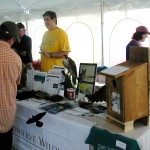
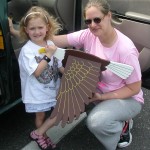
Matt Klewin and Liz Silvernail at the CWF table.Rebecca and Tari Clark with their new eagle birdhouse.
On Sunday May 1st Liz Silvernail, CWF Director of Development, and I spent the day at the Atlantic County Utilities Authority Earth Day celebration. The weather was gorgeous and we were busy all day talking to people about CWF and the different projects that we are working on. Kids especially stopped by to see the mounted Barred Owl, Peregrine Falcon and turtle shells. Also helping at the table were volunteers Matt Klewin, Margaret Klewin-Atack and their daughter Rhianna. Their team the, Wrending Talons, which has been together for 18 years, will be participating in the World Series of Birding on May 14th and CWF is the recipient of their pledges.
We also had a free raffle for an eagle bird house made by eagle project volunteer Kevin Buynie. The winners were Tari Clark
and her daughter Rebecca. They were thrilled to be the winners and were excited to see if any birds would nest in the house this year.
The New Jersey midwinter eagle survey takes place each January and is part of the National midwinter eagle survey to monitor population levels. Another benefit of the midwinter eagle survey is that new eagle nests and nesting pairs are often located. The target dates for the 2011 survey was January 8th and 9th. Approximately 75 volunteers participated throughout the state. This year the snowy winter weather on Saturday did effect the count due to the heavy snow fall at times and low visibility. Sunday was clear and sunny which allowed volunteers to get out and survey.
Preliminary results:
194 eagles – southern NJ
24 eagles – northern NJ reservoirs
17 eagles – Delaware Water Gap
A total of 235 eagles were observed this year.
This total is lower than 2010s count of 333 eagles which is in large part due to the weather. Full results will be released soon.
Thank you to all the volunteers who braved the snow, cold and windy weather!
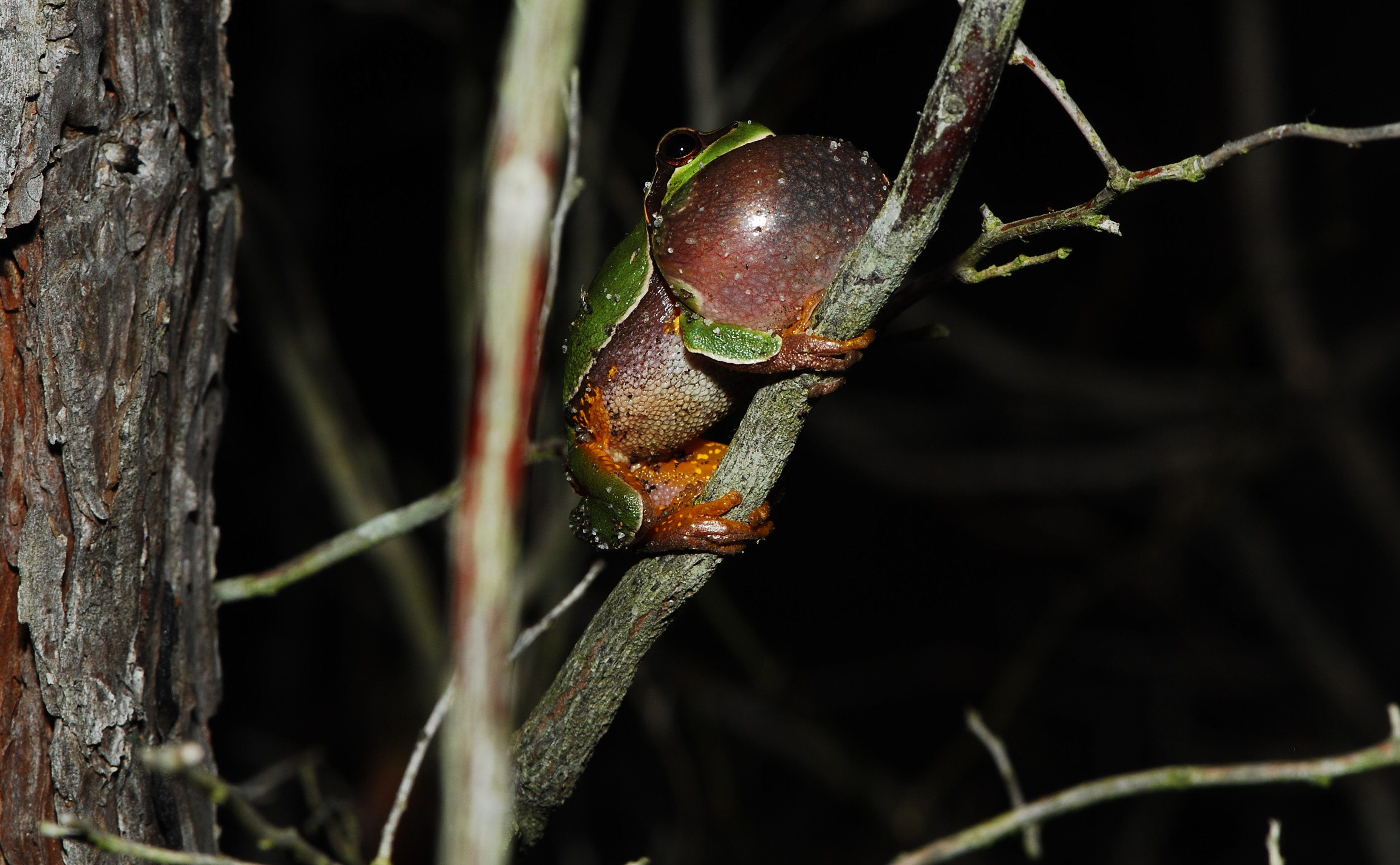
If you enjoy hearing the sounds of frogs and toads and like a bit of adventure then the NJ Calling Amphibian Project (CAMP) might be the right project for you! Each of the 16 species of frogs and toads in NJ has a unique vocalization or “call” that can be heard during their mating season. The Conserve Wildlife Foundation of NJ is actively recruiting volunteers to participate in a statewide Calling Amphibian Monitoring Program (CAMP). Fourteen CAMP routes are currently available for the 2011 season.