Barnegat Light Osprey Cam
Barnegat Light, New Jersey
Welcome to the home of the Barnegat Light Osprey Cam! We decided to pursue the installation of a camera system at this tall osprey nest platform so that we can share the intimate life of ospreys with everyone from the Long Beach Island region and worldwide. This nest was first occupied and successful in 2018, after it sat idle for many years. The camera system was installed before the 2019 nesting season.
The Breeding Pair
The first female to occupy the nest was not banded, so we knew little about her. She nested here from 2018-2020. In 2021 she did not return and a new female formed a pair bond with the resident male. We could tell it was a new female by the unique coloration of her iris.
This new female was named “Daisy” by viewers, she is also unbanded and quickly formed a new pair bond with the male, who was named “Duke.” He has been nesting here since 2018 and is banded (788-49033). He was banded in 2006 as a nestling at a nest within Sedge Island WMA, which is less than 2 miles to the north from this nest. This year he will be 20 years old. As you will read in the updates from 2025, Daisy did not return and Duke courted with several new females. Duke did end up forming a pair bond with a new unbanded female, that laid three eggs in mid-May. They were lost to a herring gull after Dixie, the new female, had to leave the nest to find food. This was after Duke went missing for 67 hours after a nor’easter impacted the area and prey was scarce.
As many know, ospreys are an important bioindicator species and reflect the health of their surrounding environment, particularly estuarine and marine ecosystems. A healthy coastal ecosystem equals a booming shore economy and ospreys have indicated that we’ve done a good job of protecting our coastal areas. There are still many threats to ospreys, even though they have recovered from the effects of DDT and habitat loss. In recent years we have observed the effects of food stress on coastal nesting ospreys with an increase in nest failures and brood reduction.
You can make a difference and help ospreys by reducing your dependence on single use plastics, eating sustainable/local wild caught seafood and by not releasing balloons. You can also help ospreys by participating in coastal cleanups or by picking up plastic litter that you see.
The Barnegat Light Osprey Cam is proudly sponsored by:

2026 Nest Cam News
April 10
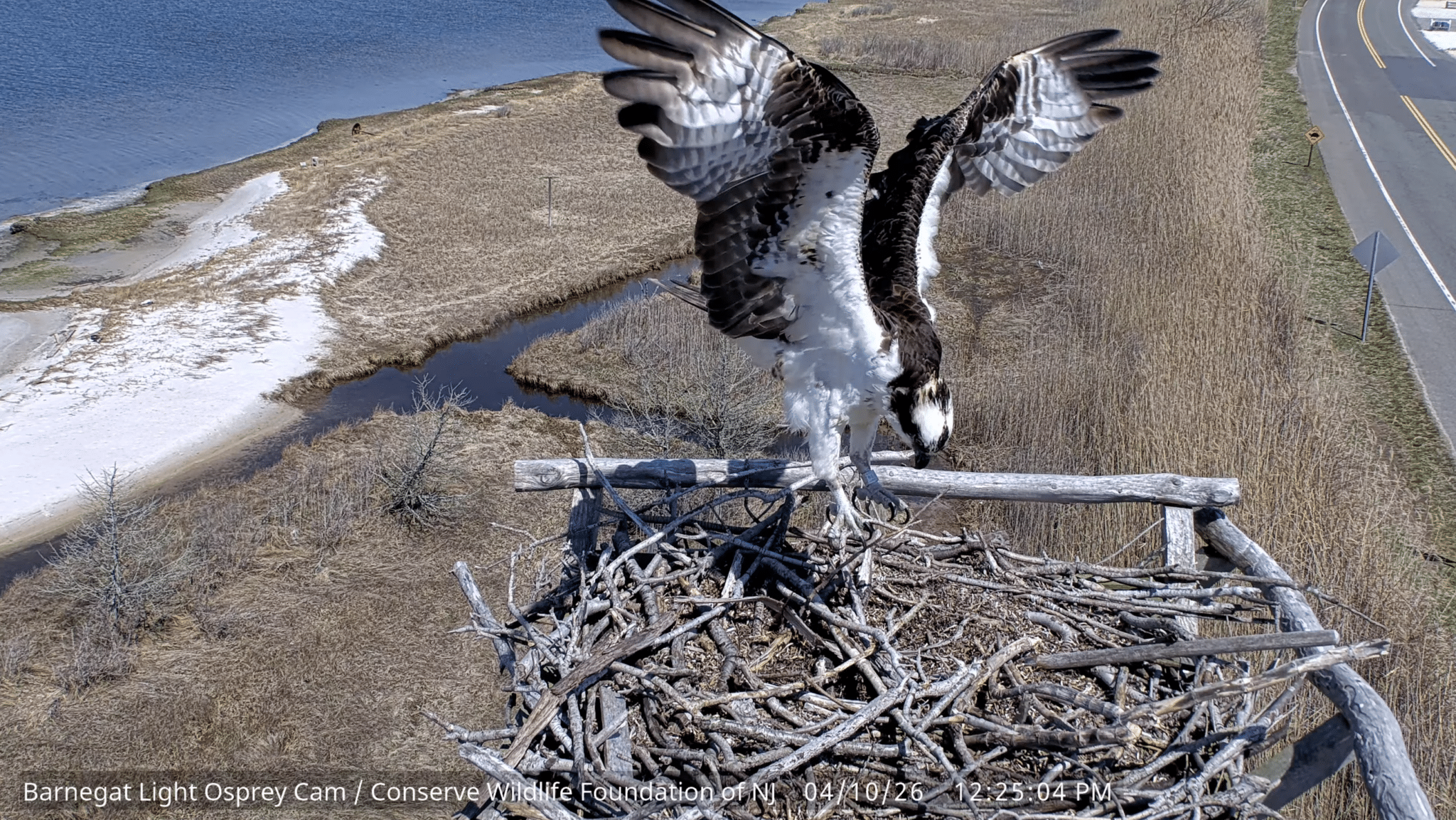
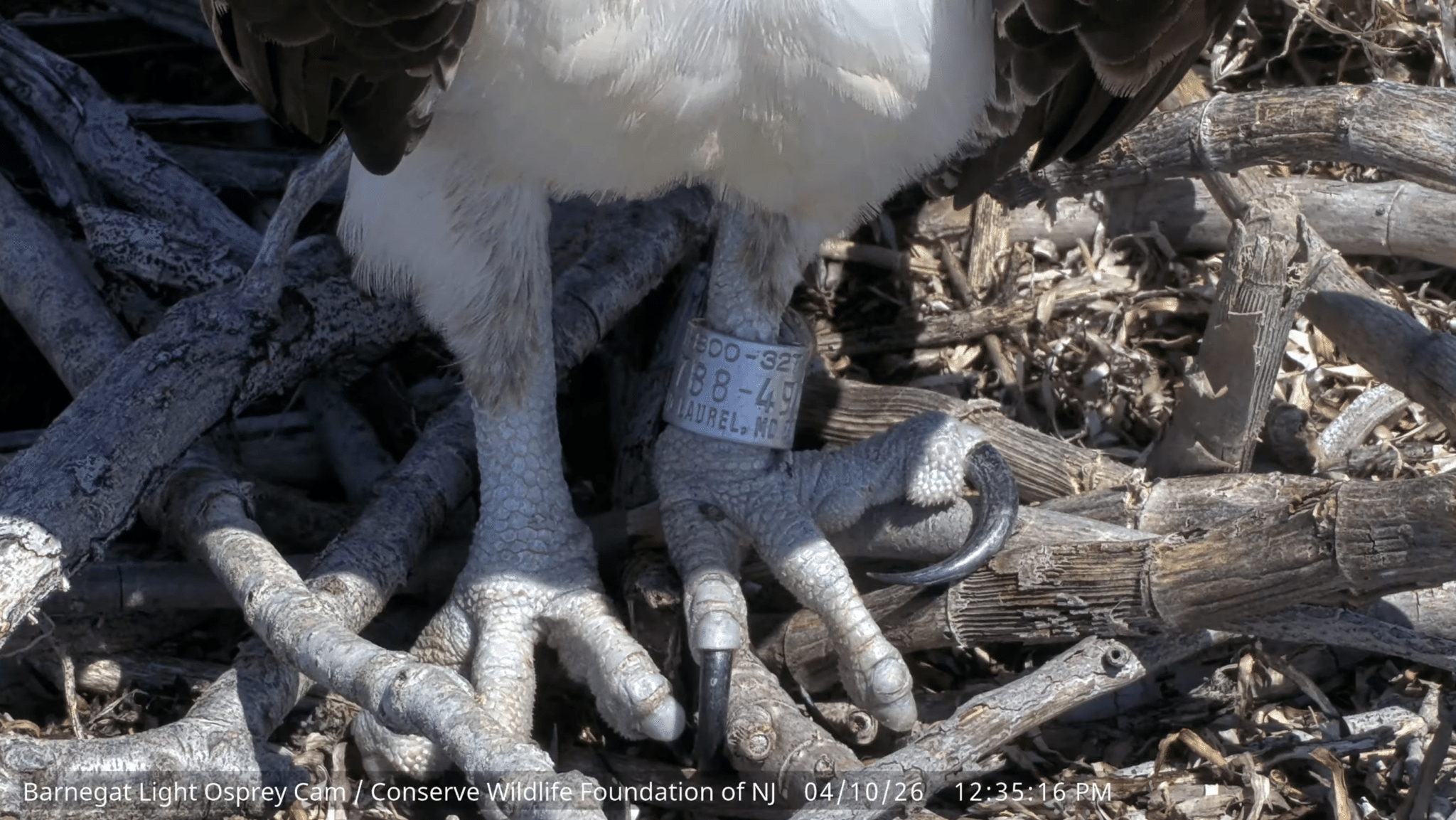
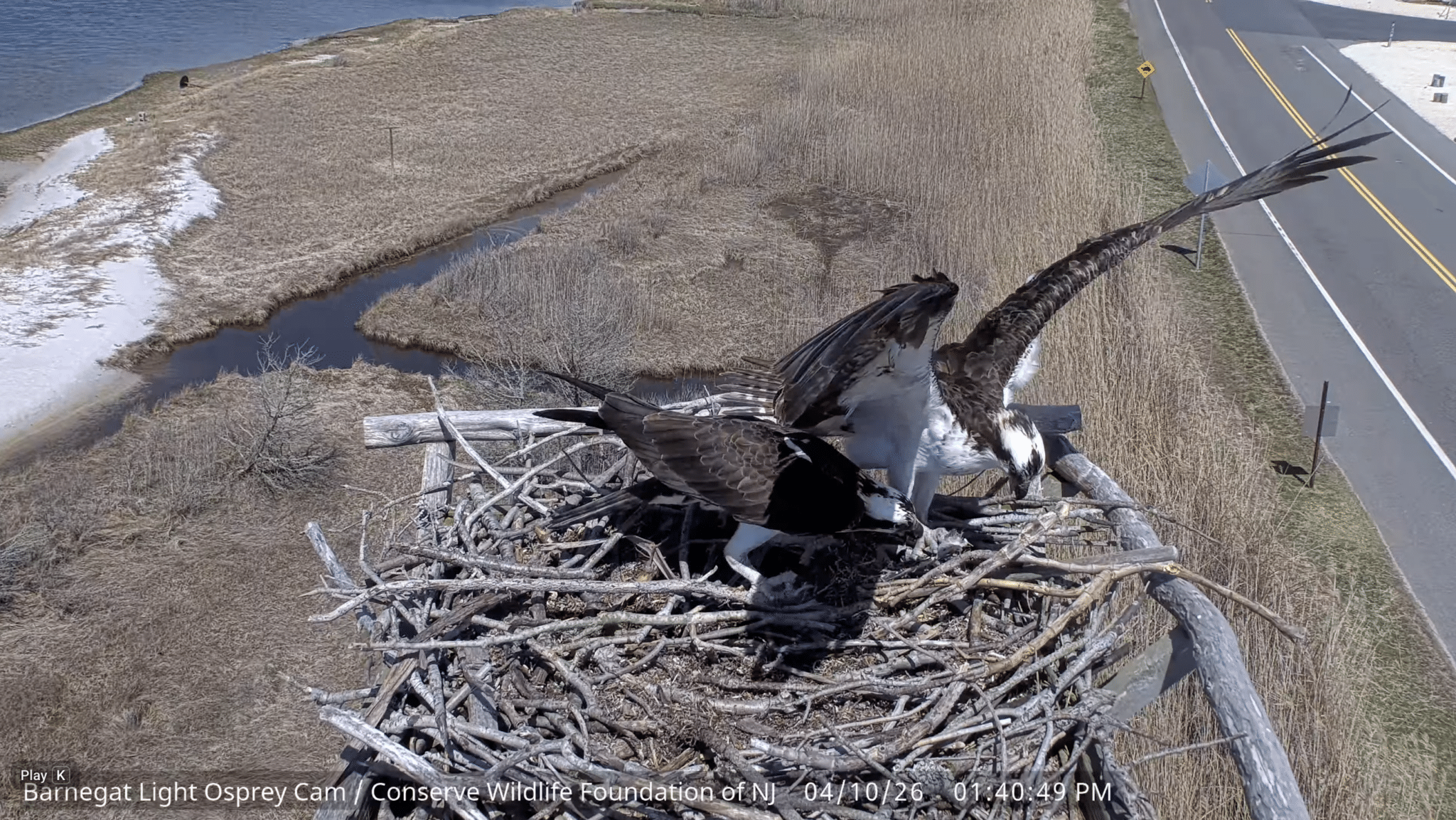
DUKE! He’s back!!
Today at around 12:30pm, Duke returned home. He returned to rekindle his pair bond with Dixie, who possibly returned before we installed the new camera. So far there have other unbanded males and females attempting to take over the nest. Even today, right after Duke landed on his nest, another male came in to challenge Duke.
He has not wasted anytime. One thing that I have learned from watching nests and live cams is that the key to the success of a nest is linked very closely to the male and his ability to find and catch prey. The factor that really matters the most is the male and his willingness to share his catch with his mate. This happens more with older/more experienced males, who realize the way to win over a suitable mate is by sharing this resource. It helps strengthen their pair bond and helps get the female into egg laying condition by providing her with more food.
Right after arriving back, Duke has defended his nest, spruced up nesting material and already proved prey to a female (not Dixie). Welcome home, Duke!
April 2
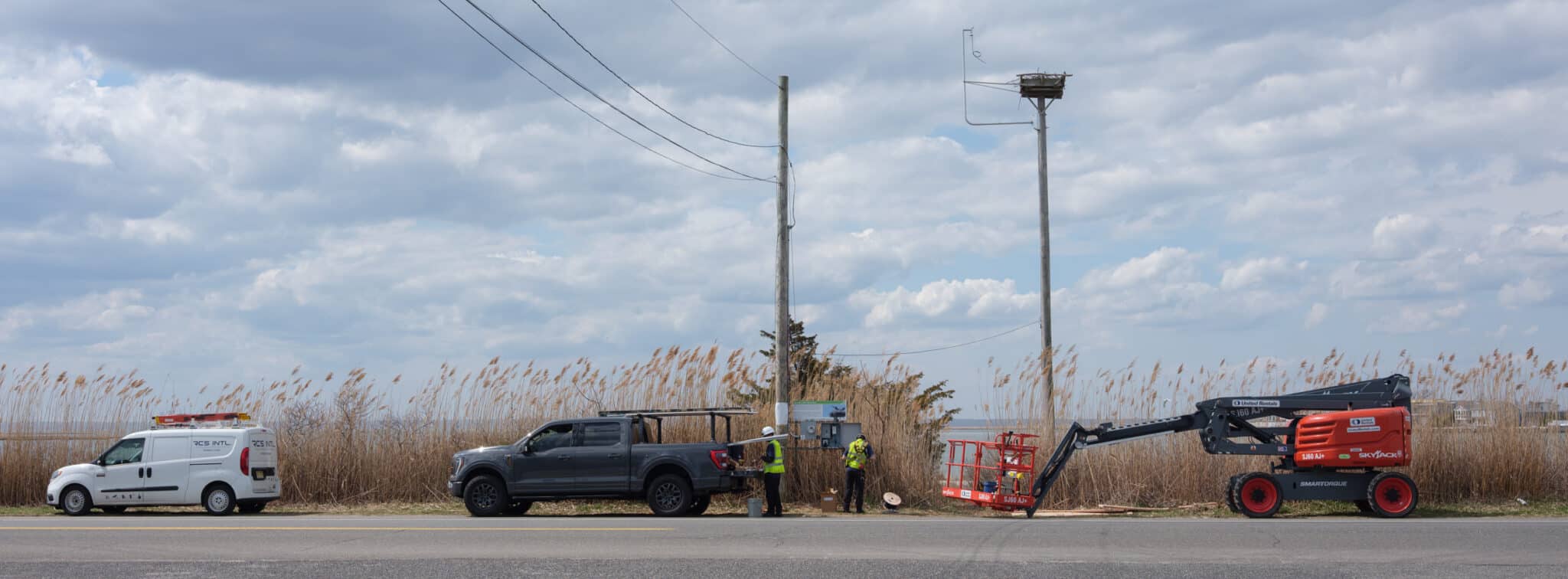
Really happy to report that the Barnegat Light Osprey Cam has been saved!
On April 1, we successfully replaced the old camera, which was not functional after the blizzard in February, with a brand new model. We were working on this initiative for quite some time, to research camera models and make a plan to get this work done before the pair returned and eggs were laid!
We couldn’t have pulled this off without the major support of RCS INTL., who are sponsoring the Barnegat Light Osprey Cam. RCS INTL. specialize in network security camera systems in the South Jersey area, so it was great to have experts in the field help us out.
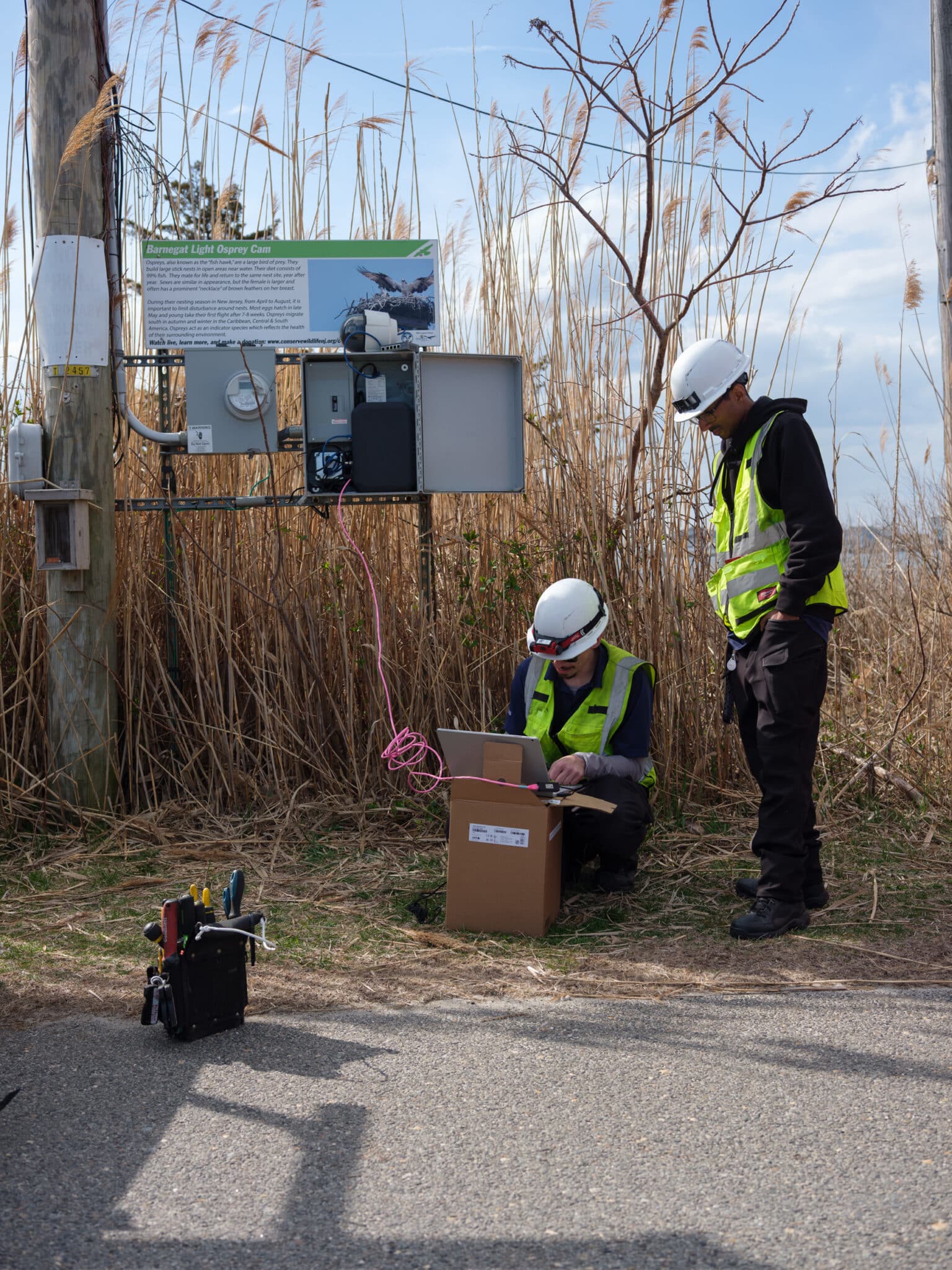
They stepped up and leaded the camera acquisition and installation. We supported the effort by getting a boom lift delivered and assisting with the installation. It was a great team effort on a gorgeous day to work outside.
About the new system. We opted for a top of the line camera that has a much bigger sensor than the old camera. It has an integrated infrared light, so when the camera pans, so does the light. This means we can also see more around the nest and on the marsh at night, which is really cool! It is more sensitive to light with the larger sensor, so low light video quality will be much better. With the larger image sensor, we can now stream at 4K! Aside from the new camera, we also replaced all the network cable to make sure that the camera won’t have any issues with handling more data or other issues related to the salt rich environment.
We do plan to add audio, as we love that component of this camera but right now the microphone we need is on backorder. When we get it then it can easily be added without disturbing the nesting pair. In the meantime, we will look at other options and potential stores where it can be found in stock..
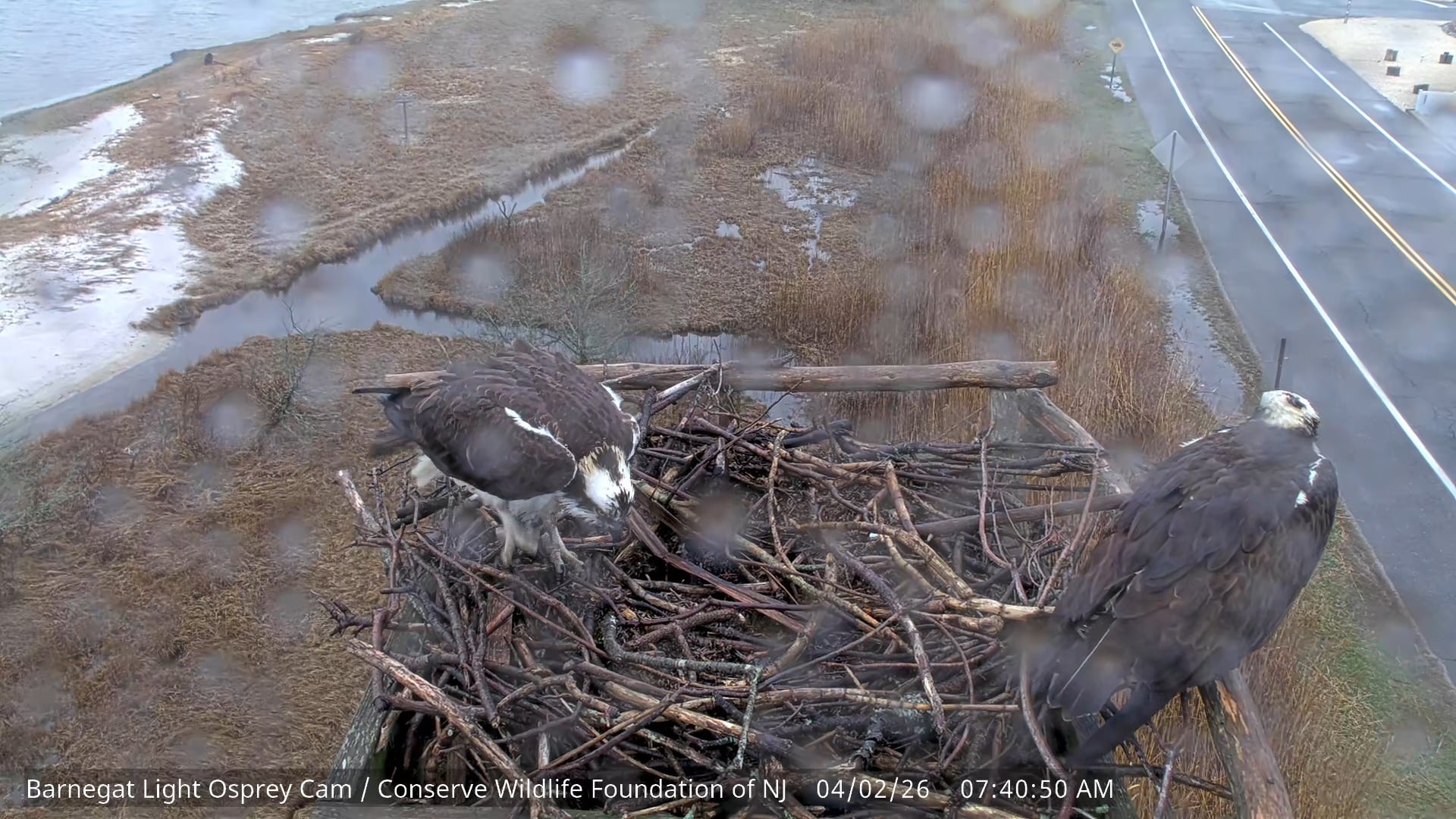
In other news, an osprey was first observed on the nest on Tuesday morning (3/31). One was observed near the nest when were working there on 4/1. This morning two ospreys were observed on the nest. Neither was Duke. One female looks to have been Missy, who we believe moved to the nest on 20th Street. Is she trying to take this nest? At one point there were two females on the nest when I was watching this morning before launching the live stream this afternoon. It is hard to tell who is who when the light is not great and neither is banded.
Later it appeared that were was a male and female. Again, no Duke. I know we’re all watching and waiting to see if he returns!
March 30
Over the weekend we launched a fundraiser on GoFundMe to Save the Barnegat Light Osprey Cam. In under 6 hours, we met our goal of raising $10,000. All donations that were made previously this month through our online shop or offline (checks mailed, etc) have also been included in this campaign. So far we’ve raised over $13,000 + a matching donation by a donor for a total of $18,368. This is simply amazing and so heart warming to receive so much for the support of this live streaming camera!
Work has already begun to replace the camera. Over the past several weeks we have researched camera models and associated network equipment. We’re are working with a local network security camera company to help us get this work done in a timely matter this week! We have a boom lift scheduled to be delivered on Wednesday and hope the weather cooperates! We will share more news here and on social media in the coming days. Thank you so much!! -Ben
March 17
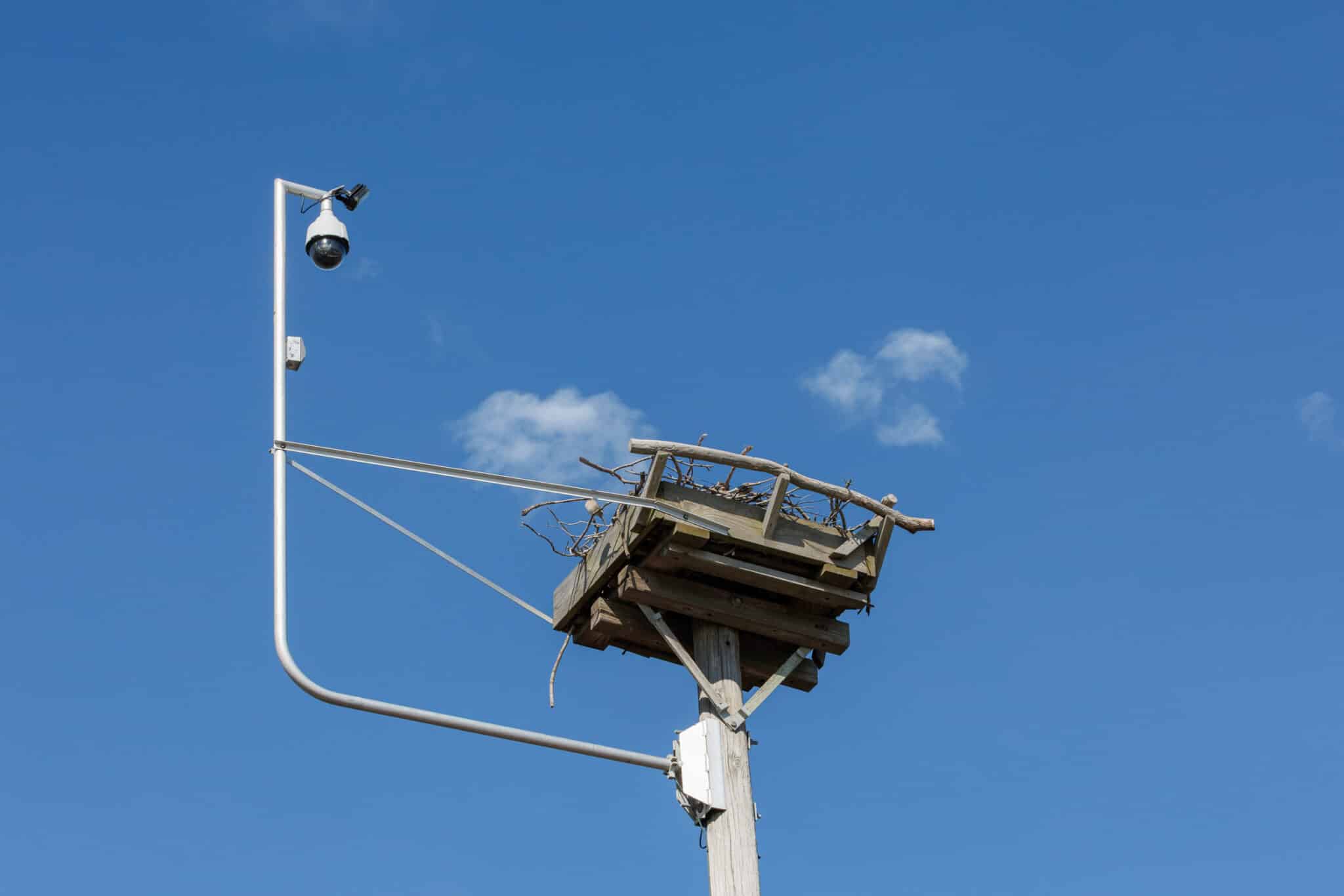
I know everyone is wondering what is going on with the camera. It is still offline after it appears to have been damaged during the blizzard in February. We are working on a plan to purchase a new camera that will be installed before eggs are laid next month. If you love the Barnegat Light Osprey Cam and are able to donate to help us purchase a new camera, you can give through this link. Thank you for your patience and support! -Ben
February 25
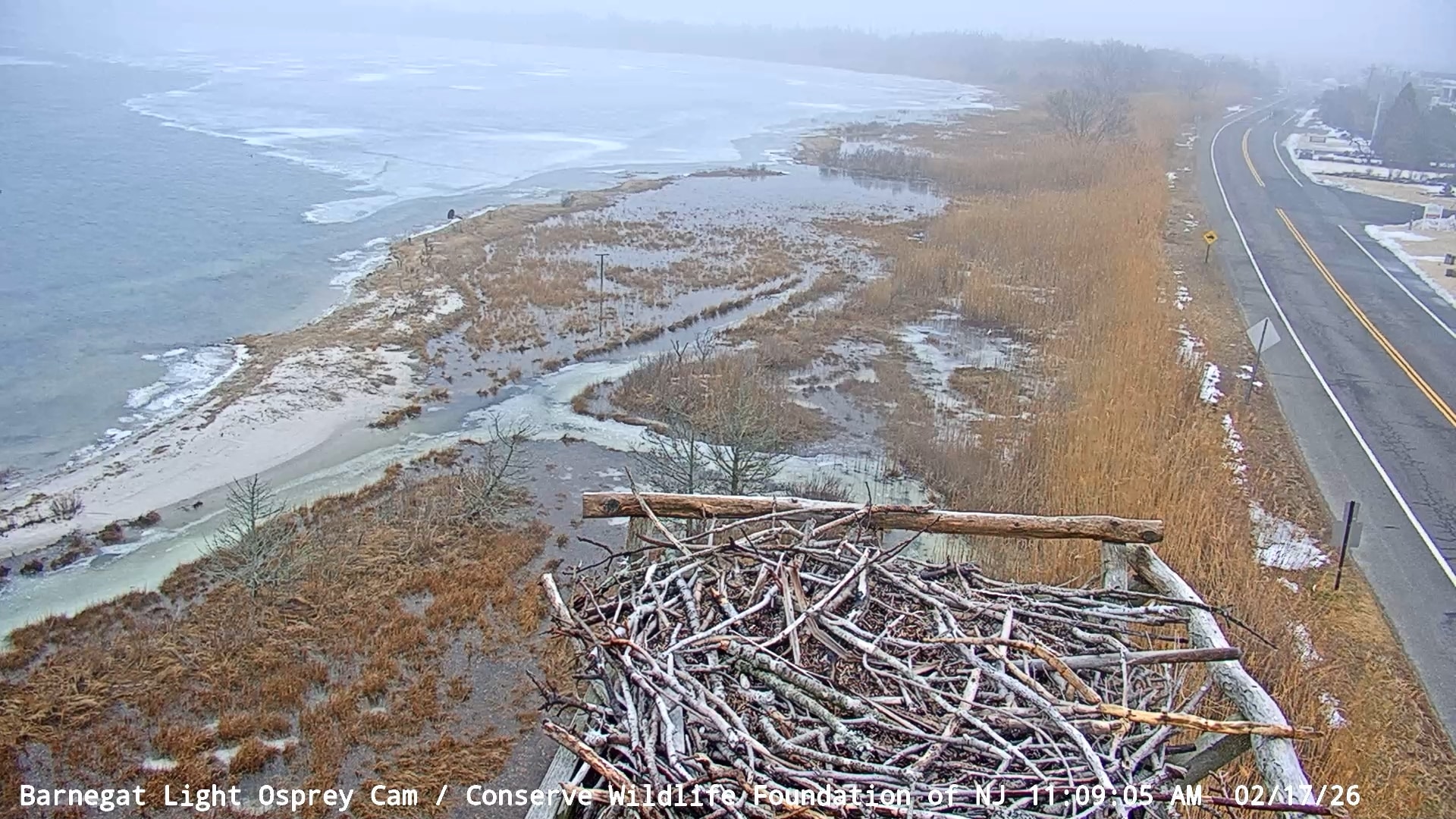
It seems that the winter weather that impacted the area on February 22-23 has damaged the camera system. A site visit today started the diagnostic process. I was unable to connect to the cam or find it on the network. It could be several components: network wire, the PoE (power over ethernet) adapter, which supplies power to the camera and sends data to and from the network, or the camera. An indicator light on the PoE adapter was flashing green, which means there is no connection or load, which is not good. This could mean that the camera needs to be replaced. A new PoE adapter was ordered so we can test the connection knowing that component is fully functional.
January 12
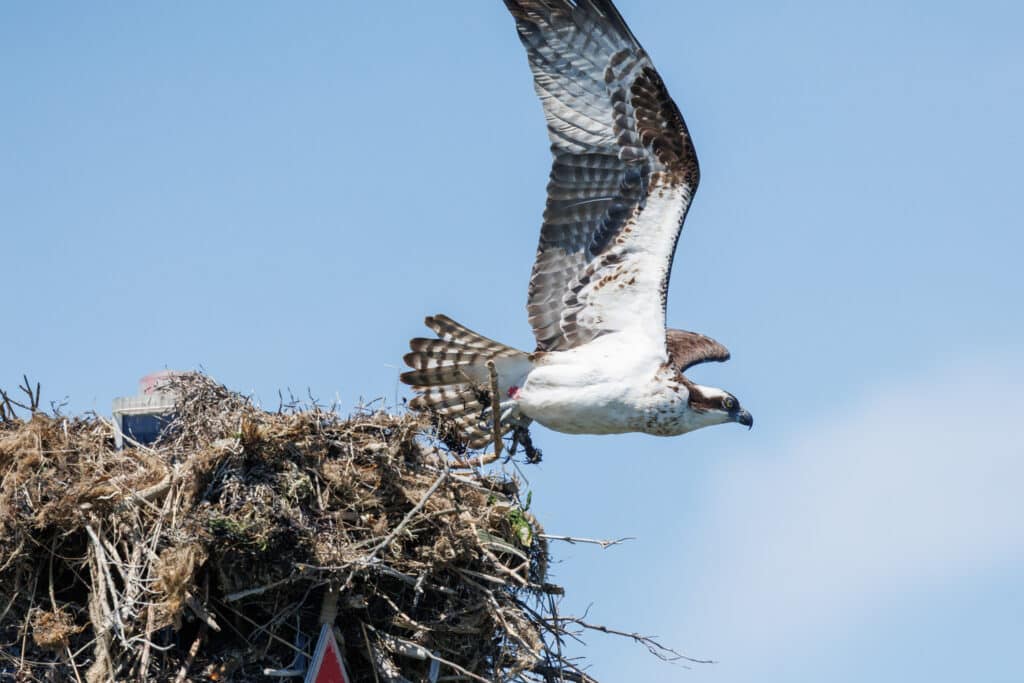
During one of our osprey nest surveys this past summer we photographed a red banded bird and initially thought we missed reading her band. Well, when zoomed in, we can clearly read her field readable band. This allows us to determine when and where she was banded. Well, it turns out that this particular osprey originated from our Osprey Cam! She fledged in 2020 and had two other siblings that were also banded (03/M + 05/M). This was a crazy fun year to be watching our osprey cam. With three young, plentiful prey were needed and the nesting male pulled through and provided plenty of fish, as prey was very plentiful.
One crazy event that occurred that year, that many of viewers may recall, was when 04/M violently grabbed her dad “Duke” by the eye socket and forcefully pulled him around as he cried for her to release him! Thankfully, he was okay and he continues to nest at the same location.
04/M was 5 years old at the time of our re-sighting and has yet to establish a nest and raise young. She was found on a new style channel marker that does not support nests as well as the old style channel markers (with a built in platform). She was right off Long Beach Island, on the bay in Harvey Cedars with a private island nearby. That island might be a good location to install a nest platform for her to finally settle down and raise young.
Now the question is, will there be enough prey for her to complete her life cycle.
2025 Nest Cam News
December 9
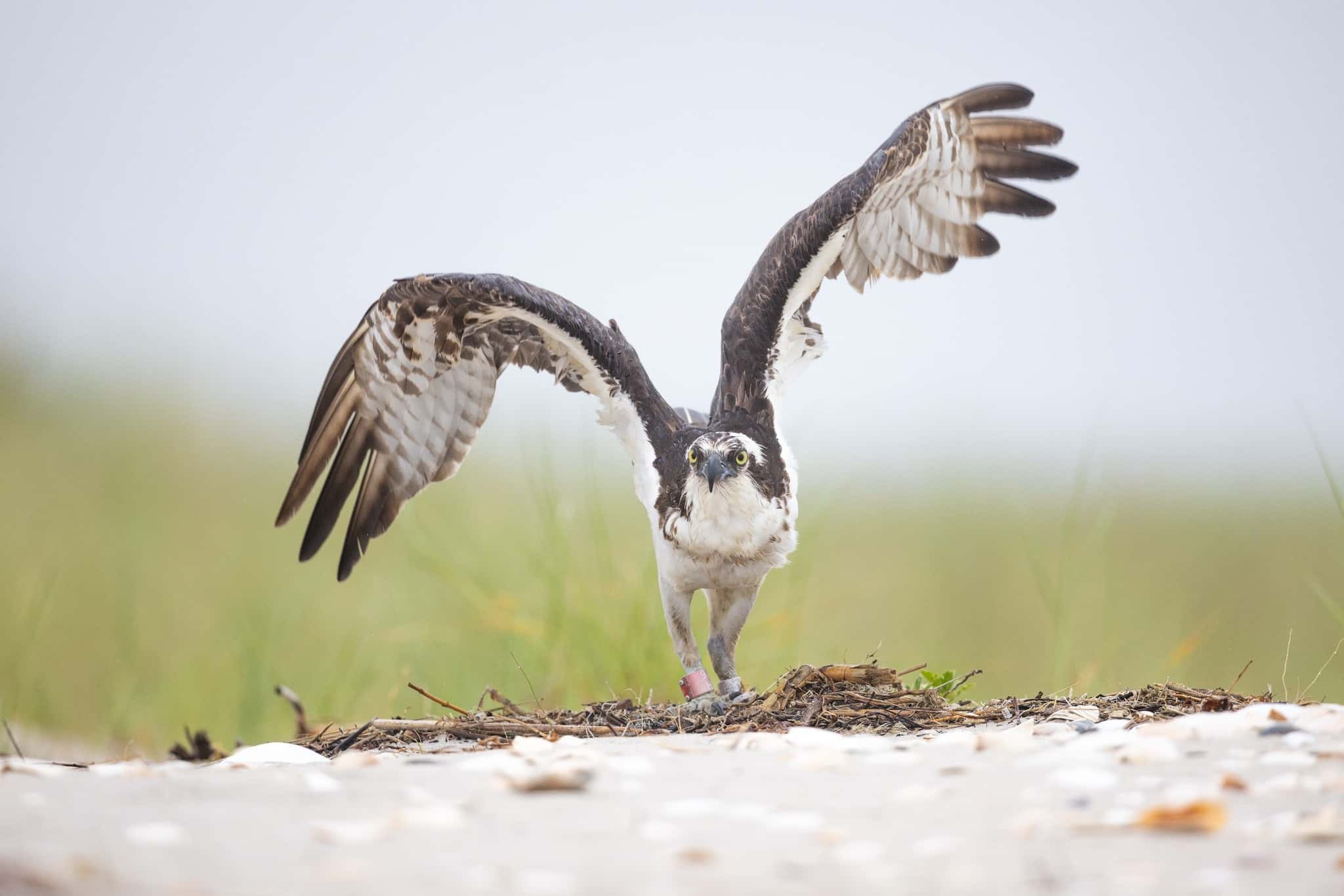
I recently stumbled upon the photo above, by LBI photographer Matt Reitinger, which spurred me to write this long overdue nest cam news entry.. 93/H is one of the first fledglings from the Barnegat Light Osprey Cam nest. This adult male osprey was banded as a nestling on July 9, 2018. He was one of two young produced by Duke and his mate that year. The day that we banded at this nest, we were also filming a trailer for our osprey project, 93/H is featured in this video @ 2:57.
Since then, he has been re-sighted in 2018 (Barnegat Light), 2022 (Loveladies) and 2025 (several times in May and early June) in Loveladies and Barnegat Light. To this date, we still do not know where he is nesting. At seven years old, he should be nesting somewhere near Barnegat Light. We have a few guesses at to where he might be nesting and hope he returns in 2026 so we can track him down.
We created a page on our website where you can report a red-banded osprey that you observe in New Jersey and beyond. Thank you to all those who re-sighted and reported 93/H this year, Northside Jim, Scott M. and Matt R.!
July 30
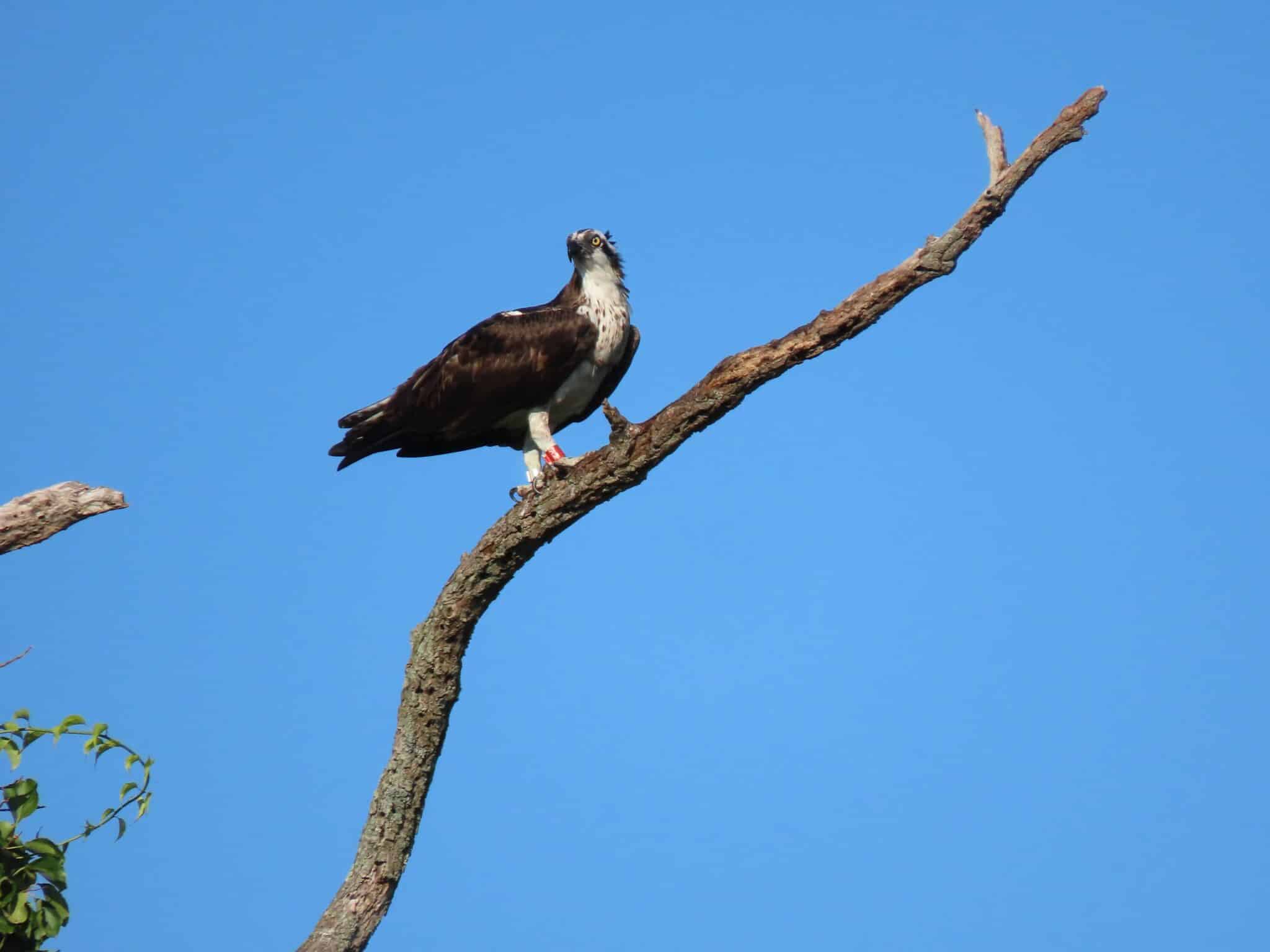
It’s been a while since my last update. That is not due to inactivity on my part. Myself and a small group of very dedicated volunteers and partner organizations have devoted much time to surveying osprey nests all along the coast. The data we collect, including nest occupancy and outcomes, allows us to help determine the health of the population.
Preliminary findings are illustrating that the failure witnessed first hand at the BL Osprey Cam has become much more widespread. Results are indicating that ospreys are (still) having a really difficult time finding sufficient prey to sustain their broods. Early in the season this caused nests like D+D’s to lose their clutch of eggs. Many other pairs with hatchlings lost them too. Then nestlings went missing. Failure rates in some colonies are close to 90%, which is something that we have haven’t witnessed in the last 30 years. I’m posting more about this on our blog today, so you can visit and read that post for more information on our findings.
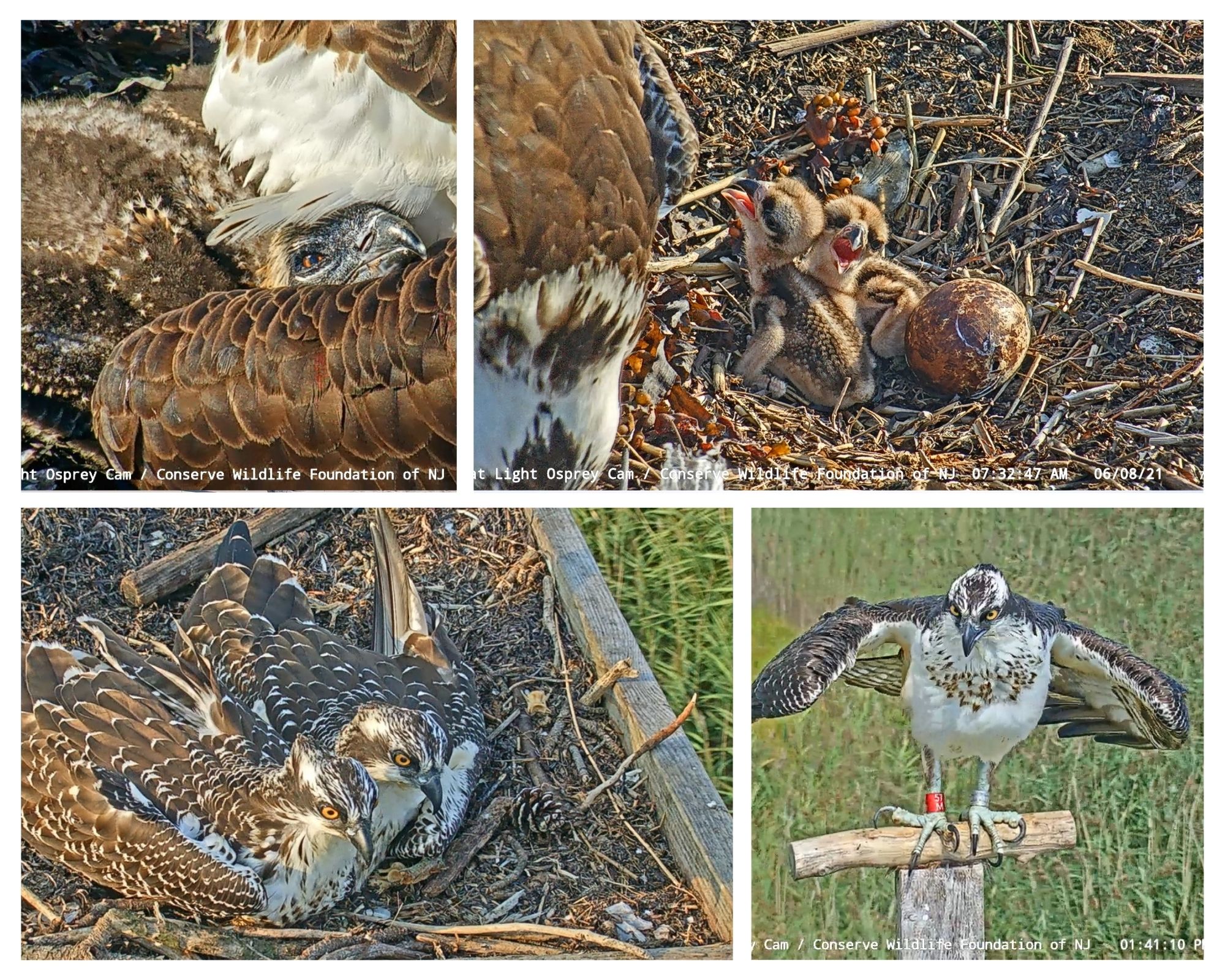
On a positive note, 57/M aka “Heinz” was recently re-sighted at Gateway National Recreation Area! She was re-sighted by her red band (photo above) by Lindsay McNamara, who nailed a great photo showing her red band. It is easy to tell Heinz is a female. She has a necklace of brown feathers, the fit of the band is snug, and she was found pretty far from her natal grounds as an adult (males return very close to their natal grounds to nest as adults and females wander). She had the same necklace of feathers before she even fledged.
At the moment, we’re not sure if she is nesting up at Sandy Hook this year but she is likely honing in on the region to find a mate and eventually nest as an adult. At least we’ll be able to locate her through more re-sightings of her red band. BW
June 4
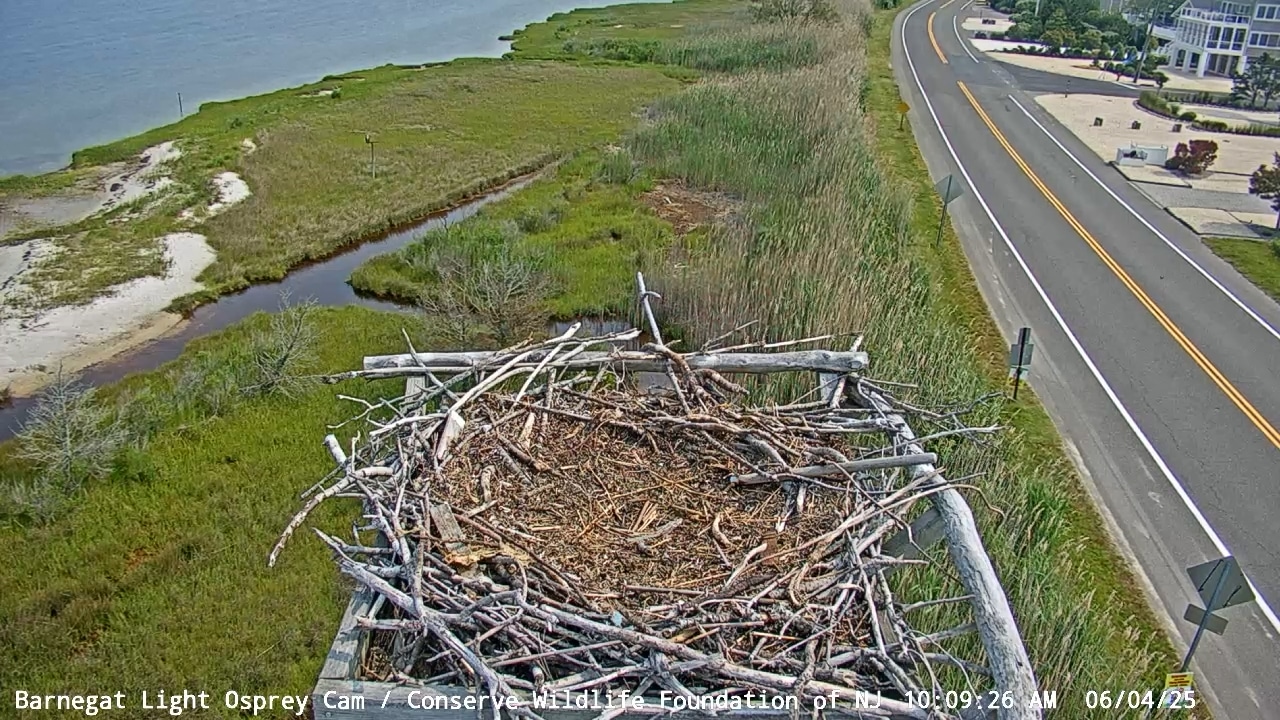
After losing two of their eggs to a gull and Duke disappearing for more than two days, following a nor’easter, which affected his ability to find and catch prey, this nest has failed to produce young. It is not an ideal outcome but is out of our control. We knew starting off the season that things were not normal, with the previous female, Daisy not returning. It took time for Duke to settle down with this new female, after other males and females attempted to usurp the nest.
Last year around 17% of active nests that were documented failed to produce young and in 2023 it was 30%. Recording this outcome is important when it comes to estimating the average productivity, which is a measure of the health of the population. The pair will continue to hang out around their nest until it comes time to migrate south later this summer.
May 27
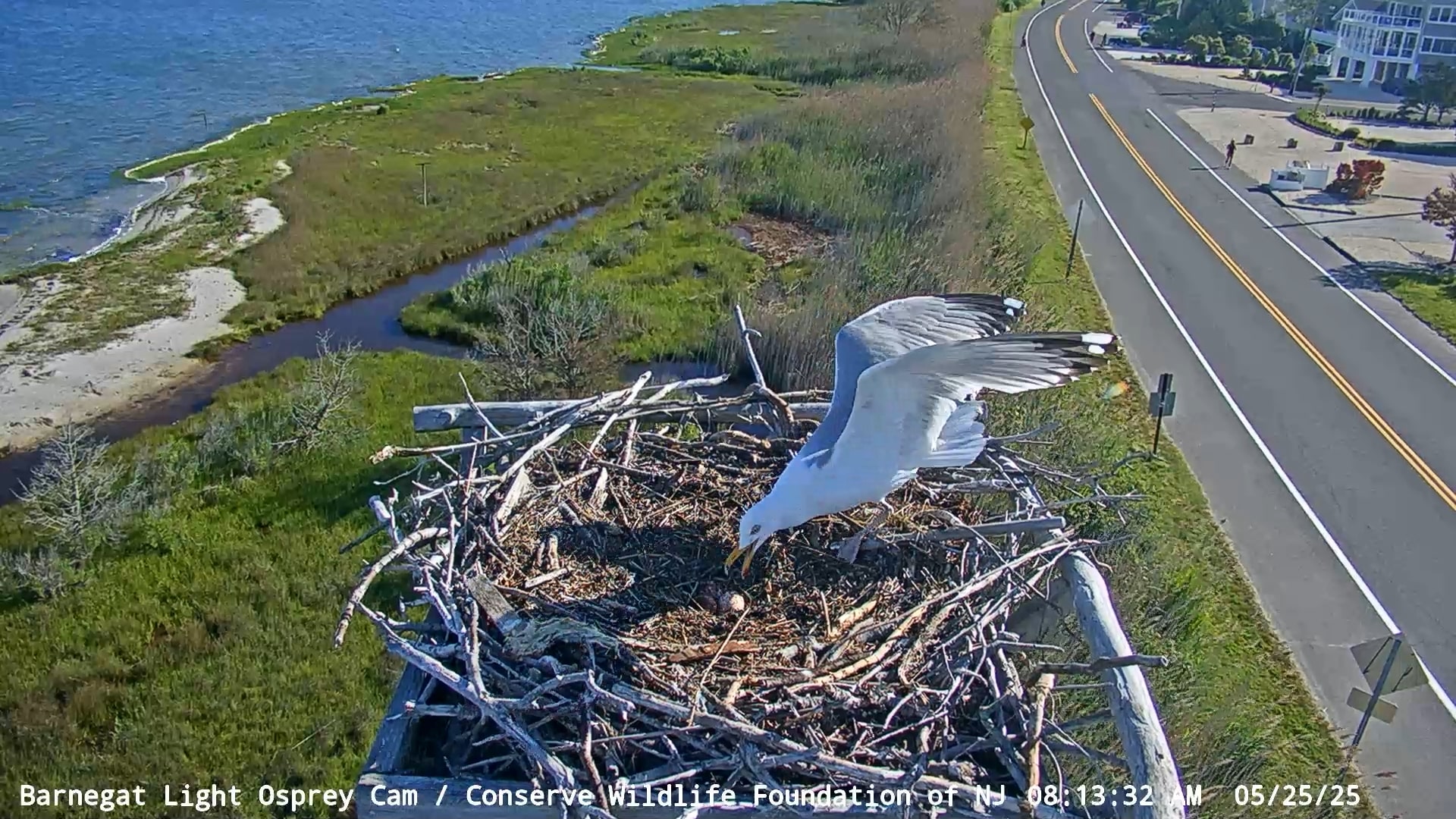
Since my last update from the Barnegat Light Osprey Cam as lot has occurred.
May 22
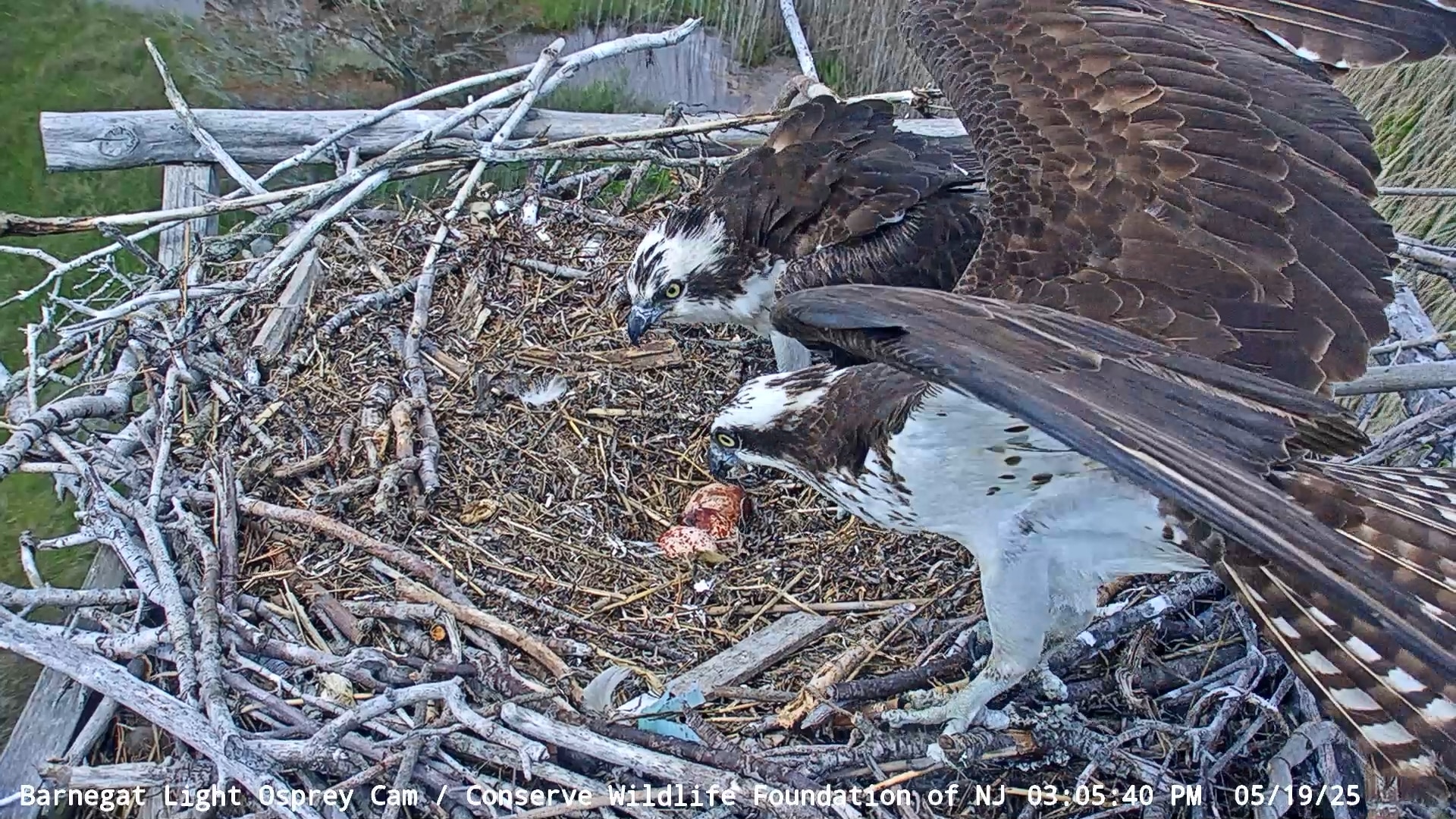
Duke + Dixie (as chosen by viewers during a poll last week) now have three eggs. After the first was laid on 5/13, she laid the second on May 16 and third on May 19. They have been incubating their full clutch since and dealing with the rain, wind, and cool conditions.
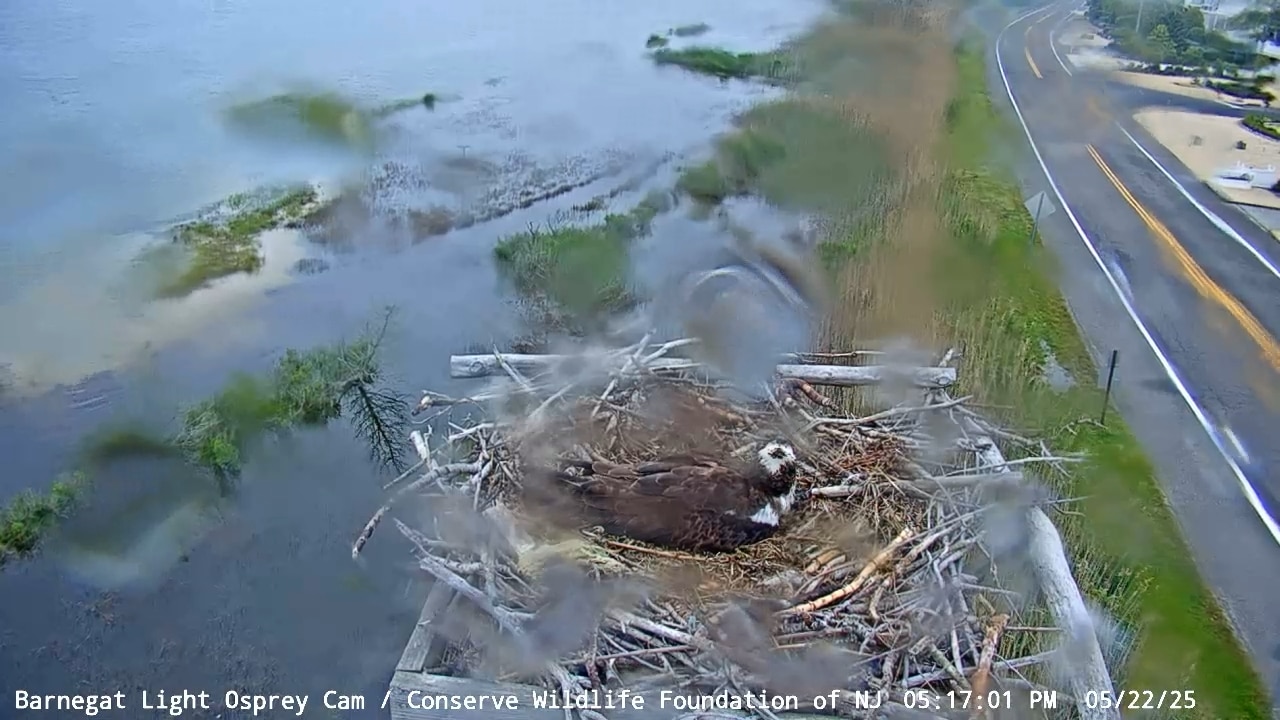
The onshore wind and rain have made it more difficult to forage. As we have seen in the past, during these nor’easters, if they stall or are prolonged, then it can have a ripple effect and cause them to reduce their brood sizes or eggs (if left exposed). As I write this post at 5:30pm, winds are still out of the NE at 20mph. Duke was not seen for some time, which indicates that he has had to spend more time foraging instead of guarding his nest or assisting with incubation.
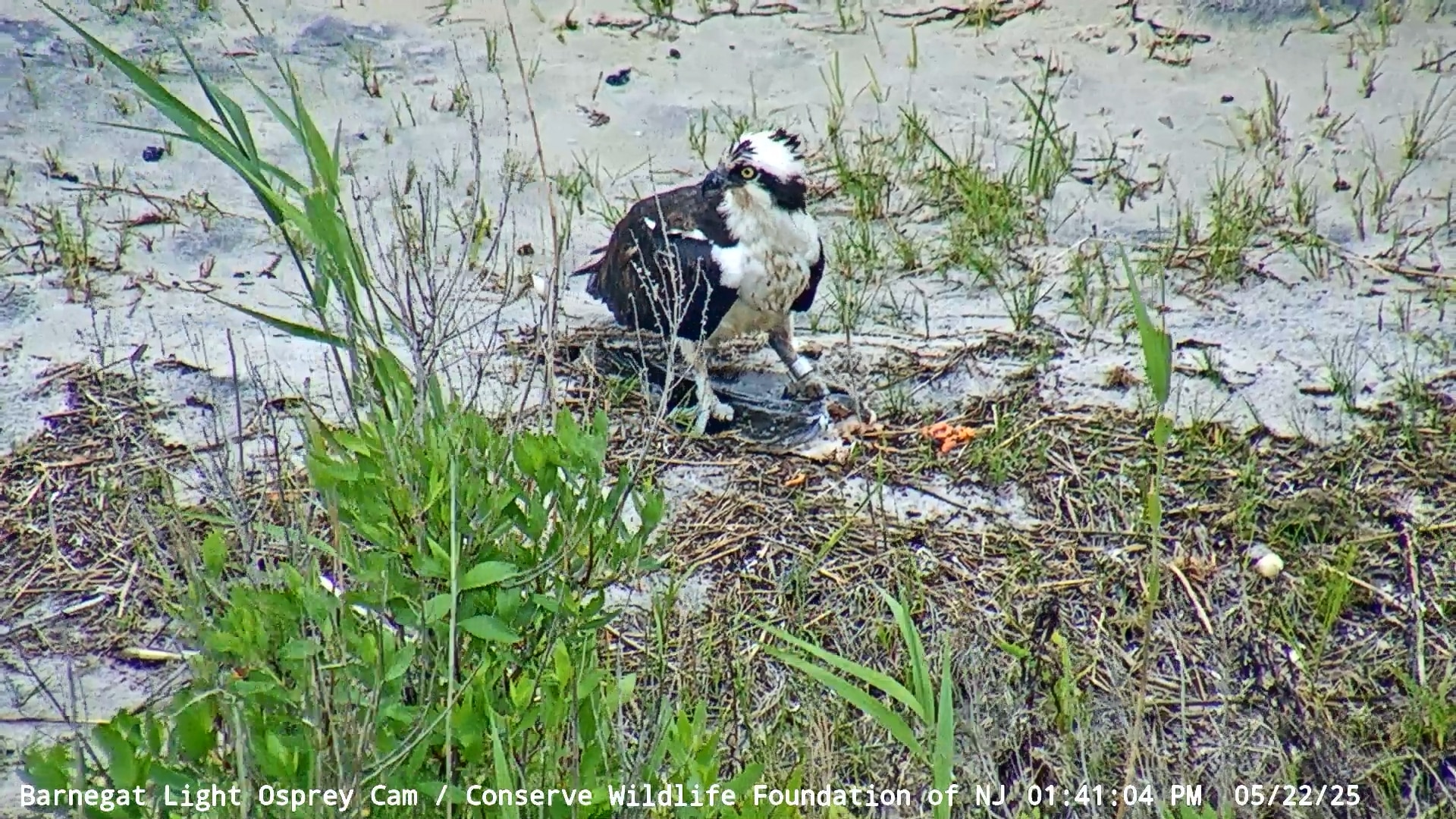
Thankfully this afternoon at around 1:45pm, he showed up on the nearby bay beach with a very large summer flounder. It was so large that he chose to eat it on the beach and not on his perch nearby. On the downside, he did not bring it to the nest to transfer to his mate. Though, he did get nourishment to forage again and will hopefully catch prey to provide for his mate, so she can continue to incubate their clutch.
It does look like this storm will move north overnight and winds will shift to the west, making foraging close offshore for menhaden much easier.
May 15
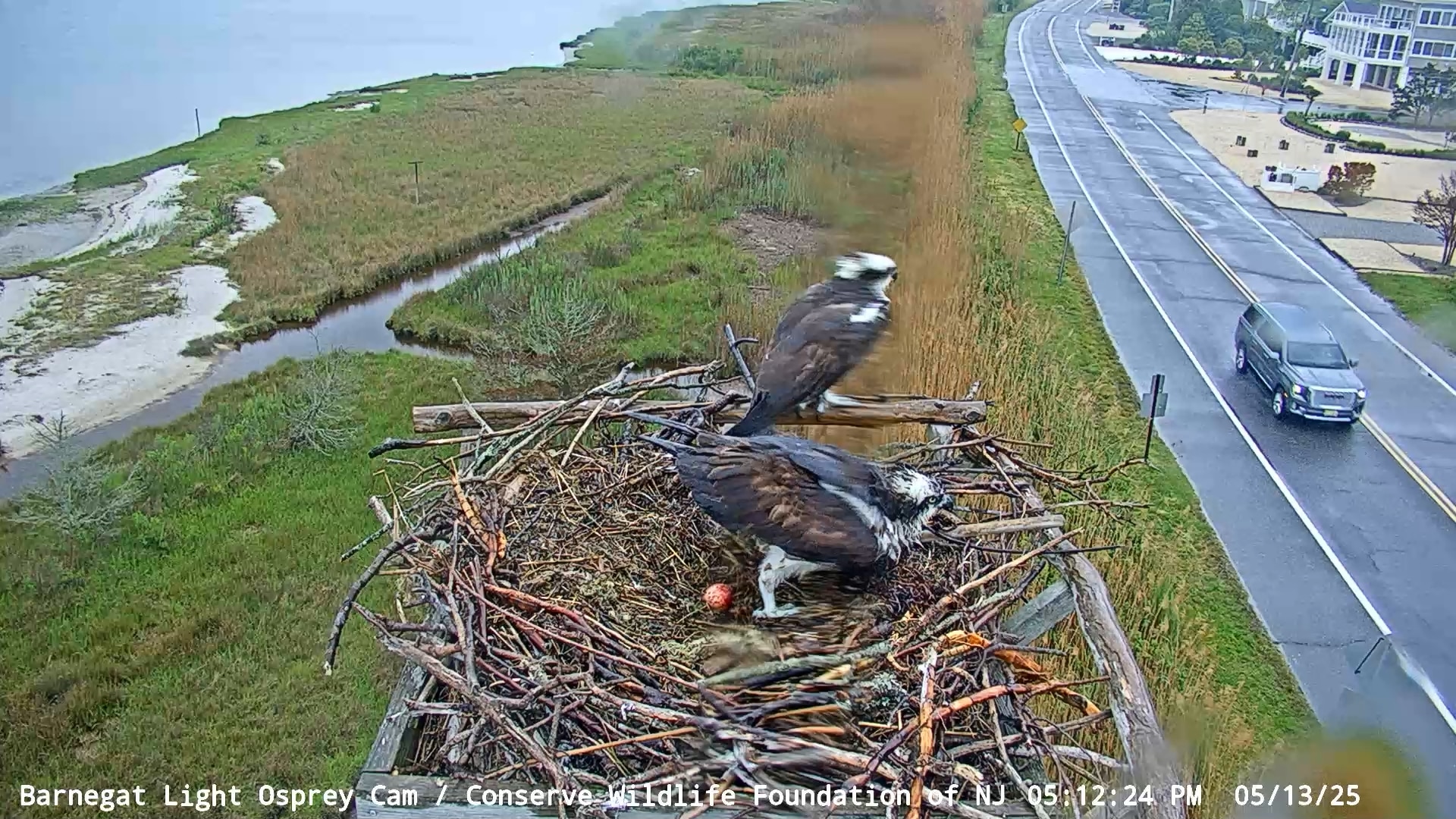
On the evening of May 13, the new female that Duke has formed a pair bond with laid an egg. This is an indication that things are getting back to normal, after Daisy, his mate since 2021 did not return. It is late for them to just begin incubation. The day she laid the egg, I was actually thinking of posting that it is unlikely for them to produce any young this year given how late it is to get started.
The chances of this egg hatching (and others she might lay) are slim. Not saying it couldn’t hatch but we’ve already seen how inattentive she is to it. A normal, more mature adult female, would not leave it unattended for hours at a time. This just illustrates what viewers already know — that she is a young adult female and this is likely her first attempt at nesting. We don’t know anything about her because she is not banded (around 25% of young ospreys in New Jersey are banded before they fledge).
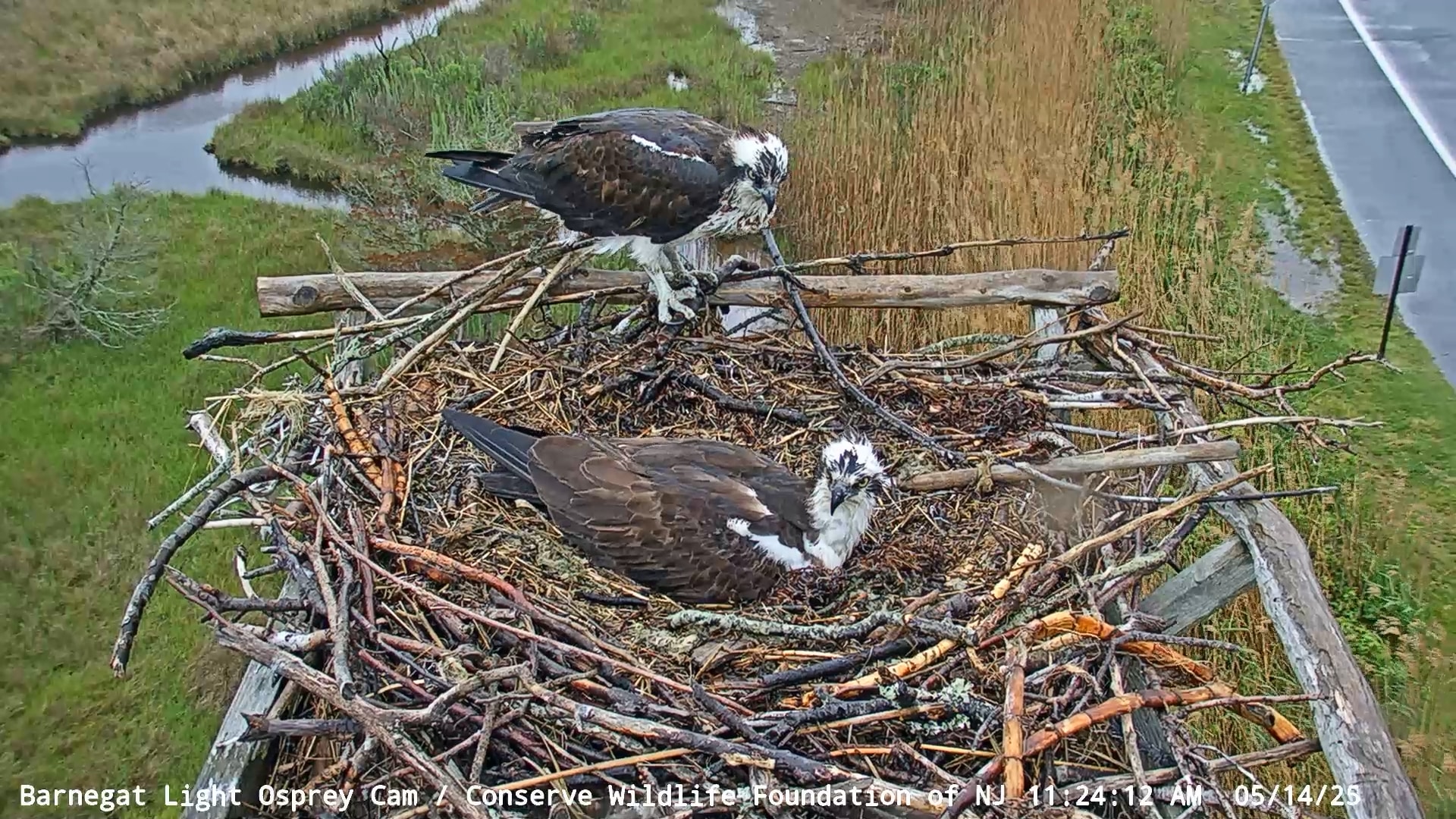
It has been interesting to watch how Duke, soon to be 19 years old, has done the majority of incubation and after not producing his own young here since 2023, he is anxious to pass on his genes. He can’t do it all, as he provides all the prey for his mate, so if the new female does not incubate, then the chances it hatches dwindle. We shall see how this plays out and are thankful for this camera to get this intimate view of how new monogamous relationships are built.
In other news, we created a poll for viewers to help choose a name for the new female. The top names chosen were: Duchess, Dixie, Dolly and Delilah. There is now a final poll on the live stream where you can help choose her name. The poll will close at 5pm or when we think we have a clear winner. Thank you to all who participated!
May 6
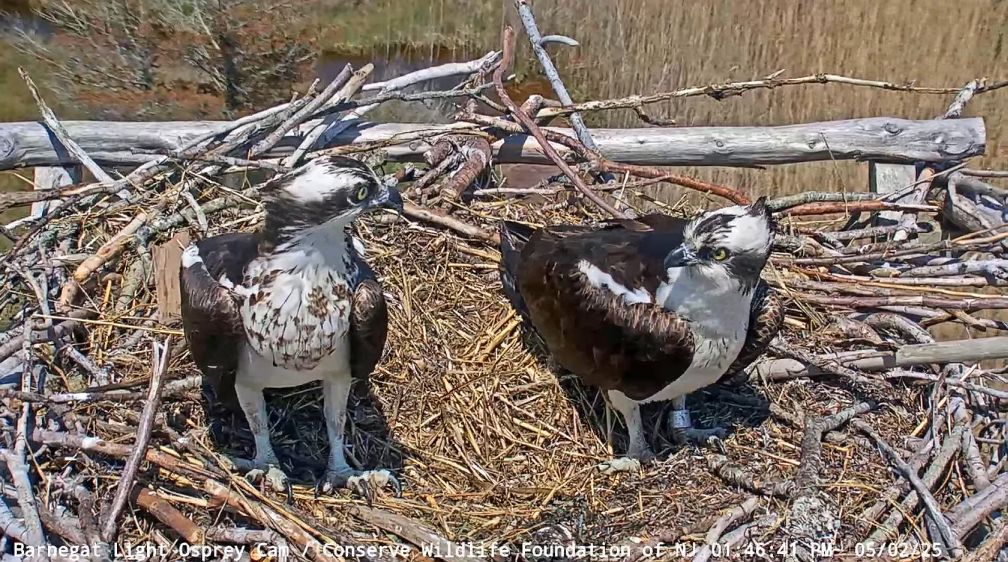 It’s been quite exciting at the nest over the last week and a half. Miss NN, (Missy), whom Duke was attempting to bond with, up and flew north the morning of 4/28, and she hasn’t been seen since. That very afternoon, a beautiful female osprey arrived. As to be expected, Duke initially was not happy and rejected her numerous times, forcing her off the nest. The next morning, it was a very different story. He was sky-dancing and later brought her a fish. She was receptive to his mating. The viewers are calling her Miss P for now.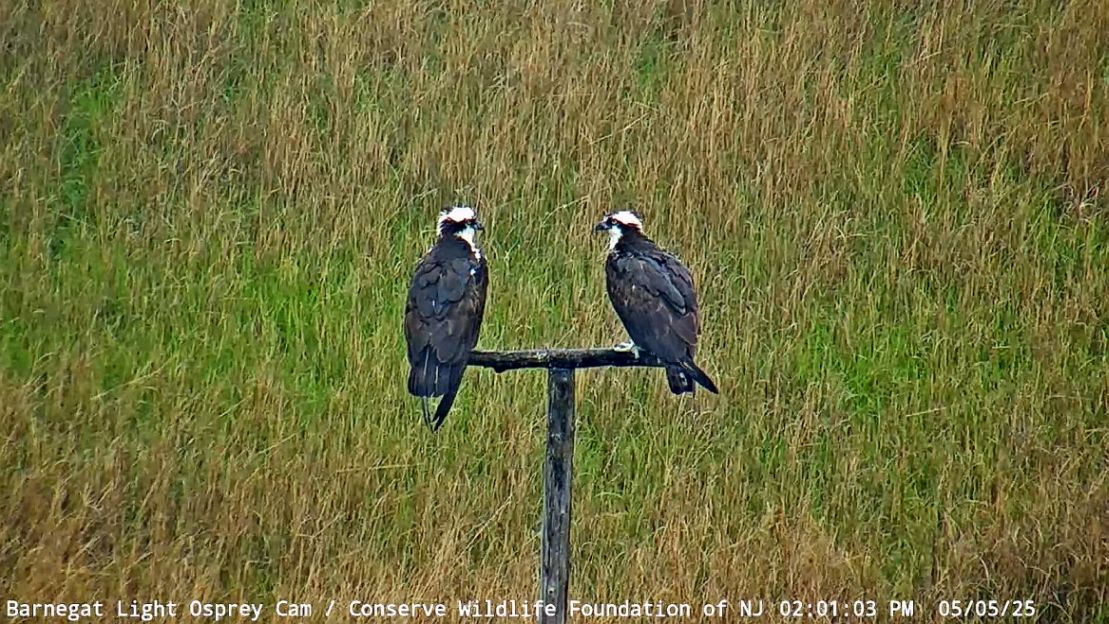
April 30
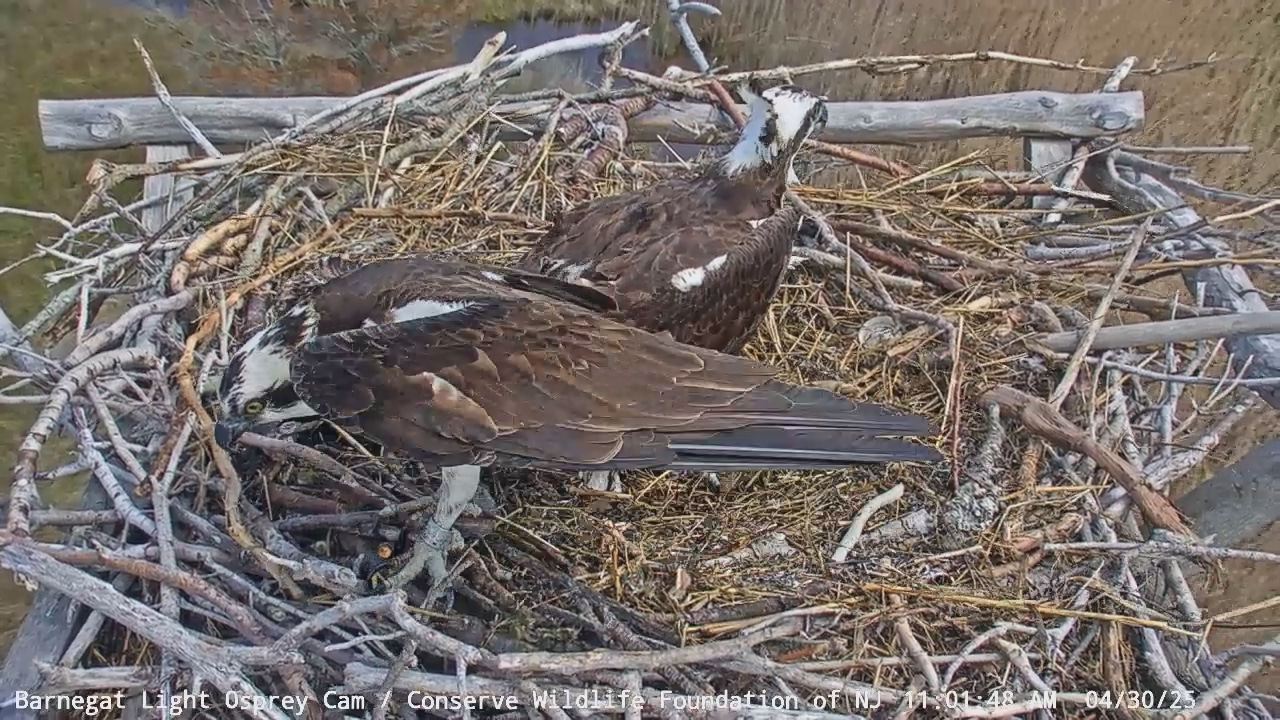
Thankfully, network issues that we were experiencing have been worked out and the stream has been uninterrupted over the past week. It has been quite busy at the nest lately, as we still don’t have an established nesting pair. The new female who was courting with Duke (Missy) is now missing or not interested anymore and another female has taken her place!
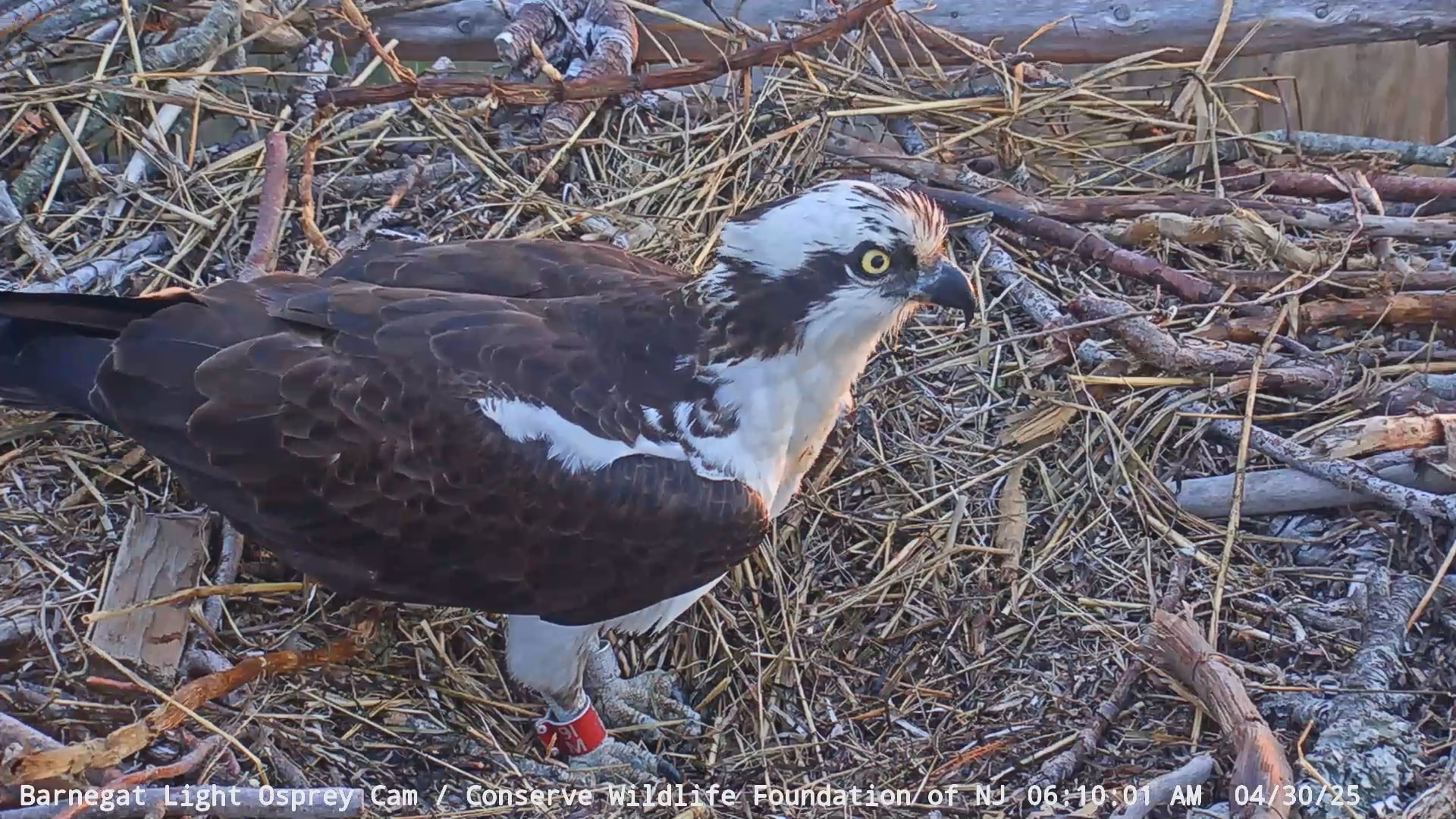
Then early this morning another red banded osprey showed up, 91/M. To make things even more interesting, he was banded at the same nest as 49/M (who has also been observed here and we believe is nesting nearby) but a year later (2021)! I re-sighted 91/M in 2023 on the saltmarsh at LBIF, which was his first year back on his breeding grounds.
Duke and his new mate could end up producing a late clutch of eggs, as we have seen hatchlings during our nesting surveys in late June. So if eggs are laid during the first half of May, then they would hatch in second half of June. Time will tell what plays out here as competition for this desirable nest continues.
April 24
The cam has been down due to an issue with the network equipment. This nest and these birds are not affected by the wildfire in Ocean/Lacey Townships.
April 17
It is apparent that Daisy was lost since she departed her home on Long Beach Island in August last year. Unfortunately, there is no way to know what happened to her. With Duke losing his mate, other females have come in to form a bond with him. Duke has also been challenged by another male, 49/M, who we have seen here in the past and on another nearby nest platform. He was banded in 2020 at a natural nest on a sandbar off High Bar Harbor (very close to this nest).
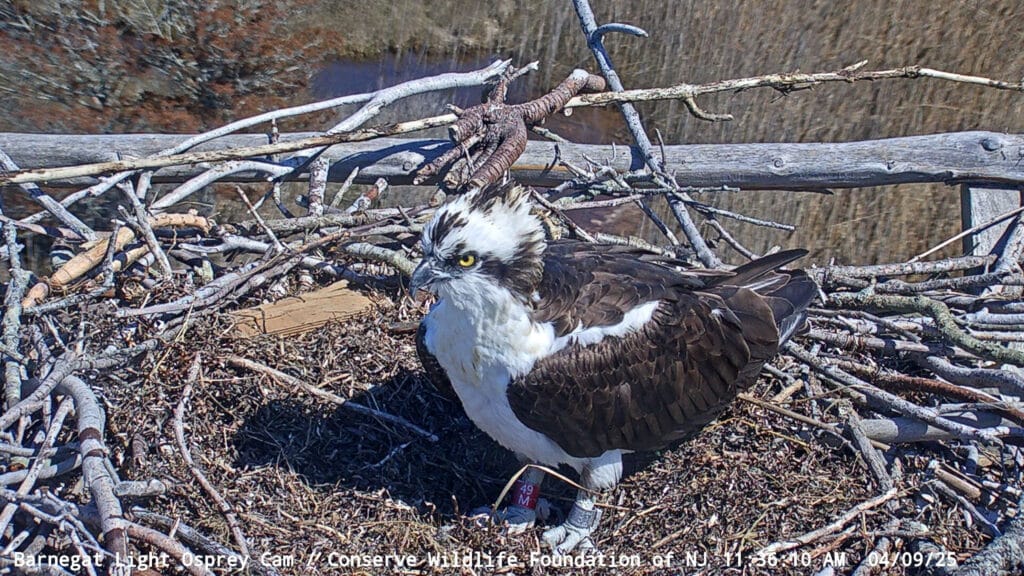
Earlier this week I visited the nest to address an issue that we have with equipment and brought my camera to get some photos of Duke. While I was there for only a short amount of time, I watched Duke perform a “sky dance” or courtship display near his nest. He then landed on his nest and a red banded female (yet to be identified – __/K) came in and landed next to him. Then the other female, who he has been building a pair bond with by mating and providing her with fish, came in — obviously, unhappy!
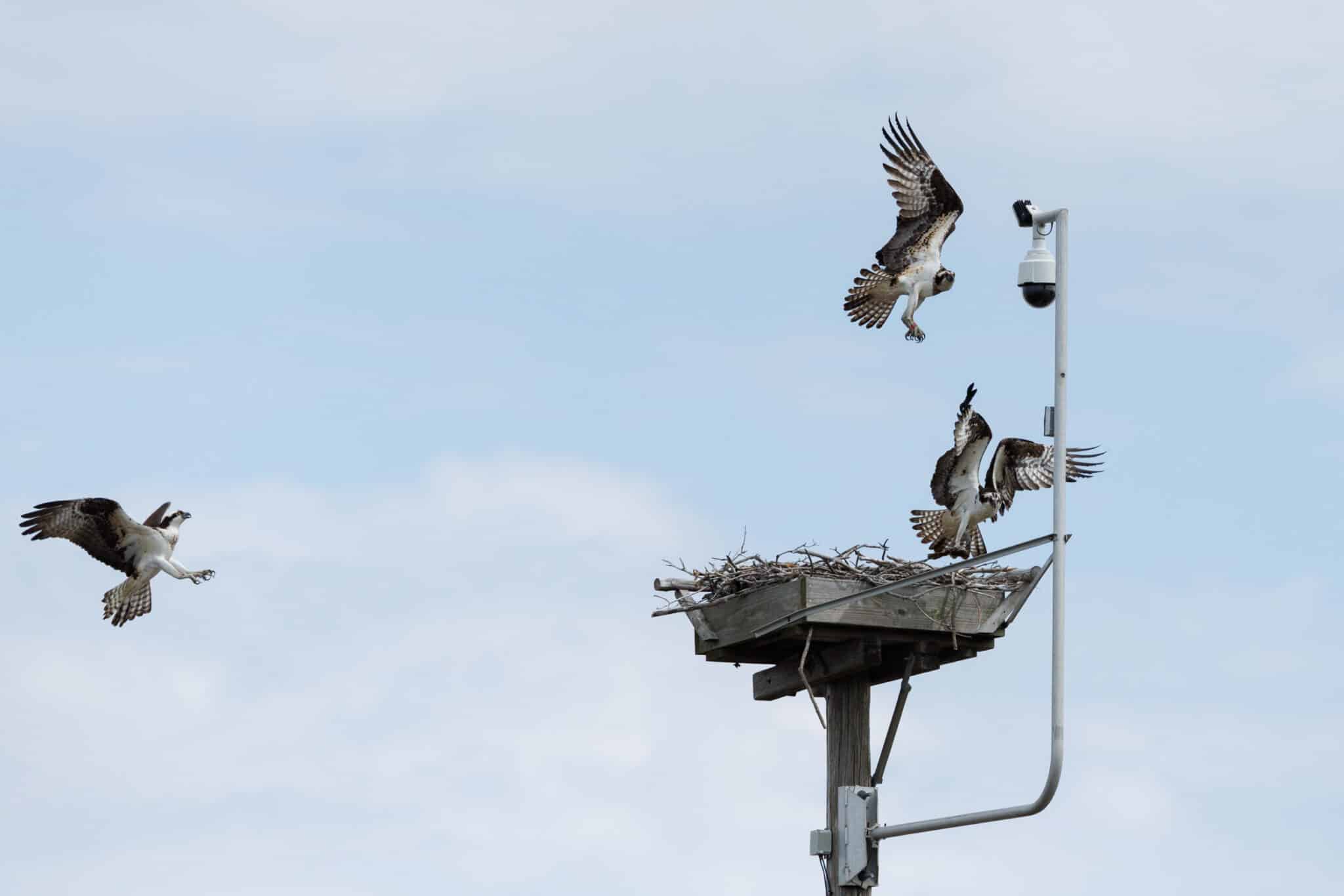
This drama, along with 49/M dive bombing is unsettling to Duke and his new mate. At this point in April, many established pairs are already incubating the first eggs of the season. Will things settle down so the female can lay? Duke knows his role in their monogamous relationship and this is really key to building their pair bond. There is still time for them to produce a full clutch of eggs.
March 31
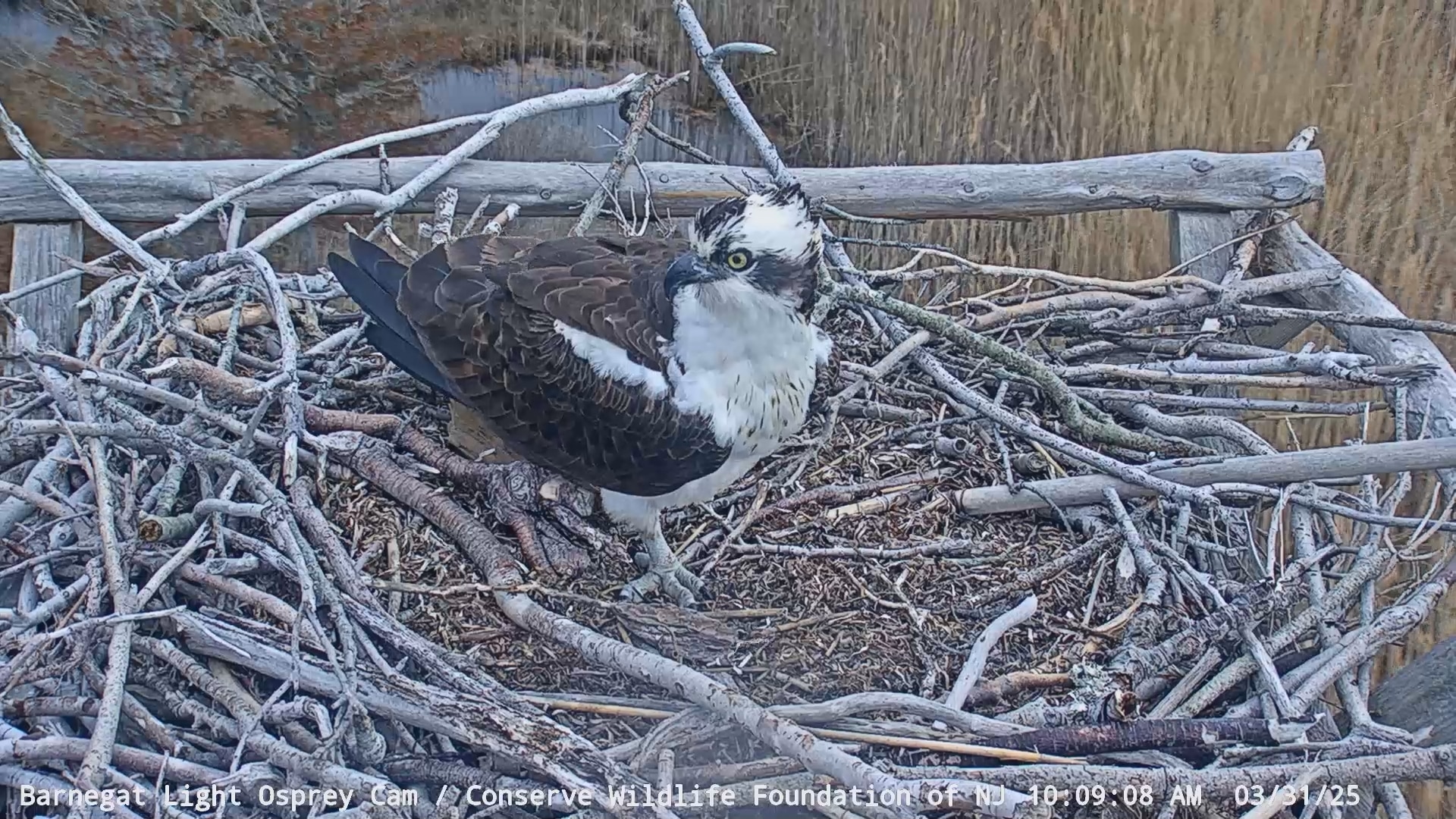
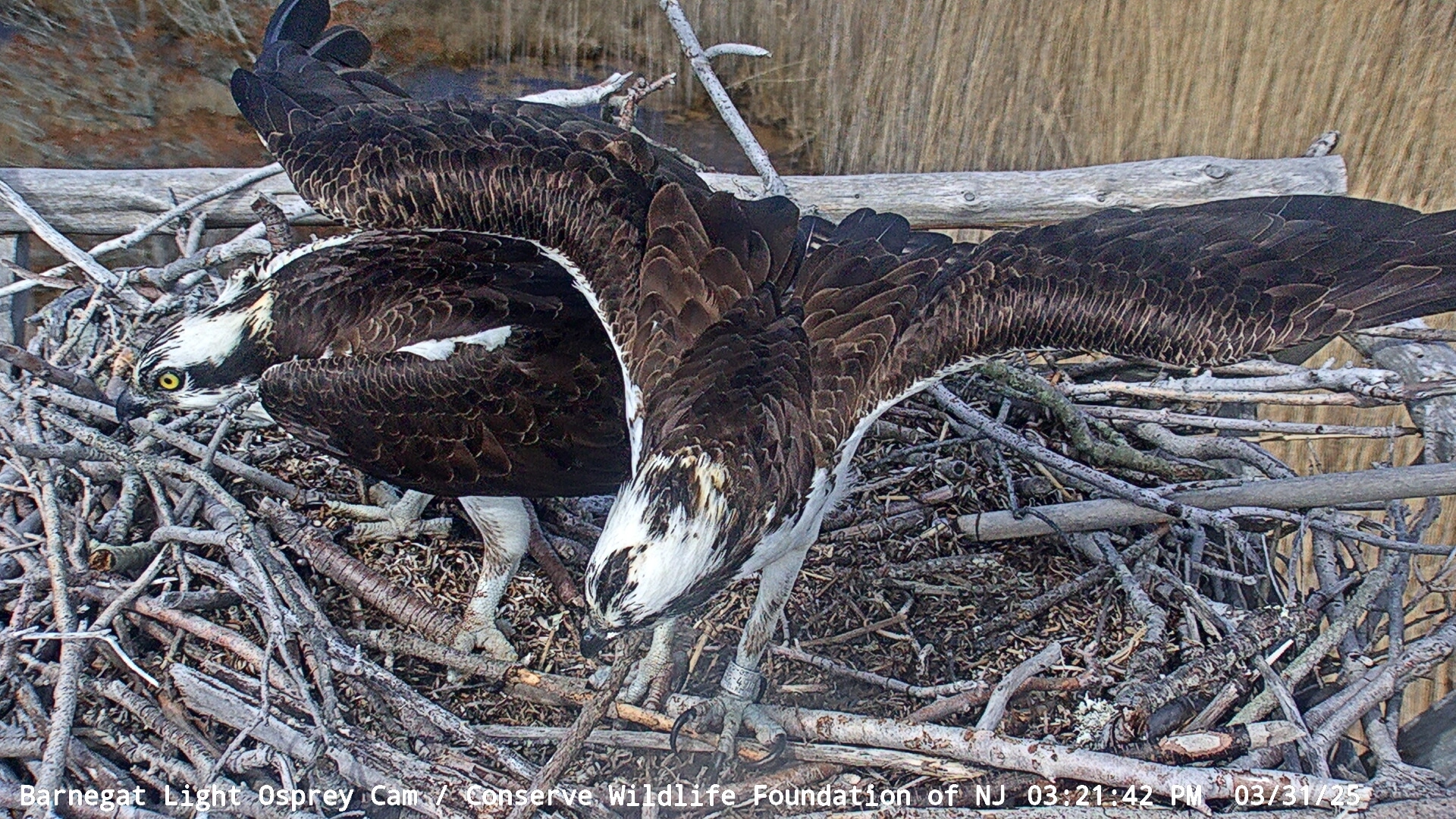
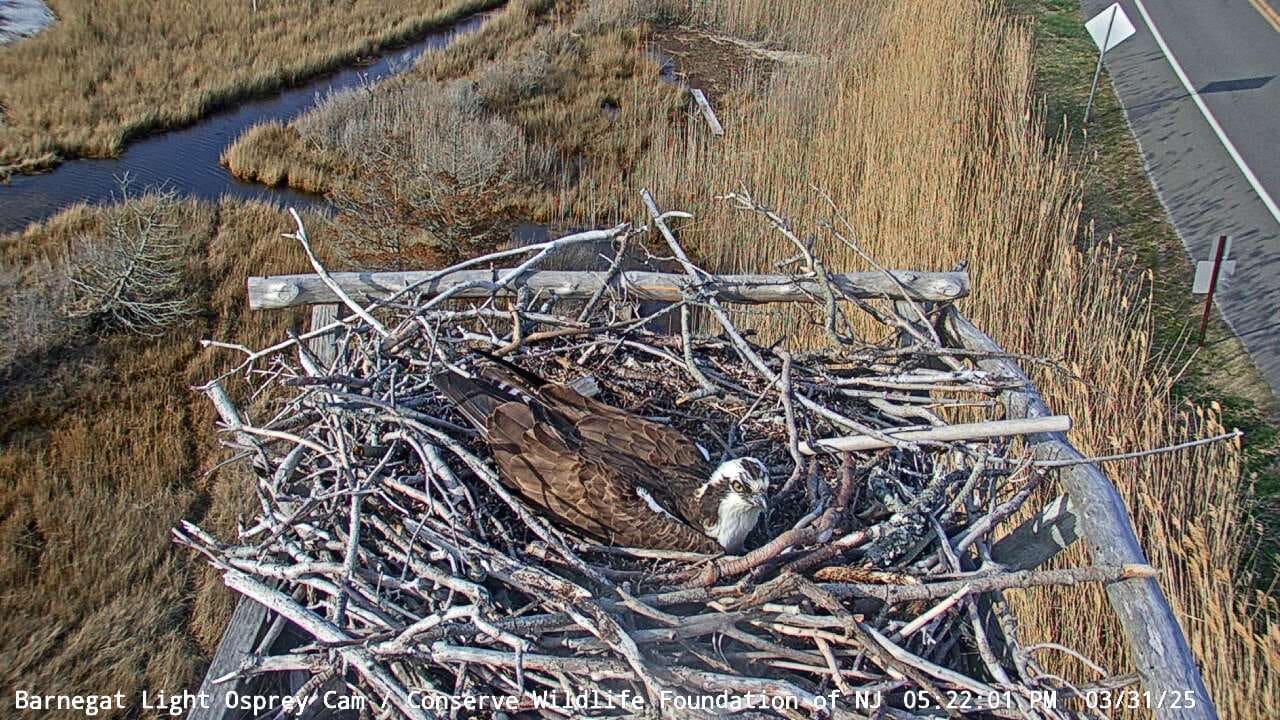
Today at 10:06am Duke, the resident male returned! He was identified by his behavior, unique iris and federal band: 788-04933. We were all watching and waiting to see if he would return. It is really amazing to see him return again.
He’s already been settling in by feeding on his perch, arranging sticks, interacting with the new female and resting in the nest bowl. We have witnessed him form a new pair bond with Daisy after his previous mate did not return. We’ll just have to watch and see what plays out. Daisy could still return. If she does, she will force the other female out. If she doesn’t return, we could possibly see other females try to take over the nest as well. April is the time of upside down ospreys, as many new/existing females return to find other females on their nests. Existing nests are premium real estate for ospreys in New Jersey.
March 29
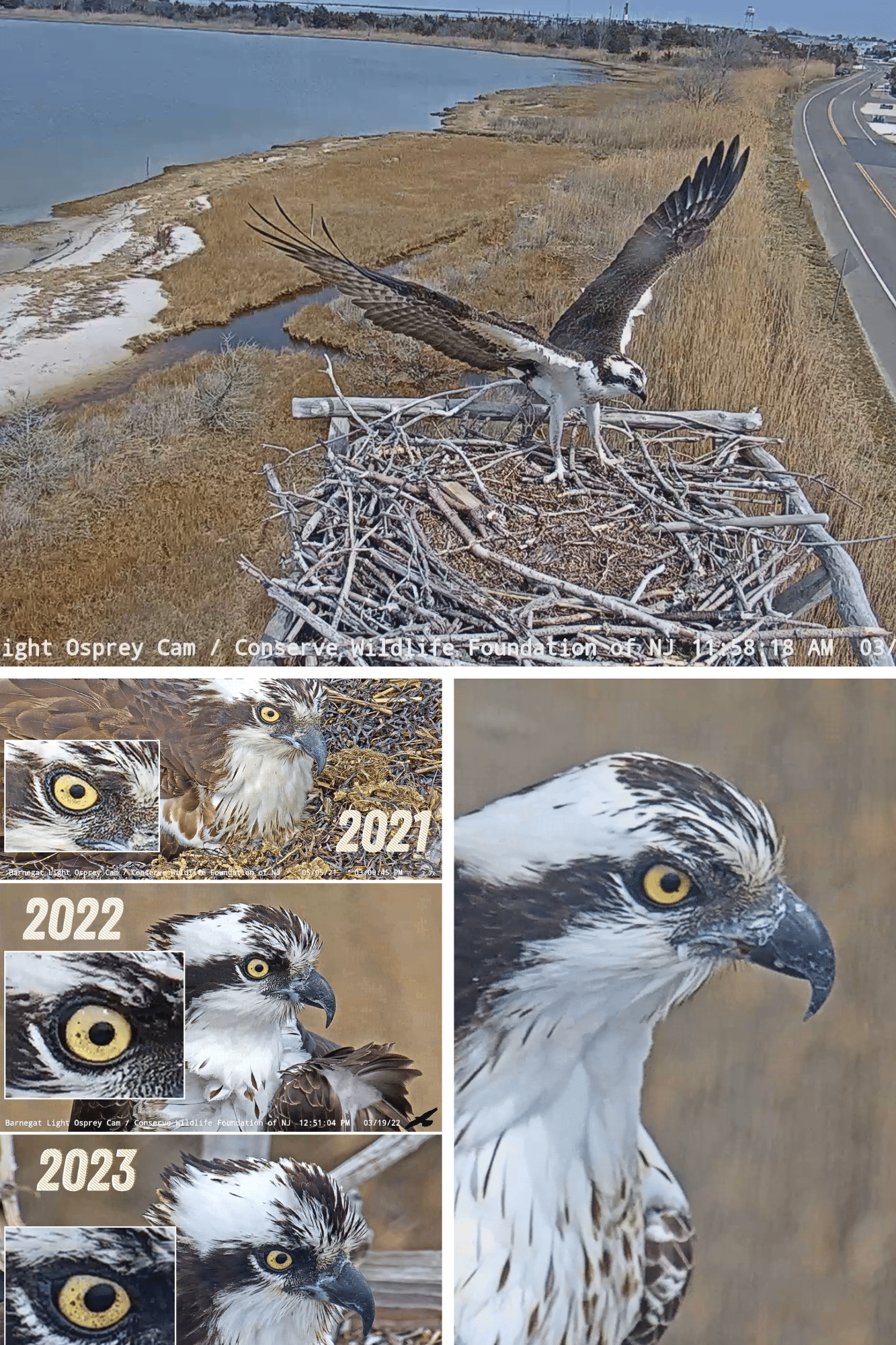
Yesterday an unbanded female osprey landed on the nest. We can tell by her iris, that it was not Daisy.
March 26
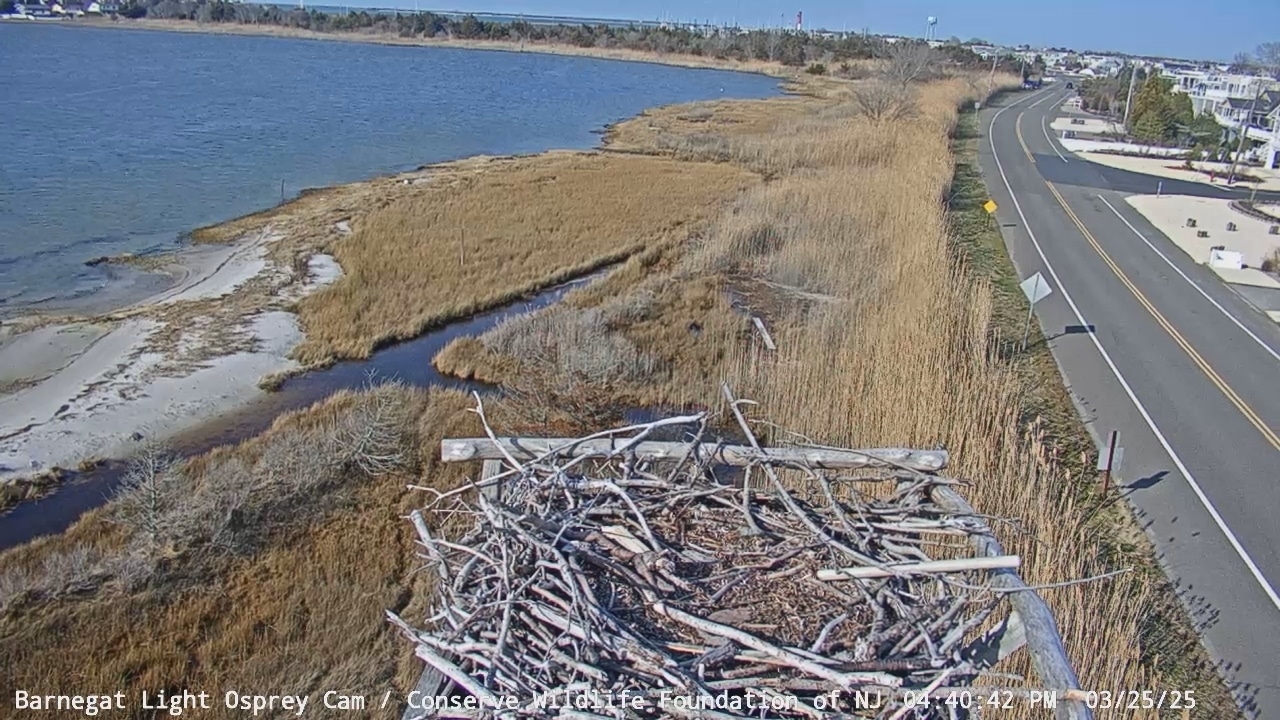
Well, I think we’re all getting antsy for the return of Duke + Daisy. Here’s a quick rundown of when they both have previously returned in the last couple years.
Duke: 4/8/2022, 3/28/2023, 3/31/2024 | Daisy: 3/19/2023, 3/16/2024
Some south winds are forecasted for Friday, so hopefully we will see some more ospreys return to the local area.
On another note, a couple of weeks ago we did some maintenance at the osprey cam. The network wire going to the nest pole was re-attached after it came loose and the modem was replaced. Ants made their way into our equipment box after chewing through the silicone seal on the bottom of the weatherproof box. We have to figure out a way to keep them out (traps were set inside the equipment box) b/c they can ruin some of our network equipment..!
February 21
We have had some issues with the live stream lately. This is due to the camera going offline. We are not sure what is happening, but we are visiting the site today to check out hardware and do a hard reset. We will also look at system logs of the camera to try and see if there is any reason for that to fail.
2024 Nest Cam News
April 9
Since our last update, Duke the nesting male here returned! He returned on March 31 at 4:23pm. Everyone watching could tell he was home. He felt very comfortable and this year had no challengers to fend off. He immediately worked to strengthen his pair bond with his mate, Daisy by providing her with fresh fish.
Since then they both have been working on the nest to spruce it up and copulating. Soon Daisy will lay her first egg. Milestones from last year: Egg 1 – April 22. Egg 2 – April 25. Egg 3 – April 28.
Edit to add: somehow my previous update and footer on this page was deleted and there is no backup.. Time to start backing up. I know I added some more text about Duke and him turning 18 this year.
April 28
By this time last year Daisy had already laid a full clutch of three eggs (first on April 22). It might seem odd that this pair isn't incubating by now as some other pairs have been incubating for a couple weeks. In 2021, Daisy laid her first egg on April 27, so we aren't too far off from previous years. Both birds have been perching on the platform at night, which is nice to see. When Daisy is preparing to lay her first egg, then she will remain close to the nest bowl for extended periods of time. Will Duke encourage her to lay her first egg, like he did in 2021?
May 10
By now, Daisy should be incubating a full clutch of three eggs, like most normal ospreys during this time of year. Something is amiss and we aren't sure what's going on. Both adults came back early and have had plenty of time to mate and spruce up their nest. Duke is old (soon to be 18 years old) but not TOO OLD to still be fertile. Since Daisy is not banded, we don't know her exact age, but she only showed up here in 2020 and when we see banded ospreys begin nesting they're usually less than 10 years old. Ospreys can live for over 20 years and still be productive, like [href=https://www.youtube.com/watch?v=pcv5D6R9jn8–]Iris in Montana[/a] or [href=https://www.theguardian.com/environment/2010/jun/22/osprey-webcam–]Lady of the Loch
Even if Duke was not fertile anymore, then Daisy should still lay eggs. They would just not be fertile and hatch young. As far as we know, Daisy appears healthy and is well fed. There is still time for her to lay eggs since we have observed many nests in the middle of summer have hatchling aged young. But, time is not slowing down. We simply have to wait and see what happens. It may be an off year for them and no young will be produced. This will be interesting to observe to see what they do when no young are here to care for. Will Duke stop providing food for Daisy? Will Daisy disperse locally until she migrates south or will both defend their nest? Time will tell.
June 3
This will be my last update for the season, unless something else happens to warrant one. Duke and Daisy continue to hang near their inactive nest. Like mentioned before, we do not know what is happening. We have heard from a few other osprey watchers that they are witnessing the same behavior. Adults present but no eggs or young this year. One pair on Mordecai Island and one on the Mullica River. We hope to learn more during our surveys.
December 4

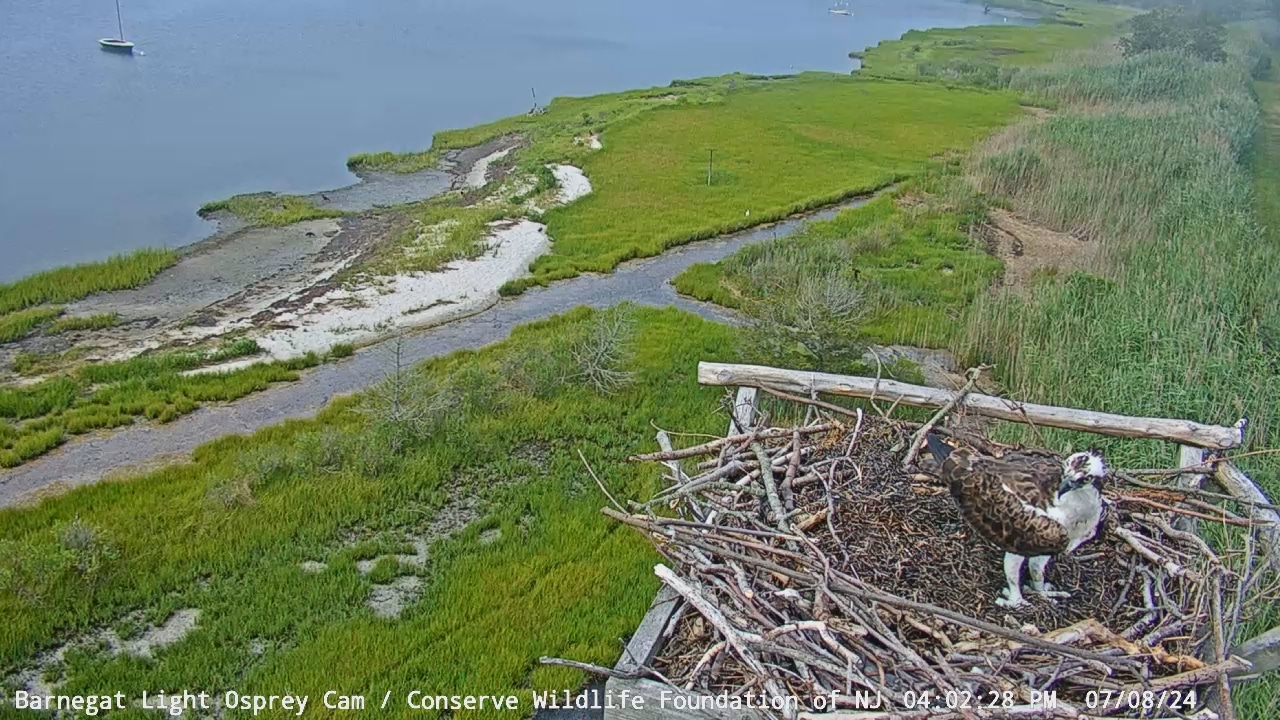
Atlantic brant are beginning to congregate along the shoreline here in Barnegat Light for the winter months. Coastal waters of New Jersey (and New York) provide essential habitat for brant, where the majority of the population overwinter. As more gather here, we may see some that are banded with auxiliary bands, which is part of a banding and re-sighting project by NJDEP Fish & Wildlife to study the breeding and wintering ecology of brant. By reporting re-sightings of auxiliary banded birds, we can help waterfowl biologists learn more about their life history and the importance of wintering sites like we have here on Barnegat Bay.
2023 Nest Cam News Archive
September 25
The osprey family from here Barnegat Light has completed their life cycle and started their non-breeding season. This begins with fall migration. Adult females typically leave first. Here we saw Daisy last observed on August 27. North American ospreys (all who are migratory) follow landmasses south. Here along the Atlantic flyway, they fly through Florida and then south over open water to Cuba or the Yucatan Peninsula. There they hopscotch over islands or land to N. South America, where the majority of N. American ospreys overwinter.
Following females are hatch year juveniles and adult males. Here Dorsett was last observed on September 11. We know from re-sightings or encounters of banded birds, that young birds don’t always fly south right away. Many disperse as they hone their foraging skills. We have had banded hatch year ospreys from NJ who were encountered in NY, PA and other parts of NJ before fall migration peaks (for ospreys), which is during the first week of October in Cape May.
Duke, our 17 yr old male, was last seen on Sept 19, which was before Tropical Storm Ophelia hit the area on Sept 23. It is likely that this storm disrupted a lot of migrating birds and we can only hope that many were pushed offshore. Since the storm hit, we have not seen Duke but viewing conditions have not been optimal. We hope to see Duke next year!
Thank you to all who have watched, donated and supported the Barnegat Light Osprey Cam this year! Special thanks our devoted volunteer camera operator and moderators on YouTube! Your contributions help ensure the success of this camera and osprey outreach initiatives in New Jersey!!
PS – I would post a couple snapshots but ants infested our network attached storage device, so repairs are needed to access these files.. I also think they are to blame for the intermittent internet outages!
August 8
On July 30, the one osprey produced at this nest fledged. She was banded on June 28 with both a federal bird band and state auxiliary band, as part of Project RedBand, an osprey banding a re-sighting project on Barnegat Bay. 09/N is one of over 500 ospreys who have been banded with red auxiliary bands to learn more about them when alive. So far this season, 30 auxiliary banded ospreys have been re-sighted throughout their range in NJ, with most being breeding birds observed during nest surveys. A full report of all red banded ospreys re-sighted this year will be published in our NJ Osprey Project annual report.
Overall, results from our surveys and data from osprey cams show that they are having a very tough year. With many shortages of food and/or starvation being reported by osprey nest watchers. During many of our surveys, we found many empty nests and some with young had no adults present, which meant that both adults have been spending more time foraging to support their reduced broods. This is the aftermath of a nor’easter that impacted the area in mid-June, which caused adult menhaden to be less abundant. Large scale commercial fishing of menhaden may have also played a factor, especially along the southern extent of the New Jersey coast, where we witnessed widespread brood reduction and many nest failures during our surveys.
Just last week I watched the Forsythe Osprey Cam, which has two fledglings (four young hatched). As one fledgling sat on the nest and awaited an incoming prey delivery from the adult male, the other fledgling came in and attacked its sibling for that prey. Right after that, I watched as the adult male returned several times with very small prey, which was not menhaden but more likely a small freshwater fish species. This too showed the effects of reduced menhaden, which is causing adults to forage more frequently while expending more energy. Thankfully here both adults have not had issues with catching prey, as they have brought in a variety of prey items including black sea bass, bluefish, summer flounder and Atlantic bonito.
Daisy has been doing a lot of foraging as well. This is to help her build up fat reserves for her southbound migration. In the coming weeks, she will begin her migration south. In September young will finally disperse before beginning their migration south. Mated pairs do separate during the non-breeding season and young of the year remain on their wintering grounds for two years. Sorry for the loss of my previous updates this season. It seems that they were removed from the page somehow. There is no backup for content that was posted and not saved, so I hope to write some small snippets of information at the end of the season to have a full summary of the season.
*Some previous updates were lost, hence the gap between June and August.
June 24
The past few days have been difficult to watch for viewers of the BL Osprey Cam. As you’ve seen, the youngest nestling passed away earlier on Friday morning. Then this morning, the second oldest passed away. Both of these losses were the direct result of weather, specifically wind. From late Tuesday through Thursday we had stiff onshore winds. These northeast winds created waves which increased water turbidity and made fish more difficult to catch. Duke had not provided a fish to his mate and brood since Wednesday morning.
Since Thursday evening, Duke has not been seen. Winds out of the NE have moved on, but without a male, who does the majority of foraging it has been very difficult for the young to thrive. The lack of prey has now caused brood reduction. In the species it is quite common to see as availability of their prey varies throughout the region and world. In New Jersey, from this recent weather we have seen brood reduction occur at two other osprey cam nests — Cape May Meadows Osprey Cam lost two of three hatchling age young and the Forsythe NWR Osprey Cam lost two of four young in this same time period.
June 9
Well, a month has passed and there are now three nestlings in the nest. The first egg hatched on May 31 (~3:30pm), the second on June 1 (~3:30pm) and the third on June 4 (~5am). All have been thriving over the past week, even the runt. Duke has done a stellar job of providing plenty of fish for them, including a couple large bluefish, which were fed to the young multiple times. Duke even fed his offspring yesterday afternoon. We’re really thrilled to see that prey availability is not an issue here as fish stocks appear to be plentiful.
As you’ve seen via the live stream during these smokey/hazy days, there is little that wildlife can do to get away from these unhealthy conditions. Thankfully the smoke in the air is clearing. In other news, it has been quite cool during the evening/early morning hours, so Daisy will brood young to keep them warm until they get too large and by then, they have more downy feathers and are able to thermoregulate much better. When it is too warm, then Daisy will shade her young to keep them cool.
Just a couple weeks ago, we received a shipment of custom made red auxiliary bands for Project RedBand! We have been unable to get them over the past few years and are really excited to continue this osprey banding and re-sighting project on Barnegat Bay! So, that means that this year we will be visiting this nest to band the young. We will do this when they’re around 4 weeks old, so possibly during the last week of June or first week of July.
May 1
The pair is now incubating a full clutch of three eggs! The last was laid on April 28 (1-4/22, 2-4/25). Incubation began after the first egg was laid and this gives the oldest young an advantage (as we have seen previously here). Incubation period tends to be longer along the direct coast as temps are usually cooler due to the ocean and prevailing winds, which is usually around 40 days.
April 22
What a surprise on Earth Day! I meant to write more when posting this photo but didn’t have much time on Saturday (today is 4/25). I captained a cleanup in my town for Earth Day at a local park with a lake and then had a lot else going that took my time this past weekend. Daisy laid her first egg early on Saturday morning when she got a break from the relentless intruders. Yes, if you have noticed, there is a lot more competition for this nest (and probably many others) as the population of ospreys continues to grow. These new recruits (young adults) are itching to takeover established nests like this, which show that they are suitable nest sites. In some areas (even BL) there are suitable nest platforms that remain unused. That is because they are in less desirable locations — not as close to water or too close to trees, etc, so birds are less likely to choose them over established nests that are in open areas near water — like this nest!
In other news, egg two is due anytime. Hatching of this first egg is tentatively slated for June 1. This is great, as it will be after the holiday weekend of Memorial Day.
April 3
Viewers who watched over the past week have seen that Duke returned last Tuesday! He is very easily identified by his old aluminum leg band with a 788- prefix, which has long been retired. He was banded as a nestling with another sibling on July 12, 2006 at a nest within Sedge Island Wildlife Management Area. The nest that he originated from is 123-A-013. It was first found in 1982 and is located in an area called Horsefoot Slough, which connects the back bay waters of Sedge with Oyster Creek Channel and Barnegat Inlet. In this area there are five osprey nests that are very close to each other. At Sedge Island there are around 40 nesting pairs of ospreys that nest within a 2.5 square miles, which is the most densely populated colony in New Jersey. Sedge is open to the public for outdoor recreation, including kayaking, canoeing, clamming and fishing. It is best accessible from Island Beach State Park. I can’t recommend a trip to Sedge Island enough.
This year Duke surprised us all by returning a full 10 days earlier than usual. With his mate already back, he hasn’t wasted much time sprucing up their nest to begin another nesting season. We shall see how the season progresses, but on some nests where the monogamous pair returned early, they started laying eggs during the second week of April. We shall see if this occurs here or not.
March 22
As you’ve seen in the live stream, ospreys are back on the nest here! On Sunday, March 19 a female arrived in the mid-afternoon. Snapshots of her on the nest by the cam have confirmed that this is Daisy, the female who has nested here since 2021! I think we all knew it was her the moment she arrived. From her familiarity of the area, to bathing in the bay and then trying to arrange that pesky piece of nesting material, we knew it was her!
Today a male arrived on the nest. This is a male that we have likely seen here in the past. He is banded on his left leg. We didn’t get a good look at the band but did see -0885, which is a partial of 1088-08856. If this is his band, then this is Lefty, who was here last year and started to form a pair bond with Daisy, until Duke arrived (late as usual). I banded him as a nestling in 2016 at a nest behind LBIF in Loveladies. At 7 years old this summer, it is interesting to see him here. Is he just checking things out (again) before going to his less desirable nest? I truly wish he had a red auxiliary band so we could identify him in the field when away from the cam more easily! His nest mates were banded with red bands that day, so I must have run out of rivets..
Hopefully we will get a better look at his band. But this is the time of year when we have lots of ospreys returning to their breeding grounds and nests, with many who are not apart of a breeding pair. These birds attempt to usrup pairs by arriving early. The key factor in forming that pair bond, as we’ve seen, is whether or not the new male will provide food for the female. Either way, they are setting the stage in case the previous male did not survive the winter. Of course, we all love Duke and the fact that he will be 17 years old this summer adds to our love for him.
March 15
Today, March 15 we activated live chat for the osprey nesting season! No ospreys have been seen on camera but some are back on their breeding grounds here in New Jersey. Winds have been brutal with the coastal low that impacted the area over the last couple days and west winds have yet to lift. We should see south winds build late tomorrow and continue through Friday. This will help migratory birds, like osprey move north!
February 9
Only a month until we get some early spring arrivals of ospreys in New Jersey. Chat on YouTube will be open on February 25-26 from 7am – 8pm each day. Thank you to our volunteer moderators for offering to engage with the public during this time. We are seeking a couple more moderators to help oversee chat this summer. If you are interested, please contact Ben Wurst.
January 30
Shout out to Ben P. and Rory M. w/ Pine Barrens Tree for stopping by the nest to clean out any plastic marine debris!
The countdown to the spring arrival of migratory ospreys has begun! Only ~35 days until ospreys begin arriving back in New Jersey on spring migration, though one has been observed at Lake of the Lilies in Ocean County for several weeks this winter…!
Special thanks to Rory + Ben from Pine Barrens Tree Service for devoting some time and use of their bucket truck to clean out any remnant plastic marine debris from the nest here. Some viewers had asked if we would clean out the dangerous plastics, including white balloon ribbon, plastic film and other plastics that were brought into the nest last summer. Thankfully the guys from PBT were working up in the Barnegat Light area and decided to stop by to clean it out. Thanks so much for their help to ensure that Daisy & Duke return to a safe, clean home.
With that said, from now until April 1 is when we finish any nest maintenance and repairs. This also includes cleaning out excess nesting material, including any and all harmful plastics. Hoping to put together a short video showcasing some of this off season work to engage more volunteers to help do the same to their local nests.
January 3, 2023
Osprey 93/H photographed on 7/26/22 near Loveladies, NJ.
Happy New Year, BL Osprey Cam fans! As I work to finalize osprey survey data and write our report from 2022, I thought I’d share some BL Osprey Cam alumni news. During one of my surveys near LBI last summer, I photographed a red banded osprey in flight. Thankfully the red band was readable, 93/H. This was one of seven red banded ospreys that I re-sighted last summer. I didn’t realize it at the time, but this was a young bird that had fledged from the BL Osprey Cam nest (122-B-021) in 2018! This was one of two that were produced at this nest and the first at this location. This was also the year before we upgraded the nest platform and install the camera system.
Osprey 93/H after being banded on July 9, 2018 in Barnegat Light, NJ.
When I looked back at my data and the date banded (July 9, 2018), I then realized that this was the epic day that we filmed footage for the NJ Osprey Project trailer, New Jersey’s Ospreys: A Symbol of a Healthy Coast with Oak Leaf Media, Northside Jim; AC Electric. The banding of 93/H at the future BL Osprey Cam is seen near the end of the video.
This is not the first time that 93/H has been re-sighted either. He was re-sighted after fledging in Barnegat Light in late September. Since he is only 4 years old, he is likely not settled down at a nest yet, but since he is a male, he will be returning to establish a nest in the Barnegat Light area in the future. We will have to keep our eyes peeled for him to make an appearance at the BL Osprey Cam this year. I know I will be looking for him on the bay this spring and summer!
Lastly, you may have seen the live stream stop, start, etc several times today. I am trying to stream at 1080P again for that great HD picture we all love. We have received warnings from Comcast about using too much bandwidth last year, so we decided to reduce resolution of the stream. Well, time to bump it up again and see how things go. We would love to stream at 1080P (or even 4K w/ a new camera) but are not sure if the added internet cost is worth it. Either way, we are always looking for ways to get reduced rates from our ISP!
2022 Nest Cam News Archive
In summary, this year Duke + Daisy produced two young that fledged successfully. Three eggs were laid but the youngest hatchling did not survive, due to the female inadvertently moving it outside of the nest bowl.
September 6
Autumn is upon us and migration is underway. Since the beginning of September, close to 600 ospreys have been counted at the NJ Audubon Cape May Hawkwatch. Daisy has left on her southbound migration (last seen on 8/28) and Harper has dispersed and may have started his migration (though juveniles don’t always go south first). He was last seen on 8/30. Harbor continues to hang on the nest to rest, feed and preen and be supported by Duke. Harper is likely out perfecting his foraging skills. It has been delightful to see him with a variety of small prey that he caught himself, like a striped killifish, blue claw crab, blowfish, small menhaden, and a needlefish!
Soon Harbor and Duke will also begin their migration south to their wintering grounds. So far the tropics have been very quiet, which is great for migratory birds, including ospreys. Large tropical storms are known to suck up birds and can draw them out into the ocean and open water, where birds like ospreys do not fair well. We hope the tropics remain quiet, as osprey migration at Cape May peaks during the first week of October.
August 11
Both Harper and Harbor have fledged! As they become more confident with their flight skills, they will venture further from their home nest. Even though they are still dependent on the adults for food, they know that they need to start foraging on their own. As they take to the skies and fly with other ospreys, they will soon learn to find and catch prey on their own.
With a cold front passing through the area on Friday, it will set the stage for the early migrants to begin their southbound migration. Adult females will be the first to depart and arrive on their wintering grounds. The young will remain and the adult male will continue to provide food for them, but it will be less frequent which also encourages them to begin foraging for themselves.
July 29
Time does fly (and so do ospreys!)!! I can’t believe that it has been a month since my last update… In that time the young have been named, Harbor for #1 (by my daughter) and Harper for the male (by my son) and developed into fledglings! On a personal note, I relocated during this time, so my life has been a bit hectic..
Moving on, today the oldest of the young, Harbor fledged! This morning at exactly 7:16am she took off from her nest. She was observed by viewers of the live stream flying over the marsh, bay and eventually taking her first bath. Her flight was notably strong and uneventful. Fledglings here are known to utilize the nearby shoreline to rest, which is a great natural feature for them. With the upgraded perches on the nest, we hope that they will allow for easy landing and takeoff for both fledglings as they become more experience on the wing.
Soon Daisy, the adult female will begin her southbound migration. Now that her young are older and not in need for close parental care, she can leave the nest to forage more for herself. Over the past several weeks we have seen her bring in dogfish and very large summer flounders. She is building up fat reserves that will help ensure her safe passage to her wintering grounds.
June 27
The two nestlings are almost four weeks old where they reach the 75% developed benchmark. Their eyes are bright orange and their body feathers have emerged from pin. Their flight feathers are also growing quickly and have emerged from pin as well. At this age they are able to thermoregulate, but on hot days the female will still try to give them shade to keep them cool, and on cool rainy days she will do her best to keep them dry.
Rain hasn’t been too plentiful, so the thunderstorms that passed through this afternoon gave them a chance to drink some water as it flowed over their bill. Ospreys get the majority of water that they need from their prey, so a little freshwater is welcome on a warm summer day.
In other news, it has been interesting to see some plastic marine debris that was brought into the nest, including some balloons w/ ribbon and part of a softball. Daisy loved the ball so much that she was seen brooding it in the nest bowl.
At this point we are not planning to band the young for future tracking. We do not have any red aux. bands to deploy and our bucket truck cannot visit the site until July 12. Young will be 6 weeks old at that point and more difficult to band. Instead we will save resources and use our time to survey more nests for our 2022 NJ Osprey Census.
June 15
The two nestlings (who have yet to be named – viewers have asked my kids to name them..) — referred to as “one and two” are now around 14 days old and have been thriving! At this age, they are at the point of being too big to brood and are able to keep warm, but it is not needed as much as summer is around the corner. The young, when not sleeping or eating, are starting to explore their nest and have better eyesight, so birds flying over the nest or people walking by are being noticed. Soon their body feathers will emerge from pin and they will look less like their ancient ancestors.
Viewers have likely noticed the mylar balloon w/ plastic ribbon that was brought into the nest. We are aware and thankful to have the camera to monitor it. While released balloons are deadly when eaten by marine sea life, with ospreys and other birds, often it is the plastic ribbon attached, which causes concern. The ribbon from balloons has entangled ospreys at other nests and caused nestlings to die. Luckily here, we have the camera to monitor the situation, unlike the majority of nests in New Jersey, many of which contain some form of plastic marine debris.
For now, deciding to leave the balloon in the nest is a teachable moment — viewers of the live stream will see it and hopefully raise awareness for not releasing balloons, as they do not biodegrade and are a deadly source of marine debris that is found worldwide.
June 5
We apologize for the downtime of the cam yesterday and last night… There was an issue with YouTube receiving data from our streaming software, which has always worked flawlessly. Today we started a new stream and it worked!
June 4
The third egg hatched during the day on June 2. That evening an unexpected event occurred, where the adult female accidentally removed that hatchling from the nest bowl. This put it outside the area where she provides parental care – feeding and brooding for it to stay warm and dry. The hatchling, not being able to see very well and move about the nest, remained in this area and survived downpours over night and into the next morning.
We monitored the situation very closely and made the careful decision to not interfere and save the hatchling. We debated calling our friends with a bucket truck to go there to save it, but we have already seen food stress at the nest this spring, so even if we were to place it back in the nest bowl, it would have had a severe disadvantage due to the age difference between it and the other two (older) hatchlings and the possibility of less prey to feed all three hungry mouths. The hatchling eventually passed away in the morning on June 3.
We thank all who support us, our work with ospreys and the BL Osprey Cam!
June 1
Hatching!
The first two young have hatched! The first hatched early on May 31 (day 40) and the second hatched early this morning at 4am. If the third egg hatches then that hatchling will have a clear disadvantage if prey is not plentiful. Will share more information about the effects of weather, reduced prey availability and nest failures on the population in a blog post soon..
May 11
We are nearing the halfway point of incubation (Day 21 of egg 1 is 5/12) and all has been swell, with Duke taking turns to incubate while Daisy feeds and stretches her wings. This happens like clockwork, every day, until the eggs begin to hatch. Over the past several days, after a strong coastal storm, aka nor’easter, moved into the area last Friday, winds have been steady and strong from the northeast.
Temps have been locked in 50s for the past week. On top of that, long periods of heavy rain battered the coast. With windy, cool (and possibly wet) conditions expected to persist for another few days, ospreys along the coast will struggle to battle food stress and maintaining the health of their clutch of eggs.
Weather plays a huge role in the outcome of osprey nests. Over the past five days it has been challenging for sure. Foraging (finding and catching prey) for fish eating birds during prolonged periods of heavy rain, wind and cloudy conditions will limit where they can find prey (open ocean and west side of bays are too rough) to back bays, inland lakes/rivers, and smaller coves and creeks. At this nest, we have witnessed the reduction in prey deliveries and incubation exchanges. On top of the high winds, etc has been coastal flooding from the onshore flow from the low pressure system offshore.
Just yesterday, Daisy left the nest and her eggs unprotected for 27 minutes so that she could feed.. Viewers have noted the reduction in prey deliveries (5-7) over the past several days, when we usually see multiple prey deliveries and incubation exchanges every day. Duke has not been acting normal, and it seems to be linked to the recent weather. While embryos are less sensitive to cold than to heat it is still concerning to see them exposed for such a long time (they are vulnerable to predators), especially on a very cool day. BUT, Daisy does need to eat.
The question is… why is Duke, a very experienced adult male, who has foraged in New Jersey waters for his entire life, not able to find and catch prey to provide his mate? So far today, @ 11am, no prey has been delivered to Daisy. The last fish she ate was yesterday ~ 2:30pm when her eggs were left unattended. Time will tell what plays out and we can hope that the weather improves for the health of all ospreys in coastal New Jersey.
April 27
A lot has happened since my last update.. The female, “Daisy” is now incubating a full clutch of three eggs! The first egg was laid on 4/21 ~ 3pm, 2nd on 4/24 and third on 4/27. It was so great to see the excitement of Duke when he got a glimpse of the first egg (highlight video in the works)! The pair have been taking turns to incubate their clutch of eggs, which will begin to hatch around the last day of May and into the first week of June, which is the normal time when we see hatching at osprey nests throughout the state.
There have been several red banded ospreys that have come into view of the cam this spring, but nailing their ID has been difficult. One day we hope to see a red banded adult osprey nest here, which will really be quite the treat!
April 18
Duke (788-49033 / banded July 12, 2006 @ Sedge Islands), the patriarch of the BL Osprey Cam is back!! Right after my last update the previous male returned; right on schedule! He came back late, as usual, and usurped any and all interlopers. As you can see in the snapshot of Duke above, his unique iris pattern and federal band on his left leg are key identifiers. In addition, the plumage of Duke’s upper wing coverts are faded, which for me, is reminiscent of a Ridgway’s osprey, which is a non-migratory osprey subspecies that inhabits the tropical region of the Western Hemisphere. In February 2017, I joined a small group of researchers to document nest occurrence of coastal nesting Ridgway’s in Belize, the southern most nesting ospreys in the Western Hemisphere, as no ospreys nest in South America (but where most North American ospreys winter). I hope to join another expedition to Belize in 2023, as we attempt to conduct a follow up census of Ridgway’s ospreys.
Back to Duke, all viewers have seen what it takes to win the heart of a female osprey! At first Daisy wasn’t too sure of Duke, since she was already starting to form a pair bond with another male, but after Duke settled in an provided her with a plentiful supply of fish, their pair bond was re-established. They have copulated many times since his return, so eggs should be coming soon and I expect them to arrive earlier than last year (4/27).
April 7
Over the past couple days and week, the live stream has been interesting to watch, with multiple males attempting to stake their claim on the nest. First, they need to impress the female (Daisy) by performing aerial courtship displays and most importantly, transferring food to her. While this has not really been observed on the nest by all of the males, mating attempts (some that looked successful) have been. It is interesting to see Daisy accept males long enough for them to attempt to mate with her, but few have transferred food to her, which makes her more receptive to breed. We all know that she is waiting (and hoping) for her tried and true mate, Duke to return.
In Alan Poole’s book, Ospreys: A Natural and Unnatural History, he describes early copulation attempts by males as a way to form a pair bond, synchronize the development of gonads, but have little to do with fertilization. When females arrive back from their wintering grounds, their ovaries are only partially developed, and undergo a period of rapid development. “In this phase, ovaries gain five to 15 times their initial weight before descending the oviduct (Lofts & Murton, 1973).
Last year, Duke arrived on April 8, so I think it’s safe to say that we are all anxiously waiting to see if this experienced adult male will return. If not, then it will be an interesting year at the nest to see if a male can win over Daisy and provide for his young. We know that the success of a nest is related to the males ability to find and catch enough food for him, his mate and their offspring.
March 29
This stretch of cold weather is likely to have ospreys re-thinking their early arrival here. With below freezing temperatures, high winds, and snow squalls — it does not feel like spring!
The same female has been back and has been adding nesting material to her nest. She has yet to reunite with her mate from last year – Duke. At least two other males have been observed on or near the nest with her and they have attempted mating – with no real success. Both are banded. One, with a band on his left leg was ID’d as: 1088-08856, a soon to be six year old banded by myself at a nest in Loveladies in July 2016. This is the first time re-sighting this osprey. Another banded male, called Righty by viewers has yet to be ID’d. Viewers have gotten xxxx-xxx82 so far. Both have eaten fish on or near the nest but haven’t really offered much to Daisy, which would certainly improve their pair bond.. At least one was performing the sky dance over the nest, which is a high undulating flight over a nest, while often after a successful hunt, where the males calls with high pitch whistle calls.
Duke is known to arrive late, usually in April (he arrived on April 8 in 2021) so we’re all watching and waiting to see if and when he will survive. If he does not, then this season will be more interesting than last year…
March 21
Both a male and female osprey have been observed on the BL Osprey Cam. A male was first observed on Saturday (3/19) morning and a female around mid-day. Today three ospreys were observed on cam, as another female landed on the nest and then a male flew in and had second thoughts about landing on the nest. The female who arrived on Saturday appears to be the same female, as you can see by the darker coloration on her yellow iris. She has already been working the nest. The male (1088-08822) who has been observed here has not yet allowed for close up inspection of his band, but we assume it is the same male who has tried to usurp the soon to be 16 year old male, named Duke.
We are seeking a volunteer camera operator who is willing to devote time to help control the BL Osprey Cam. For anyone interested, you can apply here.
[p]In other news, we are still not recording video for highlights, but did just purchase a new hard drive that needs to be installing with the network equipment at the nest. Hope to get this done on Saturday morning when we visit the area to replace a nest platform.
March 15, 2022
The new weather station, which was donated by Jackie Jetton (Twist’s mother) was installed last week at the osprey cam, so we have data on temperature, wind speed and more! Now we will know when a sea breezes kicks in (besides observing the birds facing east) and when it’s beastly hot at the nest…
The nest is all set for them to return, as it was enhanced late last year. The only thing we need to re-install is the local recording device to store video. We’re in the (long process) of reviewing footage from last year to make a season long video (might be a multipart series). We would buy a new hard drive to install in the storage device, but they are all on backorder.. So, if you see an osprey on the nest, please take a snapshot and email Ben Wurst.
2021 Nest Cam News Archive
This year the previous female (unbanded/unnamed) did not return and Duke formed a new pair bond with an unbanded female, now named Daisy. Three eggs were laid and all hatched. The youngest hatchling was outcompeted by its siblings. Two young were banded and fledged this year.
November 26
Cam is down due to some sort of problem with the cam, so the live stream was ended today. We are planning to do maint. to the cam and nestbox late next week and will troubleshoot the cam then. Thanks to all who followed along with the BL Osprey Cam this season. It was a good one! Special thanks to our YT Moderator Beach Girl and Cam Op JD for their devotion to the BL Osprey Cam to ensure a pleasant experience for all viewers!
September 21
Fall migration is underway! Both the two young, 56/M (Sneezy) and 57/M (Heinz) and the adult male (Duke) have not been observed since Saturday, September 18. They departed when north winds prevailed, which more than likely gave them the urge to start moving south. They stuck around for quite a while and enjoyed every last minute of summer. Now that autumn is right around the corner, they knew it was time to start their ~2,000 mile journey to their temperate wintering grounds! Last summer the two young departed on Sept 13/14 after a strong cold front passed through the region.
In Cape May osprey migration peaks during the first week of October, which is an amazing place to visit during fall migration. If you get a chance to go down there in the fall, then choose a day right after a cold front passes through to see a lot of migratory birds, including many raptors!
Working on a season long highlight reel, which will showcase many moments throughout the breeding season. Plans are underway to conduct some maint. to the cam this fall to improve the viewing experience.
NOTE: It is assumed that Duke has left as well, but some ospreys still linger in the area. Since he no longer has young to care for, he is not reliant on the nest anymore. He will build up fat reserves and migrate south when he is ready and weather conditions are favorable.
August 2
A lot has happened over the past week… In the evening on July 29, an EF2 tornado passed the nest around 1000 feet to the north. It tore a couple roofs off houses, flipped a few boats and sent a lot of debris in the bay. Luckily no humans or ospreys were hurt too bad by the dangerous storm. Here we watched as the young laid low as the wind switched from east to west and then Daisy got blown from the perch. Luckily she came back several minutes later, after the strong winds subsided. The next day, Duke did not return until around 4pm, so many were fearful of the worst case scenario, that this 15 year old osprey could have been injured during the storm!
Today both young fledged! 57/M (the oldest) fledged first and then 56/M followed. If you were one of the 100+ viewers to watch live this morning, you saw how 56 landed on the nearby wrack line by the bay and was bombarded by Daisy until taking to the air again. As of right now, at approx. 2pm, 56 has yet to be seen back on the nest again. This is the most dangerous time for them as they take to the skies and interact more with our human dominated landscape. We can only hope that she's alive and will be seen back on the nest later today.
In other news, our camera operator and viewers totaled up the number of fish consumed so far this season to roughly 450! More recently we have seen Daisy foraging when Duke is not providing enough food. Females are known to start foraging around when their young are ab out to fledge or after, since their young require more food and they need to build up some fat reserves before migrating south later this month.
July 8
A lot of fish have been consumed since my last update here. In fact, if you watch on YT the viewers who engage in the chat keep track. It is usually around 7-8 per day. Mostly the male catches menhaden and flounder, but this past week he brought in a smooth dogfish, which was quite a surprise. Ospreys are known to be “specialized generalists” where they will eat just about any fish that they can catch.
The two young have grown quickly, as expected. Now their buff colored body feathers help keep them cryptically colored when laying low in the nest. Now they are starting to stand more and stretch their wings. Two is the perfect number of young for an osprey pair to produce and care for. There is plenty of food to share and the female is able to fatten up a bit as well. It won’t be long until she departs for her wintering grounds after all.
Tomorrow morning their banding is scheduled to begin at ~ 8:15am and be live on YouTube. The weather may have other plans, with a tropical storm moving northeast along the Atlantic Coast. We are hopeful that it will move out of the area in time for us to move forward with the planned banding and live stream[/a]. At this time we are not sure if we will be able to reschedule to a later date. We will keep everyone updated on the BL Osprey Cam live stream chat if the banding will be canceled or not.
In other news, we have been busy conducting osprey nest surveys, one colony at a time, along the coast of NJ. So far, the colonies we have surveyed are doing quite well, with modest productivity. Follow our NJ Osprey Project FB page for colony by colony results and photos from our surveys.
June 18
A sad situation came to light over the past couple days. 3, the youngest nestling, who was 10 days old, passed away this afternoon. If you’ve watched the cam then you saw what played out. The older, more aggressive nestlings outcompeted 3 for food, which never allowed it to grow as the others did. As we wrote on our social networks, this is how ospreys are adapted to deal with shortages in prey throughout their range. They exhibit asynchronous hatching and brood reduction – it happened here this season.
Another contributor, in my professional opinion, is the lack of experience of the adult female. At feedings she would eat more than feed to the young. From watching and managing this cam over the past several years, the female provides most food to her young and then she gets the scraps (tail, fins, boney pieces). With that said, she is still doing a great job at her first nesting attempt. It is better to raise two healthy young than three that aren’t as fit.
Either way, it is sad to witness but happens throughout their worldwide range. It puts us in our place here on earth as witnesses to the magic of the wild world we live in. It reminds us to not humanize wildlife. They are wild after all. RIP 3.
June 6
Over the past 24 hours, two young have hatched! First hatched yesterday evening at around 5pm and the second this morning around 7:30am. In the morning today the make went to forage and returned with a nice size menhaden, with the head already consumed. He “taloned” it off to the female, where she started to feed herself. Being that this is likely the females first attempt at nesting, she is not very experienced, like the male. She did not start to feed her young first, as any experienced female would do. She was upset with some action on the ground which caused her to flush from the nest with fish in foot. Then she dropped the fish and returned with no meal for her young.
Fast forward another hour and the male leaves to forage again after persistent nagging by the female. The drama continues!
May 19
It’s been a while since my last update. As we have all observed, the pair is incubating three eggs! The first was laid on April 27 ~ 4:45pm, second on April 30 ~ 12:30pm and the third on May 3 ~ 10:30am. Ospreys along the coast typically incubate for 40 days, so we will watch for the first egg to hatch during the week of June 6.
This new female has been doing a great job so far! It is interesting to learn from this as it is her first year (that we know of) producing young. Luckily she has a very experienced mate and is why we say that the success of a nest is centered around the males ability to find and catch prey for his mate and young.
April 23
Now that we finally have an established nesting pair, we can expect the female to lay an egg in the coming days or weeks. After many battles occurred at the nest, the returning male, a soon to be 15 year old individual (band 788-04933) has formed a pair bond with a new female. She is unbanded, so we don’t know her age, but we have seen her in the past. She was observed on the osprey cam nest here last spring, in early April. She was outcompeted by the returning female last year. The fascinating thing is that the young male (1088-08822) who was seen attempting to form a pair bond with her this year was also with her on the nest last spring! So, it seems these two are setting the stage for 08822 to overtake 04933’s nest if and when he does not return.
This year the previous female did not return and this new female, named Daisy by chatters on YT, outcompeted other females who attempted to overtake this established nest. For the past two years the previous female laid the first egg on April 20. Daisy has yet to lay an egg, which is not surprising since she is new and had to first establish her pair bond with the resident male. Established pairs are known to lay eggs sooner. We have no doubt that this female is of breeding age, with adult plumage and a pale yellow iris.
Many viewers on YT are trying to guess when the first egg will be laid. This is very hard to predict, especially with a new female. What we know is that when she is ready to lay she remains very close to the nest bowl and spends the night on the nest. When she is getting close she often looks tired and shuts an eye to rest, even during the day. My bet is for her to lay the first egg on April 24. 🙂
April 14
Viewers reported a red banded osprey that came into view of the camera at 9:23am on April 13. After reviewing the footage, frame by frame, I was able to confirm the band #, which is 18/H. 18/H was banded in 2017 at Sedge Island. This might not have been the first time that this bird has been re-sighted in NJ. Last summer when conducting a survey along the shoreline in Bayville we spotted a red banded adult in flight. He was circling with several other ospreys and I got some photos of him, but he was pretty distant and the band was just barely readable. I was not 100% sure that the band was 18/H, so I didn’t report to USGS. I was hoping we would see this bird again and now we have! I did just report 18/H to USGS.
In other news, more battles at this nest are underway. Now it appears two females are duking it out. Is the resident female back!?! One hasn’t sat on the nest long enough to make a positive ID, so again, time will tell who will reside at the nest this year. With more and more ospreys returning to breed here, there is more competition at established nests. This is becoming more and more common as more birds survive to reach adulthood and the best nest sites are limited.
April 9
Viewers have gotten quite the show over the past couple weeks and more so in the past few days. Since my last update the pair observed on the nest are not the nesting pair from last year, but are two birds that were seen on the nest early in the 2020 nesting season. We can tell who is who by their band (male) and iris (female). This pair was seen together on this nest last spring, before the residents returned and re-established their dominance.
Over the past two days there have been two males duking it out. After multiple dive bombs, foot grabs and holds, the younger male has been outcompeted by the resident male, who will be 15 years old this summer. Last night he finally claimed his nest back after arriving on April 7 and battling with the six year old to claim his nest. We got some great images and video of him as he finally got to relax at his home on LBI. The six year old sustained some injuries, as blood was visible on his breast. The 14 year old returning male seems unfazed.
So far today he has been guarding the nest and feeding nearby. He now awaits his mate, since he has driven off the new female. It will be interesting to see what happens if she doesn’t return.
This weekend I’ll put together some graphics showing the eyes of each female to highlight the differences. With the males it is much easier since both are banded. I’ll also put together a highlight reel from the past week showing some of the battles that have occurred.
March 28
Yesterday morning, as I drove to a local coastal cleanup with my family in High Bar Harbor, I passed this nest and saw two birds on the nest! The adult female, who looks to be the same as last year, was joined by an adult male. He is the same male who attempted to overtake the nest from the 13 year old male. His band is 1088-08822 and I banded him as a nestling in July 2015. 08822 will need to step up and provide some prey for the female to help win her over. It is interesting to see him back, after he got outcompeted last spring. Where was he all summer? Interesting to see how turnover of the breeding pair occurs at nests. If the 13 yr old male does not return, then it sure seems that 08822 is set to take over. Time will tell.
March 24
Excited to report that an osprey has been seen on the nest! One graced the sky during sunset on March 22 and then the first seen on the nest was early March 23 (three days later than 2020). It is hard to see if this bird is banded in the video above. He (or another) osprey has been observed on the nest today and a band was noted by watchers on his left leg. If true, could this be the young adult male who tried to usurp the resident male last year? Is it another male? Again, time will tell.
Thank you to everyone who has donated to support the osprey cam! Next week we are planning to visit the nest to make some last minute adjustments if the weather holds out. We had to cancel these plans during the winter, so we’re hopeful that things work out. We’re planning to replace the perch with a longer one, to accommodate more perching ops for the fledgling young, clean the camera lens, and replace the windscreen on the mic, that may have been lost over the winter.
March 19
We highlight some of Bobby’s contributions to the osprey cam last summer in the video above. Last year the first osprey was observed on the nest on March 20. Will we see one on the same day? Time will tell.
March 8
The 2021 nesting season is dedicated in memory of Bobby Jetton or "Twist," as known by chatters on YouTube. He came on board to help control the cam and moderate chat in July 2020 and left a lasting impression. As a former IT tech and security camera expert, he helped improve the settings for the cam and captured amazing views while engaging many hundreds of viewers. He passed away in late February 2021 and is missed very much. For those who were inspired by Twist's interaction and camera operation are encouraged to support the BL Osprey Cam in his memory.
A few ospreys have been observed in New Jersey, so it won’t be long until we see some back on LBI. The camera is now recording during daylight hours, so if you see something, please let us know!
March 1
Spring is near and in the coming days and weeks North American ospreys will begin their northward migration to their breeding grounds. Last year an osprey was first seen on the platform on March 23. The adult female arrived around April 8. The resident male after that. This nest has become very popular to other ospreys, since there are few suitable nests in the area (except for another tall platform in the distance, which we placed a nestbox on several years ago). We can expect some action at this nest in the coming weeks. Did the resident pair survive? The male will be 15 years old this summer. After what happened last summer, we really hope he is alive and well and returns. Time will tell.
We will visit the cam in the coming weeks for some light maintenance.
January 2021
The countdown to the spring arrival of ospreys has begun. We are planning to do some maintenance to this camera at some point before the nesting pair arrives back in early April. If the male returns, he will be 15 yrs old this summer. Maybe we’ll throw him a party by banding his young with colorful red aux. bands. 🙂
If you enjoy this live view, please consider making a donation.
2020 Nest Cam Archive
September 17
Well, we’ve had the great pleasure of having two young remain here long after they could have dispersed and started their migration south. 04 was last observed was on Sept. 13 and 05 on Sept. 14. The male was also last seen on the morning of the 14, when he dropped one last fish for 05. The day they left was after a cold front passed through the area which brought cool north winds and the sign for their migration to begin.
No birds were observed on the nest since, though today, an osprey was perched on a sailboat mast in the harbor to the west of the cam. Hard to know if that is our male. Twist, our volunteer camera operator, has been doing a fantastic job with panning and zooming the cam to follow the action these past couple weeks. He’s also helped dial in the camera (and audio!) for a more pleasing viewing experience. We only wish we had Twist on board at the start of the season, but are grateful for his time. Now we can look forward to some neat winter sightings via the cam and already can’t wait for the 2021 season to start.
If we get any re-sightings of past BL OSPR CAM alumni then we’ll be sure to let you know!
August 26
More than likely the adult female has begun her migration south to her wintering areas. Mid-late August is when adult females begin their journey south. They leave first and are followed by their offspring and then adult males. A theory is that they migrate first to avoid any interference with tropical storms, which could throw them way off course and possibly over open water, where they will not survive.
In other news, the male has been doing a stellar job of capturing prey for 04/M, 05/M. 03/M might be around somewhere, but he is often not seen on the nest much. He is likely able to catch his own prey and is not reliant on the adults anymore, unlike the two females. Early this morning the male delivered a fish to the nest and was grabbed beneath his right eye by one of the fledglings. At first it looked like an intruder came in to steal prey from the fledgling. An act of aggression like this from a fledgling to their own parent has never been witnessed by myself. That’s why I thought it was one bird attempting to steal prey from another (called kleptoparasitism). After watching the video frame by frame, we can see the whole fish get dropped during the encounter. A really odd incident to unfold. It is hard to say if the male sustained any injuries to his eye. He has delivered prey since then, so apparently he is okay.. We hope to get a good look at him, but he isn’t spending much time on the nest.
August 13
We’ve been treated to some great views of the area around the osprey nest lately. As the young are becoming more agile on the wing they are less dependent on the nest to rest and feed. They can now be found perched atop local utility poles, sailboat masts, the camera mount, and smaller boats moored in the cove to the west of the nest. It’s getting to be the time of year when the young disperse and aren't in view of the camera anymore. Soon the female will begin her epic journey to her wintering grounds. Last year the female was gone by the third week in August. We’ve seen her fattening up with plentiful catches of large bluefish to feed her and her young.
This fall we are planning some simple upgrades to the camera system, which we built and installed. We will be removing the camera and mount to relocate the microphone to a lower location beneath the nest box (where it can be shielded better from wind noise). For this to happen we need the aluminum mount pole to be modified, so our wiring will need to be removed and reinstalled. When we reattach the camera then we will mount it a little lower on the pole, so that we get a little more of an eye level perspective – something that we planned for, but did not have power to view the camera when installing it. Lastly, we will brace the camera mount pole to the nestbox so that camera sway is minimized. After all upgrades are done, then we will re-install the camera for winter viewing.
July 29
On July 26 at 9:22am 04/M fledged and on July 27 at 9:21am 05/M fledged!
July 21
Fledge day is here! 03/M the oldest of the brood fledged this morning at 9:29am. He (we can tell he is a male because of the fit of his bands and the lack of brown feathers on his breast) had some strong hops with short flights directly over the nest yesterday and took flight today. Given that he is the oldest and a male, it is no surprise to see him fledge first. He hasn’t been on camera too much, given his new freedom to explore. The other two nestlings 04/M and 05/M should fledge any day. Females are larger and usually take longer for their flight feathers to fully develop. Now that the young are starting to fledge, the female will be off the nest more and she will forage for herself. She needs to build up some fat reserves before starting her southbound journey to N. South America in August.
July 15
Things have been quiet at the nest over the past two weeks, which is great. All three were banded on June 30 with both federal USGS aluminum and state aux. red bands (03/M, 04/M, 05/M) for future tracking. The red bands are the least expensive and intrusive way to follow and learn about them throughout their lives. Since we started banding young ospreys with red aux. bands produced at nests on Barnegat Bay, close to 450 young have been banded as part of Project RedBand. This year a total of 22 red banded ospreys from Barnegat Bay have been re-sighted!! Most of those re-sightings have been here in New Jersey and several are birds who have returned here to nest as adults.
As many of you are aware, this is the peak of the osprey nesting season in New Jersey. Most nests contain young and many have young that are close to fledging, at around 7-8 weeks old. The young at this nest are now 6-7 weeks old and should start to fledge in another week. We are now seeing them self feed, which is great. This gives young birds a chance to gain experience gripping a fish and tearing apart flesh and the female a much needed break.
Late last week we had our first named tropical storm impact the area, which was very early for this time of year. With gusty winds and heavy rain, many ospreys had to lay low. Luckily the winds were not too severe to cause any widespread nest failures. So far we have observed mixed results for ospreys throughout the Atlantic coast. There have been some isolated nest failures where groups of nest platforms were completely empty and devoid of any young, and then we had nests overflowing with broods of 2-3 young at every nest. It’s a bit of a mystery at this point what might have caused some nests to fail as it could have been predators like eagles or the effects of high winds. Overall, productivity still seems good and enough to sustain the population.
June 30
Banding day is here! Today CWF Habitat Program Manager Ben Wurst will be visiting the BL Osprey Cam nest to band all three young for future tracking. They are around 4-5 weeks old and at the perfect age for banding. When accessing a nest for banding, the adults fly off the nest and circle and call to defend their nest. The young lay down to play dead. We try to minimize our time at nests by being well prepared (prepping bands) and will leave some fresh fish for the adults to feed themselves and young afterwards. These young will get both a silver USGS aluminum band and a red aluminum aux. band. The red band will allow us to be able to learn more about these birds while they are still alive! This year we have received re-sightings of 18! live red banded ospreys in NJ!
We are not sure about doing a separate live video of the banding this year, because Ben will be by himself in the bucket and sometimes it is hard to concentrate on banding when also going live. As always you can simply watch the live stream on YouTube or above. Ben will likely take some video from his perspective of the banding to share afterwards and with photos of the young ospreys.
If you live on the island or are visiting, you are welcome to come by to talk to Ben afterwards! The nest is at the west side of 24th St. in Barnegat Light.
June 18
I feel like I say this every year — time flies! The young are growing quickly and are now around 21 days old. This is when their body feathers are emerging from pin and they eat about half their body weight every day. They move around the nest more and are more aware of things outside of the nest.
The male is foraging more often to feed himself, his mate and his brood of three. So far it seems as though he is having no problem finding prey even during times when we have had constant NE winds. I often speculate that nests here in coastal NJ have no problem finding prey because we have both protected estuaries with shallow areas and also open ocean to forage.
In other news – I banded the first osprey nestlings of the season yesterday at Island Beach State Park. They are a little older than these nestlings and around 3.5-4 weeks old. You can watch them via the Pete McLain Osprey Cam hosted by the Friends of Island Beach State Park. Next week we will begin our surveys of osprey nests throughout Barnegat Bay to determine how the colony as a whole is doing. Our volunteers will be doing their own surveys to determine the outcome of ospreys in other major nesting colonies throughout the state. Others are reporting nest outcomes on Osprey Watch, which is where you can view all known osprey nests in NJ.
We will be banding these young during the last week of June or first week of July and will stream it live on our YouTube channel like last year.
June 2
We have three! The first egg hatched late in the afternoon on May 28 and then the second hatched early on May 30. Then the third finally hatched early on June 1. This is the first time that this pair (who have nested here since 2018) produced three young!
May 22
Can’t believe it’s been so long since my last update here! Time really does fly!! Today marks day 32 of incubation of the first egg. Since this pair has been on the same exact schedule as last year with laying eggs, I wouldn’t be the least bit surprised about hatching that coincides with 2019 dates. We saw a pip in the first egg on May 28 and the first feeding on May 29, day 38. Incubation of 40 days is about average for nests that are closest to the ocean. Hard to do a hatching contest with these birds!
In other news, so far we have gotten 36 responses to our prey research form. The majority have observed the male returning with menhaden (44.4%) and flounder (27.8%). No surprises there. Thanks to everyone who has contributed so far. Foraging will really kick into high gear for the male once the eggs hatch. Then the survival of their brood will be determined by his ability to find and catch prey. Luckily he is a veteran at 14 years old, so he knows all the best foraging grounds.
May 1
Today a viewer commented on YouTube about the perch. That prompted me to zoom in to showcase it when the male was perched. I instantly saw his band and did a double take. It read 788, not 1088. This meant one thing – that our old (soon to be 14 years old) male is alive! I looked back at video over the past few weeks and saw that he’s been here for the past two weeks – hiding in plain sight! With such poor weather and not as much time to zoom in for a good view, we’ve missed closeups to positively ID him during this time. Plus, both birds were banded on their left leg with a USGS bird band, so it was honestly something that could easily be missed if not looking close enough to tell the difference. My post on April 24 with the photo of the male I assumed it was the new male, but when you look close you can just barely read 490, so that is our 14 year old – 788-49033!
Now the question is, did the younger 5 year old mate with the female and if so, did he fertilize her eggs? Possibly. It is hard to say for sure, but from when we looked back at the recorded video, the old male returned around April 12 and the first egg was laid on April 20. From Alan Poole, Ospreys: A Natural and Unnatural History, pairs mate most frequently just prior to egg laying. Earlier copulations may actually have little to do with fertilization, serving instead to test a mates receptiveness (strengthen pair bond). So it sounds like the young male was just playing around and attempting to court with this female, but the resident male returned just in time to fertilize her eggs.
Either way, this is fascinating behavior to witness because of this camera. This likely happens at other nests where resident birds arrive late on spring migration. Thankfully, this old, experienced male is back and has a brood of three eggs to help incubate!
April 27
Then there were three! Throughout New Jersey most ospreys are now incubating eggs. The onset of incubation can be determined by the presence of birds sitting on the nest 24/7. A low posture, with a flat back, indicates that they’re incubating. As we can see by simply watching this camera, the female does the majority of incubation, while the male does 100% of the foraging. Therefore, the success in their reproduction lies with his ability to find and catch prey to feed himself and his mate. The female will get breaks from incubating to stretch her wings, preen, and feed. I find it really intriguing that they usually do not feed on the nest until they have young. This is likely to avoid attracting would-be predators, like crows, gulls, and raccoons to their nest and unhatched eggs.
Since we’re right on schedule with 2019, having a contest to guess when the eggs might hatch would be too easy…
April 24
As mentioned in a previous entry (4/18), we are contributing to research by a college student who is gathering data from osprey nest cams throughout the world on osprey prey and their productivity. The research will be published as a manuscript in the Journal of Raptor Research. Currently there are four countries and 13 cameras (including ours) who are participating. The goal of the research, as stated by the student, is to report fish counts and species, and nesting success gathered from citizen science and nest cam data. My aim is to establish citizen science and nest cameras as valid and substantial tools for the scientific and educational communities. Thus, enhancing our knowledge.
Here we know what the main prey items are (flounder and menhaden), but we do not officially record them. Contributing to this project will be a great way to document what prey are delivered, how often and how successful they are in producing young that fledge. It will also help engage more people in watching the cam and learning about the life cycle of ospreys. Anyone can contribute by watching the live stream or locally from the ground, like Stephanie H. who got a great shot of the male with a large summer flounder!
April 23
Right on schedule! Egg two was laid sometime early this morning (will look to confirm time from recorded video). Viewer Michelle B. reported seeing two eggs around 5:10am. Egg three should drop on 4/26.
April 20
This morning the female laid the first of at least three eggs! Right after 8:00am she stood and showed the glossy, fresh laid egg. So far today she has been glued to the egg, but got a chance to feed around 1:30pm, then the male took over incubating. Females do around 70% of nest duties, including incubating and males do 100% of the foraging. They start incubating after they lay the first egg, so an adult will always be on the nest from now until they all hatch.
The amazing part is that she laid the egg today one year from when she laid the first egg last year! If she keeps on the same schedule then we should see egg 2 on 4/23 and 3 on 4/26. If they incubate for the same number of days (38 days) then the first egg should pip and hatch on 5/28.
April 18
I like to think that this site is being more and more desirable to ospreys, as we continually see more competition for the nest. Generally speaking, this is becoming more and more common, as there are more ospreys who are living longer and seeking to takeover established nests. Not far from this nest platform, which sat unused for more than a decade after being installed by the Garden Club of LBI, there is another unused tall nest platform. This spring we heard from locals that ospreys have been seen perched on it and even adding nesting material. Hopefully we see some birds settle down to nest on that platform as well, since there aren’t too many available nest sites on the 18 mile long barrier island. Most nests are located on the many channel markers, islands, and back bay saltmarshes.
Viewers yesterday notified us that a red banded osprey, 65/D, who looks like a female (by the fit of her leg bands) attempted to land on the nest around 12:52pm on April 17. 65/D is one of 400 ospreys who originated from nests on Barnegat Bay and were banded as a nestling as part of Project RedBand, our osprey re-sighting project. She was banded at a nest near the south end of LBI on Marshelder Island on June 26, 2017. This is the first time that she has been re-sighted. If you see a red banded bird, please report it using this form.
In other news, this year we are helping a researcher look into the prey of ospreys by using observations collected from live streaming cameras at nests. The goal is to report fish counts and species, and nesting success gathered from citizen science and nest cam data. My aim is to establish citizen science and nest cameras as valid and substantial tools for the scientific and educational communities. Thus, enhancing our knowledge.
The data that we will collect includes:
Date
Fish data (how many and fish species, if possible)
Breeding Success or Failure
We will create a form (linked to from this page and the live stream on YouTube) where viewers can submit reports of fish caught and consumed at the nest. Stay tuned for more information!
April 15
A cold front brought heavy rain and high winds to New Jersey. Gusts of at least 78mph were observed at coastal locations. Wind speeds this high can easily destroy an osprey nest. One such nest in Oceanville, our old Osprey Cam, had eggs. The female could not remain on the eggs in such high winds, so her clutch of eggs was lost (we are not sure if she had a full clutch). Luckily, it is still early in the nesting season for ospreys, so they can re-nest. At a few other sites we heard that nests had been blown off platforms or structures. This happening early in the season means that the birds will have another chance to re-build. When we see storms like this in summer months, then it means big trouble for ospreys where many nests can fail by losing eggs/young. This severe weather was more damaging to nesting eagles, who have young that are still flightless.
Otherwise, the female stuck around the nest for a while last night. When this happens then it usually means eggs will be laid soon.
April 8
The young male who arrived first at this nest has been defeated by the older, more mature male. We finally confirmed his full band number is 1088-08822. I banded him as a nestling on July 13, 2015 inside Sedge Islands WMA at nest 123-A-042, just 3.15 miles to the north of where he now nests.
Today I also confirmed that it’s the same female as last year (first year of cam) and likely the same as when the nest first became active (2018)! Like mentioned previously, ospreys can be identified by their iris; and feather patterns on their heads, like an avian fingerprint. The female at this nest has some distinct flecking of brown spots on her right iris, as you can see in the above comparison photos. This is a really neat component of using technology to ID birds.
As you can see the pair is working on the nest a bit to spruce it up and prepare for egg laying. We did observe what looked like successful breeding this past Sunday, but they will mate again to strengthen their pair bond. The male been providing prey to her, which is key for their successful nesting attempt.
Last year the female laid the first egg on April 20. Think she’ll lay before then? I do.
April 2
Activity at the nest is spreading like wildfire now! This morning before 8am the young (unbanded) male battled with a banded adult male. As you’ll see in the video above the banded male won. He has been seen perched on the nest later this morning and there has been no sign of the young male. We shall see what plays out with regards to who wins over the female, and if that female is the same as last year (we need to get some good stills of her head to ID).
Otherwise, we mentioned that the new male is banded. Well, so far we’ve been able to read at least 3 digits of his federal bird band, which is 9 digits long — xxxx-xx822. This alone tells us that this is NOT the same 12 year old male as last year, whose band ended in 033. A quick search of our banding records revealed at least 18 birds who have a suffix that ends in 822, but we suspect it is one bird who was banded close to Barnegat Light, at Sedge Islands. This is because males return very close to their natal areas to breed as adults and female tend to wander further away. This is likely to prevent inbreeding. The real fascinating component of this is that if the full band # of the male is 1088-08822, then he was banded on the same day as 90/C, a red banded osprey (fed band is: 1088-08825) who was observed on the nest on March 31!! They originated from different nests from inside Sedge Islands WMA. Great observations using the camera system here to identify birds we’ve banded.
March 31
Well, things are really heating up here! Both birds who have been hanging on the nest over the past few days are new. The old male was banded and had a much more distinctive pale yellow iris. This new male is a young adult with a more orange tinted iris and little experience. He is mantling a lot and being very submissive to the female, who also appears to be new (I still have to get some good snapshots of her head to confirm). The male has made a few (unsuccessful) attempts to mate with this female this morning on the nest.
It is still early, so one from last year could still return and take back their nest. If they don’t then this might be an interesting season to watch with a new pair attempting to nest for their first time…
At around 11am this morning a red banded bird landed on the nest long enough to get it on video and review to confirm its ID — 90/C, who was banded as a nestling near the Spizzle Creek Bird Blind at Island Beach State Park. 90/C was one of three 5 week old nestlings who were banded on July 13, 2015. You can [href=https://www.islandbeachnatureprograms.org/news/osprey-90-c-returns–]read more about that on the Island Beach Nature Programs Blog
March 29
Yesterday morning two females landed on the nest – one after another. Neither appears to be the same female as last year. We can ID an individual bird by a couple different methods. One is their leg band (if banded). Another by the plumage on the top of their heads, which is like a fingerprint. The last is their iris, which can have dark pigmentation around their pupil.
A male landed on the nest this morning. If you see a bird on the nest, please post to the interaction page or email me to let me know when and I can pull video to share.
March 23
More and more ospreys are returning to their summer breeding grounds. South winds aid in their northward migration in spring. At the osprey cam on Friday, a banded male was observed landing on the nest. He didn’t stay long but you can see in the video that he is banded, so could this be our male? It's quite possible, but he hasn’t been seen on the nest since.
March 3
Word on the interwebs is that an osprey was viewed on camera yesterday! I did not see myself and we did not yet have our internal network storage device installed, so we are relying on sightings from our faithful watchers on the report. It is still early for most birds to arrive back, but sightings have been coming in from coastal locations in Virginia, and Maryland. With more south winds, they will help push more spring migrants northward. With a very mild winter it’s anything goes at this point. Last year we observed egg laying as early as April 9.
If you happen to catch a glimpse of an osprey on the nest, take a screen shot and hop on over to our interaction page and post it there to share your sighting.
Feb 7
If you haven’t noticed, after popular demand, we decided to keep the Osprey Cam online all winter. While we should re-brand as the Brant Cam; it is a great time to watch the seasonal shift in winter wildlife and weather. January seemed to fly by and there was little in the form of ice on the bay as opposed to last year, when the bay was frozen solid. It’s no surprise as January was the warmest ever recorded worldwide and the 5th warmest in the US. As I type this I received notifications for a severe thunderstorm.
Anyway, ospreys are set to begin to their northward migration in the coming weeks. From now until they begin nesting, we have the big task of completing repairs at nests. This is something that would not be possible without our awesome volunteers! Next week we will release the 2019 NJ Osprey Project Report, so stay tuned for that.
Interact, post photos and comments
Chronology
- 2018: This platform was first used in 2018 after being installed many years ago by the Garden Club of LBI. We knew this would be the perfect site for a camera, with access to power and internet. We received a generous grant from the Osprey Foundation to install a new camera at this location in late 2018.
- Early 2019: We presented our idea for a nest cam to the Town Council of the Borough of Barnegat Light and they enthusiastically approved.
- February: We consulted with an electrician, ITS Electric Service LLC and they helped obtain construction permits and install service for us.
- Late-March: Electric service was installed and the camera and associated equipment was attached to the osprey nest platform, after that was repaired by adding a new nest box.