Re-sight Round Up: American Oystercatchers at Holgate

Posted on
In our last American oystercatcher Re-sight Round Up, we checked in with some NJ breeders on their wintering grounds further south. This time, we’re switching gears to focus on some recent banded bird sightings in New Jersey! New Jersey hosts both staging and wintering oystercatcher flocks, and is generally considered to represent the northernmost boundary of the wintering range for oystercatchers on the East Coast. This fall, CWF biologists and volunteers conducted weekly ground surveys to track locations and numbers of the staging/wintering roost of American oystercatchers at Holgate Unit of Edwin F. Forsythe National Wildlife Refuge (“Holgate”) as part of a new NFWF-funded pilot study that includes researching marsh-nesting oystercatchers in the surrounding back-bay marsh habitats within Great Bay Boulevard Wildlife Management Area.
We identified 25 unique banded individuals throughout the course of the survey period, many of which were recorded in the roost multiple times from October to December. Of the 25 banded individuals, most birds were originally banded in New Jersey and New York (nine birds from each state), five were banded in the South (three in Virginia and two in Georgia), and two were banded in New England states. This Re-sight Roundup highlights just some of the interesting stories we were able to uncover in the band record database.
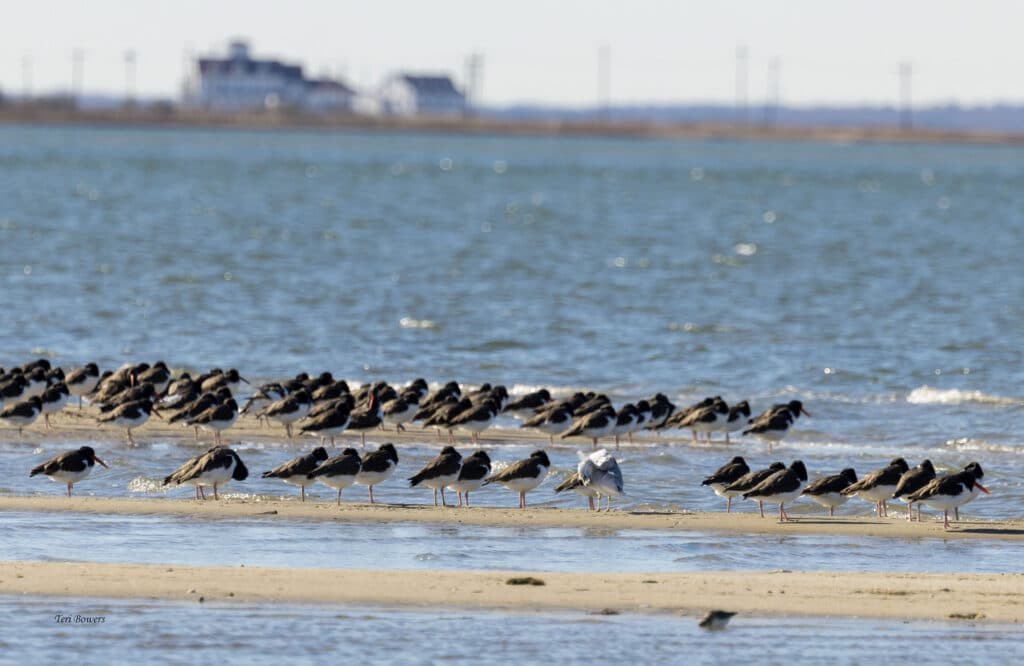
Orange LH and Orange KN
We were excited to spot these two New Jersey old-timers, indicated by faded orange bands usually sporting two alphanumeric digits instead of the more recent triangular configuration. O(KN) and O(LH) were banded all the way back in 2011 and 2012 by Dr. Tom Virzi, as part of a research project investigating American oystercatcher nesting success in New Jersey. O(KN) was banded as an adult at Goosebar Sedge, a historical dredge disposal site directly west of Holgate, Long Beach Island. O(LH) was banded one year later off the opposite end of Long Beach Island, on a small marsh island just a few blocks southwest of Barnegat Lighthouse State Park. These two locations piqued my interest because both birds nest in habitats outside the scope of New Jersey’s formal oystercatcher monitoring efforts, which primarily target the ocean-strand beaches. When we compare re-sight records, we can see an interesting dichotomy between these two “unmonitored” New Jersey breeders.
Although O(LH)’s nesting territory on her tiny marsh island isn’t officially monitored, its close proximity to local boat ramps and bait shops makes it easily visible from Long Beach Island. As a result, I was pleasantly surprised to find a rich record of photos, sightings, and intel submitted by the public throughout the past 14 years. eBird and other sighting records tell us that LH regularly nests on her tiny marsh island and has hatched multiple chicks over the years (although we can’t know how many she has fledged without formal monitoring). Additional sightings outside the breeding season indicate she typically joins the large staging roost of oystercatchers around Hereford Inlet in Cape May County during the fall, before traveling further south to her wintering grounds in North Carolina. This year, we recorded her in the Holgate roost twice in November (only the second year she’s been seen at Holgate).
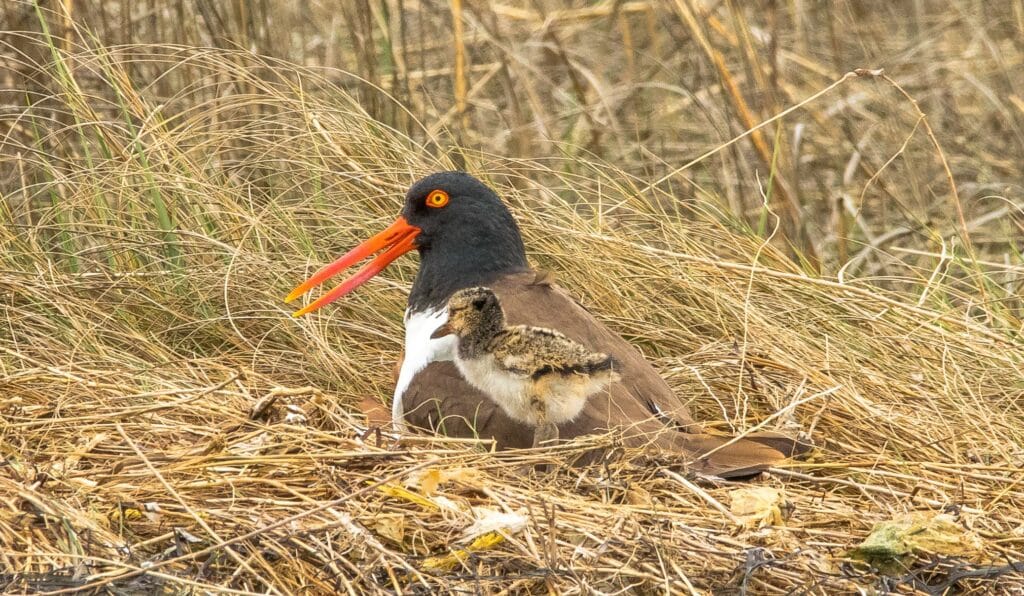
Whereas O(LH) represents a fantastic example of how public sightings can help piece together a life story for an otherwise unmonitored breeder, she also serves as a reminder of what researchers may be missing in New Jersey’s less monitored habitats. Her Holgate roost companion, O(KN) represents the other side of the coin. O(KN)’s original nesting territory on Goosebar Sedge sits just across the bay from one of the most intensely monitored American oystercatcher breeding sites in New Jersey (Holgate), but its remote location in the back-bay islands means it has not been regularly monitored. While monitoring technicians at Holgate have spotted O(KN) staging at Holgate almost every year (since 2018), its nesting history is largely a mystery. We’re excited for the opportunity to catch O(KN) on a nest this upcoming season, as we survey for marsh-nesting pairs in the back-bay islands including Goosebar Sedge.
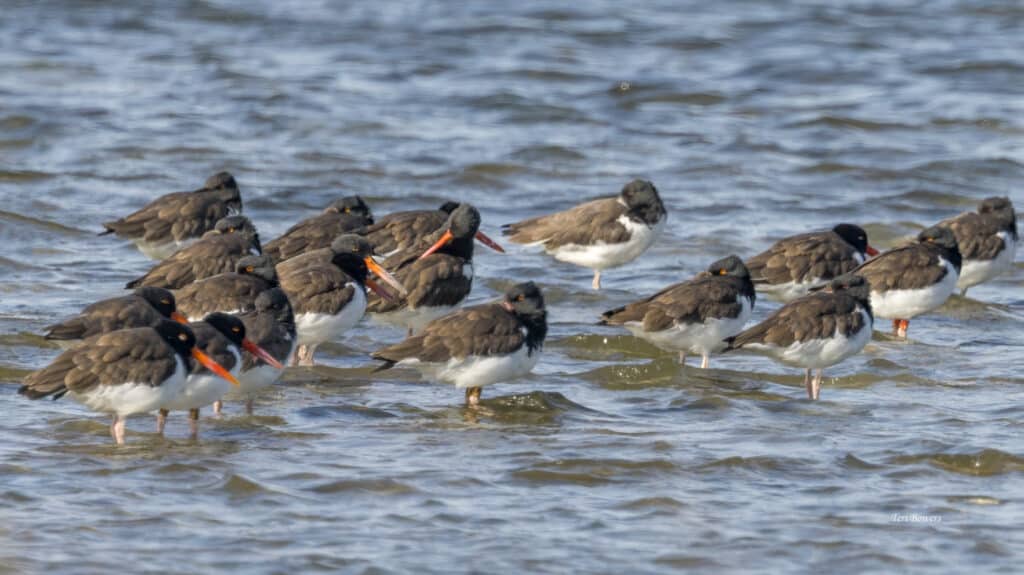
Now for some visitors from out of state…
Black CLF
When most people think of bird migration, they imagine birds flying south for the winter. Black CLF challenged that expectation by flying north from Virginia to the Holgate roost. Our oystercatcher colleagues at Chincoteague National Wildlife Refuge tell us they serendipitously banded Black CLF this past June when it and its presumed mate (the pair did not have a nest) both walked into a leg-loop trap just 30 seconds after it was deployed. Anyone who has ever tried banding oystercatchers knows how lucky that is! The crew also collected feather samples to confirm the bird’s sex as part of a study investigating sexual dimorphism in the species.
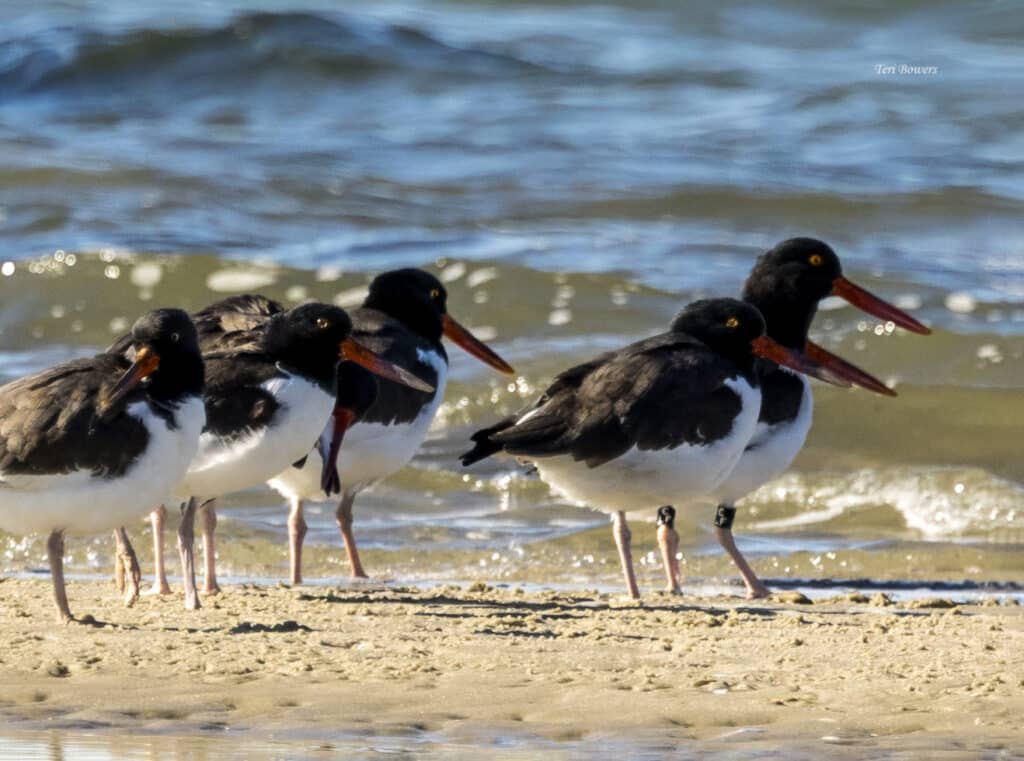
Orange KKF
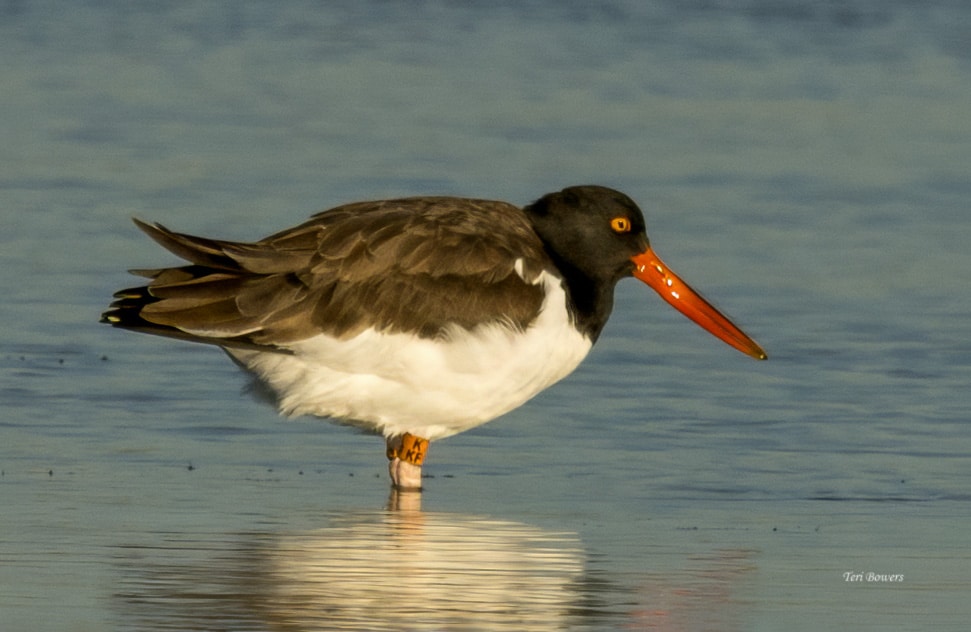
New Jersey shares its orange band color configuration with our neighbors in New York. We spotted nine oystercatchers originally from the Empire State during these surveys, including O(KKF) who was banded as a chick at Jacob Riis Park (NYC) in July 2023. This was its first sighting away from its natal ground since being banded.
Yellow N35
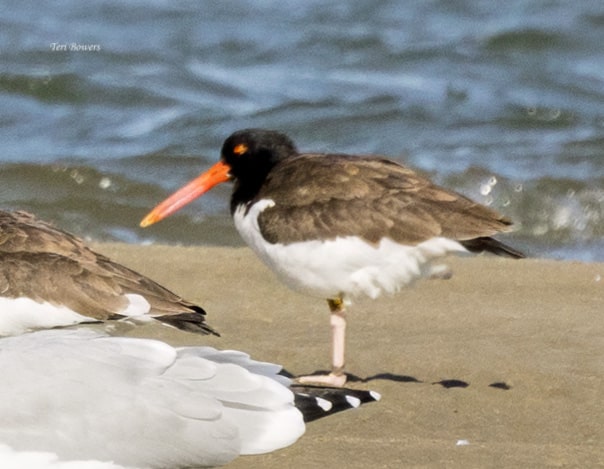
Last, but definitely not least, Yellow N35 is a particularly special visitor all the way from New Hampshire! This is an exciting record because banded oystercatchers from New Hampshire are relatively rare compared to other states. Oystercatcher nesting was recently confirmed in New Hampshire in 2020, and it is estimated that the state hosts a small breeding population of approximately 12-15 pairs. Many of these birds inhabit remote, rocky islands like the Isles of Shoals, which sit miles off the coast of New Hampshire. Since monitoring and banding in New Hampshire are relatively new (and challenging!) efforts, only a handful of birds have been banded, making Y(N35) unique.
What makes Y(N35) more special is its bander. Y(N35) hatched in 2023 on Lunging Island (Isles of Shoals) and was banded as a pre-fledged chick by the late Dr. Shiloh Schulte. As leader of the American Oystercatcher Working Group, Shiloh helped coordinate the range-wide effort to increase the American oystercatcher population by an estimated 45% since 2008. Shiloh tragically lost his life in June 2025 in a helicopter accident while conducting fieldwork in Alaska. This is the first recorded sighting of Y(N35) since Shiloh banded it in 2023, which serves as a special reminder of how Shiloh’s legacy continues to live on.
Have you ever seen a banded American oystercatcher in the field? Report Banded American Oystercatcher Sightings to the American Oystercatcher Working Group.
Discover more from Conserve Wildlife Foundation of NJ
Subscribe to get the latest posts sent to your email.