Barnegat Light Habitat Restoration: Build It and Even More Will Come
Senior Wildlife Biologist
Posted on
Even as the New Jersey’s statewide piping plover population remained near historic lows, pairs nesting at the Barnegat Light habitat restoration site continued to excel during the 2026 breeding season.
Piping plovers, the prime species focus of the restoration, reached an exciting milestone in 2026 with ten pairs – double digits – utilizing the site, up from just one pair nesting along the inlet before the restoration was started in 2019. The restoration site is now the third highest in the state in terms of breeding pairs, trailing only Holgate and Sandy Hook, both of which are considerably larger than the relatively compact ~40-acre Barnegat Light site.
The piping plovers nesting at the restoration site were also very productive this year; 19 chicks fledged for an average of 1.90 fledglings per pair. This rate was above the federal recovery goal of 1.50 fledglings per pair and more than twice the New Jersey statewide rate for 2026 of 0.90 fledglings per pair. Given that piping plovers tend to return to (or close to) their birth site, increasing fledgling productivity is the primary way to grow a population, meaning the Barnegat Light restoration site did its “job” this year to help boost the statewide population next year.
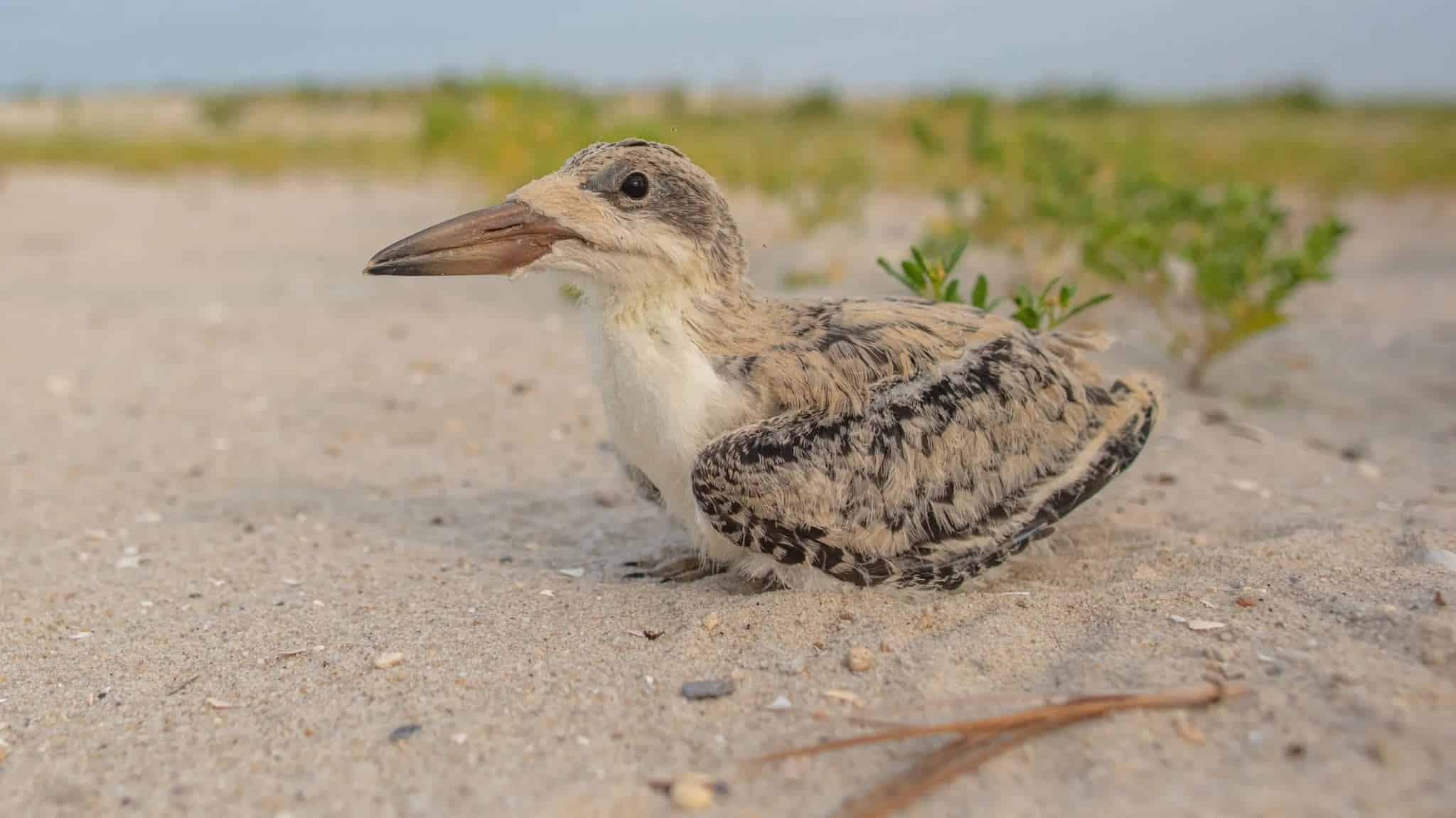
As good as the plover news was, an equally exciting development in 2026 was the formation of a successful black skimmer colony at the restoration site, just one of four known colonies in the state. A little over 50 skimmers nested at the site and produced its first skimmer fledglings since the restoration was completed. One of the state’s largest least tern colonies – about 150 pairs – was also at the inlet site this year. American oystercatchers had a banner year at the site as well, with four pairs producing eight fledglings, making it one of the more success sites in the state on a per pair basis. Finally, common terns joined the restoration “party” this year, squeezing in a small colony next to the skimmers. For the sheer diversity of beach nesting bird species breeding at the site, Barnegat Light has now reclaimed its former glory, which was one of the goals of the project from the outset.
In related news, on the heels of the success of the Barnegat Light habitat restoration project and following it as a model, CWF and the U.S. Fish and Wildlife Service, embarked on a new beach restoration project at the Two-Mile Beach Unit of the Cape May National Wildlife Refuge this past winter. Piping plovers are again the focus of the project, although the hope is other species will also utilize the enhanced habitat. The jury is still out on its success after the first year, typically nesting at enhanced sites takes a few years to hit its stride. This winter CWF will be back at both the 2-Mile and Barnegat Light sites to oversee tweaks to the habitat, part of the annual maintenance needed to maintain and improve the conditions for nesting birds.
The Barnegat Light habitat restoration project is a collaborative effort between CWF, New Jersey Fish and Wildlife, U.S. Fish and Wildlife Service, U.S. Army Corps of Engineers, and Rutgers, the State University of New Jersey. Nesting results used in this report were provided by New Jersey Fish and Wildlife.
Discover more from Conserve Wildlife Foundation of NJ
Subscribe to get the latest posts sent to your email.