American Oystercatchers

Studying Migration in New Jersey

By Alfred Breed, Seasonal Field Technician

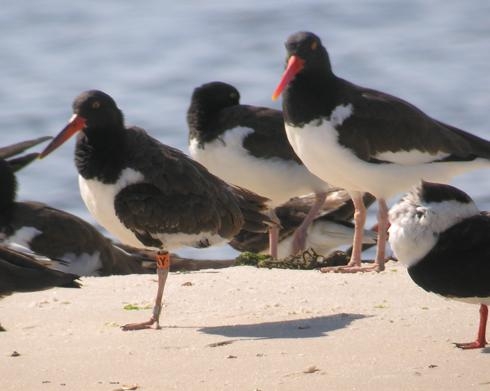
A group of non-breeding oystercatchers. © Alf Breed

Species diversity is critical for the continued health of any ecosystem.  All organisms have a role to play, but defining that role for any species is no easy task.  Certain species might act as a keystone, one whose healthy presence is absolutely required.  Others might serve the role of an indicator species, the proverbial canary in the coal mine, with the health of that species being a sign of the health of the overall system.  Without data, we cannot know.  While data has been collected for several years for breeding and wintering populations of American Oystercatcher in New Jersey, very little data has been collected during migration.  Collecting that data is my job at the moment.
The American oystercatcher is a species of special concern in the state of New Jersey.  Causes for concern include their low population and risky breeding strategy, combined with habitat degradation from pollution, habitat loss from development, as well as increased predation and disturbance directly related to human activities within their habitat.

Although oystercatcher pairs will fiercely defend a territory from other oystercatchers during nesting season, in the fall and early winter they are almost always to be found hanging out together either at the beach or on the marsh.  They can generally be relied on during the non-breeding season to roost in flocks near ocean inlets, but locating the flock and approaching to within band-resighting distance during a limited high-tide time frame can be challenging.
An ocean inlet can encompass a very large area; and when your quarry can fly and you can’t, that area can seem even larger! Just finding the flock and getting to an effective observation point (which even with quality optics is surprisingly close) without them “spooking” is more than half the battle.  Using a boat or kayak, combined with marsh trekking and the occasional swim, there are few places the oystercatchers go where they cannot be followed and discretely observed.

The goal of this field research is to collect data on roosting flocks of American oystercatchers at southern New Jersey Atlantic coastal inlets during migratory season.  The data collected also enables further research on life-span, survival rates, movement patterns, population, age structure and other important characteristics.
I’m incredibly fortunate to be a part of this important research collecting data vital to our understanding of this species, while at the same time being privileged to be able to enjoy and become more intimately familiar with our beautiful southern New Jersey coastal ecosystem.  We would like to thank the National Fish and Wildlife Foundation for funding this important research.

End of the Beach Nesting Bird Season

A final report from our seasonal beach nesting bird steward at Stone Harbor Point

by Christopher Haxter, Seasonal Steward

A juvenile piping plover. © Chris Kisiel

Well as summer’s end slowly draws near, the beach nesting bird season has wrapped up on Stone Harbor Point.  All of the Piping Plover and American Oystercatcher chicks have fledged (i.e. reached the stage where they can fly).  In the past, this has often been a very depressing time.  Stone Harbor Point has a bad history of flooding, and many of the nests and chicks were destroyed; some years we only had a couple of chicks fledge.  This year, however, there is good news!  A total of 13 Piping Plover chicks and 10 Oystercatcher chicks have fledged, from 9 and 21 breeding pairs, respectively!  I owe this very successful year to the weather cooperating during the high spring tides; flooding was not a big issue this summer.  I also owe my thanks to the public for respecting the rules and staying out of the fenced areas, giving these beach nesting birds the room to successfully fledge their chicks.

This breeding season sure has had its ups and downs.  One low point that comes to mind is finding Oystercatcher nest after nest washed away from a high tide the night before (most of them luckily renested).  One of the greatest feelings is finding a chick on its fledge date, knowing that it now has a much greater chance of survival.  We also had a Least Tern colony on Stone Harbor Point that fledged a good amount of chicks.

Our focus now has shifted to migration.  Thousands of migratory shorebirds are now congregating on Stone Harbor Point.  Most are on their way south from breeding up north in Canada and the Arctic.  Oystercatchers and Piping Plovers are also preparing to head south for the winter.  They are currently gathering in huge roosting flocks before their departure.  This gives us ample opportunity for band resighting and to conduct surveys, estimating the population sizes of these shorebirds.

Since the season is just about over it means my job (as Seasonal Steward) is just about over.  Words can’t describe how much I love this job and what I have learned over the last four months.  The Conserve Wildlife Foundation of NJ is truly making the difference for wildlife all over the state, and I’m glad I got to be a part of it!

Monitoring Oystercatchers in New Jersey

Banding American Oystercatchers

By Christopher Haxter, Seasonal Steward

American Oystercatcher. © Chris Davidson

The American Oystercatcher (Haematopus palliates) may not get as much attention as some other species since it’s not listed as endangered or threatened in New Jersey. However, it is listed as a species of special concern because the population is thought to be in decline. On Stone Harbor Point, the site I mainly monitor for my job, I spend a good deal of time finding oystercatcher nests and chicks. Together with Piping Plovers and Least Terns, oystercatchers constitute a large portion of the beach nesting birds found on “the Point”.

Oystercatchers are hard to miss; they stand nearly one and a half feet tall, are boldly colored, and have very loud calls. On average, they lay three eggs per nest, and incubate their eggs from April-June and care for their chicks from May-July. They tend to have much more trouble with predators and flooding during the egg laying stage. Once hatched, the chicks tend to have better survival rates. As of right now on Stone Harbor Point we have at least ten pairs of American Oystercatchers with offspring. One pair is still incubating a nest, nine pairs are brooding a total of thirteen chicks, and one pair has successfully fledged two chicks.

One of the ways to track these birds year after year is to put colored bands on their legs that are marked with letters and numbers so individual birds can be identified. Tom Virzi, one of our research partners (from Rutgers University), has been studying oystercatchers in New Jersey since 2004. Last week I had the privilege of helping two of his interns, Jason Pietrzak and Allison Anholt, band some oystercatcher chicks on Stone Harbor Point.

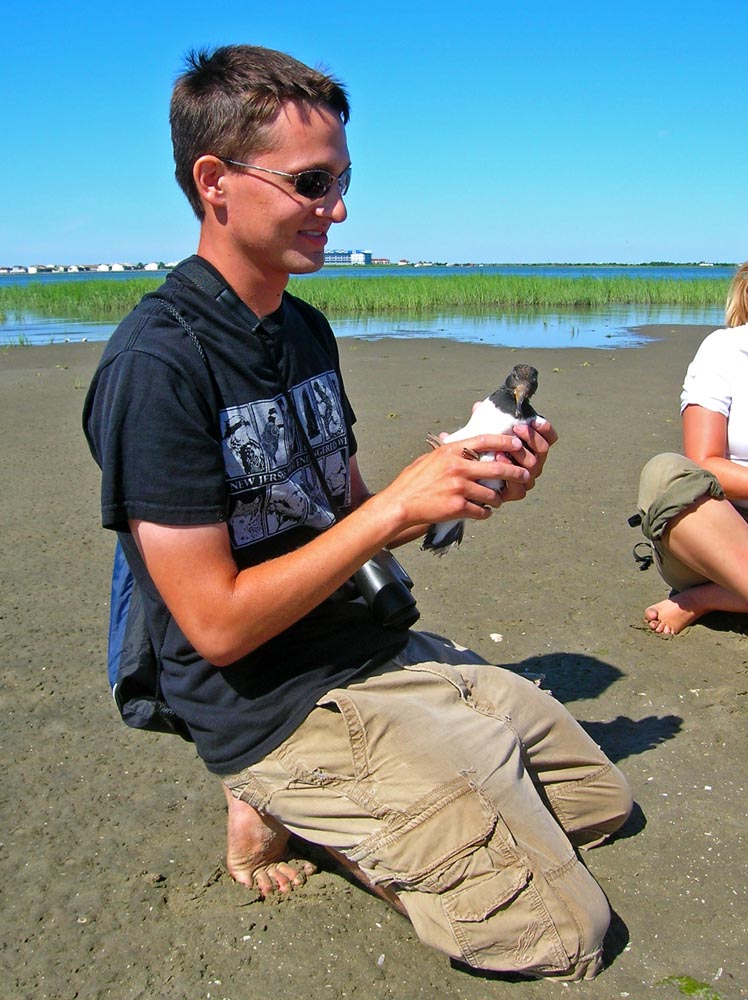
CWF Seasonal Chris Haxter holding captured American Oystercatcher chick in preparation for banding. Photo courtesy of Tara Hewitt.

The first step was to capture the chicks. Since the chicks can’t fly yet, all we had to do was surround and grab them. Sometimes easier said than done – the two chicks we went after were already a month old, so they were quite fast. Once captured we inspected the chicks, making sure they were healthy and their legs were fully grown. The band that goes around the leg of the chick is a small orange plastic cylinder with a black number/letter code (each state participating in this banding project has a unique color). After banding, we took measurements, including beak/head/wing length, and then collected a few feathers so the chicks could be sexed using DNA analysis.

The chicks were surprisingly calm throughout the process and the parents stood near us watching carefully. When we were finished we released the chicks back to the parents and kept an eye on them to make sure the parents accepted the chicks.

Adult oystercathers are also banded, but because they can fly the process is much different and involves some trickery. To try to capture the adults we set up a decoy, played some oystercatcher calls, and placed a board lined with many tiny nooses in the sand to capture the foot of the bird. When the adults defend their territory and fight with the decoy they get caught in the trap. We did attempt this but were not successful this time.

When a banded bird is re-sighted, and the code is observed and recorded, we are able to follow them for years. The data gathered from banding oystercatchers is essential in studying their long term habits, population trends, chick survival rates, and movement patterns.