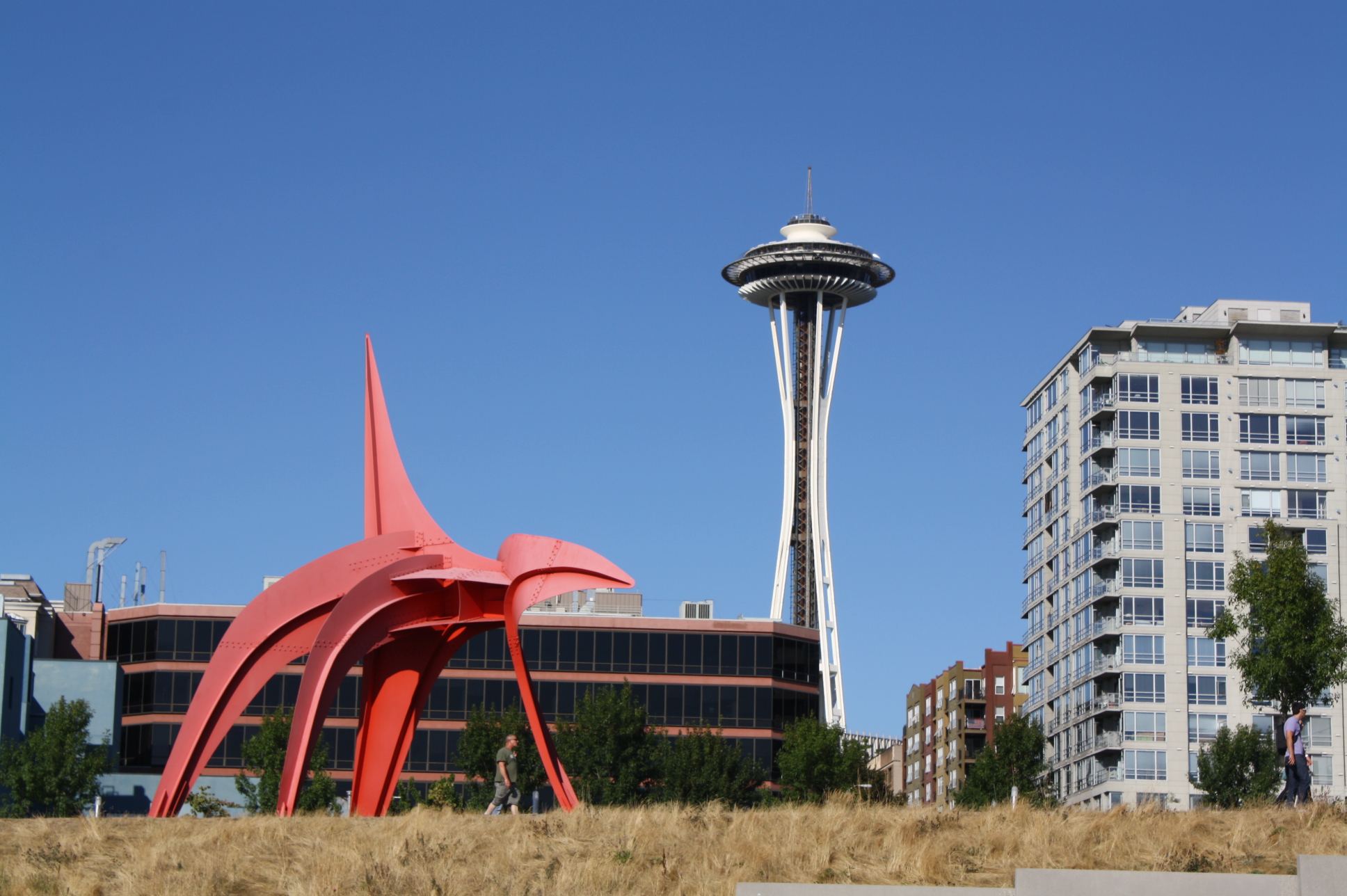
The iconic Space Needle, photographed from the edge of Puget Sound.
Last week – literally moments before Irene began her Garden State smack-down – my plane landed on home ground. I was returning from six days in Seattle, WA, where more than 550 professionals from 21 countries gathered for the International Conference on Ecology & Transportation (ICOET). The conference offered over 170 combined talks and posters on a variety of research, planning, ecology, and engineering topics that, by and large, had to do with animals crossing roads.
The reason I made the trip was our Amphibian Crossing project (ok, and it was also Seattle, birthplace of the counter-culture that fashioned my grungy teenagehood!). Over the last decade we’ve surveyed, mapped, and prioritized hotspots throughout the northern half of NJ where frogs and salamanders have to travel across roads to reach their breeding pools each spring. Enormous numbers are killed in doing so. The hallmark of our Amphibian Crossing project has always been the volunteer-based rescue surveys – at night, in the rain, in traffic; requiring a lot of hands and a maniacal level of commitment to plan and carry out year after year. At this point, we’ve got around 35 “high” and “highest” priority crossings…far too many to manually protect in the short-term, not to mention the long-term. Our long-term solution is to get special under-road culverts installed for these migrating amphibians, and ICOET was a place I could find folks who have done it. Continue reading “Salamanders and…Seattle?”
Each spring Calling Amphibian Monitoring Project (CAMP) volunteers take time out of their busy lives to drive the dark roads of NJ and listen for the calls of NJ’s amphibians. Not only do these volunteers have to find the time to schedule the three surveys, each in a specific four week period, they need to meet the protocol for the surveys. This means meeting the minimum temperature requirement, which is not the easiest in March, as well as other weather protocol. Once they find a perfect night to survey the volunteers follow a 15-mile route with 10 stops. They stop and listen for 5 minutes at each stop and record the amphibians they hear. This can be a frustrating experience depending upon the route. Noise from cars can make surveying difficult and some of the routes in more developed areas record no amphibians calling on many of the stops. Meanwhile volunteers on the less developed routes can often hear a chorus of frogs and toads that can be almost deafening.
I’d like to thank all the dedicated CAMP volunteers for finding the time to survey this season.
Survey Results
Thirty-one volunteers surveyed 33 routes. Each route is to be surveyed three times during the spring in March, April & June. A total of 77 surveys were conducted. All 16 species of NJ frogs and toads were detected on the surveys. The species that was heard on the most routes was the Northern Spring Peeper which was heard on 31 routes out of 33 that were surveyed. The second most detected species was the Green Frog heard on 22 routes out of the 33 surveyed. The least detected species was the Spade Foot Toad which was only heard on one route.
Would you like to help next year?
Fourteen routes are available for the 2012 season.
For more information on volunteering email Larissa Smith.
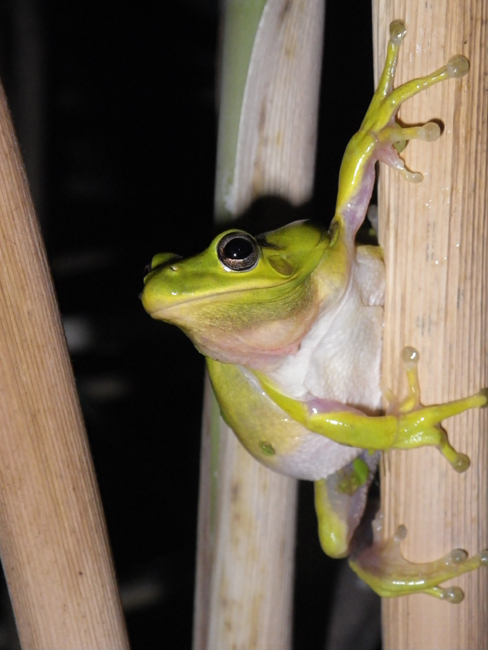
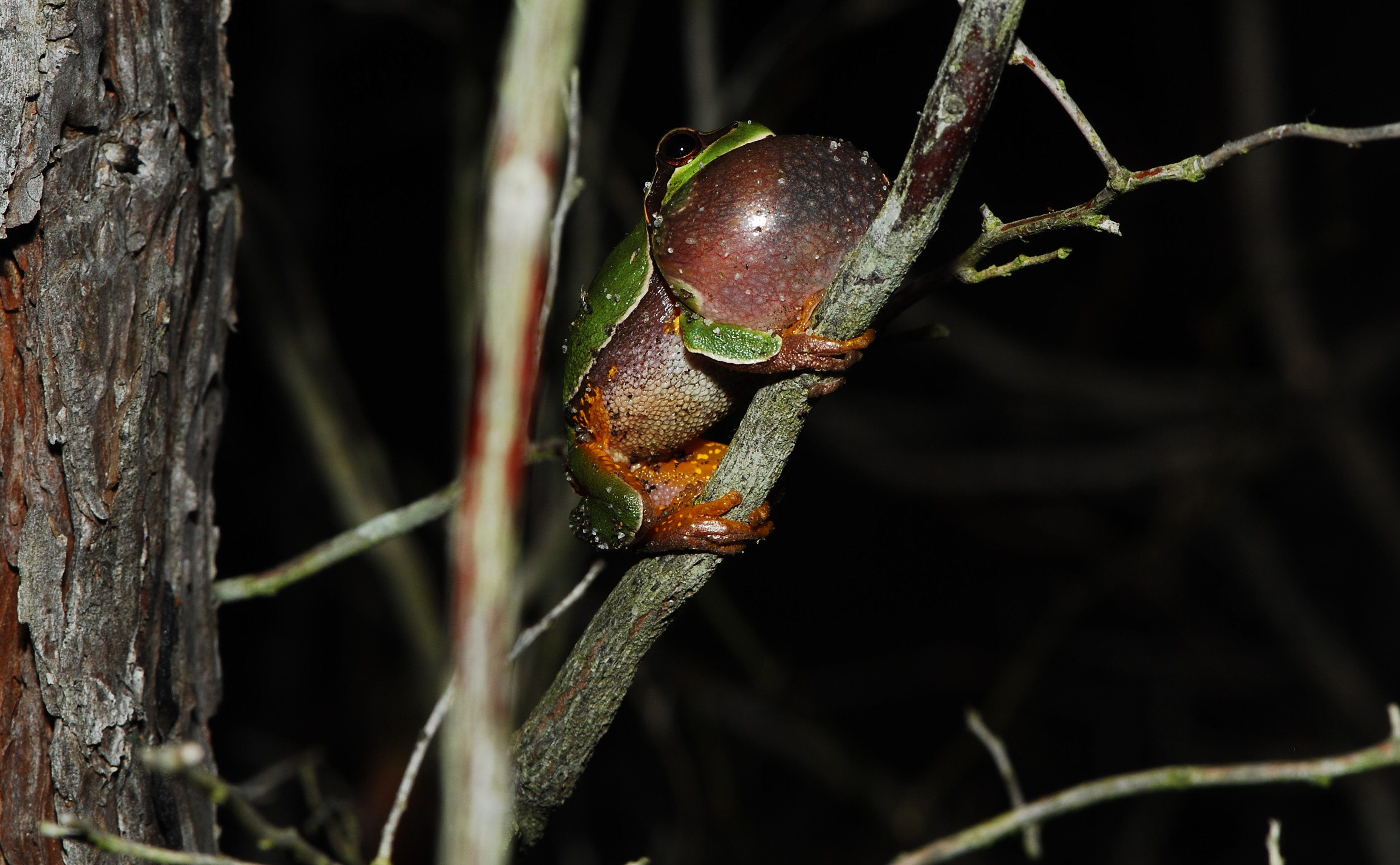
A large, breeding population of the American green treefrog, Hyla cinerea, has been discovered in Salem County, New Jersey. H. cinerea is a common treefrog found in the southeastern United States with a range extending from southern Delaware down the coastal plain to Florida and along the Gulf to Texas. Although very abundant in sections of its range, it has never been documented in New Jersey.
This serendipitous discovery happened during a routine chytridiomycosis survey in southern New Jersey. After finishing up a bat acoustics training, MacKenzie (our Private Lands Biologist), offered to help me conduct my night-time amphibian survey. My intention was to visit a site in the Pinelands but I was surprised by the loud and unidentifiable calling from an impoundment across the road. As we hiked through dense phrag that had been weaved together by mile-a-minute weed, we were completely oblivious to the clear path to our right that would become apparent in daylight.
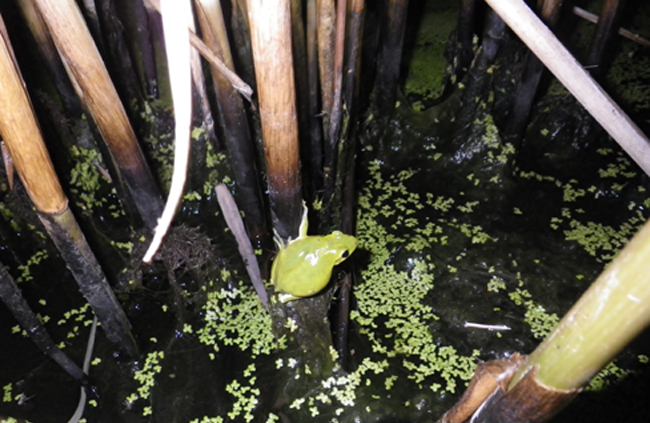
Upon reaching the water, the calling was almost deafening and any communication between us was conducted by yelling. As I waded across the impoundment, the water became very deep and the thick silt slowed movement and caused a fair amount of water to overflow my chest waders. As the emergent vegetation grew thicker, I began to notice an abundance of small, green treefrogs clasped to the phrag, calling a couple inches above the water. Confused, as they clearly weren’t peepers and we were out of Pine Barren Treefrog range, I was able to catch one and return to the other side for MacKenzie’s opinion.
Upon closer inspection, this frog was clearly not a native to New Jersey. This little light green frog was about 2 inches in length with small, bright, yellow spots on its back and a pale underside. (This first treefrog did not have the characteristic white side line, but subsequent samples did.) Luckily, MacKenzie had her camera and was able to take several diagnostic pictures that we would later investigate.
After consulting with several experts and a site visit with ENSP Biologist, Dave Golden, we confirmed that there was a large population of H. cinerea at this site in Salem County. We are currently conducting more site assessments in the area to determine the green treefrog’s range in New Jersey. Together with ENSP, we will be starting a genetic study comparing samples collected in New Jersey to local samples found in Delaware in hopes of determining the origin of the New Jersey population.
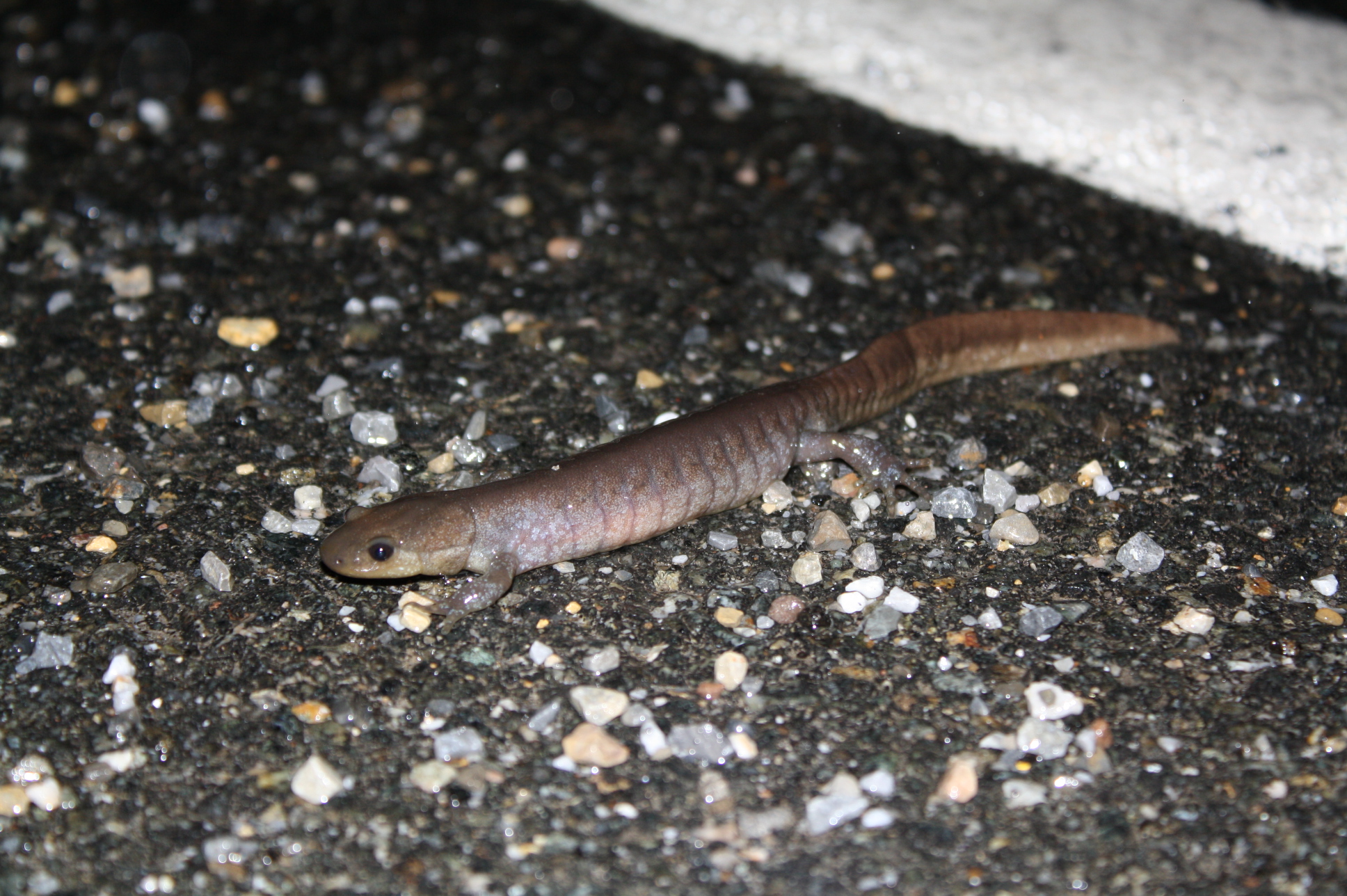
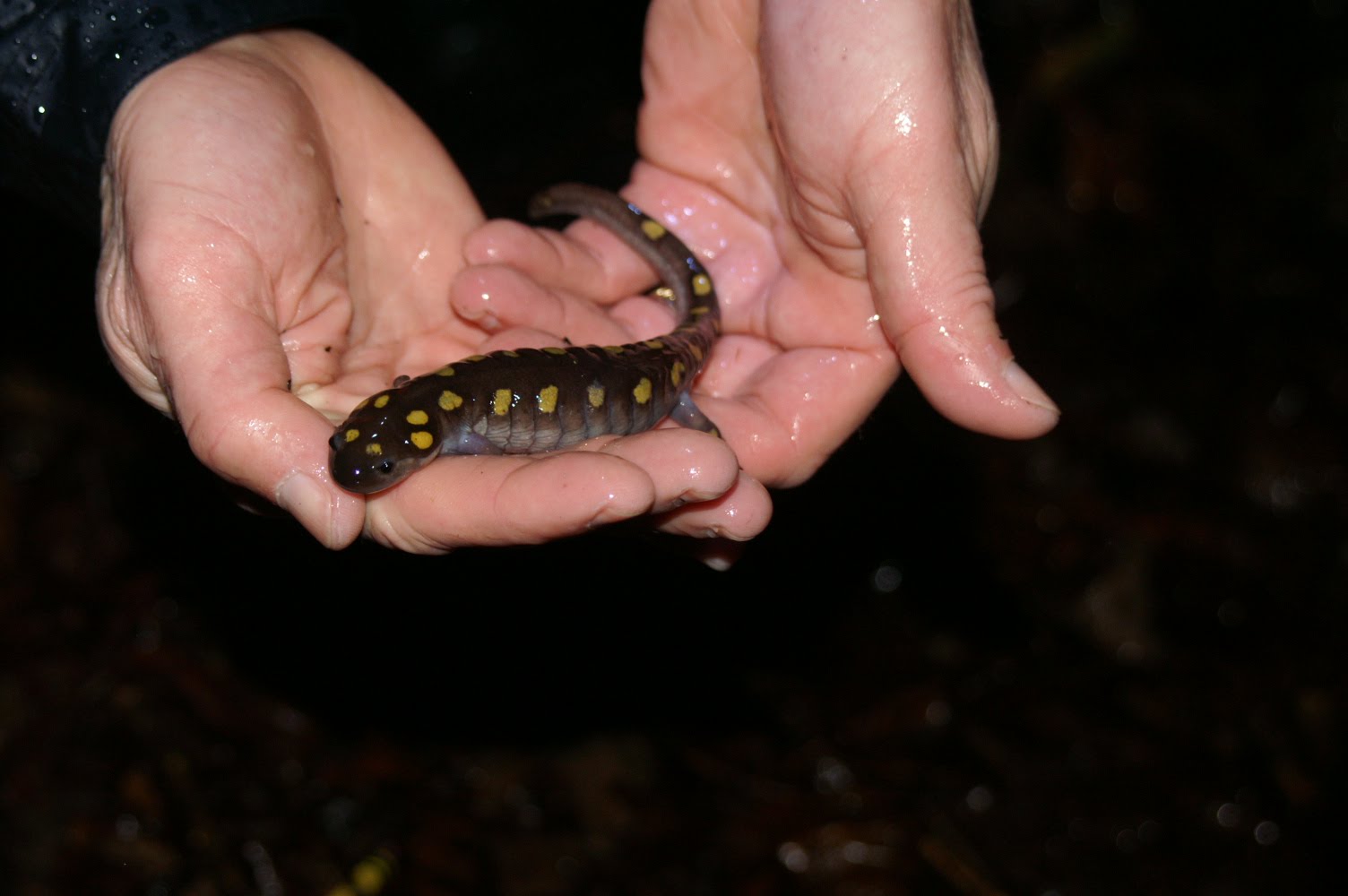
Jefferson Salamander, a species of special concern in New Jersey, crossing to its breeding pools. Photo by MacKenzie Hall.
Well, it’s that time of year again. As the temperature slowly climb and the ground thaws with spring rains, New Jersey amphibians emerge from their upland habitat and begin their long and increasingly treacherous journey to their spring breeding pools.
This March marked my first official amphibian migration night with Conserve Wildlife Foundation’s Amphibian Crossing Project. As always, any potential migration night begins with frantic checking for weather updates, a call to volunteers to suit up and meet us at rescue sites, early arrival to set up road signs and safety equipment, and hoping the rains continue…we wait. We wait as rush hour begins, the traffic steadily increasing as dusk falls, and then it happens: one by one, we spot wood frogs and spotted salamanders on the road edges- hesitating to leave the coverage of the forest almost like they know the roads bisecting their ancestral migration paths may prove an impassable barrier.
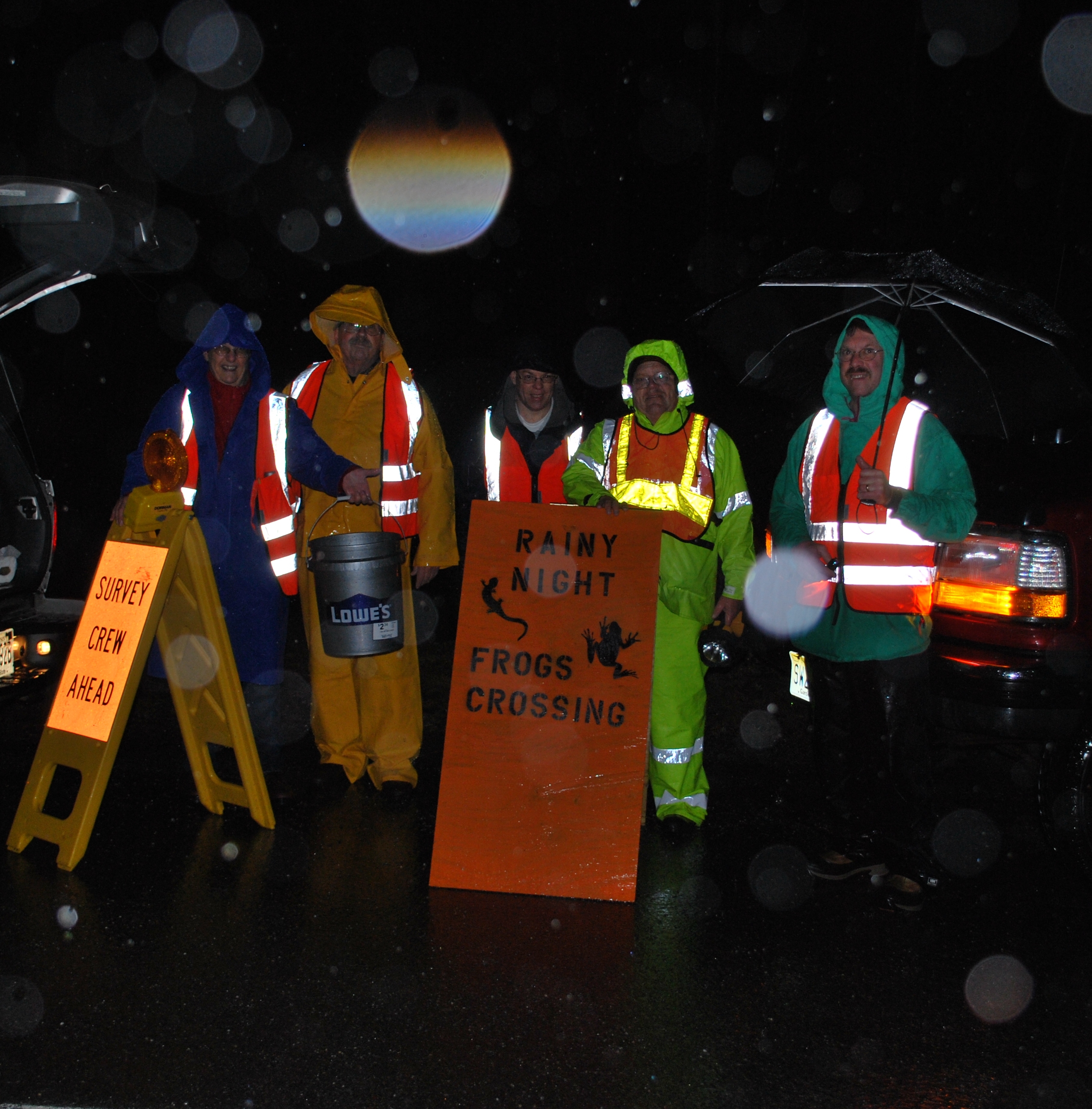
This past Thursday, our destination was a rescue site on East Shore Drive in Stillwater Township. With the help of dedicated volunteers, including boy scouts from local Patriots Path Council, we patrolled almost 250 meters of roadway and rescued 572 frogs, salamanders, and newts in just 2 ½ hours—that’s 229 amphibians per hour! Within this short span of time we also waved 70 cars through- most of which seemed oblivious to natural phenomenon taking place under their wheels.
Dedicated volunteers patrol roadway. From left to right: Diane Gonski, Doug Hankin, Wayne Bancroft, Eckhardt Debbert, and Paul Cook. Photo by Phil Wooldridge.
By 10pm, migration had slowed and more importantly traffic had too. So it was on to the next site. MacKenzie and I wanted to check out how a site on a busy road faired in Liberty Township. The results were disheartening—within a narrow corridor we saw at least 50 dead frogs and salamanders littering the road. During the hour we patrolled, 50 spotted salamanders were counted (and moved) trying to cross a road with still significant traffic at 11pm at night.
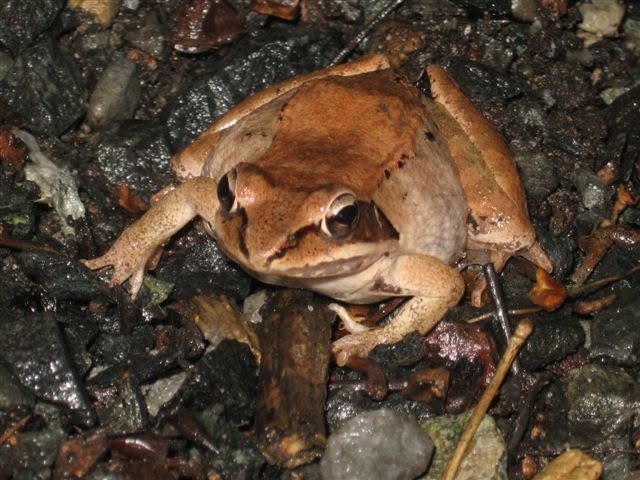
Wood frog dead on road. Photo by MacKenzie Hall.
If hundreds of amphibians died within hours in this narrow corridor- imagine how many thousands are killed throughout the state each rainy spring night. Each individual’s death marks a loss to the population but with females carrying between 200 and 2,000 eggs it marks a significant loss not only to their species future generations but also to the ecosystem as an important food source to other animals.
I knew the importance of amphibian migration and the potential extirpation populations were facing due to roads- I had seen other migration nights but I had never before seen the mass mortalities on a single road. So please on the next rainy spring night, leave your car in your driveway and instead grab a flashlight and see what you can find or contact CWF and become one of our dedicated Amphibian Crossing volunteers!
If you enjoy hearing the sounds of frogs and toads and like a bit of adventure then the NJ Calling Amphibian Project (CAMP) might be the right project for you! Each of the 16 species of frogs and toads in NJ has a unique vocalization or “call” that can be heard during their mating season. The Conserve Wildlife Foundation of NJ is actively recruiting volunteers to participate in a statewide Calling Amphibian Monitoring Program (CAMP). Fourteen CAMP routes are currently available for the 2011 season.
Over the past two weeks in New Jersey, the hills have awakened! This is the time of year when a quiet resurgence of frogs, salamanders, and toads takes place as the ground finally thaws, releasing them from their subterranean slumbers. They’ve spent nearly half a year in hibernation, and the amphibians are anxious to begin the serious business of breeding!
The earliest amphibians to head above ground are the ones that breed in temporary springtime (vernal) pools. In north Jersey these include the spotted salamander, jefferson salamander, wood frog, and the endangered blue-spotted salamander. The females emerge full of eggs…as many as 2,000 per frog and around 200 per salamander…and a lot is riding on those eggs. They are the next generation. They are our algae- and insect-eaters. They are food for other animals like garter snakes, thrushes, and bears; members of the web of life.
Helping Frogs and Salamaders Cross the Road
In areas where roads divide the woods from the water, traffic can take a huge toll on these amphibians every year. We’re doing what we can to identify amphibian road-crossing “hot spots” and to help our small, slow, slimy friends make it safely to their destinations.
Across most of NJ, the 2010 amphibian migration began on Friday, March 12th, with the first post-snowmelt rain storm of the season. The nor’easter came in early on Friday and
pummelled us with chilly rain until Monday the 15th…while we humans were holed up in our houses, those frogs & salamanders were celebrating the weather they’d been waiting for.
At one high-density crossing site in northern Warren County, we worked in teams of 5-10 people throughout Friday night to usher amphibians across the road and record what we saw (this project has been active since 2002, when the Conserve Wildlife Foundation, NJ’s Endangered and Nongame Species Program, and NJ Audubon Society partnered to create the volunteer-based effort). Over the course of 9 hours, we tallied more than 1,800 amphibians! The procession included 405 spotted salamanders, 644 wood frogs, and 742 spring peepers, with a few other species in the mix. A total of 59 vehicles passed through during that time; by reasonable estimate as many as a quarter or more of those road-crossing amphibians might not have made it without our help.
Ten of us braved the whipping storm on Saturday, March 13th, to again chaperone amphibians across the road. We stayed for a few hours (about 7:00-10:00 pm, to cover peak traffic time) and counted nearly 400 more amphibians. The vast majority of them were spring peepers, cute little tree frogs only an inch or so long. Despite the storm – with flood warnings and 40 mph wind gusts – people were still on the roads, and 27 vehicles traveled through our corridor during the 3-hour rescue survey.
After the storm finally passed, we sun-loving people got a sweeeeeeet reprieve with 6 days of bright skies and basking-quality temperatures in the 60s & 70s F. I just didn’t even know what to do with myself, I was so excited (…shorts? flip flops? laying in the grass? happiness overload!!!). The point is, whatever snow had been left in far northern NJ, and whatever ground was still frozen in the hills, wasn’t anymore.
Volunteers Count Our slimy friends
So as the next rain storm rolled in on Monday, March 22nd, another round of amphibians were ready to move. Our “drive-around” survey volunteers in Sussex, Passaic, and northern Warren & Morris Counties all reported big amphibian migrations in their areas and collected data that will help us identify the spots that warrant protection – whether in the form of rescue surveys, road closures, or an attempt at installing amphibian culverts. At our Warren County rescue site, one hardy & heroic volunteer offered to check things out around dark, and ended up staying until 1:30 in the morning when he found that amphibians were again moving in mass (you’re awesome, George!!). He tallied around 600 more amphibians, including 154 spotted salamanders, 56 American toads, countless peepers, a handful of four-toed salamanders, and even a brown snake! All of the 67 wood frogs he saw were moving away from the wetlands – their breeding and egg-laying were complete.
Amphibians will continue to be present on the wet roads all spring and summer. You can help keep them safe by limiting your driving on rainy nights and by keeping a watchful eye when you are on the road in those “froggy” conditions.
If you know of a spot where amphibians cross the road in large numbers, or if you’d like to volunteer for our project next year, please email MacKenzie Hall.