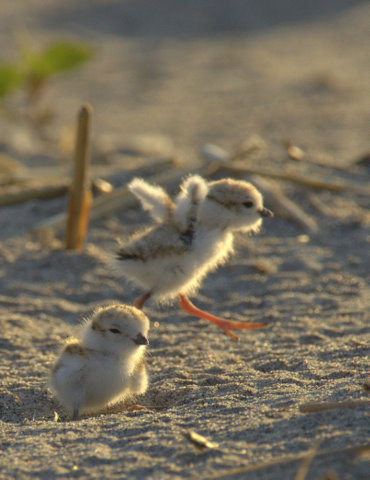
Back on May 20th, we had our first Piping Plover nest hatch at Stone Harbor Point. Three out of the four eggs hatched, and since hatching only one chick was lost. On June 12th, I was delighted to witness the two chicks flying! When a chick survives to the point where it can fly, we call it a fledge or fledgling; usually about 25 days after hatching for piping plovers. I observed the pair of chicks flying even before their estimated fledge date; they grew up fast!
Watching the chicks over the last month has been fascinating. Within a day of hatching they are out of the nest feeding, not straying far from their parents. They grew quickly in the last month, now they’re just a bit smaller than the parents. The most discernable difference between the parent and the chicks now is the color of the beak; the chick’s beak is black while the parent’s is still yellow.
It is great news when a chick fledges; it has a much better chance of survival. As of right now there are three more chicks from another pair at Stone Harbor Point. Hopefully these chicks are just as successful. Sure makes all the hard work that goes into protecting them seem more worthwhile!
Ever since I was young I knew I wanted to work with nature and wildlife. As I grew up I learned many species were in trouble and needed our help. Imagine my excitement when I got a job working for the Conserve Wildlife Foundation of New Jersey. I was hired to monitor Hereford Inlet, between Stone Harbor and North Wildwood in Cape May County, for the migratory and breeding bird season.
My first day on the job was the day after my last college final (I just graduated from the Richard Stockton College of New Jersey). After I met the people I would be working with for the next few months we were off to set up a predator exclosure, which is a special wire cage that protects piping plover nests from its many predators. This is when I first got to observe a piping plover up close. To put up a predator exclosure, we needed to temporarily cover the nest while we set up the cage. The piping plover spent this time trying to draw us away from its nest; their defensive behavior is fascinating. The first thing you notice is the ‘peep’, their call to distract you from the nest. When you get closer to the nest, the piping p[lover starts exhibiting a behavior called ‘broken wing’. The goal is to look injured to further distract a predator from their nest. Ironically, looking for this behavior is one of the ways we use to find the nests. After working this job for a few weeks, I have had the exciting experience of finding quite a few nests (including finding American oystercatcher nests).
Before the end of my first day I also got to see Stone Harbor Point, the location that I would be focusing on this summer. This area is different every year, and this year it is quite large. After enough exploring and assembling an accurate map I eventually learned the area well. One area of concern I have for the future of the beach nesting birds at the “Point” is its history of flooding. Hopefully the weather and tides will cooperate this summer. This job has been an amazing experience so far; and when the eggs start hatching, I can only imagine things getting more exciting.
POSTSCRIPT: Just after I submitted this blog, the first piping plover nest hatched at the Point. Now I have the challenge of keeping tracking of three highly mobile chicks. On the downside, quite a few nests were lost to flood tides already. Looks like my job as a “beachnester” will have its share of ups and downs.
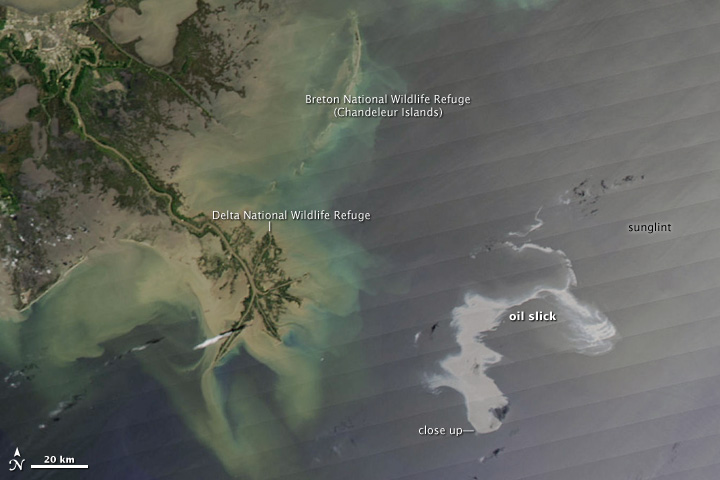
Satellite image of the oil spill in the Gulf of Mexico. Photo courtesy NASA.
Margaret O’Gorman, Executive Director
The oil spill in the Gulf of Mexico should cause concern to us all. But for those of us engaged in stopping species loss on a global or national scale, it should cause mild panic and dread as we think about the oil slick fast approaching the coasts of Louisiana and Florida.
As the oil floats with malign intent towards to the Breton National Wildlife Refuge and other areas of coastal habitat, a dark cloud hovers over the piping plovers, least terns and other beach and shore birds in New Jersey. Their winter home is being attacked and the habitat they need to survive is being destroyed.
Piping plovers in New Jersey belong to what is known as the Atlantic Coast population. This population breeds along the Atlantic Coast from Nova Scotia to North Carolina. It winters along the Atlantic and Gulf Coasts from North Carolina to Mexico, with significant numbers found on the Louisiana and Florida coasts in the Gulf of Mexico.
Piping plover numbers initially crashed in the late 19th and early 20th centuries because of hunting. Since the Migratory Bird Treaty Act outlawed such practices in 1918, habitat loss and degradation has caused the continued downward population trend of these birds, leading the federal government to list the Atlantic Coast population as threatened in 1986.
Efforts to restore the population to a sustainable size have been ongoing since then with states along the Atlantic Coast developing and implementing management and recovery plans. In New Jersey, management and recovery plans for the piping plover are overseen by the US Fish and Wildlife Service and implemented by Conserve Wildlife Foundation and the state’s Endangered Species Program. The work which is described in detail on our website includes managing the population on a nest-by-nest basis, minimizing disturbance and predation and maximizing nest success.
In New Jersey, 120 pairs of piping plover are managed intensively as part of a national effort to protect this bird from extinction. The oil slick currently moving through the Gulf of Mexico just made this job a lot harder.
According to the US Fish and Wildlife Service, oil can become a long-term contaminant in an ecosystem. Different types of oil weather out of an ecosystem over different time periods but oil can “cause harm to wildlife through physical contact, ingestion, inhalation and absorption. Floating oil can contaminate plankton, which includes algae, fish eggs, and the larvae of various invertebrates.” Oil can remain in the habitat for up to 30 years causing contamination to food chains and leading to irreversible damage to ecosystems. It can cause an ecosystem to loose or substantially decrease its carrying capacity for wildlife.
While the piping plovers in New Jersey and along the Atlantic Coast strive to successfully breed against the threats of spring storms, human and animal disturbance and, predators, their wintering grounds are threatened with a danger that has serious and long-term consequences.
So, as the crude oil in the Gulf of Mexico breaches the booms set out to contain it, we shiver for the piping plovers, least terns and other species whose winter just got a whole lot tougher.
It has already been a very busy Spring season. Finding the first piping plover nest of the year is always a highly anticipated moment and for our staff it came a little earlier than normal when it was found last week at Stone Harbor Point. And our nest wasn’t the first one found in New Jersey this year – honors for that go to the staff at the National Park Service, who found a nest a on April 11th at the Coast Guard base at Sandy Hook. In the same vein, our colleagues up at Massachusetts Audubon’s Coastal Waterbird Program found a nest on April 13th; the earliest ever recorded in Massachusetts!
So is there a trend going on? Perhaps the impacts of global climate change?
Well, it is definitely premature to make that conclusion. New Jersey’s earliest nest was recorded on April 6th, nearly a decade ago during the 2000 breeding season. And there doesn’t seem to be any clear trend to when our first nest was found looking over the past 25 years, although the third week of April is more typical.
It has been documented that some bird species are arriving on their breeding grounds and/or initiating nesting earlier, but we think the early start to piping plover nesting in New Jersey this year is the result of weather conditions. In this case the long run of relatively warmer than normal temperatures in late March and early April (including several days over 80 degrees), likely account for the early start, essentially jump starting the hormones of the birds. We often observe more active breeding activity on warm days during the early part of the season, but in a typical spring, cold spells slow things back down.
Regardless of what kicked the season off early, our seasonal monitors are definitely off and running. Piping plovers began arriving in New Jersey in March and with the help of dedicated volunteers and our partners at other federal agencies, we have already protected nesting areas with fence and signs at nearly twenty sites. And that is just the start.