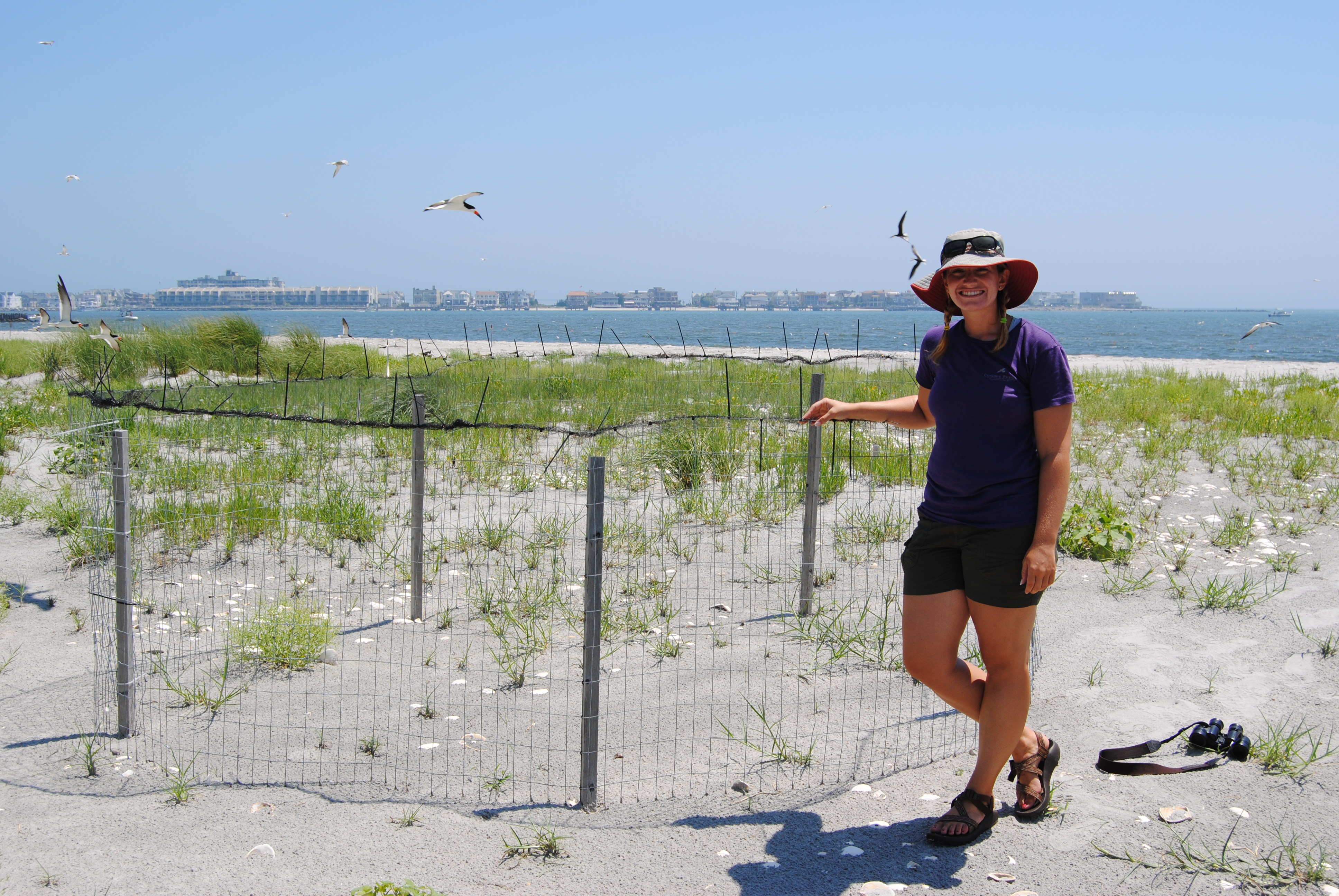
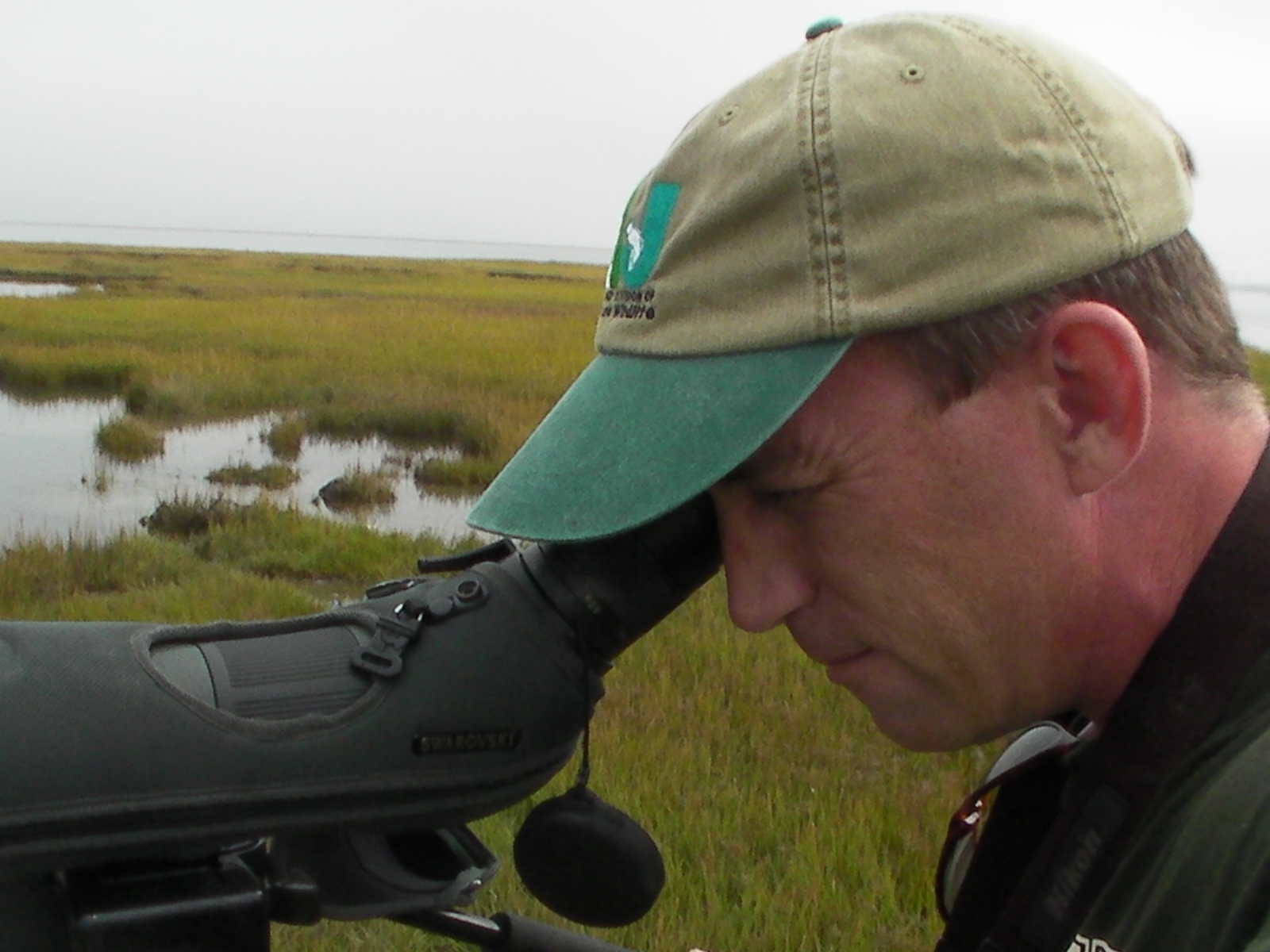
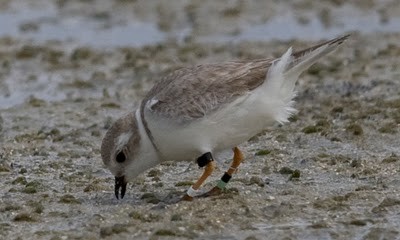
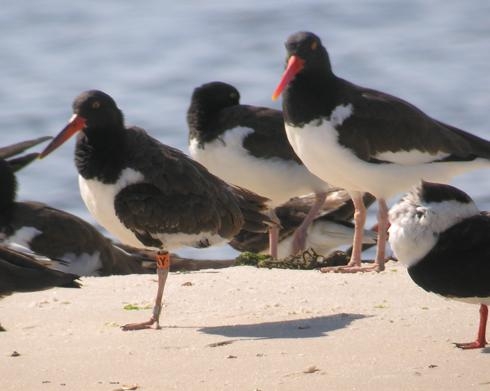
Here on the Conserve Wildlife Foundation blog we have talked a lot about piping plovers and the conservation efforts we enact when we find a nest. But have you ever wondered how we locate their nests? The key is knowing where to look. This is my second summer working on the beach nesting bird project and this year I have been able to observe a behavior which I had only heard about the year before. Piping plovers return to the same breeding site year after year, a behavior called site fidelity.
Plovers Evolved to Nest on the Beach
This behavior is thought to help maintain the adaptation of a population to a very specific environment. In this case the piping plovers have evolved to nesting on the beach and those that nest elsewhere may not be successful. Natural selection favors the birds who exhibit site fidelity. Another benefit to this behavior comes at the beginning of the nesting season. When the plovers return to the same spot they spend less time fighting with other plovers over territory. When a nest is destroyed or predated, it takes time to re-nest; so those plovers that nest sooner have a greater chance at fledging chicks. Continue reading “The Great Piping Plover Nest Search”
There is not too much more we could have guessed would happen to a particular pair of piping plovers that nested at the North Brigantine Natural Area (NBNA) this season. Every time one of the staff members ventured out to NBNA, it seemed as though a soap opera was unfolding with dramatic twists and turns to the story! Disturbance, flooding, and the infamous Brigantine foxes were all to blame for the failure of three nests that a single pair of plovers laid. And just when we thought this pair was done for the season, they surprised us by laying their fourth nest! Over the course of two months, this very special pair of piping plovers determinedly laid 14 eggs! Continue reading “If At First You Don’t Succeed, Try, Try and Try Again!”
Piping Plovers and Conservation Partners in the Tropics
By Todd Pover, Beach Nesting Bird Project Manager
Todd Pover, CWFNJ Beach Nesting Bird Project Manager and Ellen Jedrey, of Massachusetts Audubon Society “making friends” in the Bahamas
We found the first piping plover nest of the season in New Jersey this week. In the course of our nest searching we also spotted two piping plovers marked with color bands indicating they had been banded in the Bahamas last winter. It is hard to believe that just a month ago these small birds were still settled in for the winter more than 1000 miles from our state.
And as I reported in an earlier installment of this series (It’s Better in the Bahamas – Part 1), I also spent a week in the Bahamas in January/February searching for piping plovers as part of the winter segment of the International Piping Plover Census. As exciting as it was to be part of the survey team scouring the islands and cays of the Bahamas looking for plovers, the Abaco (island) portion of the survey, which I participated in, was just as much about building conservation partners as it was about the survey work itself.
The Bahamas portion of the winter census was sponsored by the U.S. Geological Survey, in close collaboration with the Bahamas National Trust and the National Audubon Society, itself a great partnership. My participation came about because of a partnership I have been cultivating with Massachusetts Audubon Society’s Coastal Waterbird Program. They were already slated to assist with the Bahamas survey and suggested I come along as well.
Even before we boarded a plane to head to the Bahamas, numerous local contacts had been established. Nobody on the Abaco survey team had ever been to the Bahamas and there were dozens of islands and miles of shoreline to be searched. We were headed there to help because of our expertise about piping plovers, not local geography – so in the end the success of the project really hinged on local knowledge and participation to help direct our efforts.
And there was local assistance from the moment we arrived. I was met at the airport by
David Knowles, Chief Park Warden for the Bahamas National Trust on Abaco, who generously took time from his busy schedule to orient me around the island. Within minutes of piling into his car, we were discussing similar problems we faced dealing with cats striking ground nesting birds – in my case with beach nesting birds and in his case with the Bahama Parrot, whose stronghold is the southern part of Abaco. David was a critical link in establishing key contacts on the island and helping us gain assess to some sites that would have otherwise been off-limits.
Important support came from the Friends of the Environment, a conservation group dedicated to protecting Abaco’s marine and terrestrial environment. They hosted a public information session at their headquarters which allowed our research team to discuss the survey and raise awareness, but also garner feedback from locals as to where our efforts might be focused.
Important advice came from plenty of individuals as well. Woody Bracey, a well-known bird expert from Treasure Cay, shared much needed information prior to and during the census, provided logistical support when it came to housing and transportation, and participated in various segments of the survey. (He was also a great boat captain and brought us to an awesome sand flat on Green Turtle Cay – one of the highlights of our trip). Bruce Wolck provided similar birding expertise and support on Elbow Cay. Beyond that, these folks invited us into their homes to share stories – they were all around great “hosts”.
We were introduced to Loggerhead Productions, a local film production company, who tagged along to shoot footage of plovers and interview us. They are now interested in coming to the states to film piping plovers on their breeding grounds – this connection may lead to a compelling film about plovers sometime down the road.
We met and talked to bonefisherman and boat captains, sometimes hiring them on the spot to transport us out to hard to reach locations (there was no shortage of those). We coordinated with resort managers and even picked the brains of random folks lying under a palm tree if that’s what it took. It truly took a “village” to complete the surveys.
I have talked extensively in the past about developing conservation partnerships – to the extent I fear it is starting to sound like a “soapbox” – but it really is the model we need to follow, especially for migratory species, such as piping plover, that cross state and international borders.
Being so vested in piping plovers that nest in New Jersey, I can get a little possessive about “my” birds. The trip to the Bahamas was a good reminder that they actually spend the majority of the year elsewhere – if anything, the plovers I saw in the Bahamas are “their” birds. That was one of the messages we tried to leave with the groups and individuals we met along the way in the Bahamas. But I guess the real message should be that they are “our” birds. Ultimately, if we are going to be successful in recovering piping plovers, we all have an important conservation role to play, right here in New Jersey and a thousand miles away in the Bahamas.
Because of the small amount of research undertaken when compared to other more intensely studied bird species, we are still very far from a complete understanding of the American oystercatcher. For several years staff from Conserve Wildlife Foundation of NJ, along with other partners throughout the state have collected data for both breeding and wintering populations of American oystercatcher in New Jersey. Very little data has been collected, however, during the non-breeding/migratory season.
That data gap is now beginning to close. Thanks to a grant provided by the National Fish and Wildlife Foundation, CWF was able to conduct surveys during the post-breeding/migratory season on roosting flocks of American oystercatcher at southern New Jersey Atlantic coastal inlets from Brigantine to Cape May. This data, when combined with data collected by other researchers range-wide, helps us to discern life-span, survival rates, movement patterns, population numbers, age structure and other important characteristics vital to our better understanding of this species.
For this study research staff surveyed inlet flocks of American oystercatchers between late July and early December 2010. Flocks were counted and observed for banded birds. There were just over 400 individual band resights during the survey period, significantly increasing our database of resighted birds. The majority of birds that were resighted were banded in New Jersey, although a number of birds banded in other states were also observed, including from Massachusetts, Delaware, Virginia, Georgia, North Carolina, and South Carolina.
Preliminary analyses of band resights and flock counts suggest seasonal patterns of behavior and show a variety of migration strategies within the species. Some migrants were sighted only once and seem to be passing through relatively quickly en route to roost sites further south. Some individuals resighted here in New Jersey were subsequently resighted a short time later on the Florida Gulf Coast at Cedar Key, indicating impressive migration distances covered in a very short time.
Others banded oystercatchers where resighted during the survey more than once here in New Jersey and spent considerable time roosting at or near our southern coastal inlets before moving on as temperatures dropped towards the end of the survey period. Still others were present during the entire period. New Jersey is the northernmost extent of the wintering range for the Atlantic Coast population of oystercatchers.
During the survey period, Brigantine, Great Egg Harbor, Corson’s, and Townsend’s inlets all showed a gradual increase in oystercatcher numbers to their peak flock counts towards the middle and end of October, when migrants headed for warmer latitudes and winter residents consolidated into New Jersey’s two primary winter flocks at Absecon and Hereford Inlets. These two primary winter roost sites had their flock counts gradually increase to their peak counts shortly before the end of the survey period. Between 350 and 400 birds were seen in each of these flocks at their peak.
As the primary surveyor for CWFNJ, one unexpected discovery I made early in the survey period was the identification of several alternative high-tide roosting sites at vernal marsh ponds close to, but some distance from, the inlets, and away from previously recorded roost site locations. Further research may help clarify if these alternative sites are a normal part of early migratory oystercatcher habitat, or are in response to the documented high levels of human disturbance in their normal roosting locations during the tourist season. Birds were observed regularly feeding at these ponds during the high-tide roost. It is possible that early in migration season the birds are still actively building reserves of energy to take them safely through the winter, and inhabit the vernal ponds to be close to an easily accessed food source. Wintering flocks, in contrast, are less likely to be seen feeding during the high-tide roost, and more likely to assume their energy conservation pose, standing on one leg with bill tucked under a wing, and the other leg drawn up tight beneath the body, with little or no feeding activity observed.
As fall progressed and human disturbance tapered off to some degree, the flocks did move to their more traditional roost sites, which are generally the beaches, sandbar islands and bayside sandflats of our inlets. Frequent shoulder-season human disturbance of the roosting flocks in these areas from watercraft users, beach walkers, anglers, ORVs, and dogs warrants additional systematic quantitative assessment and analysis for possible negative effects on the survival rates of migratory oystercatchers. Such analysis will aid in the evaluation of the need for the implementation of habitat management actions to mitigate any negative effects discovered.
The American oystercatcher precariously inhabits a narrow ribbon of coastal habitat which is also used by many other threatened and endangered plants and animals. It thus has strong potential as a “sentinel species” to help us to gauge both the current health of our ecosystem and the success or failure of habitat management actions undertaken. Continued data collection and analysis will enable us to take science-based steps in our efforts to understand the American oystercatcher, and to preserve and protect the beautiful barrier-island beaches, bays, and adjacent tidal marsh that make up our southern Jersey Shore.
The Search for Piping Plovers on their Wintering Grounds
By Todd Pover, Beach Nesting Bird Project Manager
Todd Pover, CWFNJ Beach Nesting Bird Project Manager in search of Piping Plovers in the Bahamas.
One of the most frequently asked questions about piping plovers is, “where do they go in the winter?” In the most general sense, piping plovers that breed along the Atlantic Coast winter from North Carolina to Florida, along parts of the Gulf Coast, and on some Caribbean islands. Where our birds from New Jersey specifically spend the winter is largely unknown.
But research conducted over the past several years suggests that the Bahamas is a particularly important wintering site for piping plovers. Last winter under the auspices of Dr. Cheri Gratto-Trevor from Environment Canada, a total of 57 piping plovers were color banded in the Bahamas. All of the 41 banded piping plovers that were resighted on the breeding grounds last summer were found on sites along the Atlantic coast, including two that nested in New Jersey (Sandy Hook and North Brigantine Natural Area).
Every five years starting in 1991, the U.S. Geological Survey (USGS) has conducted an International Piping Plover Census, which includes both a breeding and wintering component. In 2001, just 35 piping plovers were reported in the Bahamas, although it was noted that there was not a coordinated effort to survey the islands that winter. In 2006, a total of 417 piping plovers were found in the Bahamas on the winter census, a significant increase that was attributed to a more intensive survey effort. Even at that, given that there are hundreds of islands and sand flats in the Bahamas, many of them difficult to access, it is believed even more piping plovers likely winter there.
Piping Plover banded in the Bahamas in the Winter of 2010.
This brings us to 2011, which is once again an international census year. The USGS, in association with the Bahamas National Trust and the National Audubon Society have made the Bahamas a high priority for this year’s winter census. Towards this end, a number of piping plover biologists and researchers that work on the breeding grounds in the U.S. and Canada were asked to assist with the Bahamas survey. The survey was conducted from January 24-February 6, and I was one of about a dozen or so members of the research team fortunate enough to help out.
The USGS has just begun to tally the survey results, but a rough preliminary tally indicates just over 1000 piping plovers being recorded in the Bahamas this winter, a significant increase over previous surveys. If most of those birds are from the Atlantic Coast population, as banding results suggest, at least a quarter of that population may winter in the Bahamas. By all accounts, it appears it very well may be “Better in The Bahamas” for our piping plovers!
Stay tuned. Over the next several weeks, I plan on penning more installments about my Bahamas piping plover adventure, including details about the surveys themselves, the logistical difficulties encountered, and the various local partnerships developed along the way.
The final results are in and it was a banner year for piping plovers in New Jersey. Statewide, our piping plovers produced an average of 1.39 fledglings per pair – one of the highest rates recorded since monitoring began several decades ago. Those results couldn’t have come at a better time. Fledgling rates had been poor the past several years and at just 108 pairs the breeding population is still extremely low. Because piping plover chicks often return to the same general area where they were born when they are ready to breed, the hope is that this year’s success will help grow the state’s population in the next several years. To find out more about the results of the 2010 piping plover breeding season click here (pdf). And if you want to find out more about how the Conserve Wildlife Foundation of New Jersey helps protect piping plovers in our state or how you can help, click here.
American Oystercatcher Working Group annual meeting. Photo by Tracy Borneman.
Working closely with wildlife is the “sexy” part of my job. It is what makes me look forward to work on those days when I find myself less than inspired. It is also what the public most wants to hear about. But it is not necessarily the most important part of my job.
A great deal of my conservation efforts happen in meetings, offices, and behind a computer screen. A good case in point is the American Oystercatcher Working Group meeting I attended in Wellfleet, Massachusetts last week. This annual meeting brings together other managers, biologists, researchers, and policy experts from the Atlantic coast states that are specifically focused on oystercatchers. It is a chance for all us to share ideas, compare “notes” so to speak, build partnerships, and in general leverage the collective knowledge of the group.
This particular meeting is small by most standards, typically just 25-35 attendees, and much more informal than others I attend. It is also one of the most effective. Simply put, we get stuff done! Sure, we have spirited discussions and debate, but at the end of the day there is usually a cooperative spirit.
Projects move forward to benefit oystercatchers in individual states from Massachusetts to Florida, but through the prism of what is best for the range wide conservation of the species. This is how it should be. My job is to help monitor, manage, and protect oystercatchers in New Jersey, but since we only host a portion of the overall breeding population and they only spend a small part of each year in our state, we are just one piece of the puzzle.
You cannot effectively recover or conserve a species without partners. So we will keep telling you sexy, up-close-and-personal stories about wildlife, but once in awhile we will also remind you about the behind the scenes work we do to keep wildlife from disappearing from our state (and beyond).
Species diversity is critical for the continued health of any ecosystem. All organisms have a role to play, but defining that role for any species is no easy task. Certain species might act as a keystone, one whose healthy presence is absolutely required. Others might serve the role of an indicator species, the proverbial canary in the coal mine, with the health of that species being a sign of the health of the overall system. Without data, we cannot know. While data has been collected for several years for breeding and wintering populations of American Oystercatcher in New Jersey, very little data has been collected during migration. Collecting that data is my job at the moment.
The American oystercatcher is a species of special concern in the state of New Jersey. Causes for concern include their low population and risky breeding strategy, combined with habitat degradation from pollution, habitat loss from development, as well as increased predation and disturbance directly related to human activities within their habitat.
Although oystercatcher pairs will fiercely defend a territory from other oystercatchers during nesting season, in the fall and early winter they are almost always to be found hanging out together either at the beach or on the marsh. They can generally be relied on during the non-breeding season to roost in flocks near ocean inlets, but locating the flock and approaching to within band-resighting distance during a limited high-tide time frame can be challenging.
An ocean inlet can encompass a very large area; and when your quarry can fly and you can’t, that area can seem even larger! Just finding the flock and getting to an effective observation point (which even with quality optics is surprisingly close) without them “spooking” is more than half the battle. Using a boat or kayak, combined with marsh trekking and the occasional swim, there are few places the oystercatchers go where they cannot be followed and discretely observed.
The goal of this field research is to collect data on roosting flocks of American oystercatchers at southern New Jersey Atlantic coastal inlets during migratory season. The data collected also enables further research on life-span, survival rates, movement patterns, population, age structure and other important characteristics.
I’m incredibly fortunate to be a part of this important research collecting data vital to our understanding of this species, while at the same time being privileged to be able to enjoy and become more intimately familiar with our beautiful southern New Jersey coastal ecosystem. We would like to thank the National Fish and Wildlife Foundation for funding this important research.
Well as summer’s end slowly draws near, the beach nesting bird season has wrapped up on Stone Harbor Point. All of the Piping Plover and American Oystercatcher chicks have fledged (i.e. reached the stage where they can fly). In the past, this has often been a very depressing time. Stone Harbor Point has a bad history of flooding, and many of the nests and chicks were destroyed; some years we only had a couple of chicks fledge. This year, however, there is good news! A total of 13 Piping Plover chicks and 10 Oystercatcher chicks have fledged, from 9 and 21 breeding pairs, respectively! I owe this very successful year to the weather cooperating during the high spring tides; flooding was not a big issue this summer. I also owe my thanks to the public for respecting the rules and staying out of the fenced areas, giving these beach nesting birds the room to successfully fledge their chicks.
This breeding season sure has had its ups and downs. One low point that comes to mind is finding Oystercatcher nest after nest washed away from a high tide the night before (most of them luckily renested). One of the greatest feelings is finding a chick on its fledge date, knowing that it now has a much greater chance of survival. We also had a Least Tern colony on Stone Harbor Point that fledged a good amount of chicks.
Our focus now has shifted to migration. Thousands of migratory shorebirds are now congregating on Stone Harbor Point. Most are on their way south from breeding up north in Canada and the Arctic. Oystercatchers and Piping Plovers are also preparing to head south for the winter. They are currently gathering in huge roosting flocks before their departure. This gives us ample opportunity for band resighting and to conduct surveys, estimating the population sizes of these shorebirds.
Since the season is just about over it means my job (as Seasonal Steward) is just about over. Words can’t describe how much I love this job and what I have learned over the last four months. The Conserve Wildlife Foundation of NJ is truly making the difference for wildlife all over the state, and I’m glad I got to be a part of it!
The American Oystercatcher (Haematopus palliates) may not get as much attention as some other species since it’s not listed as endangered or threatened in New Jersey. However, it is listed as a species of special concern because the population is thought to be in decline. On Stone Harbor Point, the site I mainly monitor for my job, I spend a good deal of time finding oystercatcher nests and chicks. Together with Piping Plovers and Least Terns, oystercatchers constitute a large portion of the beach nesting birds found on “the Point”.
Oystercatchers are hard to miss; they stand nearly one and a half feet tall, are boldly colored, and have very loud calls. On average, they lay three eggs per nest, and incubate their eggs from April-June and care for their chicks from May-July. They tend to have much more trouble with predators and flooding during the egg laying stage. Once hatched, the chicks tend to have better survival rates. As of right now on Stone Harbor Point we have at least ten pairs of American Oystercatchers with offspring. One pair is still incubating a nest, nine pairs are brooding a total of thirteen chicks, and one pair has successfully fledged two chicks.
One of the ways to track these birds year after year is to put colored bands on their legs that are marked with letters and numbers so individual birds can be identified. Tom Virzi, one of our research partners (from Rutgers University), has been studying oystercatchers in New Jersey since 2004. Last week I had the privilege of helping two of his interns, Jason Pietrzak and Allison Anholt, band some oystercatcher chicks on Stone Harbor Point.
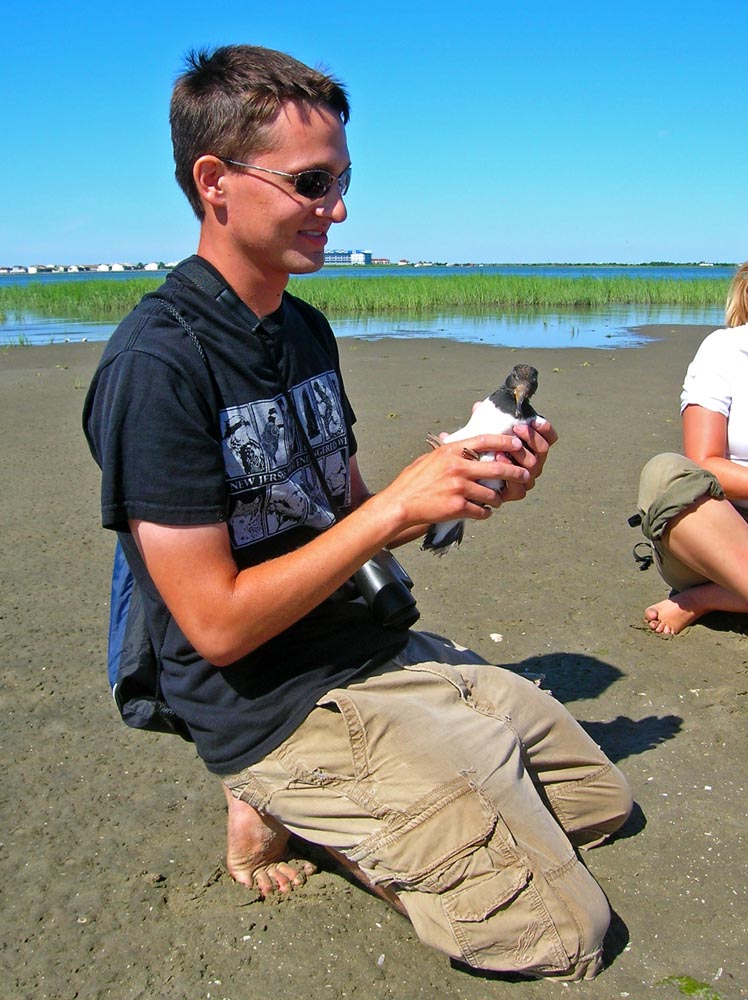
CWF Seasonal Chris Haxter holding captured American Oystercatcher chick in preparation for banding. Photo courtesy of Tara Hewitt.
The first step was to capture the chicks. Since the chicks can’t fly yet, all we had to do was surround and grab them. Sometimes easier said than done – the two chicks we went after were already a month old, so they were quite fast. Once captured we inspected the chicks, making sure they were healthy and their legs were fully grown. The band that goes around the leg of the chick is a small orange plastic cylinder with a black number/letter code (each state participating in this banding project has a unique color). After banding, we took measurements, including beak/head/wing length, and then collected a few feathers so the chicks could be sexed using DNA analysis.
The chicks were surprisingly calm throughout the process and the parents stood near us watching carefully. When we were finished we released the chicks back to the parents and kept an eye on them to make sure the parents accepted the chicks.
Adult oystercathers are also banded, but because they can fly the process is much different and involves some trickery. To try to capture the adults we set up a decoy, played some oystercatcher calls, and placed a board lined with many tiny nooses in the sand to capture the foot of the bird. When the adults defend their territory and fight with the decoy they get caught in the trap. We did attempt this but were not successful this time.
When a banded bird is re-sighted, and the code is observed and recorded, we are able to follow them for years. The data gathered from banding oystercatchers is essential in studying their long term habits, population trends, chick survival rates, and movement patterns.