Report a Red Banded Osprey
Jim Verhagen
Contribute to Osprey Conservation
Ospreys have made a truly remarkable recovery in New Jersey. In 1973, their population had plummeted to just 53 nesting pairs. Thanks to decades of conservation work, that number has soared to over 800 pairs by 2023. In early 2025, their status was changed to stable by NJDEP. While this comeback is an incredible success story, it does not mean ospreys are free from threats. Funding for their management has steadily declined, and today resources are being shifted toward species still on the brink.
That’s where birders, wildlife photographers, and citizen scientists can make a real difference. Your help in reporting nest activity and tracking red-banded ospreys is vital. Each sighting helps us uncover important details about their life history, including migration routes, survival rates, genealogy, nesting success, and the challenges they face throughout their lives—insights that are otherwise difficult to capture.
If you spot an osprey with a red band, take note of the band code, date, location, and behavior, and share your observation with us. Use the form below to report the red banded osprey. We will respond to you with details on that individual bird, including when and where it was banded (often with a photo taken at banding), other encounters, and a reward will be sent to you, the finder, as a token of appreciation. Every report strengthens our ability to protect ospreys for future generations and ensures that their recovery story continues.
Together, we can turn everyday wildlife encounters into meaningful science.
Report a Red Band
Please include as much information as possible. For assistance or questions, please reach out to Ben Wurst (ben.wurst@conservewildlifenj.org).
Red Band Information
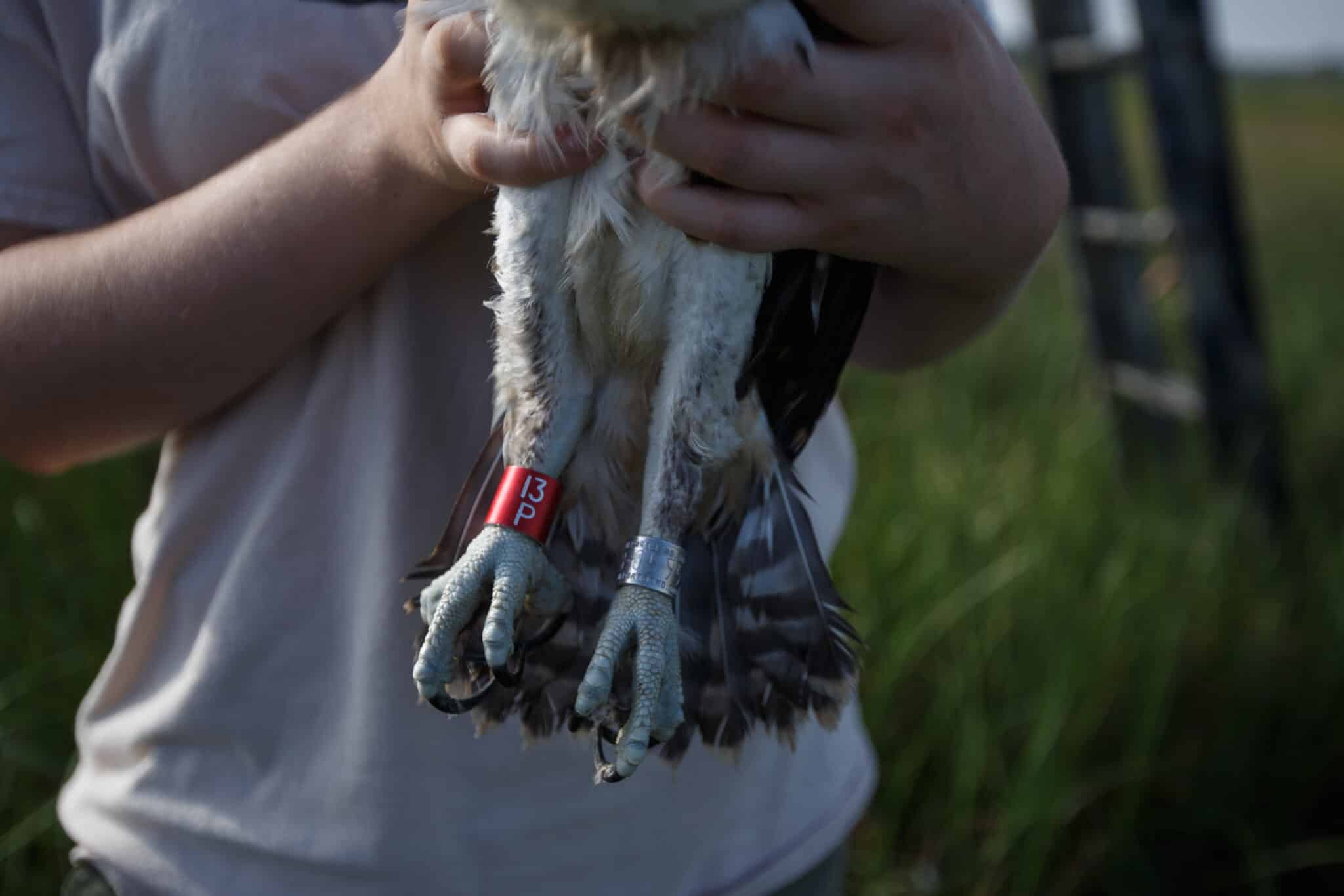
Bands are anodized red with codes 00-99 over capital C, D, H, K, M, N, P. All red banded ospreys from New Jersey also have a silver USGS band on their left leg. Some are known to have faded and can appear silver like a federal band. NOTE: Red bands were deployed in PA years ago and might be with the sequence 00-99/A-B.
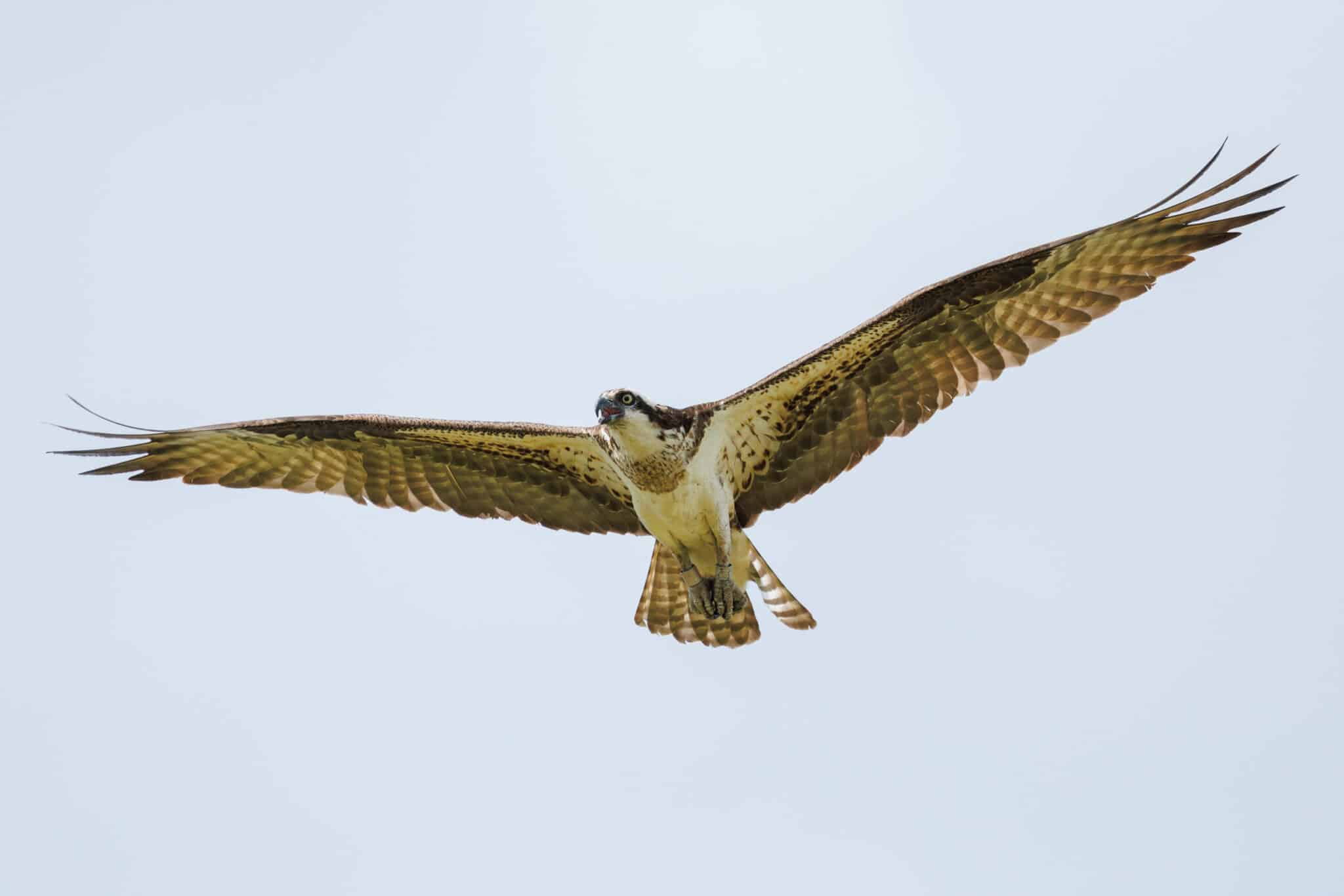
All banding, marking, and sampling is being conducted under a federally authorized Bird Banding Permit issued by the U.S. Geological Survey’s Bird Banding Lab.
East Coast Osprey Tracking

Ospreys are banded all around the world to help track their movements via encounters or re-sightings of their bands. Below is a list of color bands that were authorized by USGS BBL for use on ospreys along the east coast. Some of these ospreys could be encountered in New Jersey during migration and as breeding birds.
- BICOLOR BLUE, GREEN, RED, WHITE, YELLOW / Delaware + Maryland. Mr. Steven Cardano. Anodized (bicolor) aluminum bands (no code).
- BLUE / Massachusetts – Manomet Bird Observatory. Anodized aluminum bands w/ two characters; Maine – Dr. David Evers – Biodiversity Research Institute. Anodized aluminum bands with white codes: A/A through E/Z, H/A through H/W
- GREEN / New York – STATE OF NEW YORK-NONGAME — Anodized aluminum color bands w/ silver codes. Some are known to have faded.
- MISC COLOR / Virginia Department of Game & Inland Fisheries. Anodized aluminum color band.
- PURPLE / Virginia + Maryland – Dr. Bryan Watts – Center for Conservation Biology. Anodized aluminum band w/ alpha numeric code. Dr. Scott Barras / USDA/APHIS/WS. Anodized aluminum color bands w/ silver codes.
- RED / New Jersey – Kathy Clark – DEP Fish & Wildlife. Anodized aluminum color band w/ silver codes. Alpha-numeric. Some are known to have faded and can appear silver like federal band.