Photo and Report from the Field

A little human help goes a long way!

written by Maureen Barrett, CWF volunteer/donor/wildlife enthusiast/educator

With wind speeds clocked at 91-92 mph, the osprey nest behind my house didn’t stand a chance! On Tuesday, July 19th around 8:00 P.M., a thunderstorm came barreling into Fortescue from the northeast. It was a wicked storm with thunder, lightning, and even hail. The wind was so strong that my purple martin housing was being blown around like it was a stalk of phragmites. The adult osprey held their positions on the perching supports of the platform for as long as they could, but soon jumped ship. By that time, the pole for the martin house broke and I couldn’t even see the osprey platform through the rain.

After the storm, some moonlight allowed me to see the silhouette of the osprey platform. It was still standing. But I couldn’t see any nesting material inside; it looked empty. I made an attempt to walk through the marsh to get a closer look, but I thought it would be wise to wait until first light. So I waited for the sun to rise.
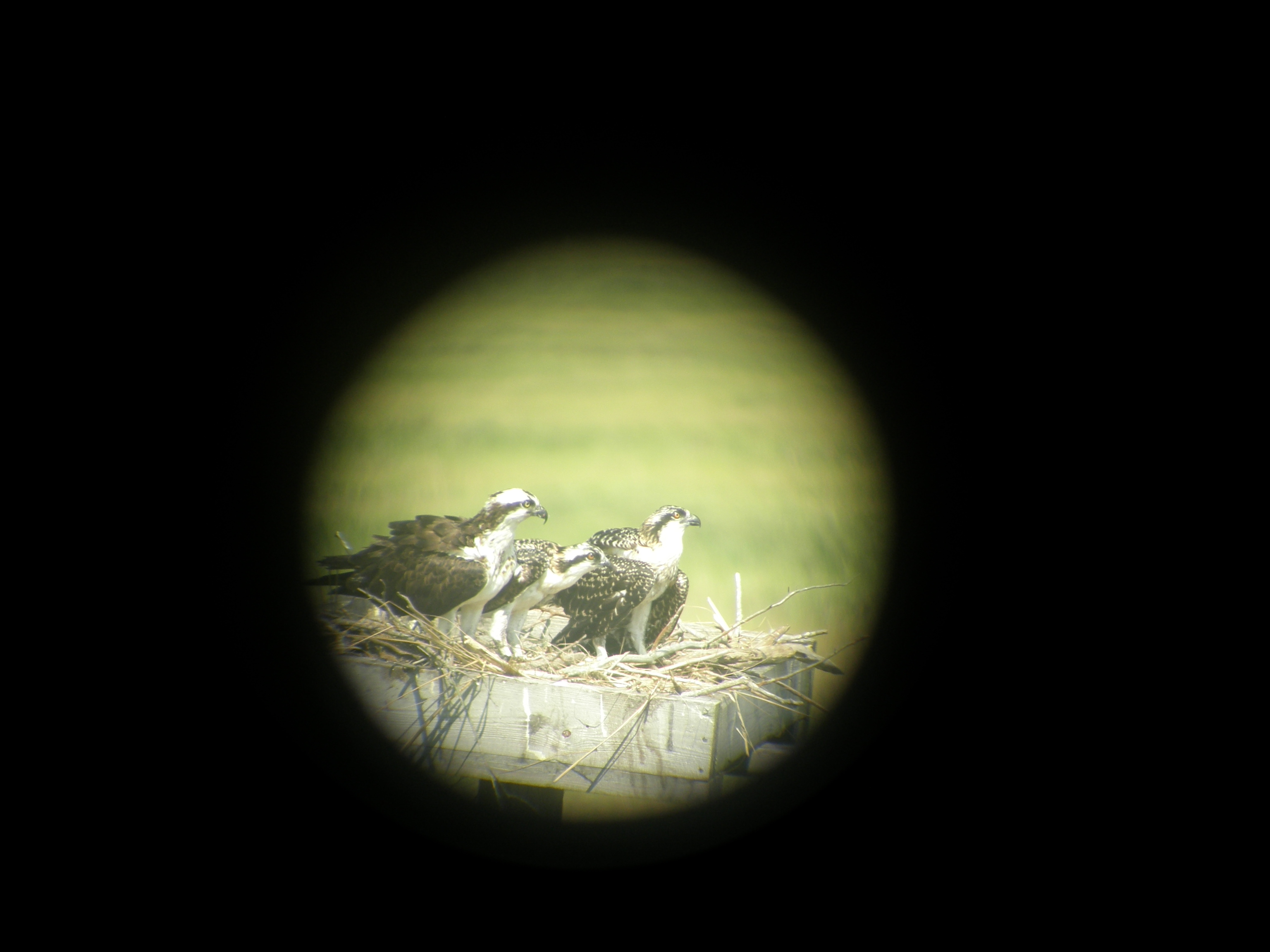
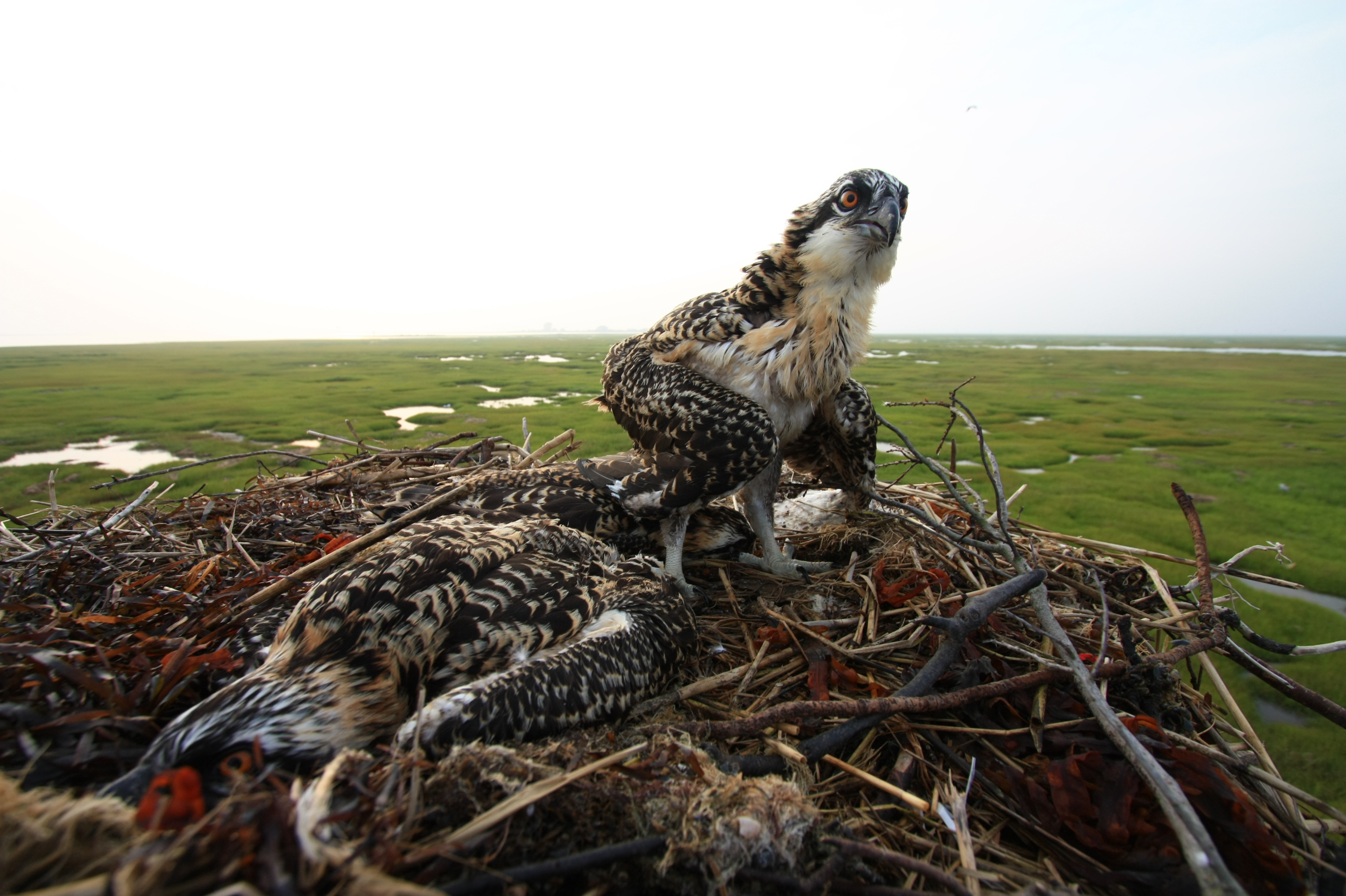
An image that was taken using a technique called "digiscoping" reveals two osprey young in the nest.

By 5:00 A.M., my suspicions were confirmed. There was not one piece of nesting material on the platform. Fortunately the adults survived the storm and were once again perched on the platform supports, but the nest and chick were gone. The high winds blew everything off the platform. I quickly put my boots on and walked out on the marsh. I was surprised how relatively easy it was to get to the platform after getting a few inches of rain the night before. There was only one very small ditch I had to cross. I soon found the pile of nesting material and on the edge of the pile was a clump of wet feathers. It looked like the storm had taken the chick’s life. But then I saw some movement! It had survived the storm, the fall, and an evening on the ground!

This being my first experience with such an ordeal, I called my friend Bill Miller who lives up the street. (You know who your friends are when you call them before 6:00 A.M. for a favor!) He brought down a ladder and a piece of plywood. We went back on the marsh, dried the chick with a towel, and put it back on the platform. Within a few minutes, the adults returned to the platform to see their chick back in the nest.

Two other nests in Fortescue were also destroyed by the storm. Later that day, Brian Johnson of the Natural Land Trust’s Glades Wildlife Refuge had to place a foster chick in my nest. This chick’s nest was in a tree and totally destroyed. Both chicks are getting along just fine and being fed by the adults.

The Great Piping Plover Nest Search

An Insider’s Perspective

By Christoper Haxter, Field Technician

A well camouflaged piping plover nest.

Here on the Conserve Wildlife Foundation blog we have talked a lot about piping plovers and the conservation efforts we enact when we find a nest.  But have you ever wondered how we locate their nests?  The key is knowing where to look.  This is my second summer working on the beach nesting bird project and this year I have been able to observe a behavior which I had only heard about the year before.  Piping plovers return to the same breeding site year after year, a behavior called site fidelity.

Plovers Evolved to Nest on the Beach

This behavior is thought to help maintain the adaptation of a population to a very specific environment.  In this case the piping plovers have evolved to nesting on the beach and those that nest elsewhere may not be successful.  Natural selection favors the birds who exhibit site fidelity.  Another benefit to this behavior comes at the beginning of the nesting season.  When the plovers return to the same spot they spend less time fighting with other plovers over territory.  When a nest is destroyed or predated, it takes time to re-nest; so those plovers that nest sooner have a greater chance at fledging chicks. Continue reading “The Great Piping Plover Nest Search”

If At First You Don’t Succeed, Try, Try and Try Again!

Migrating with Piping Plovers

By Emily Heiser, Field Technician

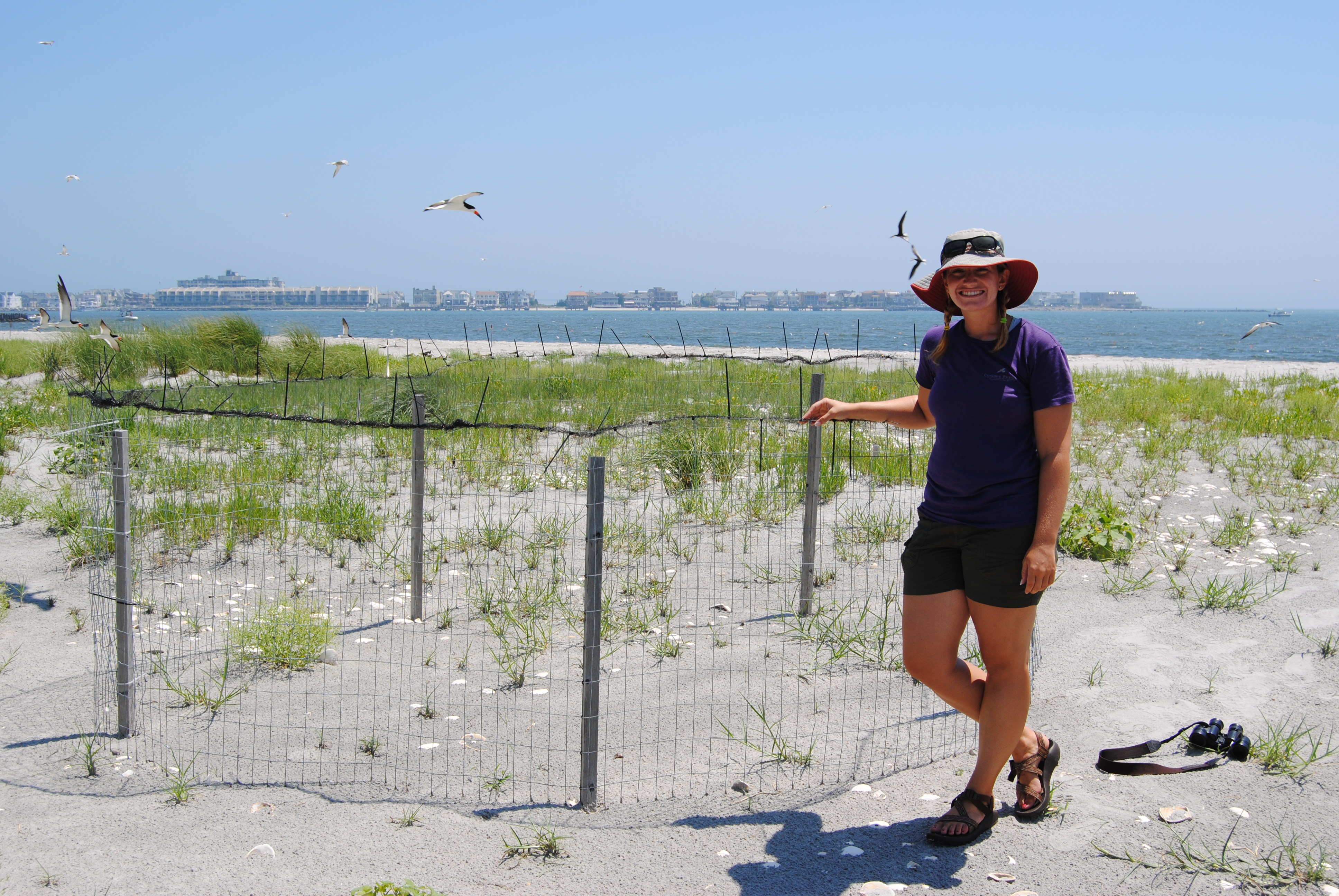
Emily Heiser and a plover exclosure

There is not too much more we could have guessed would happen to a particular pair of piping plovers that nested at the North Brigantine Natural Area (NBNA) this season.  Every time one of the staff members ventured out to NBNA, it seemed as though a soap opera was unfolding with dramatic twists and turns to the story!  Disturbance, flooding, and the infamous Brigantine foxes were all to blame for the failure of three nests that a single pair of plovers laid.  And just when we thought this pair was done for the season, they surprised us by laying their fourth nest!  Over the course of two months, this very special pair of piping plovers determinedly laid 14 eggs! Continue reading “If At First You Don’t Succeed, Try, Try and Try Again!”

Photo from the field

Osprey numbers continue to rise!

by Ben Wurst, Habitat Program Manager

Three osprey nestlings were a common sight in many nests from Sedge Island to Little Egg Harbor, New Jersey. © Ben Wurst

Volunteers, CWF staff, and biologists with NJ Fish & Wildlife recently completed osprey nesting surveys throughout coastal areas of New Jersey. Each year these “osprey banders” complete “ground surveys” (referred to as ground surveys because they are surveying nests by land/sea, not by helicopter) that cover around 70% of the state population. I survey colonies on Barnegat Bay, Little Egg Harbor, and Absecon. The surveys are meant to keep track of the population and determine its health. During the surveys the banders access nesting areas mainly by boat since most ospreys nest in coastal areas or by water (their source of food). We use ladders to access nests where we count the number of young produced and then place an aluminum band on each of the young.  For the past two years we have also been collecting feather samples for a study being conducted by the Academy of Natural Sciences in Philadelphia where they are analyzing the stable isotopes to determine what ospreys are eating and how their diet has changed over time. More specifically they’ll be looking for changes in the isotope profiles across the local range of ospreys – something that has never been done before.

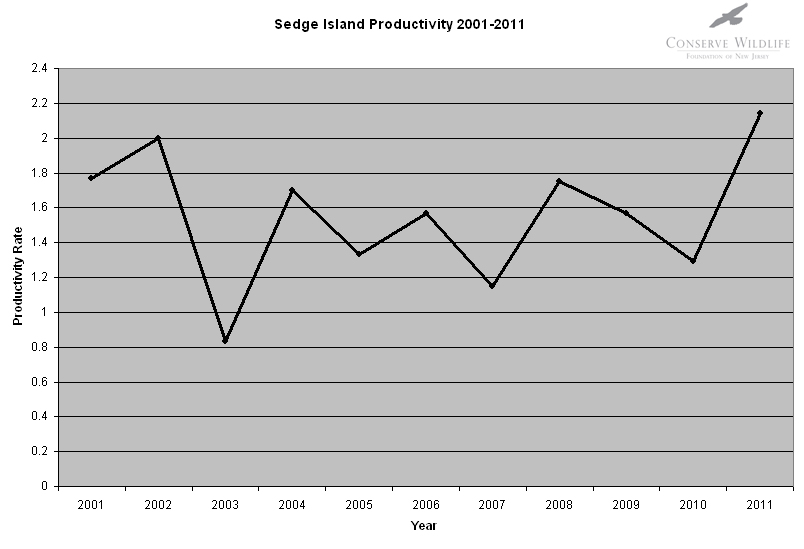
In one area, Sedge Island WMA, that I’ve surveyed for the past few years I surveyed 27 nests. 22 of those nests were occupied and produced a total of 47 young. 34 of those young were banded for future tracking. From the survey I can calculate the productivity or reproductive rate which is a measure of how healthy the population of that colony is. The productivity rate for Sedge Island is 2.14 young/active(known-outcome)nest this year which is the highest ever recorded (see chart at right for more details). These awesome results are the result of calm and mild weather conditions this spring and summer, high availability of prey, and possibly the increased amount of experienced breeding birds. Another factor that has surely helped to give the population a boost is the increased availability of suitable nest sites along the coast. Since 2004, I’ve helped to install more than 100 nesting platforms. Many of these platforms replaced old dilapidated structures and now give ospreys a better chance at successfully raising young that will eventually return to New Jersey to reproduce.


Photo from the Field

Final Phase of site work at Ballanger Creek Complete!

by Ben Wurst, Habitat Program Manager

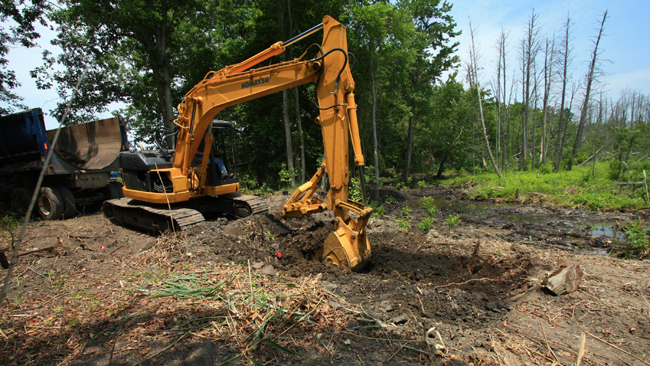
An excavator removes milled asphalt that was dumped into freshwater wetlands. © Ben Wurst

In late 2009 we received notification that we were going to receive funding through the American Recovery and Reinvestment Act of 2009 to carry out a habitat enhancement project inside Bass River State Forest. The purpose of the project was to enhance habitat on site for migratory birds and other wildlife, especially rare species. The main part of the project was to remove fill and control invasives, like phragmites, that was illegally dumped on the edge of freshwater wetlands. The first phase of the project was to create scrub-shrub habitat. In early 2010 we planted over 1,000 native shrubs that provide both food and cover. Even though it was a hot, dry summer last year many of the shrubs are already flowering and bearing fruit. In summer we broadcast 75 lbs. of wildflower seed in the old fallow fields. Finally, over the past 2 weeks a crew from Anthony Excavating Inc. used excavators to remove tons (literally) of milled asphalt, concrete, and other debris (everything but the kitchen sink) along the edge of the wetlands. They used a small excavator that was able to reach a long distance without disturbing much of the surrounding area.

A series of interpretive signs are being designed and will be installed on site this fall. I also plan to work with volunteers from Bass River State Forest to enhance a 1.5 mile loop hiking trail around an old fire road on the edge of the wetlands.


Removing milled asphalt that was dumped into freshwater wetlands. © Ben Wurst

The American green treefrog found in southern New Jersey!

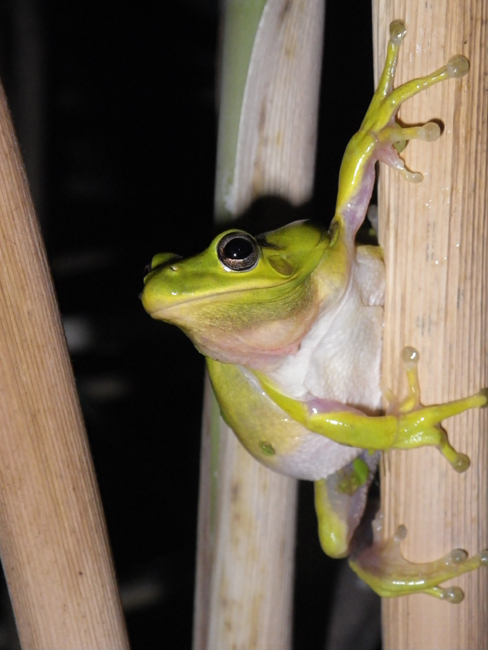
© Dave Golden

by Karena DiLeo, Assistant Biologist

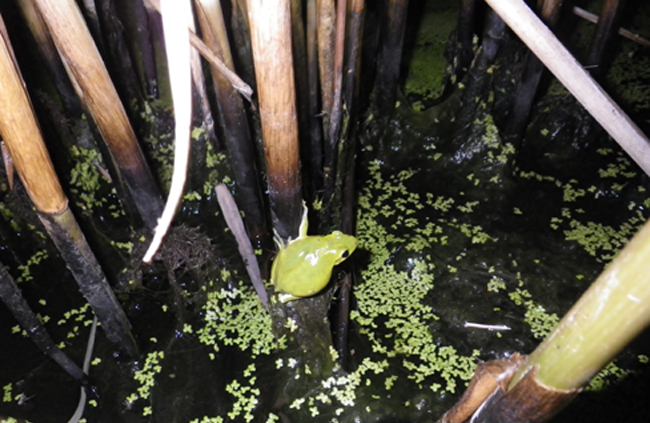
A large, breeding population of the American green treefrog, Hyla cinerea, has been discovered in Salem County, New Jersey.  H. cinerea is a common treefrog found in the southeastern United States with a range extending from southern Delaware down the coastal plain to Florida and along the Gulf to Texas.   Although very abundant in sections of its range, it has never been documented in New Jersey.

This serendipitous discovery happened during a routine chytridiomycosis survey in southern New Jersey.  After finishing up a bat acoustics training, MacKenzie (our Private Lands Biologist), offered to help me conduct my night-time amphibian survey.  My intention was to visit a site in the Pinelands but I was surprised by the loud and unidentifiable calling from an impoundment across the road.   As we hiked through dense phrag that had been weaved together by mile-a-minute weed, we were completely oblivious to the clear path to our right that would become apparent in daylight.

Upon reaching the water, the calling was almost deafening and any communication between us was conducted by yelling.  As I waded across the impoundment, the water became very deep and the thick silt slowed movement and caused a fair amount of water to overflow my chest waders.  As the emergent vegetation grew thicker, I began to notice an abundance of small, green treefrogs clasped to the phrag, calling a couple inches above the water.  Confused, as they clearly weren’t peepers and we were out of Pine Barren Treefrog range, I was able to catch one and return to the other side for MacKenzie’s opinion.

© Dave Golden

Upon closer inspection, this frog was clearly not a native to New Jersey.  This little light green frog was about 2 inches in length with small, bright, yellow spots on its back and a pale underside. (This first treefrog did not have the characteristic white side line, but subsequent samples did.)  Luckily, MacKenzie had her camera and was able to take several diagnostic pictures that we would later investigate.

After consulting with several experts and a site visit with ENSP Biologist, Dave Golden, we confirmed that there was a large population of H. cinerea at this site in Salem County.   We are currently conducting more site assessments in the area to determine the green treefrog’s range in New Jersey.   Together with ENSP, we will be starting a genetic study comparing samples collected in New Jersey to local samples found in Delaware in hopes of determining the origin of the New Jersey population.

Photo from the Field

Stranded osprey gets helping hand

by Ben Wurst, Habitat Program Manager

I’ve been off work for the past week to spend some time with the newest member of my family, Reed Alexander Wurst. I was planning on heading into the office today to play catch up with a lot of projects that I’ve involved with (having a baby during field season is definitely keeping me busy!). So I started the day by opening up my laptop to download the 90+ emails I’ve gotten in the past week. As I sat down for some breakfast I saw an email from a woman where the subject said “Osprey on our Sailboat and we need help!” Immediately after I saw that I thought, there goes heading into the office… The woman who contacted me was Melissa, who was living on her sailboat that was moored in the harbor at Barnegat Light (BL). She sent me an image and this is what she wrote:

“We read your story in the SandPaper so are contacting you about this situation.

We heard a loud noise around 1am and when we looked with the flashlight we saw this osprey. It tried to fly up and out w/o success and now that it’s light we can see blood and it’s appears that his/her wing is injured.

We are anchored at Barnegat Light across from the town boat ramp. Our boat is Piscator and is the 32′ white and green double-ender.

We have no way to deal with handling this osprey, so really need help!! “

An injured osprey on the deck of s/v Piscator in Barnegat Light, NJ. © Ben Wurst

I called Melissa and I headed up to BL. I met John at the boat ramp and we rode out to the s/v Piscator in his dingy. After the short ride I saw that that osprey had a fracture to it’s left wing in the carpal (wrist) joint. I carefully collected the osprey and saw that she was banded. I looked up the band (788-49090) and she was banded in Sandy Hook on June 30, 2009. This would be her first year back from her wintering areas to breed in New Jersey. Ospreys spend two years after fledging in their wintering areas. One positive aspect is that most two year old birds do not raise young their first year after returning to nest in areas where they originated. So, no young ospreys are dieing b/c of her injury.

I then called Don Bonica with Toms River Avian Care and transported the osprey to Barnegat Animal Clinic where it would temporarily stay. I don’t know if it will heal from its wounds. Ospreys don’t do well in captivity or in rehabilitation settings. I can only hope that its fracture is minor and that it heals quickly!

Melissa knew who to contact after reading a story about my work with ospreys in New Jersey, especially the B. Bay Watershed in The Sandpaper. The story is viewable online until Wednesday, June 15th.

Volunteers needed to help install barrier fence

Protecting Terrapins through conservation along Great Bay Blvd.

by Ben Wurst, Habitat Program Manager

Great Bay Blvd. in Little Egg Harbor, New Jersey. © Ben Wurst

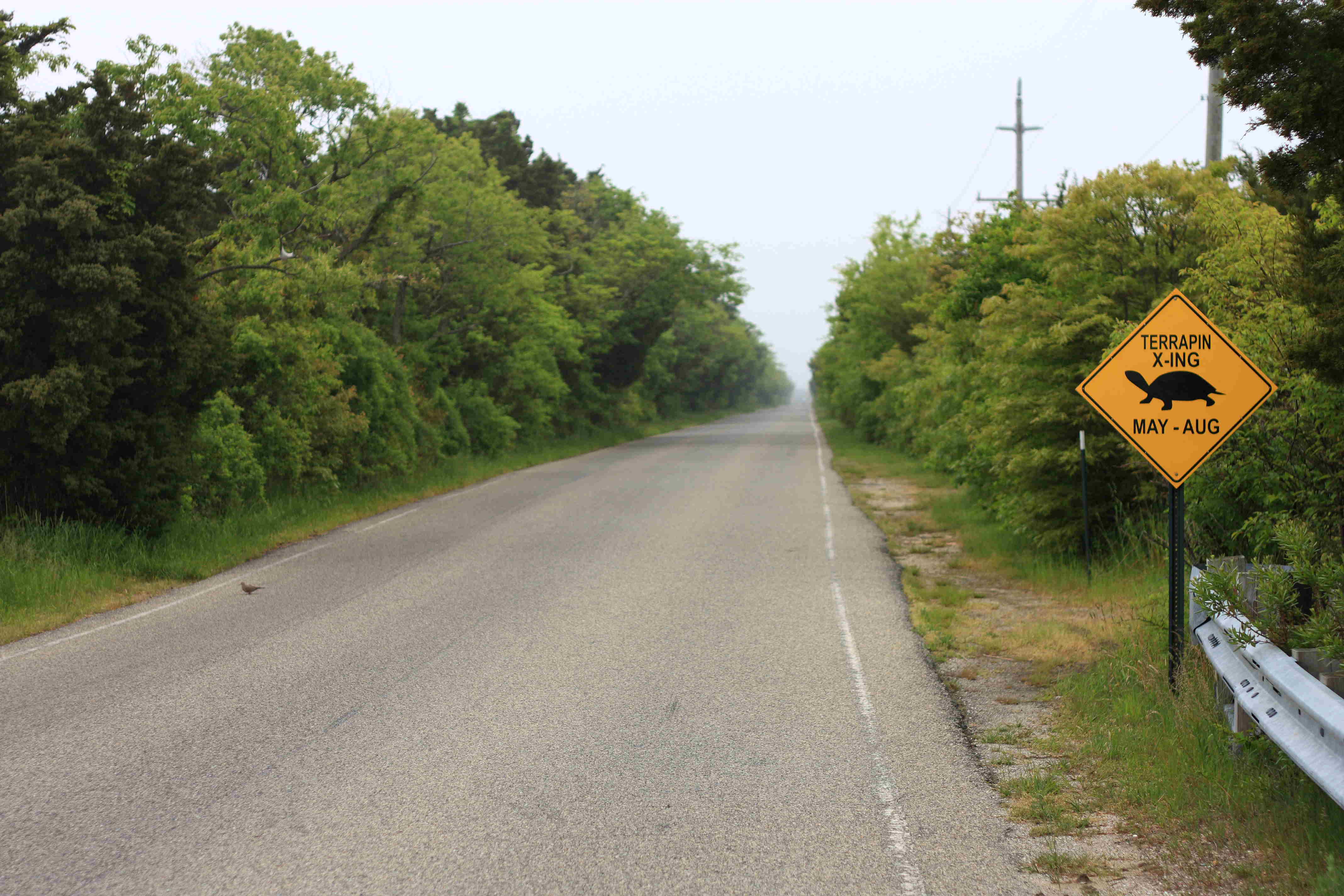
Northern Diamondback Terrapins are native to New Jersey and inhabit the many miles of coastal salt marshes along the Atlantic Coast and Delaware Bay. Terrapins were once very common and were used as a main food source of protein by Native Americans and then European settlers. In the early 1900’s it was hunted so extensively that it almost faced extinction. Luckily, during the 1920’s, use of terrapins for food dropped in popularity. This allowed the population to slightly recover and avoid extinction. However, several major threats still threaten their survival. Habitat loss, mortality from being drowned in crab traps, and road mortality all pose major threats to the health of the population. Each year thousands of terrapins are killed by motor vehicles throughout their range and here in New Jersey, Great Bay Boulevard is no exception.

Great Bay Boulevard or Seven Bridges Road extends approximately 5 miles into estuarine emergent wetlands and northern diamondback terrapin nesting habitat. The boulevard is surrounded by over 5,500 acres of protected coastal habitat (Great Bay Boulevard Wildlife Management Area – Managed by NJ Division of Fish and Wildlife), a relatively unspoiled, estuarine ecosystem. This road, at times, has high a volume of traffic, especially on weekends when boaters and outdoorsmen travel on the road to get to and from one of the several active marinas along the road. Currently during May-August there is no protection to terrapins when they cross Great Bay Blvd. from vehicle traffic. Most terrapins who cross the road are adult females who are laden with eggs and are looking for a suitable nesting site. These females lay their eggs in a sand/gravel mixture where it is easy for them to dig and cover their eggs, like sandy beaches and in scrub-shrub habitat along road edges. Many female terrapins are inadvertently hit-by-car and injured or killed by speeding motorists or people unaware of the summer nesting habits of the terrapin. This high mortality rate has caused the local population to decline and it has also caused the average size of adults to drop significantly over the past 20 years.

How you can help:

Volunteers are needed to help install ~ 4,000 ft. of barrier fencing along Great Bay Blvd to help reduce the amount of road kills. Sambol construction will be helping us by trenching a ditch for us to place the fence in. Volunteers will help lay out fence, install metal posts, hang fence, and back fill trenches.

  • Please pack a lunch and bring plenty of water, sunblock, and bug spray.
  • We are starting work on Friday at 8am, but if we don’t finish, we’ll wrap up work on Saturday morning.
  • We will meet after the first bridge; click here for a Google Map link. You can park here and then we can car pool to the section of the road where the fence will be installed.
  • Please register if you plan to attend by emailing Ben Wurst.

Check out our project page on Facebook and become a fan today!

One Lucky Eaglet!

Eagle banding team rebuilds eagle nest

by Larissa Smith, Biologist & Volunteer Manager

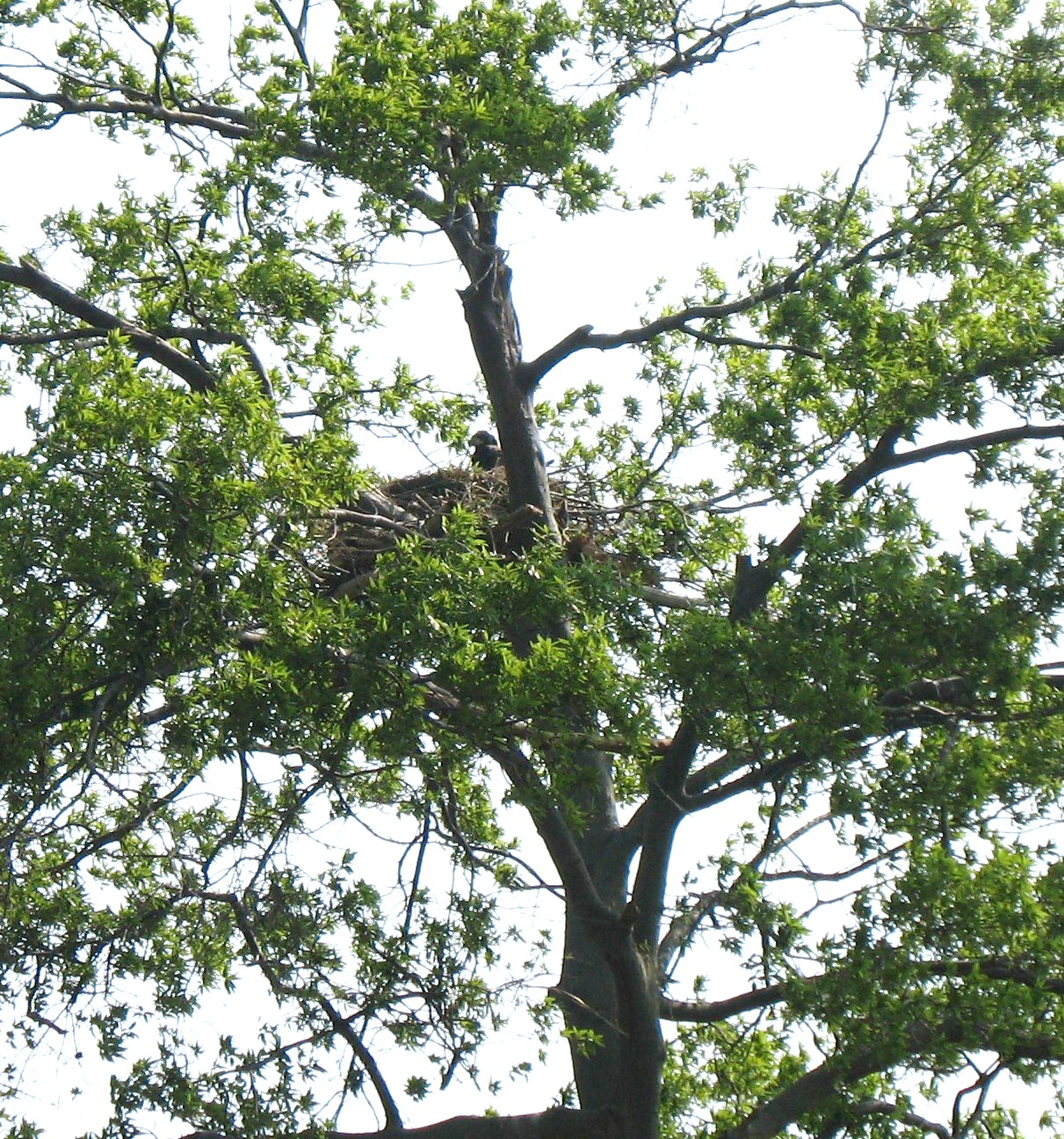
Bald eagle chick in the nest that was repaired.

On Friday May 13th the eagle banding team met to visit two eagle nests in Cumberland County. The first nest visit went smoothly, two healthy chicks were banded, blood samples and measurements were taken.  The second nest was located on an island out in the salt marsh. As we approached the island we could see that the nest looked somewhat small and it looked like some nesting material had fallen out of the tree.  As we got closer to the nest tree both of the adult eagles appeared and were making their alarm calls (which is normal) when we go out to band an active nest. As Mick Valent, Principal Zoologist with the Endangered and Nongame Species Program, prepared to climb the tree we started to look for prey items which we collect at each nest. One of the eagle project volunteers made a sad discovery, the remains of a 4-5 week old eagle chick. We then knew that something had happened to the nest.  As Mick got closer to the nest he told us that there wasn’t a nest and it must have fallen.  But the adults behavior indicated that there was still a live chick. We thought perhaps that the second chick was still alive on the ground, so we started to search.  Mick made his way up to the nest remains and we heard him yell, “there is a chick”.  It was decided that the chick would be brought to the ground  banded and examined. The nest would then be rebuild so that the chick could be put back up into the nest.

Erica Miller a veterinarian from Tri-State Bird Rescue and Research examined the bird. It had a full crop which means that it was being fed.  The only indication of its trial was a sore on the bottom of its foot pad from holding on tight to the remaining nest.

Meanwhile Mick began constructing a new nest base with large branches that were sent up using rope.  Jeremy Webber with the NJ Forest Service is training to climb nest trees and was able to assist in the nest building. Once a base platform was constructed the remaining nesting material was put up on the platform and then tied down so that it wouldn’t slide off the platform. Softer material was sent up in a bag for the final touches.  The chick was then sent back up and placed in his new home.

We estimate that the nest had fallen in the past two weeks.  The chick wouldn’t have been able to hang on much longer especially with any high winds or rain storms.   The nest volunteers went out the next day and reported that the chick was fine and the adults were at the nest.  It may have been Friday the 13th but it was this chicks lucky day!

Photo from the Field

SPECIES ON THE EDGE ART & ESSAY CONTEST AWARDS CEREMONY

by Karena DiLeo, Assistant Biologist

The Species on the Edge Art & Essay Contest Awards Ceremony was May 6th at the New Jersey Education Association in Trenton.   We had a great turn out and would like to thank everyone who attended and submitted entries into the contest.  We received over 2,000 entries this year!  Winning artwork is currently on display at NJ Audubon’s Plainsboro Preserve and will travel to Liberty State Park on June 6th.

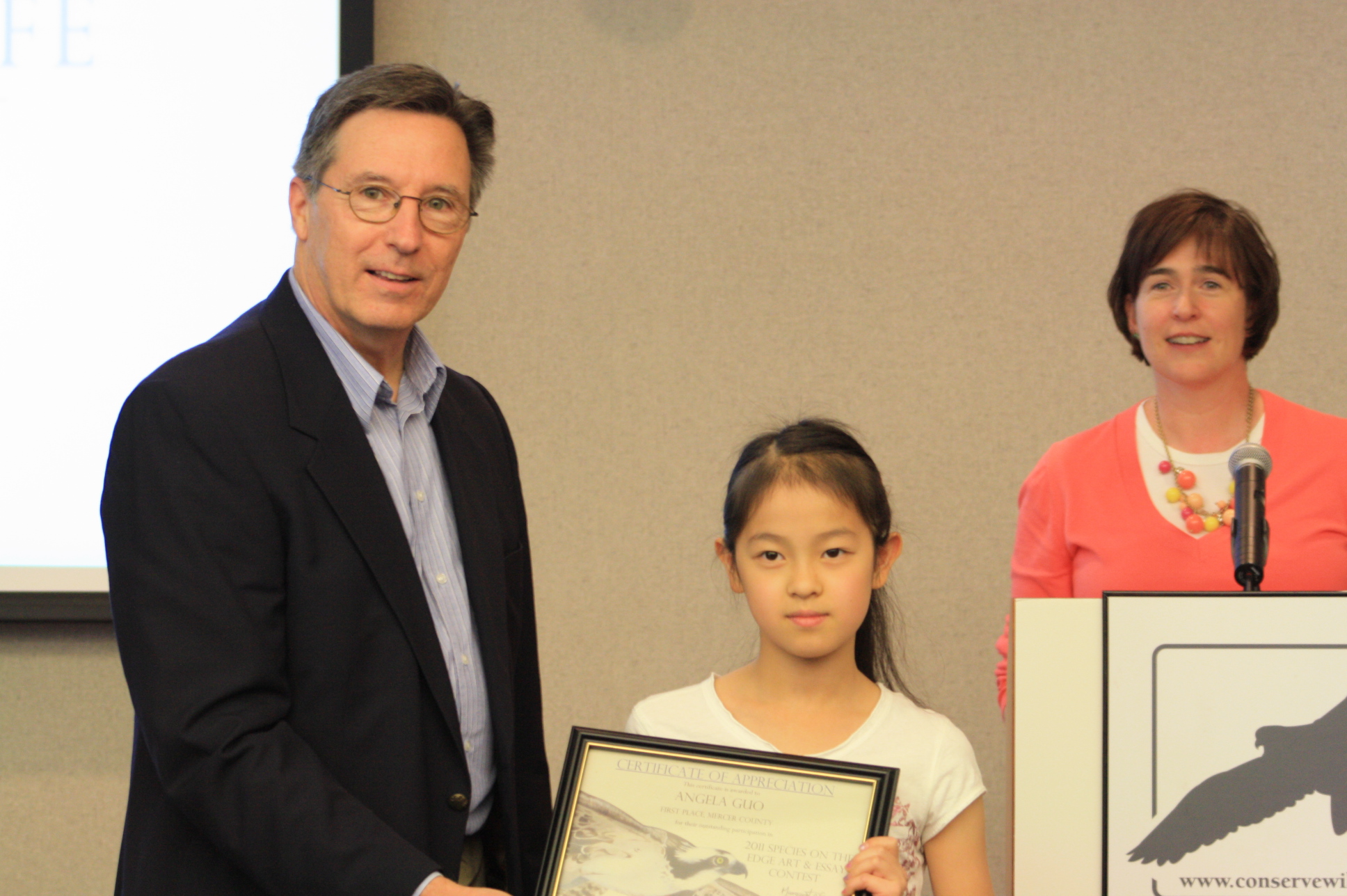
Angela Guo from Mercer County received her First Place certificate from CWF Executive Director Margaret O'Gorman and Board Member and sponsor Bob Coleman.