Highly pathogenic avian influenza (HPAI) is circulating once again this winter and has already been confirmed in New Jersey in Canada geese, Snow geese, and Bald eagles. This virus primarily affects birds and can spread quickly among species that congregate in large numbers or come into close contact with one another.
Waterfowl and raptors — especially scavengers like bald eagles — are particularly vulnerable. Eagles are often exposed when feeding on infected waterfowl or carcasses, which increases the risk of illness and mortality. Monitoring and reporting cases is critical for tracking the spread of the disease and protecting both wildlife and domestic animals.
Members of the public are urged to report sick or dead birds, especially waterfowl and raptors.
Sick or dead bald eagles should be reported immediately to the NJDEP at 1-877-WARN-DEP (1-877-927-6337).
Please remember that precautions should always be taken when encountering sick or dead birds, particularly during the winter months. Avoid direct contact whenever possible. If handling is unavoidable, wear a face mask and disposable gloves, and be sure to disinfect boots and equipment afterward.
Staying informed and reporting observations helps wildlife agencies respond effectively and protects New Jersey’s birds during this ongoing outbreak. For more information, visit the NJ Department of Agriculture’s HPAI page.
by by Christine Alber NJ Eagle Project Volunteer Posted on
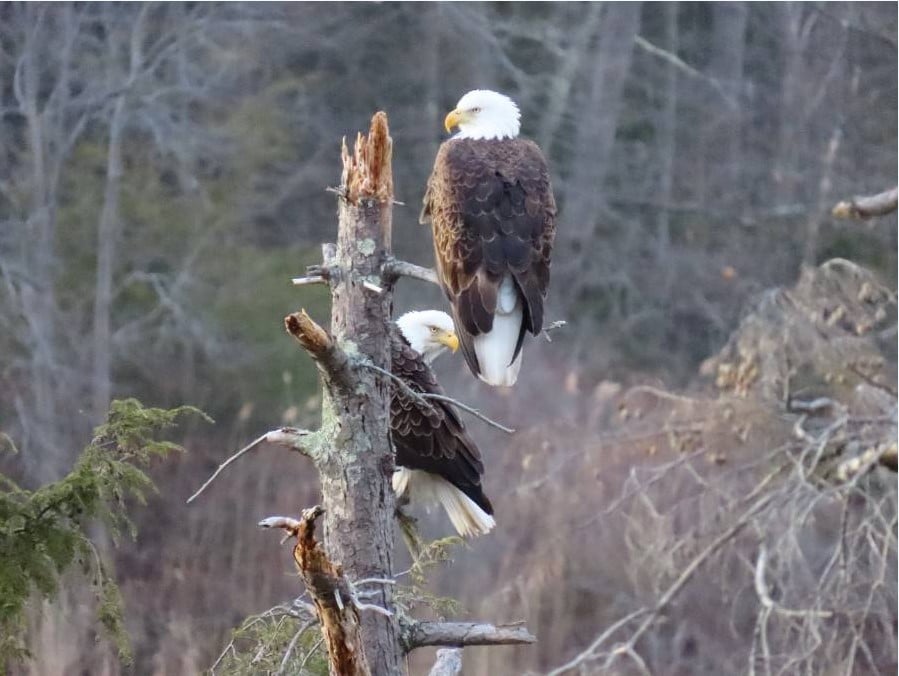
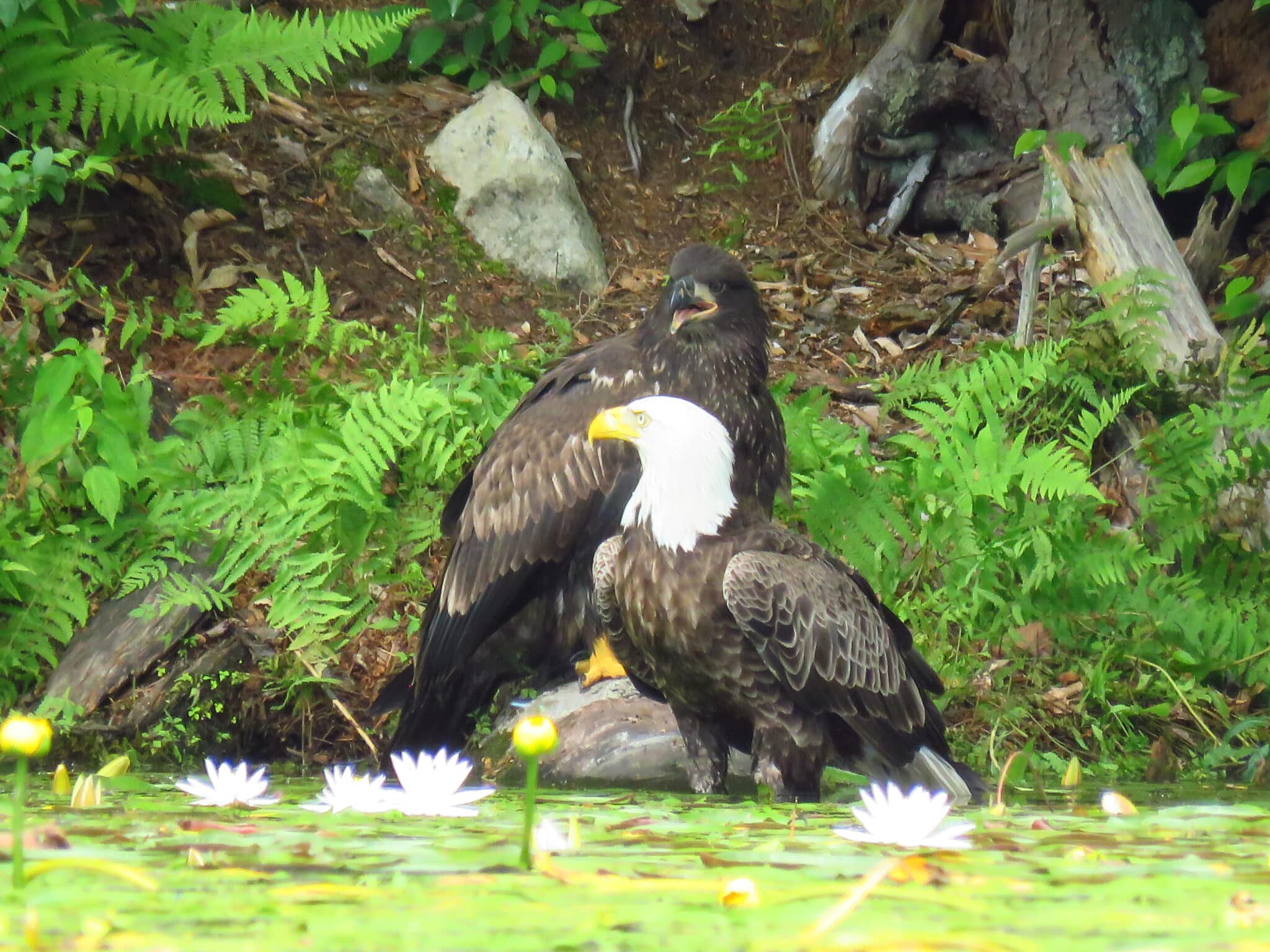
Wawayanda Pair, photo by Christine Alber
I monitor a bald eagle nest located in Wawayanda State Park, Sussex County. My heart sank when I was asked to retrieve the carcass of a bald eagle found dead on nearby Highland Lake. The Wawayanda eagles protect a large and rugged territory that includes many smaller ponds, several swamps and other wetlands, and seven lakes, including those in my community. I feared that the dead eagle was one of the Wawayanda pair. Despite their territory’s size, our local eagles are in some ways easy to follow. When the lakes are frozen, as they are this winter, we see few visiting eagles traveling through. Although eagles appear similar, each eagle is really an individual in look and behavior. After watching them closely for years, I’ve learned a lot about the eagles; characteristics, their habits, and their favorite places to perch. Moreover, the male is banded and wears distinctive green and silver ankle bands, which stand out even from a distance, especially with a pair of binoculars.
Wawayanda male Green band D10; photo by Christine Alber
Bald eagles banded in New Jersey receive two separate bands – a silver band from the federal US Fish and Wildlife Service with a unique six-digit ID number and a state green band with a two-digit code etched in silver. Because of its color and the shorter code, the state band can be read from a distance. The male’s bands tell us quite a lot about his history and this nest. He first arrived in 2016. By identifying his green NJ band as D10, I was able to learn that he was banded as a nestling at another Sussex County nest in 2010. Although I didn’t see any battles, it was clear that he and the young (fourth year) female he arrived with were the new pair in town, replacing the eagle pair that we had been seeing for at least five years prior. I didn’t know where their nest was and spent a lot of time looking for it, but I still saw them frequently throughout their territory. I eventually learned their nest is in Wawayanda.
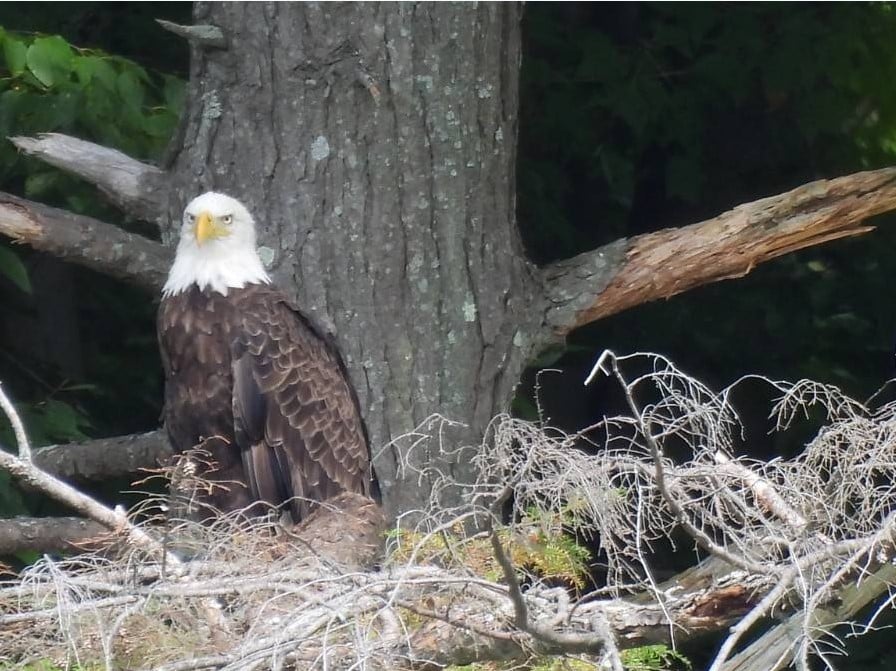
female at Wawayanda; photo by Christine Alber
The female was not banded and therefore harder to track. I don’t know for sure, but I believe the original female from 2016 may have been replaced in 2020. That year, the Wawayanda nest failed– did not fledge any chicks – and a pair of eagles were seen building a new nest near the old one. That failure, the new nest, and their behavior during the 2021 nesting season are why I think a new female took over that year. I was able to see and confirm the male’s bands, so I knew he remained. But the eagles did something I hadn’t really seen in all my years of monitoring – when either eagle was flying into the nest, they would call out, almost as if they were saying, “Hey, it’s me, not a stranger.” They did that throughout the 2021 nesting season, but not in any subsequent season. It was as if they were learning about each other that year and once they really knew each other, never had to do it again.
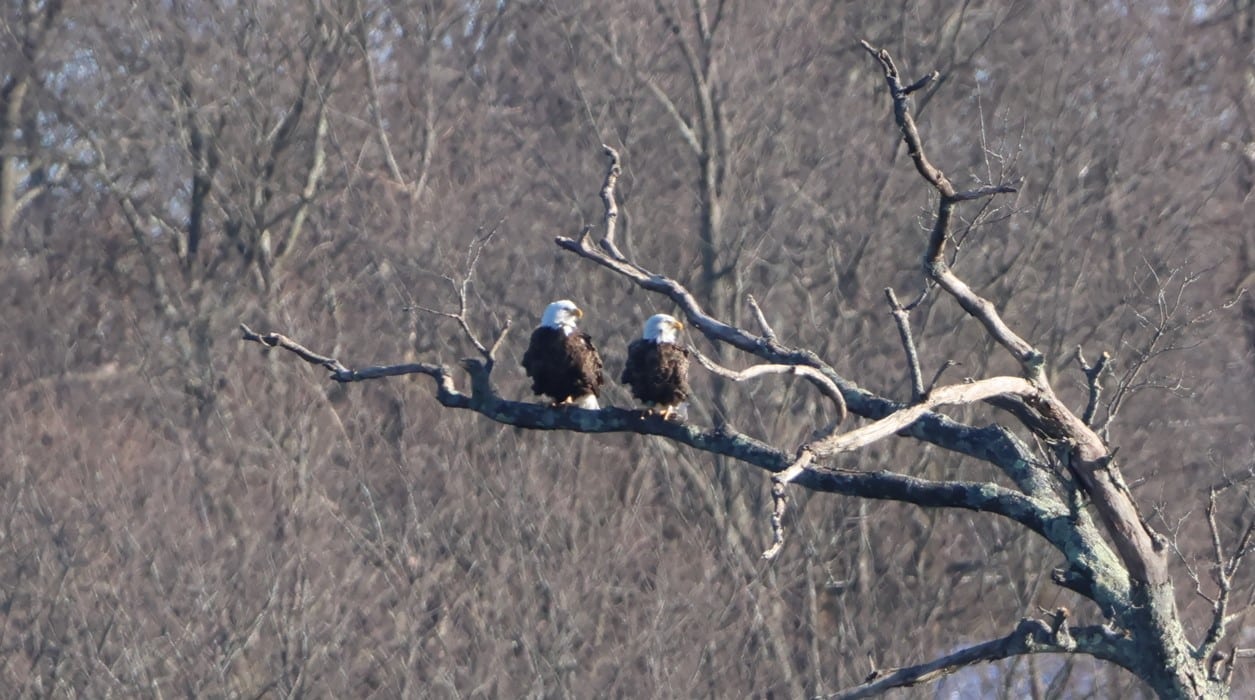
Wawayanda pair; photo by Christine Alber
This pair has been special to watch. To survive in a territory as large and challenging as landlocked northwestern New Jersey, the eagles must be especially resourceful because their nest-building, egg laying, and even early hatching season takes place when their primary food source (fish) may not be available. And they must be strong enough to repel intruding eagles across many miles to protect their dispersed food sources. When they had chicks in the nest, the male’s primary job was maintaining the security of their territory and providing food, while the female needed to ensure survival of their young. When the male was too involved with security matters, as happened in both 2023 and 2024, the female was hunting, feeding the chicks, and protecting the nest area on her own because the male was in another part of their territory for long stretches. Between 2021 and 2024, this pair fledged eight eaglets. Watching them accomplish this with fine-tuned teamwork and a secure bond has been a real privilege.
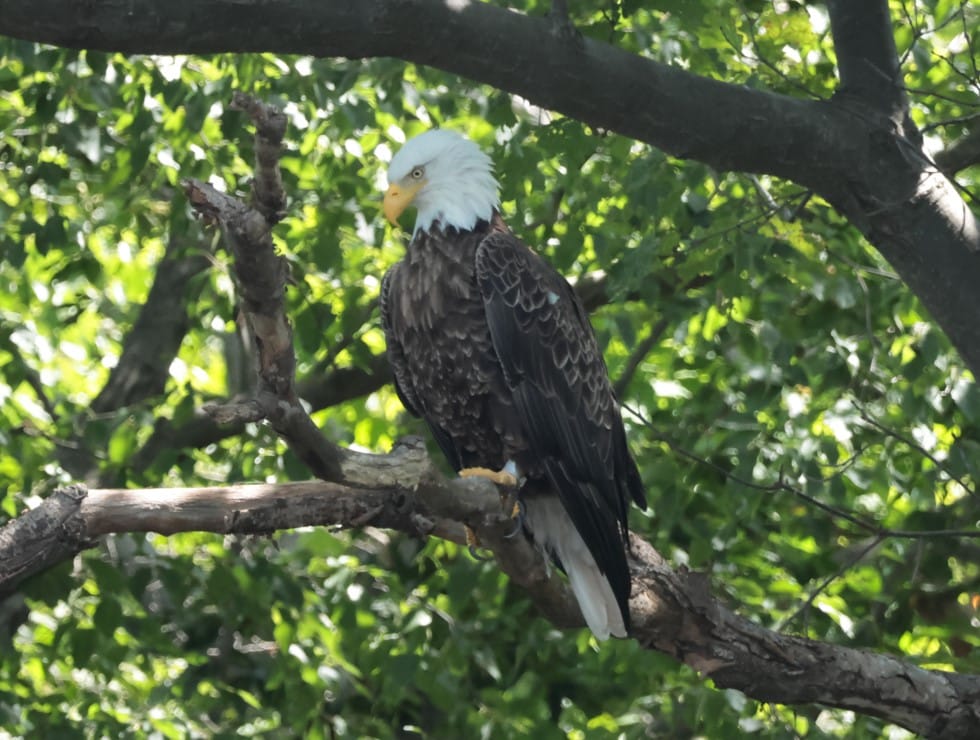
male with 2021 fledge ; photo by Christine Alber
When I retrieved the dead eagle and saw it was not banded, I thought first of the fierce Wawayanda female. With the eagle found near her favorite perching spot and few visitors in the area, it seemed likely to be her. In the two weeks after the eagle was found, two weeks that are the heart of the Wawayanda eagles; mating, nesting and egg laying season, the male waited for her by the nest. I watched him for hours, hoping I was wrong, that she would return, and the season would go on as normal. But that didn’t happen and after all of this, I’m as sure as I can be that it was indeed her. Preliminary tests are positive for Highly Pathogenic Avian Influenza (HPAI, or bird flu), which is hitting birds in our state heavily this year.
She was strong and beautiful, and I’ll miss her quite a lot. I’m sure the male spent those few weeks also missing his bonded mate. But the eagles must focus on the future and by his nature he knows he needs a new mate. As he searches for his next partner, there is no guarantee that he will even remain at Wawayanda. He may choose to move on or he may lose control to other eagles who are looking for a nesting area. I do know that there are a lot of prime nesting spaces open in our area and I hope that whoever “loses” at Wawayanda moves down the road and settles in at a nearby spot.
What happened since the female’s body was found demonstrates both the fragility and the resiliency of bald eagles in New Jersey. I have great hope that the Wawayanda nest will continue successfully and look forward to the next chapter.