Update from the Arctic #4: Knot Plateau

CWF’s Larry Niles is in Northern Canada searching for Red Knots and other shorebirds in their Arctic breeding territory. We are following him and posting summaries of his blog entries as he reports from the field.


Arctic Fox are one of the top predators of shorebird eggs. A mottled brown color in the summer, their fur turns snow white every winter.

Our camp here on knot plateau is spartan. We had to jettison many of the luxury items, like the cook tent, so that we would need to make the 25-mile ATV trip into the plateau only once. Even then, the ATVs were overloaded, and we had numerous problems like flat tires and a cracked support for the back rack.
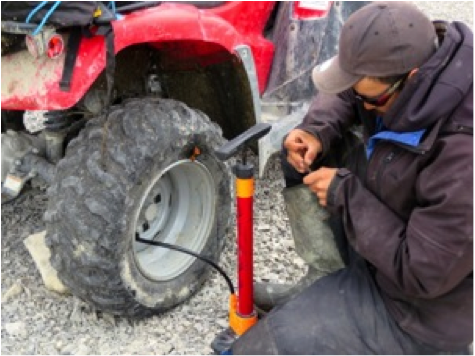
Josh’s skills have proven invaluable, as he has repaired our ATVs multiple times. Here, he fixes a slice in an ATV’s tire from a sharp rock.


At this point in our trip, the rigors of conducting daily field work and sleeping on therm-a-rest mattresses in unheated, low-ceilinged tents are starting to wear us out. Of course, much of this is age-related. The author of this blog, being on the older side of the crew, finds the need to get dressed in a tent the size of a refrigerator box to be the most difficult part of our field experience. Ironically Joshua, the youngest of our crew, has a small campaign tent in which he can stand.


A typical ridge nesting habitat on knot plateau.

But complications such as these are minor compared to what we have discovered: numbers of knots at least equal to the high densities we saw years ago. Better yet, the amount of potential nesting habitat on knot plateau is far greater than other Arctic sites we have surveyed because the knots here are nesting in much greater profusion. This plateau is perfect nesting habitat because these potential nesting sites are surrounded by wetlands where the newly-hatched young can feed, and the complex is also within 10 kilometers of the Sutton River basin. The river remains clear almost year-round, making it a perfect feeding spot for the adults while the nesting area is still frozen.

Team member Mark Peck examines an unhatched American Golden Plover nest.


The greater area of habitat, however, causes great difficulty in finding nests, and it doesn’t help that knot nests are the notoriously hard to locate to begin with. Most shorebirds react to intruders on approach because both adults stay near the nest. But Red Knots, on the other hand, don’t react to intruders because one adult is elsewhere feeding and the incubating bird won’t leave the nest until he is almost stepped on. So far, we have found the nests of several shorebird species such as American Golden Plover, Semipalmated Sandpiper, and Dunlin, as well as those of other birds like Long-tailed Jaegers – but so far no knot nests.
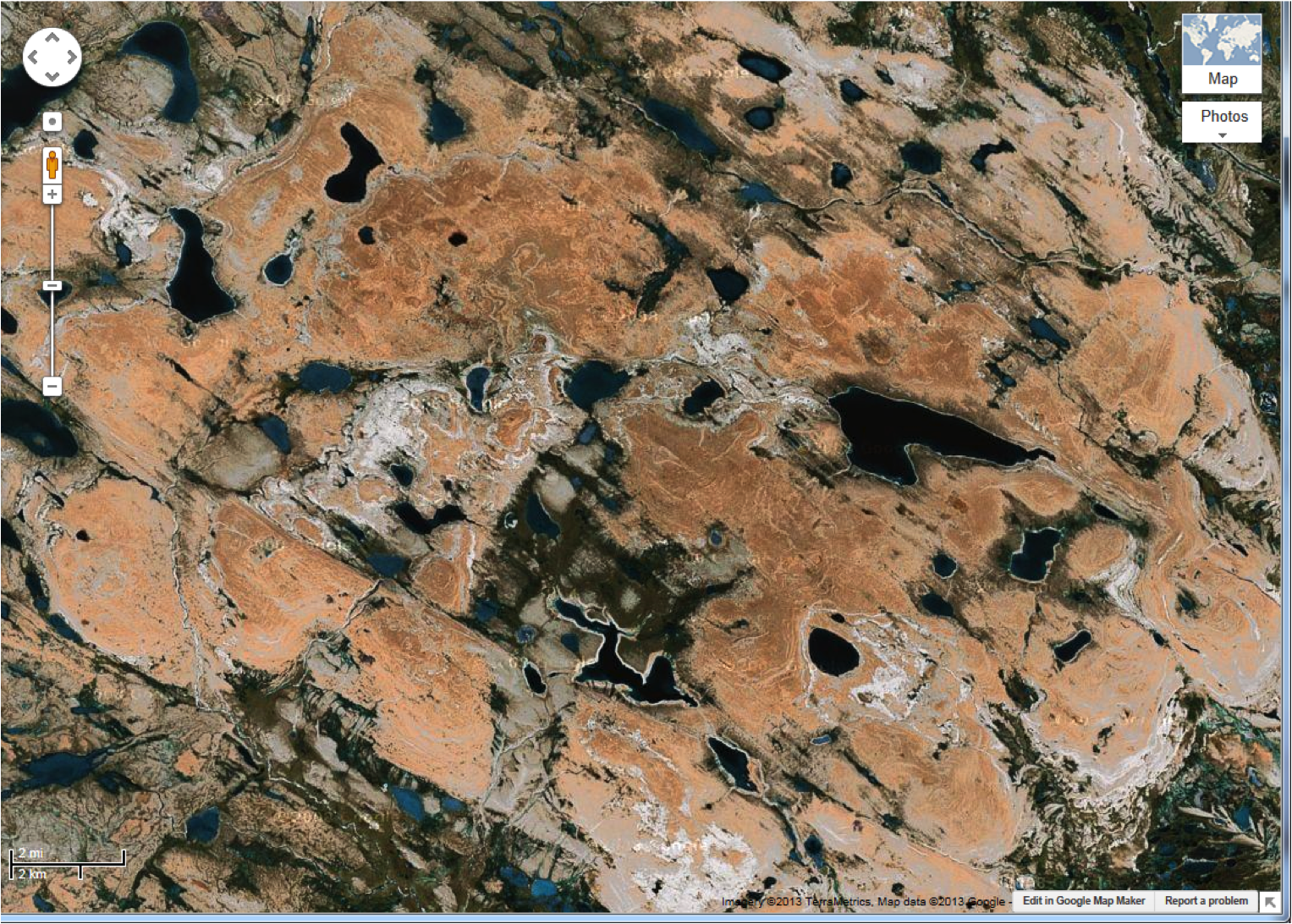
 

A Google Earth image of our study area.
An interpreted map of the same area. Each color represents a different level of desirability for Red Knots.

Our mapping work is going well and may yet prove the most valuable result of this trip. Under Rick’s guidance we are ground truthing interpreted satellite images that already distinguish tundra habitat with good precision. Our task is to train the map to distinguish habitat important to knots. In the end we will create a precise mapping of optimal knot habitat.


All in all, we still have a lot of work to do and not much time left to do it. But even though we have yet to find the knot nests we came for, we cannot help but be pleased by what we have already found.


For the original blog entries, see Larry’s posts Knot Plateau and The Search Continues.

Stay tuned for further updates!


Red knot wintering population drops by more than 5,000, accelerating slide to extinction

Decline emphasizes need to list the knot under the Endangered Species Act and implement stronger protections at key U.S. stopover
A red knot feeds on horsehsoe crabs on a Delaware Bay beach. © Bill Dalton

Summary:

  • Scientists today released a report announcing that a decrease of at least 5,000 red knots was observed at key wintering grounds in Tierra del Fuego, Chile from the previous year. Scientists reported population counts of wintering knots in other locations declined as well. The estimated current total population for the migratory shorebird is now unlikely to be more than 25,000.
  • The decline in red knot numbers elevates the importance of implementing stronger protections at Delaware Bay, a key U.S. stopover where migrating knots depend on an abundant supply of horseshoe crab eggs to fuel the final leg of their migration to breeding grounds in the Canadian Arctic.
  • The scientists’ report concludes that despite horseshoe crab harvest restrictions put in place by the Atlantic States Marine Fisheries Commission over the past decade “there is still no evidence of recovery of the horseshoe crab population, either in numbers of spawning females or in all sub-adult age groups including juveniles.” Restrictions to date have only been enough to stop the population from declining further, are insufficient to recover the population and will continue to be insufficient unless the harvest is greatly reduced.


WASHINGTON (May 23, 2011) – Conservation groups are calling on the U.S. Fish and Wildlife Service (FWS) to take immediate steps to list the red knot under the Endangered Species Act. A listing would initiate the development of a recovery plan and require federal agencies whose actions affect red knots to consult with the FWS. A listing would also require the Atlantic States Marine Fisheries Commission, housed under the National Marine Fisheries Service, to consult with the FWS on the regulations it establishes for the horseshoe crab fishery. The following are statements from groups pursuing an endangered species listing:

“It’s simple, to halt this decline and imminent extinction, we must list the red knot now and view all shorebird protection through the same lens,” said Margaret O’Gorman, executive director for Conserve Wildlife Foundation.

“This year’s huge decline in wintering red knots provides clear evidence that the status quo is not working. Unless action is taken now, red knots may be on an irreversible slide to extinction,” said Bob Irvin, senior vice president for conservation programs at Defenders of Wildlife. “The U.S. has a responsibility to the global community to protect this migratory shorebird, which stops along our coast to rest and feed while making one of the longest migrations in nature, from the tip of South America to the Arctic.”

“The bad news demands we redouble our efforts to rebuild the horseshoe crab population of Delaware Bay,” said Tim Dillingham, Executive Director of the American Littoral Society. “A listing of the red knot under the ESA will allow for management of the horseshoe crab population to be directed toward recovery of the shorebird populations, and not simply the local fishing interests. We urge the USFWS to make this a priority.”

“Until recently, the Delaware Bay resplendent with spawning horseshoe crabs and over a million shorebirds was the land of plenty – our Serengeti,” said Eric Stiles, vice president for Conservation and Stewardship for New Jersey Audubon Society. “The red knot is one of the shorebirds whose very existence is teetering on the brink of survival. Unlike special interest naysayers, we have full faith in the Endangered Species Act. Only through listing will the robin-sized, chestnut colored shorebird be enjoyed by future generations.”

“The decline of the shorebirds and the horseshoe crabs that sustain them is not speculation; it is a proven reality documented by science and history. The Atlantic States Marine Fisheries Counsel, among those charged with protecting the species, has ignored the science and the harm in order to assuage their political allies. In the absence of strong and earnest action from the ASMFC, we need strong action from our states. While New Jersey has taken that strong action to protect the crabs and the birds, Delaware’s actions leave a lot to be desired when the politics heats up” expresses Maya van Rossum, the Delaware Riverkeeper.

“The rufa red knot, which once darkened the skies during their migration, now stands on the very knife-edge of extinction. The states along the east coast, with the exception of New Jersey, dithered for decades and now the only way to save this subspecies is for the U.S. Fish and Wildlife Service to place it on the Endangered Species List. With this new report, it is clear that if the federal government doesn’t act soon, the next generation of Americans will never see this amazing long-distance migrant. People who want to see this bird in the wild best make plans in the near future because the way things are going, it will be gone sooner rather than later,”  said Darin Schroeder, Vice President for Conservation Advocacy for ABC.

“A population decline this large and this rapid is almost unequalled in our lifetime,” said Greg Butcher, Director of Bird Conservation for National Audubon Society. “Surely such a bird requires the immediate protection of the Endangered Species Act and needs to be a top conservation priority for all of us.”