It’s hard to believe that in another 6-7 weeks ospreys will be back in New Jersey and ready to begin another nesting season. Over the next few weeks we’ll be busy making repairs to existing nests, moving platforms to more suitable locations, and installing new nests to replace old derelict platforms. We maintain a huge portion of the available nest platforms along the coast and do so with no state funding! All of our funding comes from private donations from individuals, foundations, or grants. Since our osprey project began in 2006, we have installed more than 100 nesting platforms throughout New Jersey. What’s new? This winter we have plans to install three new structures in Bayonne with local high school students. This will be the furthest north that we have ever worked with ospreys. It’s a new and exciting endeavor for CWF. If you enjoy viewing ospreys during your visits to coastal areas of New Jersey during the summer, please consider making a donation today by sponsoring the placement of a platform or by adopting an existing platform.
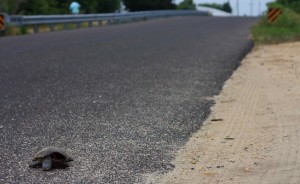
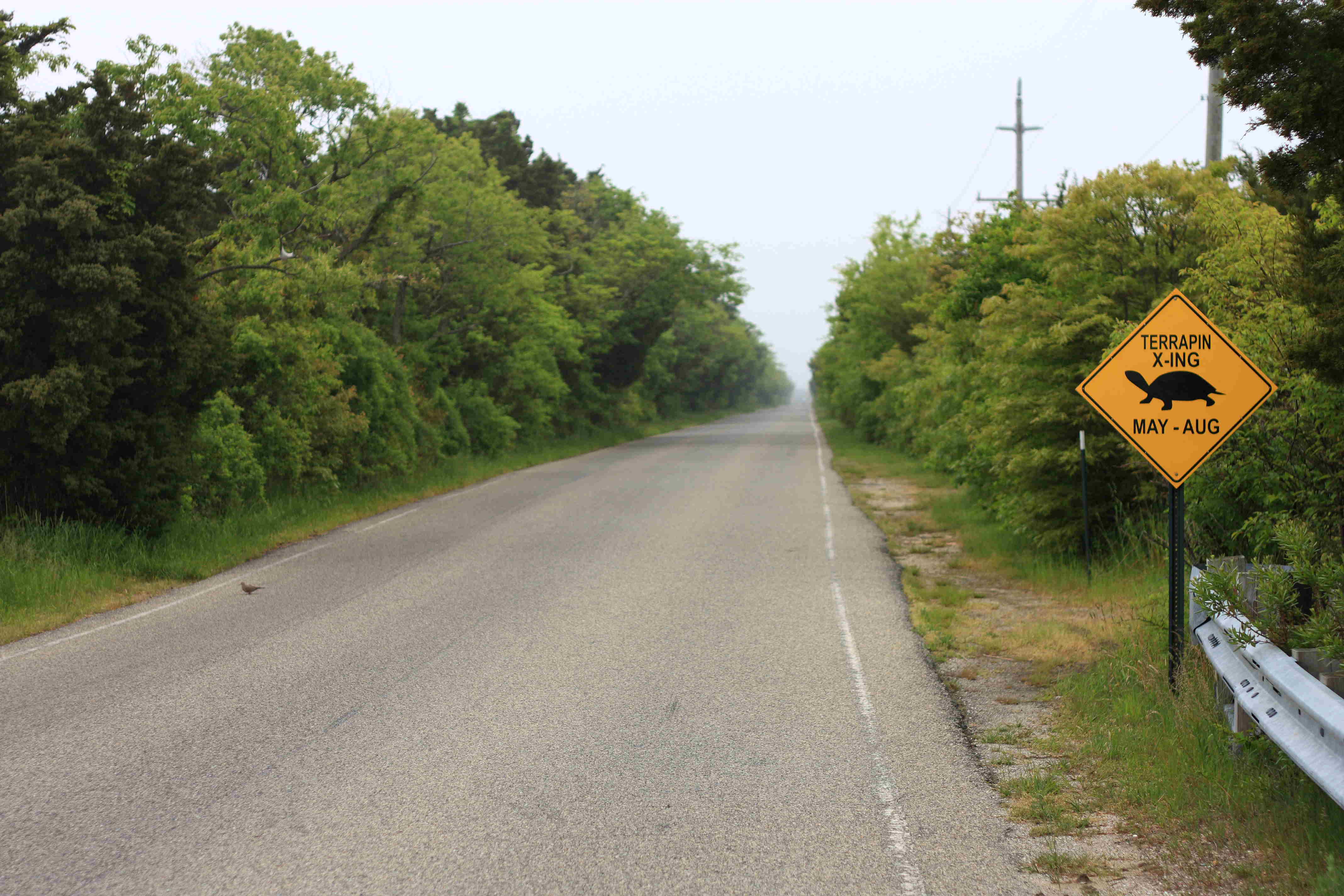
Currently there are no posted speed limits on Great Bay Boulevard from Sea Isle Drive to the east end in Little Egg Harbor Township, Ocean County, New Jersey. The road bisects one of the largest state wildlife management areas along the entire coast of New Jersey which is also designated as the Jacques Cousteau National Estuarine Research Reserve. Designation as a National Estuarine Research Reserve is “to promote the responsible use and management of the nation’s estuaries through a program combining scientific research, education, and stewardship.” The habitat alongside the road is home a diverse array of wildlife and one species, the northern diamondback terrapin, often crosses the roadway to get to prime nesting areas along the road shoulders.
Female terrapins range in length from 6-9″ and actively search for nesting areas during summers months from May through July. They are hard to see with their dark coloration and high speed limits make identification even harder. On some days as many as 50 terrapins can be seen crossing the road. Many people stop to help these terrapins cross safely and they themselves put their lives in jeopardy. Luckily no one has been seriously injured or killed yet. Unfortunately, terrapins aren’t so lucky, previous studies have indicated that up to 30% of terrapins are killed on Great Bay Blvd. while attempting to find suitable nesting areas (Szerlag and McRobert, 2006).
The Township of Little Egg Harbor knows about the problem there but has done little to help solve it. Public safety should be a serious concern for any type of government. In other parts of New Jersey and in other states people and property have been seriously injured or killed and damaged while either helping one cross safely or by avoiding a collision with them.
Little Egg Harbor can help reduce the chances that a pedestrian gets killed or injured, and they can reduce the amount of terrapins that are killed by motor vehicles. By reducing the speed limit along the road from 50 mph to 30mph both people and wildlife benefit and motorists get to their destination safely.
Last year we installed or relocated a total of 17 osprey nesting platforms. This year we installed or moved another 21. In 2011 there were 25 new pairs, some of which, that nested on these new platforms. This year was another record setting year for ospreys in New Jersey. We recorded an average of 2.07 young per active nest, a new record. We last documented the size of population at 486 nesting pairs in 2009 when we conducted a statewide census. We now believe that the state population has met recovery goals (of more than 500 nesting pairs) that were set after DDT and habitat loss decimated the population by upwards of 90%. We aren’t the only organization who has helped with the recovery of ospreys. We credit the hard work of biologists with the Endangered and Nongame Species Program in the 1970-present who worked tirelessly to help the population rebound. To name a few, former Deputy Chief of ENSP, Pete McLain; former Director of NJFW, Marty McHugh; former Chief of ENSP Larry Niles, current Chief of ENSP, Dave Jenkins; current Director of NJFW, Dave Chanda; and Supervising Zoologist Kathy Clark who has worked to protect ospreys over her entire 20+ year career with ENSP.
We can also credit the recovery efforts to local environmental and water-quality improvements, like the Barnegat Bay Initiative and restoration of the Meadowlands, and by the grass-roots efforts by concerned citizens and groups who have helped provide nesting platforms to accommodate their population growth.
In the next week ENSP and CWF will be releasing the 2011 Osprey Project Newsletter which summarizes the entire nesting season survey results. In the meantime, check out the video below of myself and two friends who volunteered to help me move a nesting platform on southern Barnegat Bay in late 2010. note: I usually have more than 3 people who assist me when installing an osprey platform.As they say “the more, the merrier…”
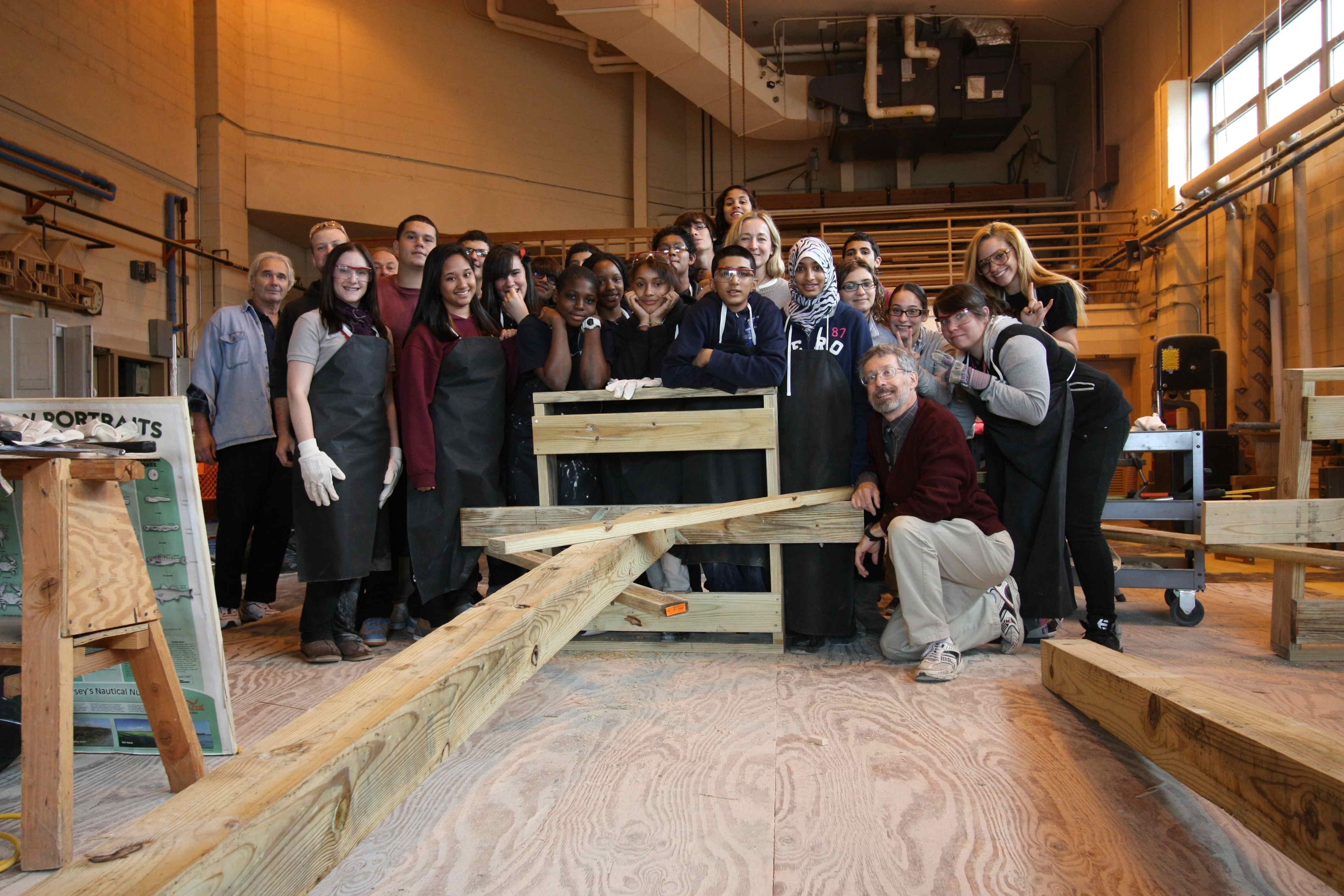
This past week I spent the day with students and teachers at Bayonne High School (BHS). I was there to help students construct three osprey nesting platforms. The platforms are being placed at the Bayonne Golf Club (BGC) along a portion wetland habitat that was restored by the BGC along New York Bay. This whole project began when I was approached a couple months ago by Tom Tokar, a teacher at BHS, about assisting them with the construction and placement of the platforms with some of his students. Tom and Larissa Drennan, a teacher at the Woodrow Wilson School, have involved their students in many environmental projects in Bayonne, one of which is where they grow mussels and seed them at the BCG. Ron D’Argenio, with BGC has supported their efforts from the beginning not only by offering up the BGC as a location to seed the mussels but also through financial assistance. Ron and the BGC are also fully funding this project as well, with a very generous donation to CWF. Continue reading “Photo from the field”
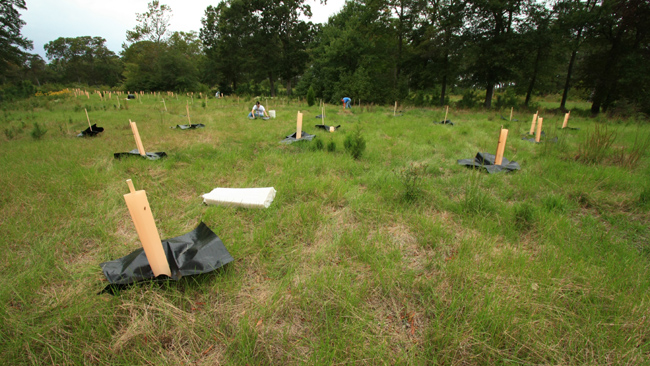
For the past 3 years Conserve Wildlife Foundation of NJ has been working to restore habitat at an old golf course in lower Cape May County. We have concentrated on reforesting many of the old fairways at the site, now known as Cape Island Wildlife Management Area. This past week we planted around 300 native tree seedlings from Pinelands Nursery there. All of the species planted will benefit wildlife by providing food and cover. It will increase biodiversity and reduce fragmentation of forested habitat. We planted white and scarlet oak, pitch pine, gray birch, bayberry, serviceberry, persimmon, beach plum, and tulip poplar. Seedlings are protected by tree tubes (help reduce light browse by deer and rabbits) and weed mats (reduce competition from cool season grasses) to help increase survival rates.
Trees also benefit you and I. They capture carbon dioxide and release oxygen. Planting trees is one of the most effective and least expensive ways to reduce carbon in the atmosphere. They can reduce heating and cooling costs if planted around your home. They can also help increase your home’s property value. Fall is the best time to plant trees. When planting a tree make sure to dig the hole twice as deep and twice as wide as the root ball. Plant to a depth where the collar of the truck is not below ground level. Amend the soil if necessary and only put up to 2″ of mulch against the trunk. Here are my picks for best native trees to plant for wildlife (and you) in your yard:
Shade trees: Sweet gum (awesome fall foliage!), tulip poplar (great pyramidal shape when mature, great shade tree), oak spp. (produce acorns and good shade trees, scarlet oaks have stunning fall foliage). Plant these on the south side of your house to reduce cooling costs in summer.
Conifers: red cedar (good wind break, dense cover for wildlife, provide berries for songbirds), american holly (beautiful red berries in winter, good cover for wildlife from heavy snow). Plant these along the NW side of your house to act as a windbreak from cold winter winds.
Watch a video clip about our work at Ponderlodge that was featured on NJTV on September 22.
written by Maureen Barrett, CWF volunteer/donor/wildlife enthusiast/educator
With wind speeds clocked at 91-92 mph, the osprey nest behind my house didn’t stand a chance! On Tuesday, July 19th around 8:00 P.M., a thunderstorm came barreling into Fortescue from the northeast. It was a wicked storm with thunder, lightning, and even hail. The wind was so strong that my purple martin housing was being blown around like it was a stalk of phragmites. The adult osprey held their positions on the perching supports of the platform for as long as they could, but soon jumped ship. By that time, the pole for the martin house broke and I couldn’t even see the osprey platform through the rain.
After the storm, some moonlight allowed me to see the silhouette of the osprey platform. It was still standing. But I couldn’t see any nesting material inside; it looked empty. I made an attempt to walk through the marsh to get a closer look, but I thought it would be wise to wait until first light. So I waited for the sun to rise.
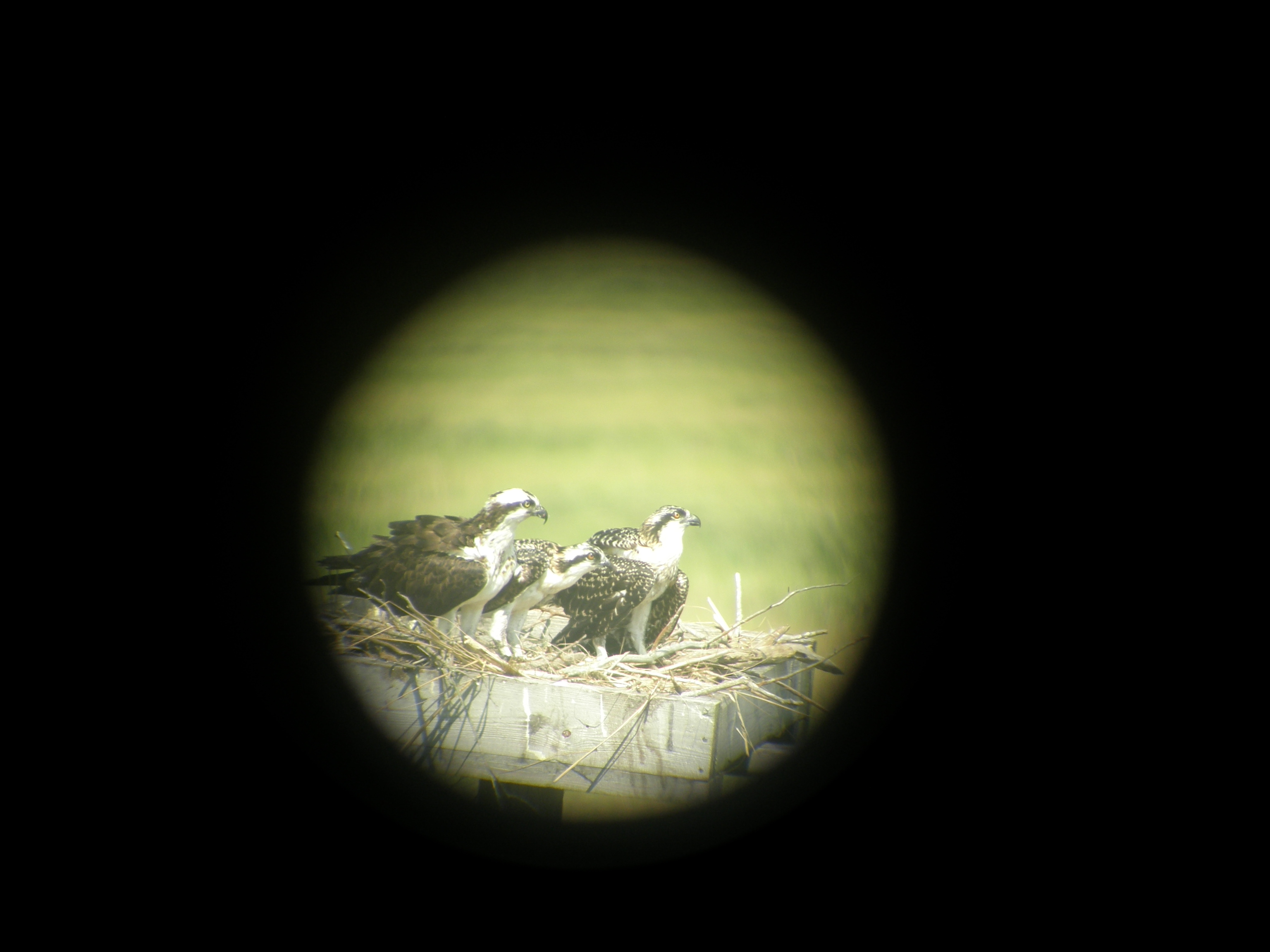
An image that was taken using a technique called "digiscoping" reveals two osprey young in the nest.
By 5:00 A.M., my suspicions were confirmed. There was not one piece of nesting material on the platform. Fortunately the adults survived the storm and were once again perched on the platform supports, but the nest and chick were gone. The high winds blew everything off the platform. I quickly put my boots on and walked out on the marsh. I was surprised how relatively easy it was to get to the platform after getting a few inches of rain the night before. There was only one very small ditch I had to cross. I soon found the pile of nesting material and on the edge of the pile was a clump of wet feathers. It looked like the storm had taken the chick’s life. But then I saw some movement! It had survived the storm, the fall, and an evening on the ground!
This being my first experience with such an ordeal, I called my friend Bill Miller who lives up the street. (You know who your friends are when you call them before 6:00 A.M. for a favor!) He brought down a ladder and a piece of plywood. We went back on the marsh, dried the chick with a towel, and put it back on the platform. Within a few minutes, the adults returned to the platform to see their chick back in the nest.
Two other nests in Fortescue were also destroyed by the storm. Later that day, Brian Johnson of the Natural Land Trust’s Glades Wildlife Refuge had to place a foster chick in my nest. This chick’s nest was in a tree and totally destroyed. Both chicks are getting along just fine and being fed by the adults.
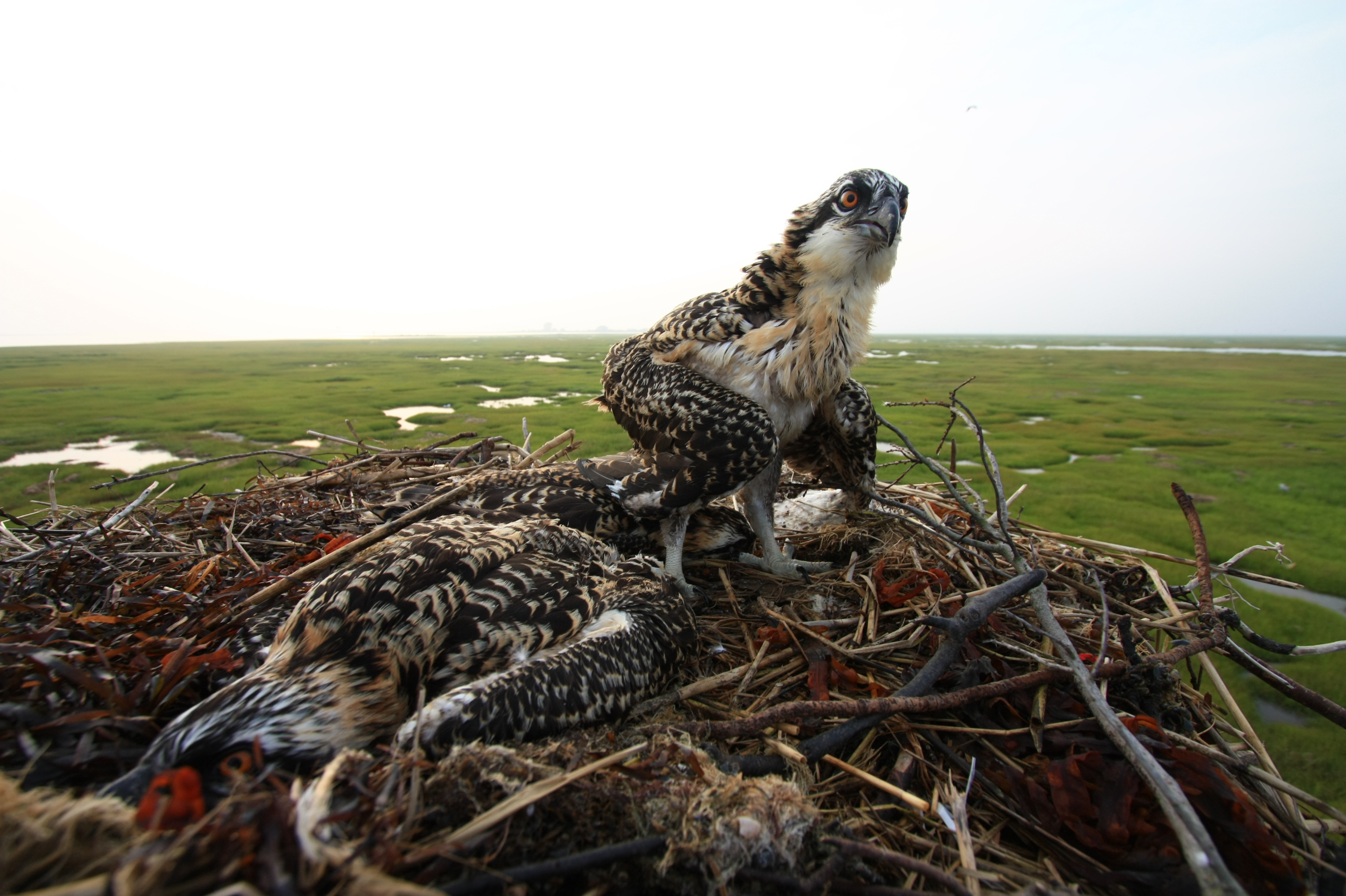
Volunteers, CWF staff, and biologists with NJ Fish & Wildlife recently completed osprey nesting surveys throughout coastal areas of New Jersey. Each year these “osprey banders” complete “ground surveys” (referred to as ground surveys because they are surveying nests by land/sea, not by helicopter) that cover around 70% of the state population. I survey colonies on Barnegat Bay, Little Egg Harbor, and Absecon. The surveys are meant to keep track of the population and determine its health. During the surveys the banders access nesting areas mainly by boat since most ospreys nest in coastal areas or by water (their source of food). We use ladders to access nests where we count the number of young produced and then place an aluminum band on each of the young. For the past two years we have also been collecting feather samples for a study being conducted by the Academy of Natural Sciences in Philadelphia where they are analyzing the stable isotopes to determine what ospreys are eating and how their diet has changed over time. More specifically they’ll be looking for changes in the isotope profiles across the local range of ospreys – something that has never been done before.
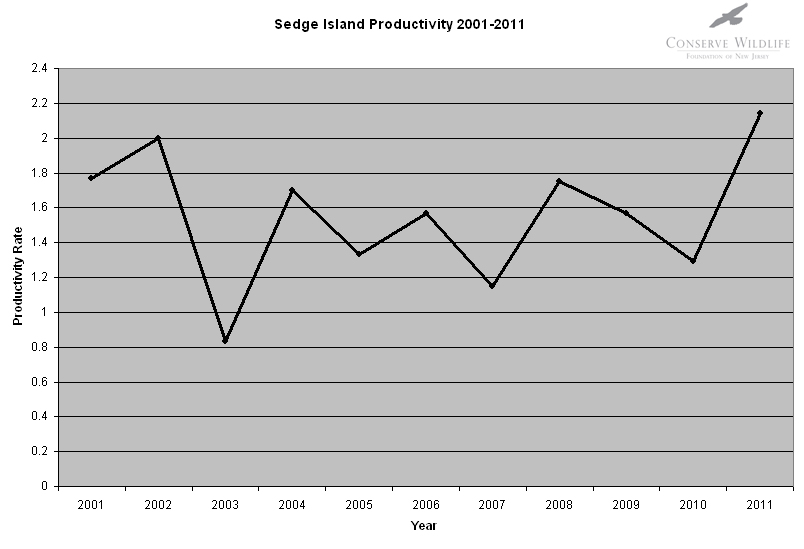
In one area, Sedge Island WMA, that I’ve surveyed for the past few years I surveyed 27 nests. 22 of those nests were occupied and produced a total of 47 young. 34 of those young were banded for future tracking. From the survey I can calculate the productivity or reproductive rate which is a measure of how healthy the population of that colony is. The productivity rate for Sedge Island is 2.14 young/active(known-outcome)nest this year which is the highest ever recorded (see chart at right for more details). These awesome results are the result of calm and mild weather conditions this spring and summer, high availability of prey, and possibly the increased amount of experienced breeding birds. Another factor that has surely helped to give the population a boost is the increased availability of suitable nest sites along the coast. Since 2004, I’ve helped to install more than 100 nesting platforms. Many of these platforms replaced old dilapidated structures and now give ospreys a better chance at successfully raising young that will eventually return to New Jersey to reproduce.
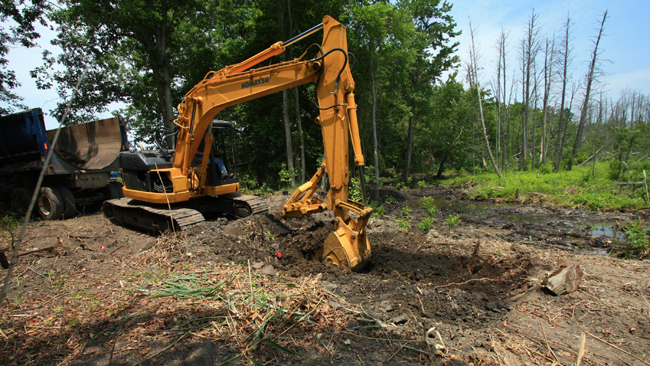
In late 2009 we received notification that we were going to receive funding through the American Recovery and Reinvestment Act of 2009 to carry out a habitat enhancement project inside Bass River State Forest. The purpose of the project was to enhance habitat on site for migratory birds and other wildlife, especially rare species. The main part of the project was to remove fill and control invasives, like phragmites, that was illegally dumped on the edge of freshwater wetlands. The first phase of the project was to create scrub-shrub habitat. In early 2010 we planted over 1,000 native shrubs that provide both food and cover. Even though it was a hot, dry summer last year many of the shrubs are already flowering and bearing fruit. In summer we broadcast 75 lbs. of wildflower seed in the old fallow fields. Finally, over the past 2 weeks a crew from Anthony Excavating Inc. used excavators to remove tons (literally) of milled asphalt, concrete, and other debris (everything but the kitchen sink) along the edge of the wetlands. They used a small excavator that was able to reach a long distance without disturbing much of the surrounding area.
A series of interpretive signs are being designed and will be installed on site this fall. I also plan to work with volunteers from Bass River State Forest to enhance a 1.5 mile loop hiking trail around an old fire road on the edge of the wetlands.
I’ve been off work for the past week to spend some time with the newest member of my family, Reed Alexander Wurst. I was planning on heading into the office today to play catch up with a lot of projects that I’ve involved with (having a baby during field season is definitely keeping me busy!). So I started the day by opening up my laptop to download the 90+ emails I’ve gotten in the past week. As I sat down for some breakfast I saw an email from a woman where the subject said “Osprey on our Sailboat and we need help!” Immediately after I saw that I thought, there goes heading into the office… The woman who contacted me was Melissa, who was living on her sailboat that was moored in the harbor at Barnegat Light (BL). She sent me an image and this is what she wrote:
“We read your story in the SandPaper so are contacting you about this situation.
We heard a loud noise around 1am and when we looked with the flashlight we saw this osprey. It tried to fly up and out w/o success and now that it’s light we can see blood and it’s appears that his/her wing is injured.
We are anchored at Barnegat Light across from the town boat ramp. Our boat is Piscator and is the 32′ white and green double-ender.
We have no way to deal with handling this osprey, so really need help!! “
I called Melissa and I headed up to BL. I met John at the boat ramp and we rode out to the s/v Piscator in his dingy. After the short ride I saw that that osprey had a fracture to it’s left wing in the carpal (wrist) joint. I carefully collected the osprey and saw that she was banded. I looked up the band (788-49090) and she was banded in Sandy Hook on June 30, 2009. This would be her first year back from her wintering areas to breed in New Jersey. Ospreys spend two years after fledging in their wintering areas. One positive aspect is that most two year old birds do not raise young their first year after returning to nest in areas where they originated. So, no young ospreys are dieing b/c of her injury.
I then called Don Bonica with Toms River Avian Care and transported the osprey to Barnegat Animal Clinic where it would temporarily stay. I don’t know if it will heal from its wounds. Ospreys don’t do well in captivity or in rehabilitation settings. I can only hope that its fracture is minor and that it heals quickly!
Melissa knew who to contact after reading a story about my work with ospreys in New Jersey, especially the B. Bay Watershed in The Sandpaper. The story is viewable online until Wednesday, June 15th.
Check out the story in The Sandpaper on page 21. Ospreys even made the cover!
Northern Diamondback Terrapins are native to New Jersey and inhabit the many miles of coastal salt marshes along the Atlantic Coast and Delaware Bay. Terrapins were once very common and were used as a main food source of protein by Native Americans and then European settlers. In the early 1900’s it was hunted so extensively that it almost faced extinction. Luckily, during the 1920’s, use of terrapins for food dropped in popularity. This allowed the population to slightly recover and avoid extinction. However, several major threats still threaten their survival. Habitat loss, mortality from being drowned in crab traps, and road mortality all pose major threats to the health of the population. Each year thousands of terrapins are killed by motor vehicles throughout their range and here in New Jersey, Great Bay Boulevard is no exception.
Great Bay Boulevard or Seven Bridges Road extends approximately 5 miles into estuarine emergent wetlands and northern diamondback terrapin nesting habitat. The boulevard is surrounded by over 5,500 acres of protected coastal habitat (Great Bay Boulevard Wildlife Management Area – Managed by NJ Division of Fish and Wildlife), a relatively unspoiled, estuarine ecosystem. This road, at times, has high a volume of traffic, especially on weekends when boaters and outdoorsmen travel on the road to get to and from one of the several active marinas along the road. Currently during May-August there is no protection to terrapins when they cross Great Bay Blvd. from vehicle traffic. Most terrapins who cross the road are adult females who are laden with eggs and are looking for a suitable nesting site. These females lay their eggs in a sand/gravel mixture where it is easy for them to dig and cover their eggs, like sandy beaches and in scrub-shrub habitat along road edges. Many female terrapins are inadvertently hit-by-car and injured or killed by speeding motorists or people unaware of the summer nesting habits of the terrapin. This high mortality rate has caused the local population to decline and it has also caused the average size of adults to drop significantly over the past 20 years.
How you can help:
Volunteers are needed to help install ~ 4,000 ft. of barrier fencing along Great Bay Blvd to help reduce the amount of road kills. Sambol construction will be helping us by trenching a ditch for us to place the fence in. Volunteers will help lay out fence, install metal posts, hang fence, and back fill trenches.
Please pack a lunch and bring plenty of water, sunblock, and bug spray.
We are starting work on Friday at 8am, but if we don’t finish, we’ll wrap up work on Saturday morning.
We will meet after the first bridge; click here for a Google Map link. You can park here and then we can car pool to the section of the road where the fence will be installed.