Three juvenile Black Vultures were released back into the wild at at site in Cumberland County.
This location is the site where several other juvenile eagles were released recently after recovering from various injuries. A feeding station has been set up and stocked every other day with fresh fish to supplement their diet until they are able to hunt on their own. Game cameras set up by ENSP, Kathy Clark show that both eagles and vultures have been visiting the site. One of the first juvenile eagles to be released and banded E/96, makes almost daily visits to the site.
Diane Nickerson Director of the Mercer County Wildlife Center was caring for three Black Vulture juveniles 3.5 to 4 months old, that were ready for release. It was decided to release them at the feeding station in Cumberland County where they could be around other vultures.
Black vulture nestlings at Mercer Co. Wildlife@ Diane Nickerson
Black vultures do not build nests, they lay their eggs in tree cavities, hollow logs, caves and on the floor of abandoned buildings. Two of the vulture nestlings had been removed from a barn during renovation and dumped in the woods. Luckily a neighbor found them and they arrived at Mercer County Wildlife Center on May 28, 2020. The third nestling came from the Raptor Trust in June.
Vultures are social, they roost, eat and soar in groups. The three juveniles needed to be released where there were other vultures. The nest cams at the feeding site showed that there were plenty of both Turkey and Black vultures, at the feeding site.
Juvenile Black vultures at release@ Kathy Clark
Thank you to Mercer County Wildlife Center and everyone who made this release possible, including the Eagle Project volunteers who have been dropping fish off at the feeding station.
Blog written by Eagle Project volunteer, Frank Budney
On June 15th, 2020 a juvenile Bald Eagle was rescued in a most unlikely location; on a major highway, located in an industrial area of Union County. At first glance stories like this usually have an unfortunate ending, considering the location, but the timely arrival of a local Police Officer on patrol saved the day.
This is only part of the story. The eagle in question was one of two nestlings that hatched from a nearby nest back on March 24. Its sibling fledged sometime in late May or early June while this individual remained on nest, branching next to it but never attempting to fly. By June 14, the juvenile in question was still perched next to the nest with no indication that it was about to fly until the following morning when it was rescued.
Forsythe NWR 5/7/20@ Alex Tongas, NJ Eagle Project Nest Monitor
We are nearing the end of the New Jersey Bald Eagle nesting season. This season we are monitoring 210 active pairs, 33 of those are newly recorded nesting pairs. Two-hundred and eighty chicks have been reported in nests and eight chicks have fledged. These numbers will change as NJ eagle project volunteers continue to report on their nests.
As with every season there have also been nest failures. Some nest failed due to storms damaging the nest tree or nest, while cause of other failures are undetermined.
On May 5th a eagle chick was found on the ground in Bridgeton and taken to Tri-State Bird Research & Rescue in Delaware. The chick was examined and found to be in good health, so the next step was to plan to re-nest. The chick was found near the Sunset nest located on private property. The next day a second chick was found on the ground in the same location. Unfortunately, this second chick did not survive it’s injuries from the fall. It was determined that the nest had partially fallen from the tree. The homeowner did see the adults still in the area of the nest.
Plans were made to install a temporary platform in which to place the surviving chick. She was 8.5 weeks old, so still a few weeks away from taking her first flight.
The chick was banded NJ E/92 and placed in her new “home” for the next few weeks. We were very pleased when we saw one of the adults fly down low over the platform area. As of May 17th, the nest monitor reported the chick was still on the platform .
We have been following “Duke” on NJ Eagle Trax, since he fledged from the Duke Farms nest on June 15th, 2019. He spent January in the Chesapeake Bay region. February and March he was ranging around northern MD and southern PA. On March 21st he made a big move up to NJ and was very close to his old nest. The points show him at Bradley Gardens at 4:42pm and the next point, to the southwest, at 4:59. We don’t know where he was between those two points but was certainly close enough to pass over his old nest. He spent the night at Round Valley Reservoir and the headed south on March 22nd.
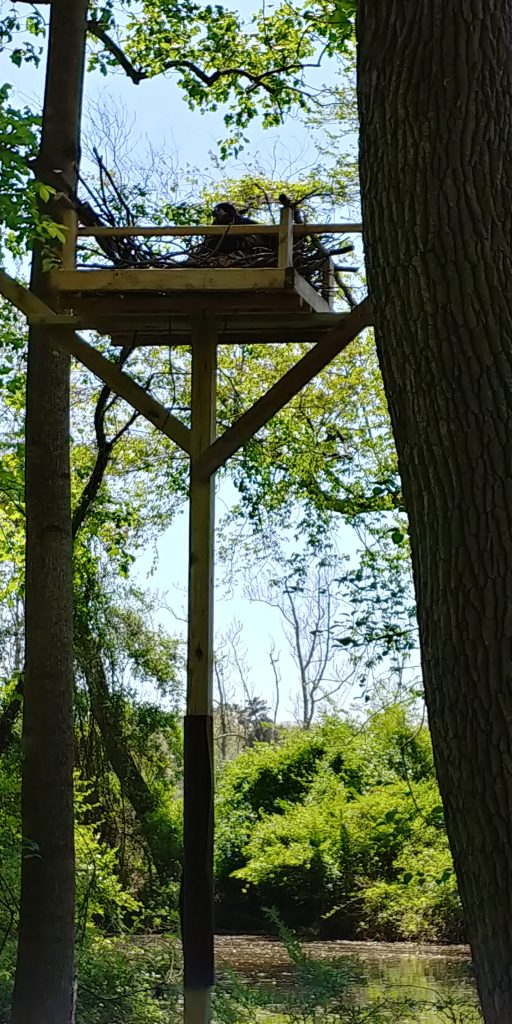
The Stow Creek Viewing platform was built and installed in 1990 along the Stow Creek in Cumberland County. In 1990 there were only four eagle nests in New Jersey. The Stow Creek pair built their nest in a large sycamore tree in an active farm field. The Division of Fish and Wildlife’s Endangered and Nongame Species Program built the viewing platform across the creek, and it was featured in the first New Jersey Wildlife Viewing Guide. This beautiful site gave the public a safe spot to view nesting eagles without disturbing them.
In 2005, the eagle pair moved to a new location about 1 mile away along the Canton Drain, inside an active blue heron rookery and have nested there ever since. The sycamore tree remained empty until this season when a new pair of eagles built a nest in the tree.
The Division of NJ Fish and Wildlife along with the Conserve Wildlife Foundation of NJ, released the 2019 New Jersey Bald Eagle Project Report. 2019 was a good year for eagles as a record high of 249 eagles fledged from nests. Two hundred eleven nest sites were monitored of which 190 were active (with eggs) and 21 were territorial or housekeeping pairs. The success of the eagle project is due to the dedication of the NJ Eagle Project volunteers who monitor and protect eagle nests throughout the state.
Duke Farms female November 22, 2019 screen shot taken by Diane Cook
Bald Eagles all over New Jersey are starting to work on their nests for the upcoming nesting season. The next few months are a good time to get outdoors and spot eagles. Wintering eagles will be in NJ during the next few months as well as the NJ nesting pairs. You can also keep an eye on eagles from the comfort and warmth of your home via eagle cams on the CWF website.
May 25th, 2019. Duke getting fitted with transmitter
A transmitter was placed on a chick from the Duke Farms Eagle Cam nest for the first time this year. This nest cam has been watched by thousands of people over the years and now cam watchers will be able to follow the movements of “Duke” after fledging.
January 13, 2019, Mercer County Park. NJ D/99banded at Duke Farms in 2014 @Bob Cook
Conserve Wildlife Foundation of NJ in partnership with the
NJ Division of Fish and Wildlife’s Endangered & Nongame Species Program, is
releasing results of the 2019 NJ Bald Eagle nesting season.
2019 was a record year for NJ eagles with the highest number
of active nests and young fledged in the history of the project. This year, 238 eagle nests were monitored, of
which 189 were active (laid eggs) and 248 young fledged. This is the highest number of fledges ever,
surpassing the previous high of 216 in 2016.
Bald eagle nesting population and young produced in New Jersey, 1982-2019.
We owe the incredible amount of information about NJ eagle success
to the NJ Eagle Project nest watchers. An
extremely dedicated group of approximately 85 volunteers monitor nests during
the season, recording the important dates and watching for possible issues at
nest sites.
This season two eagle cams were available to watch on the CWF website: one at Duke Farms and another at Mercer County Parks. The Duke Farms nest produced two chicks, and one was outfitted with a satellite transmitter; the movements of this eagle are on CWF’s Eagletrax website .
More details on the 2019 nesting season will be available in
the annual eagle report to be posted by December. The report will include individual nest data, state
totals, and eagle recoveries and resightings.
CWF partners with PSEG, the Mercer County Park Commission, Mercer County Wildlife Center, and Wildlife Center Friends and Duke Farms to protect bald eagles in New Jersey. Thank you to the Wakefern Food Corp./ShopRite Markets, Wells Fargo, Chemours and the American Eagle Foundation for additional eagle program funding.
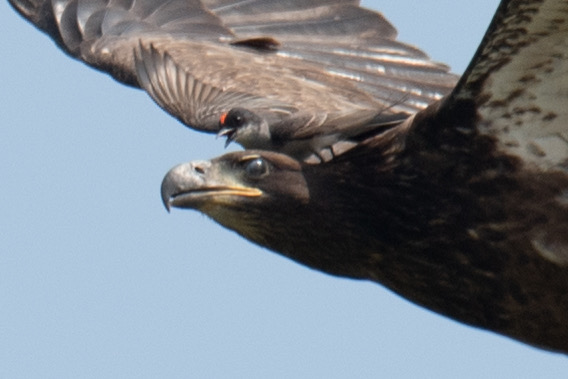
Eagle Project volunteer Randy Lubischer captured this amusing photo of a recent eagle fledge from Monmouth County, being harassed by an Eastern kingbird. In the photo below it looks like the much smaller bird is hitching a ride.