By Todd Pover, Beach Nesting Bird Project Manager and Stephanie Egger, Wildlife Biologist
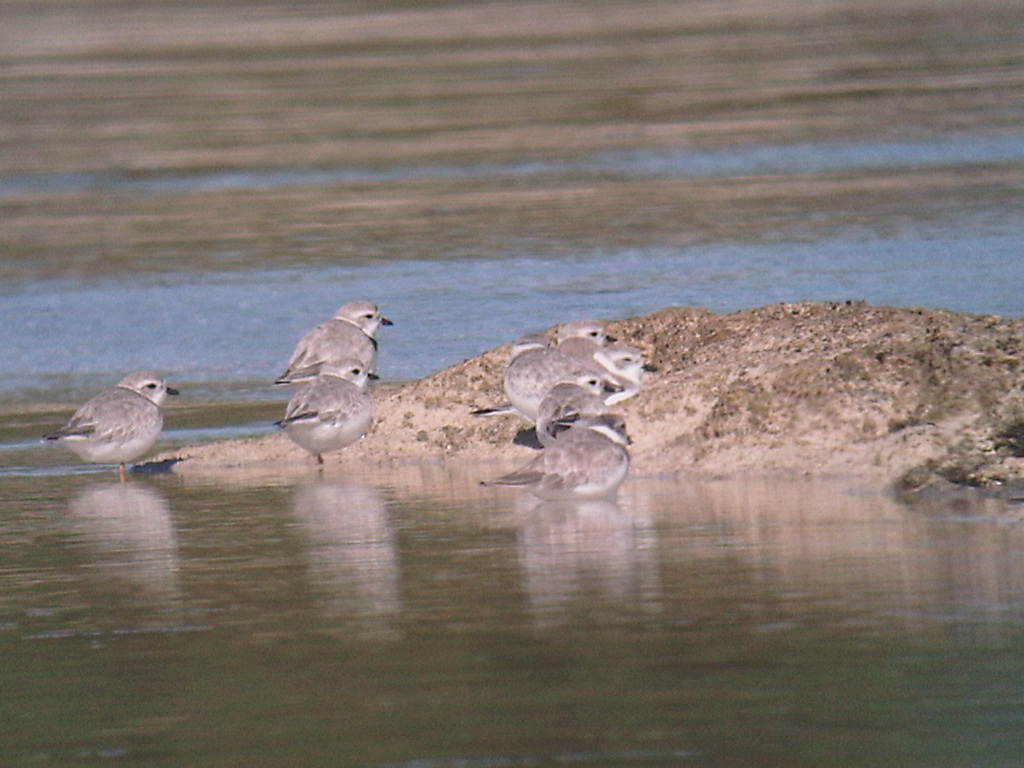
Piping Plovers on exposed limestone shore in the Bahamas.
Today was a down day from a field research perspective, a chance to recharge. That said, our minds were still working – we are already thinking about what’s next for the project and planning our return trip early next year.
As we knew coming in, and now we both know firsthand, logistics are the toughest part of piping plover research here in the Bahamas. With hundreds of islands, cays, flats, and miles of shoreline to survey, many of them inaccessible, just getting to some of the sites is half the battle. Throw in unfavorable weather issues (i.e. wind and rain), a van or boat that doesn’t start, a survey that takes much longer to complete than anticipated…and well you get the picture.
And as we previously mentioned, piping plovers use different types of habitat here in the Bahamas and it is highly tide dependent – it is critical to be at the tidal flats at low tide, otherwise there are no flats or birds to see. Likewise, you need to be at roost locations at mid or high tide or all you’ll see are tracks in the sand to tease you. Continue reading “Plovers in Paradise”
By Todd Pover, Beach Nesting Bird Project Manager and Stephanie Egger, Wildlife Biologist
CWFNJ’s presentation at Friends of the Environment to the local Abaconian community on November 7, 2013.
Last night we presented for the Abaconian community at Friends of the Environment’s office on the international link of piping plovers between the Bahamas and the United States, draft results from the 2011 International Piping Plover Census, and the importance of the Bahamas to piping plovers. We had a decent turnout including David Knowles from the Bahamas National Trust and a writer from the local Abaco newspaper. We spoke at length with Abaco’s premier birder, Woody Bracey, who has helped with on the ground coordination for piping plover surveys over the last several years. We hope to work with Woody and other Abaconians to develop a citizen scientist network to survey sites that we have been unable to get to because of time or logistics (i.e. tide cycle, transportation to the site) and to have the network securely in place for the 2016 International Census. Continue reading “Plovers in Paradise”
By Todd Pover, Beach Nesting Bird Project Manager and Stephanie Egger, Wildlife Biologist
No piping plovers, but plenty of rain!
Today was a reality check – a reminder that not every day of the project can be a highlight reel. There was work from other projects to catch up on. We had a public presentation in the evening on the importance of the Bahamas for piping plovers and we had to finish prepping for that. The van needed to be gassed up and the biologists need fuel too so a trip to the grocery store was in order. And finally, it was pouring rain all morning.
Luckily, the sun peaked out mid-day, so we headed to Treasure Cay, a popular planned community and resort north of Marsh Harbor. On the surface the long beautiful crescent beach provided perfectly suitable habitat for piping plovers. However, expectations were not particularly high for a sighting because there is not a well established history of plovers at the site. And as it turned out, no piping plovers were found today. But determining both where birds are and aren’t present is an equally important part of the scientific and conservation process. Continue reading “Plovers in Paradise”
By Todd Pover, Beach Nesting Bird Project Manager and Stephanie Egger, Wildlife Biologist
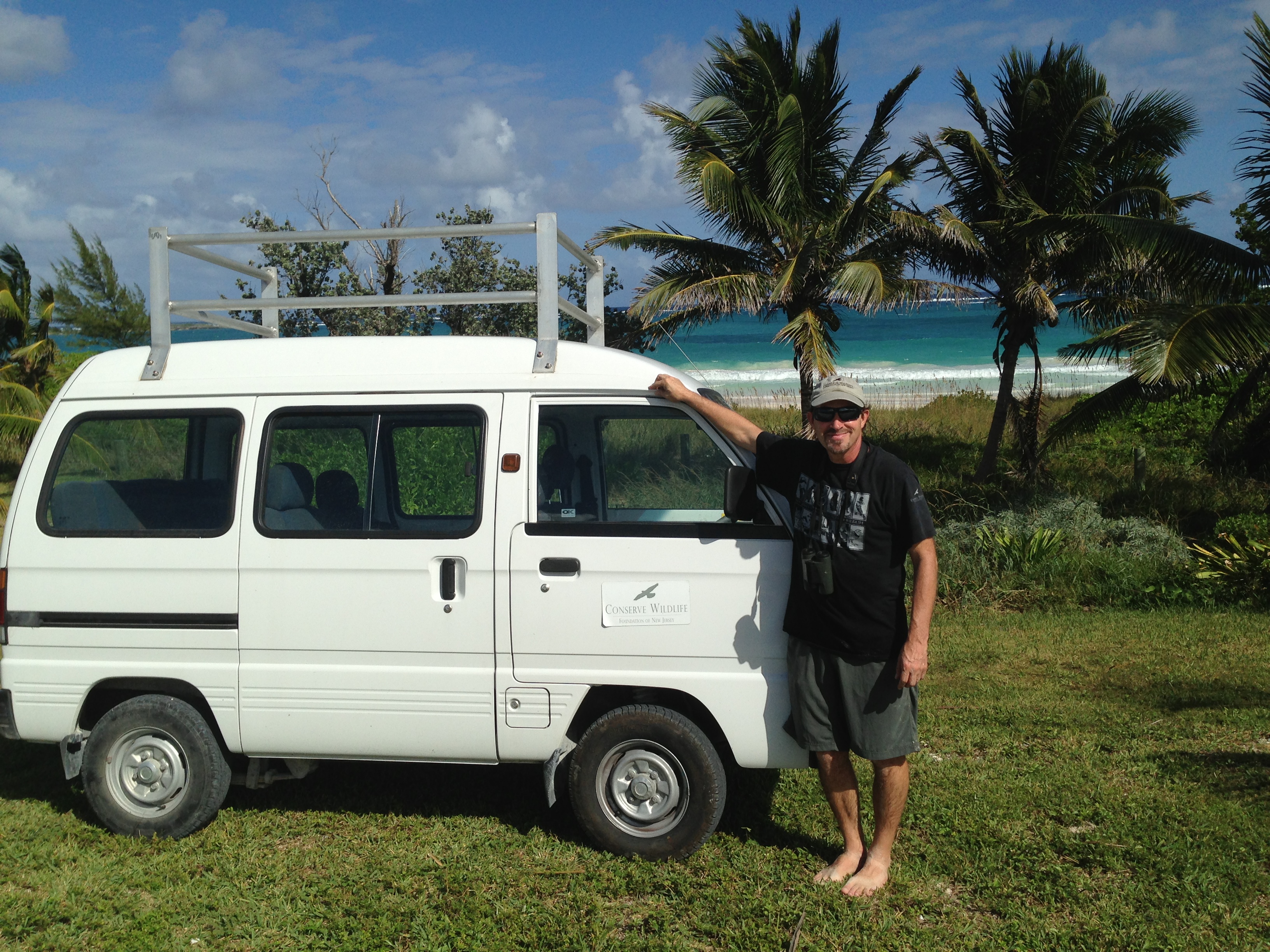
Todd Pover posing next to CWFNJ Bahamas Plover-mobile
Today we hit the road in search of piping plovers in the Bahamas. We covered several sites in the southern half of Abaco between Marsh Harbor and Sandy Point. First up was the beach near Crossing Rocks. We stood a moderate chance of seeing plovers there as either tracks or birds had been detected on surveys in recent years.
As we stepped out on the ocean facing beach, which looked very similar to one we might see in New Jersey (discounting the palm trees and turquoise water), we saw another familiar sight in the distance; a flock of tiny shorebirds racing up and down with the incoming waves. Classic sanderling behavior. Except they weren’t sanderlings – they were piping plovers. Ten, twenty, thirty, forty…can there really be fifty piping plovers here? The final tally came in at 53 piping plovers…the mother lode and more than we had ever seen in one place!
One of the most striking parts of this discovery was the type of habitat where this many birds
The pathway to the plover mother lode! Crossing Rocks, Abaco
were found. It was not on a tidal flat such as on Green Turtle Cay, which was the case yesterday, and appears to be more typical in the Bahamas for large flocks. We found them at mid-tide; some were resting on the upper beach, but many were foraging at the water’s edge. We obviously still have a great deal to learn about what type of habitat piping plovers use in the Bahamas and what influence tidal stage has on that use.
The rest of the day was bound to be a letdown after our first survey, but that wasn’t really the case. We made it to the southern end of the island (Sandy Point) where we were greeted by expansive shallow water flats. We missed peak low tide so didn’t really attempt a full survey – this was recon for our return trip in January or for local volunteers to survey.
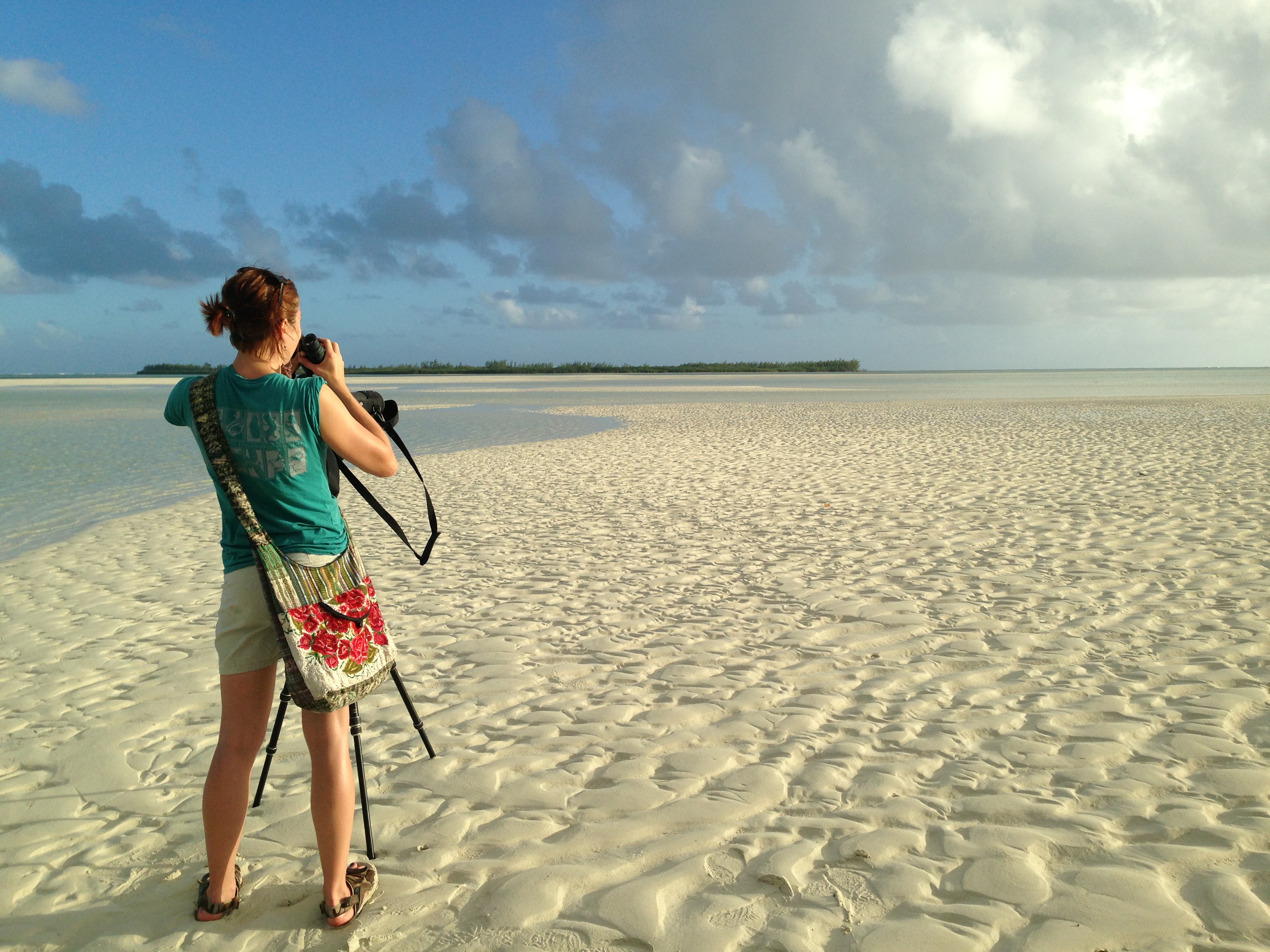
Stephanie Egger, CWFNJ, surveying for piping plovers at Casuarina Point
Last on the plover checklist for the day was Casuarina Point, a known piping plover site on Abaco. We hit it right at the low tide as the sun was getting ready to set. We had to wade out to the flats – they were loaded with shorebirds, mostly sanderlings this time, but another 17 piping plovers, as well. Of course, it isn’t really just about the numbers, but we were still a pretty pumped about the results. The first two days of the trip have exceeded our expectations.
By Todd Pover, Beach Nesting Bird Project Manager and Stephanie Egger, Wildlife Biologist
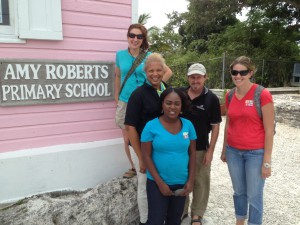
Meeting with Amy Roberts Primary School and Friends of the Environment
Today was our first official work day on Abaco, Bahamas as we spent ALL of yesterday traveling. But, today’s lineup included a meeting with our sister school, Amy Roberts Primary School on Green Turtle Cay, presenting a program to children in grades 3-6, a field visit to the tidal flats with Friends of the Environment and Loggerhead Productions, filming with Loggerhead Productions, and finally an informal meeting with the some bonefishermen and Friends of the Environment on tidal flat conservation.
Although we accomplished a lot in one day, the majority of the day was focused on
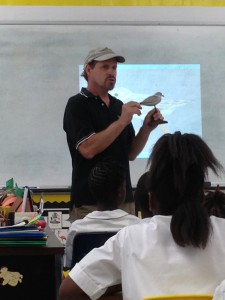
Todd Pover, CWFNJ, presenting at Amy Roberts Primary School
working with the school teachers and children. We had a great morning presenting to the students and engaging them in discussions on the different aspects of the piping plover on the their breeding grounds in the U.S. and the wintering grounds in the Bahamas and demonstrating how important the Bahamas is to the life cycle of the piping plover. The teachers were very enthusiastic about incorporating the piping plover into the children’s curriculum and the sister school program. The children in grades 3 and 4 at Amy Roberts will be part of a sister school program with an elementary school back at home in Ocean City, New Jersey. The sister school program includes in-school presentations from CWFNJ to both of these schools, a poster/interpretive sign project, a field trip to observe piping plovers, and communication between the teachers and the students using social media and other means to discuss not only piping plovers, but just the similarities and differences in our respective cultures.
Stephanie Egger, CWFNJ, and a student at Amy Roberts Primary School
The day started out with rough seas as we made a ferry crossing from mainland Abaco to Green Turtle Cay, but it was smooth sailing for our project the rest of the day. We are feeling very enthusiastic about the project, in part because of the warm welcome we have received here. Now we see why our plovers like the Bahamas so much:)
By Todd Pover, Beach Nesting Bird Project Manager and Stephanie Egger, Wildlife Biologist
Today we arrived on the island of Abaco in the Bahamas to start our piping plover project, which was made possible courtesy of a grant from the Disney Worldwide Conservation Fund. It was mostly a travel day to for us, nonetheless, still exciting to finally be here to start a project that was has been over a year in the planning.
We will hit the ground running tomorrow with a visit to a local school, participation in a round table discussion with stakeholders on tidal flats conservation, a piping plover survey, and filming for an educational video. And that’s just the first day!
So while we still have time to catch our breath, this is a good opportunity to review the purpose of our trip here. Over the course of the past two decades, considerable resources have been put into the recovery of the Atlantic Coast population of piping plover, a federally threatened species, with most of the effort taking place on the breeding grounds in the U.S and Canada. Recent research has revealed that the vast majority of the population winters in the Bahamas. Furthermore, there is a growing realization that recovery and long-term sustainability will only occur with full life cycle conservation – protection during the breeding, migration, and wintering phases of the piping plover’s life. Continue reading “Plovers in Paradise”
Habitat is the name of the game when trying to save endangered species. If there is not adequate habitat for animals to utilize during their life cycle then they can and will decline, closer and closer to extinction. A recent article in Scientific American highlights the migration of the Federally endangered Piping Plover and the importance of protecting both their migratory and wintering habitat.
By Emily Heiser, Piping Plover Research Technician
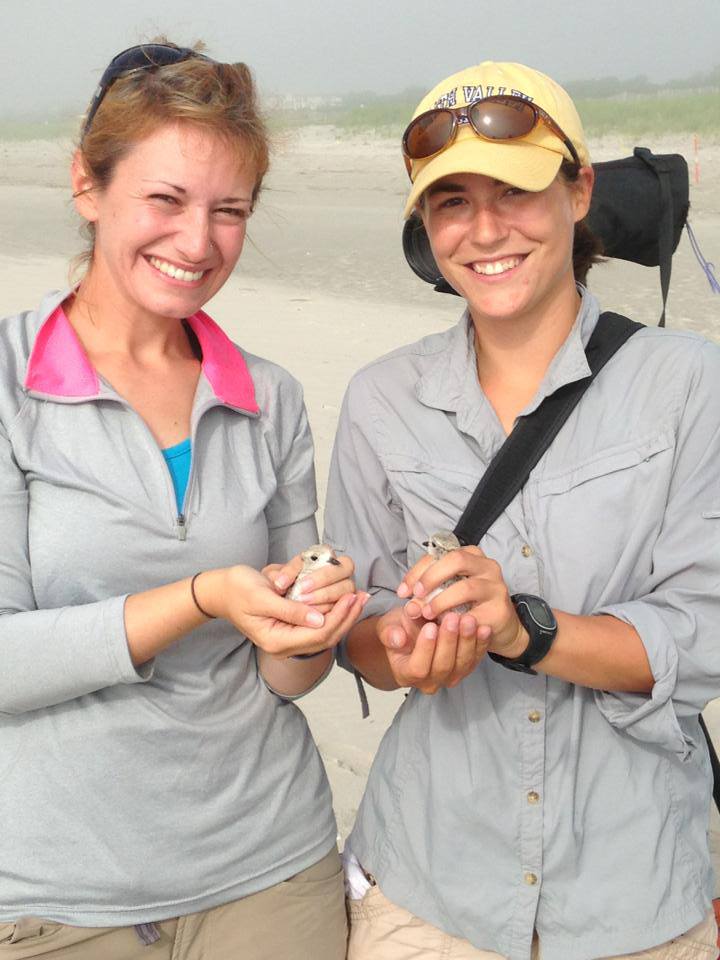
Emily Heiser (l) and Lauren Gingerella (r) with piping plovers in hand for banding.
Call me crazy, but the combination of piping plovers and New Jersey are just too much for me to resist! Over the last six years, I have spent the majority of my time working for Conserve Wildlife Foundation of New Jersey and New Jersey Division of Fish and Wildlife protecting piping plovers on their nesting grounds. Most recently I worked on a research project with the State University of New York-ESF that dealt with piping plover flight behavior in Stone Harbor, Avalon and Strathmere, New Jersey. The project’s graduate student, Michelle Avis conducted the other half of the study on Cape Cod, Massachusetts. The project was specifically designed to look at piping plover flight patterns across their breeding grounds. The results of the study could have implications for the management of coastal wind turbine development. Continue reading “Overview of piping plover flight behavior research”
The entire staff at CWFNJ works tirelessly to protect our state’s at-risk wildlife, educate the public, and raise funds to continue our work. It is especially gratifying when those efforts are recognized – We are thankful to the blog, Readings from the Northside, who recently wrote about CWF’s Todd Pover and his work to protect the piping plovers of Long Beach Island.
Read the Blog Post here, and make a donation today to help continue our work to protect beach-nesters and all of NJ’s rare wildlife.
Theresa Laverty, Field Technician, Beach Nesting Bird Project
It’s another cloudy day and I scan the beach with my binoculars. No dogs. Only a handful of fishermen dot the water line. I return my focus to the small area towards the dune line, where a high concentration of shells lies. Look for two intact clamshells just in line with where the beach entrance should be. Without the binoculars, I find the location. It is not until I use my binoculars, however, do I spot the Piping Plover incubating a four-egg nest in that exact spot. Camouflage works wonders, I remind myself.
Since late April, I have been working as a seasonal beach nesting bird field technician. Our four main species of focus are Piping Plover, American Oystercatcher, Least Tern, and Black Skimmer. While the latter two species form colonies where they lay their eggs, the former two species defend territories as pairs. All four can be found on the same beach, however, which leads to lots of interesting interspecific and intraspecific interactions. Oystercatchers chasing plovers, terns dive bombing oystercatchers, etc., etc.… My job is not focused on those behaviors, however. My tasks include bimonthly surveys of the tern/skimmer colonies and recording the nesting success of plovers and oystercatchers. How many eggs are laid, how many eggs are predated, how many eggs hatch, how many chicks are predated, and, everyone’s favorite scenario, how many chicks fledge (i.e. reach the stage where they can fly)? Some of the birds are also banded, which allows for individual identification and adds another layer to nesting success when the birds return year after year.
A big part of my job is also dealing with the public, and as with any field site, there are those that appreciate what I do and those that are against it. While I prefer the former, I am well aware of the arguments from both sides having grown up in Ocean City myself. I am particularly interested in human-wildlife interactions, so I really appreciate the opportunity to work with the local community. I began working in the field of ecology and conservation biology in college, but most of my previous work has been international. I looked at crocodilian diets in Peru, studied the behavior of mountain gorillas in Uganda, researched the effects of landscape management on carnivore and wildlife populations in Kenya’s savannas, but this has been my first experience working with birds and working in what is basically my backyard.
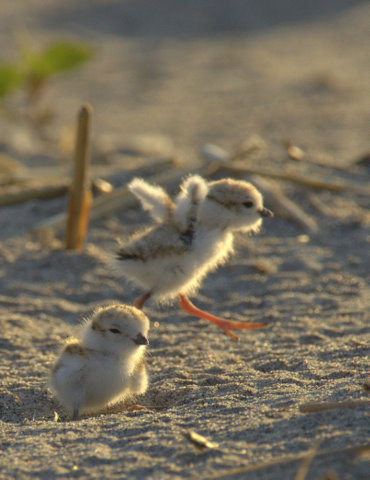
With chicks now hatching up and down the New Jersey coastline, I feel busier than ever trying to ensure these little guys have a chance to beat the odds and make it to fledging. Some days that means a lot of physical work- expanding fenced off areas to give them a little more of a buffer between the public- or sometimes it means a lot of social interaction- enforcing the law of no dogs on the beach or keeping children from chasing after the chicks at the water’s edge, where the birds feed. I know that when I leave New Jersey to begin graduate school this August, it will be hard to say goodbye to an amazing summer back home. This is an incredible opportunity to apply my skill set and wildlife conservation goals back here at home and watch these often overlooked birds through this nesting season and hope for continued success in the years to come.