Flying Fish Brewing Company Serves Plover Pale Ale, Highlights Importance of Piping Plover Conservation Programs

“Beer, Birds and The Bahamas” Showcased the International Link
between the U.S. and The Bahamas for Piping Plovers

By: Lindsay McNamara, Communications Coordinator
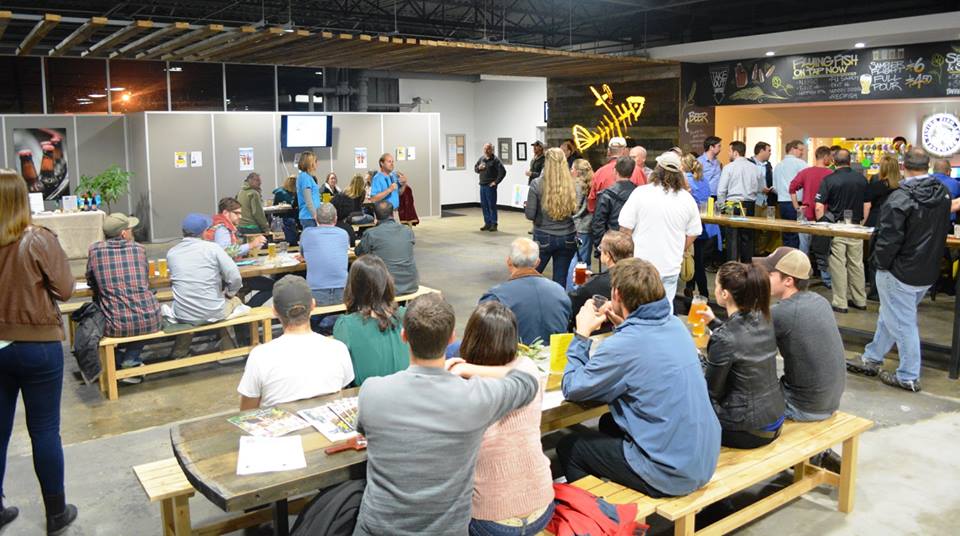
Todd and Stephanie explaining the Piping Plover Bahamas Project to guests at "Beer, Birds and The Bahamas."
Todd Pover and Stephanie Egger explaining the Piping Plover Bahamas Project to guests at “Beer, Birds and The Bahamas.”

On Thursday, November 6, over 85 guests attended “Beer, Birds and The Bahamas,” a fundraising event organized by Flying Fish Brewing Company and Conserve Wildlife Foundation of New Jersey.

Conserve Wildlife Foundation biologists, Todd Pover and Stephanie Egger educated guests about the Piping Plover “Bahamas Project” and showed the connection between The Bahamas and the U.S. for the endangered beach nesting bird species. One-night-only Plover Pale Ale was served and guests had the opportunity to attend brewery tours and play Plover Quizzo. The winners of Plover Quizzo received prize baskets full of Conserve Wildlife Foundation and Flying Fish Brewing Company merchandise.

“Events like ‘Beer, Birds and The Bahamas’ fulfill the purpose of creating a community space inside the Brewing Company,” said President of Flying Fish Brewing Company Gene Muller. “Our audience and Conserve Wildlife Foundation’s audience go hand in hand. People who appreciate wildlife and the environment also appreciate sustainably produced beer.”

“This innovative project is based on partnerships in both New Jersey and the Bahamas – bringing together distant communities who still share a strong commitment to education and a personal connection to their beaches,” said Conserve Wildlife Foundation Beach Nesting Bird Project Manager Todd Pover. “In the same vein, the event at Flying Fish Brewing was an exciting partner-driven way to promote the project.”

Conserve Wildlife Foundation of New Jersey’s Piping Plover Bahamas Project supports the recovery and long-term survival of Piping Plovers by identifying critical Bahamas wintering habitat for Piping Plovers and other shorebirds of concern on the islands of Abaco and Eleuthera, The Bahamas. Conserve Wildlife Foundation collaborates with a local Bahamas environmental group, Friends of the Environment, to engage the public and increase local awareness of the critical role played by the Bahamas in the full life cycle of the Piping Plover.

The Atlantic Coast population of Piping Plover has been federally listed as threatened in the U.S. since 1986 and endangered in Canada since 1985. Although migration and wintering protection is one of the five main recovery tasks in the U.S. Fish and Wildlife Service’s (USFWS) Piping Plover Recovery Plan (USFWS 1996), until recently protection has primarily been focused on the breeding grounds. Furthermore, population monitoring is well understood on the breeding grounds, but winter use is not as well documented.

Over the past five years the importance of the Bahamas as a major wintering site for Piping Plovers has become increasingly evident.

Conserve Wildlife Foundation of New Jersey and other partners aim to identify critical wintering habitat, provide education and outreach to school children and the public, and build local capacity for future surveys and protection of Piping Plovers in the Bahamas. For more information, please visit our website.

Flying Fish Brewing will donate proceeds from the sale of Plover Pale Ale to the Bahamas Project by Conserve Wildlife Foundation of New Jersey.

Lindsay McNamara is the Communications Coordinator for Conserve Wildlife Foundation of New Jersey.

Happy World Shorebirds Day!

American Oystercatcher
American Oystercatcher. © Jim Gilbert

On behalf of our friends – the piping plovers, red knots, American oystercatchers, least terns, ruddy turnstones, black skimmers, and many others – Conserve Wildlife Foundation wishes you a happy World Shorebirds Day.

  • For your viewing pleasure, check out our brand new Oystercatcher Story Map.
  • To learn more about our beach nesting birds work, click here.
  • You can click here to learn about our migrating shorebirds work.
  • And if you haven’t seen the Delaware Bay beach restoration video yet, enjoy it here!

Finally, you can help support our shorebirds work with a donation, or through volunteering on one of our shorebird projects.

Click here to make a donation to our shorebird work here!


One other fun way to cozy up to a bird this fall is to visit Unreal Birds, and consider making a purchase of those adorable birds. A portion of every purchase benefits CWF!

Story Map Brings Oystercatchers to Life Online

CWF Celebrates World Shorebirds Day With Release of Our First Story Map: “American Oystercatchers Through the Seasons”

By Michael Davenport, GIS Program Manager

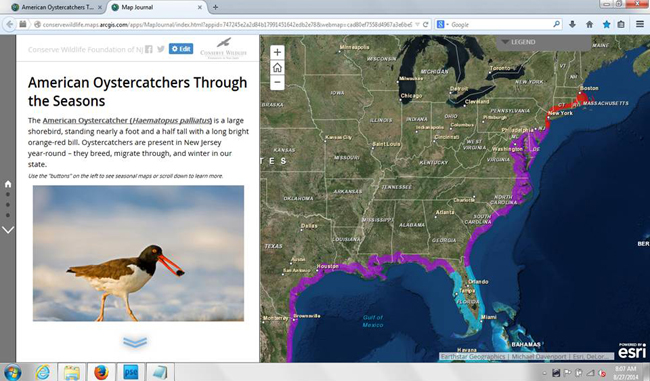
Conserve Wildlife Foundation (CWF), today released a new interactive “Wildlife Story Map” in support of this Saturday’s first annual World Shorebirds Day! The Story Map can be viewed here!

ScreenCapture

A Story Map is a web-based interactive GIS map embedded with multimedia content, such as text, photographs, and video. CWF, working with GIS software developer ESRI and with financial assistance provided by a grant from the New Jersey Division of Fish & Wildlife, plans to make this Story Map the first of many, helping engage the public about New Jersey’s rare wildlife in a dynamic and interactive way.

 “American Oystercatchers Through the Seasons” tells the story about a species of migratory bird, the American Oystercatcher, which spends the summer breeding season along the New Jersey coast, but is present year-round along the southern New Jersey coast. Our state represents the northern limit of the species’ winter range. While some New Jersey birds migrate during the winter to Florida, those that breed in New England during the summer may end up spending their winter here in New Jersey.

This Story Map also provides stories about individual banded birds, which have been tracked on journeys between New Jersey and southern states such as Florida, as well as between New Jersey and more northern states, such as Massachusetts.

Make a donation today to support additional Story Maps!


How to Use the Story Map:

On the left side of the Story Map page are several “buttons” which will allow you to flip through the different seasons in an oystercatcher’s life: Breeding, Migration, and Wintering.  Each page provides information and photos and a map specific to that portion of the bird’s life cycle. By clicking on an individual point within the map, a box containing more specific information, and a photo in some cases, will pop-up. The map also provides the ability to zoom-in and out in order to see areas of interest in more detail.

This Story Map is especially exciting since it helps celebrate the first annual World Shorebirds Day. This event seeks to “…raise global public awareness about the conservation of, and research about, shorebirds. About half of the world’s shorebird populations are in decline, and the rate of habitat loss is worse than ever before” (World Shorebirds Day 2014).

World Shorebirds Day hopes to accomplish the following:

  • To raise public awareness about the need to protect shorebirds and their habitats throughout their life cycles;
  • To raise public awareness about the need for ongoing shorebird research;
  • To connect people with shorebirds through important shorebird sites around the world;
  • To get shorebird enthusiasts to introduce shorebirds to more birdwatchers;
  • To raise awareness about the need for increased funding for shorebird research, monitoring and conservation.

CWF’s shorebird leadership ranges from the American Oystercatcher celebrated in this Story Map, to the beach nesting birds along the Atlantic Coast, to the red knots and ruddy turnstones along the Delaware Bay.

Your support can help CWF develop additional Story Maps on other rare wildlife. Support our work on Story Maps on the American Oystercatcher and other important shorebirds in honor of World Shorebirds Day by supporting research, education, and public awareness efforts carried out by CWF:

We hope that this will be the first of many Story Maps that CWF will use in order to communicate the many fascinating stories that New Jersey’s wildlife have to tell.

Make a donation today to support shorebirds today!


Piping Plover Population Reaches Lowest Levels in Decades


Plover populations at Malibu Beach in Egg Harbor Township are near a record-low this year due to predation, recreation activities and habitat loss. (c) Edward Lea

New Jersey’s Piping Plover population is at its lowest levels in decades, which raises serious concerns, but they also had one of their most successful years ever statewide in producing chicks. There is hope this will jump start the population again. To read the full article, click here.

  • To watch the video about this years Piping Plover population, click here
  • To learn more about CWF’s efforts to protect these birds, click here.

BAHAMAS PIPING PLOVER PROJECT

WINTERING PIPING PLOVER SURVEYS ON ABACO

By Todd Pover, Beach Nesting Bird Project Manager and Stephanie Egger, Wildlife Biologist

IMG_3492
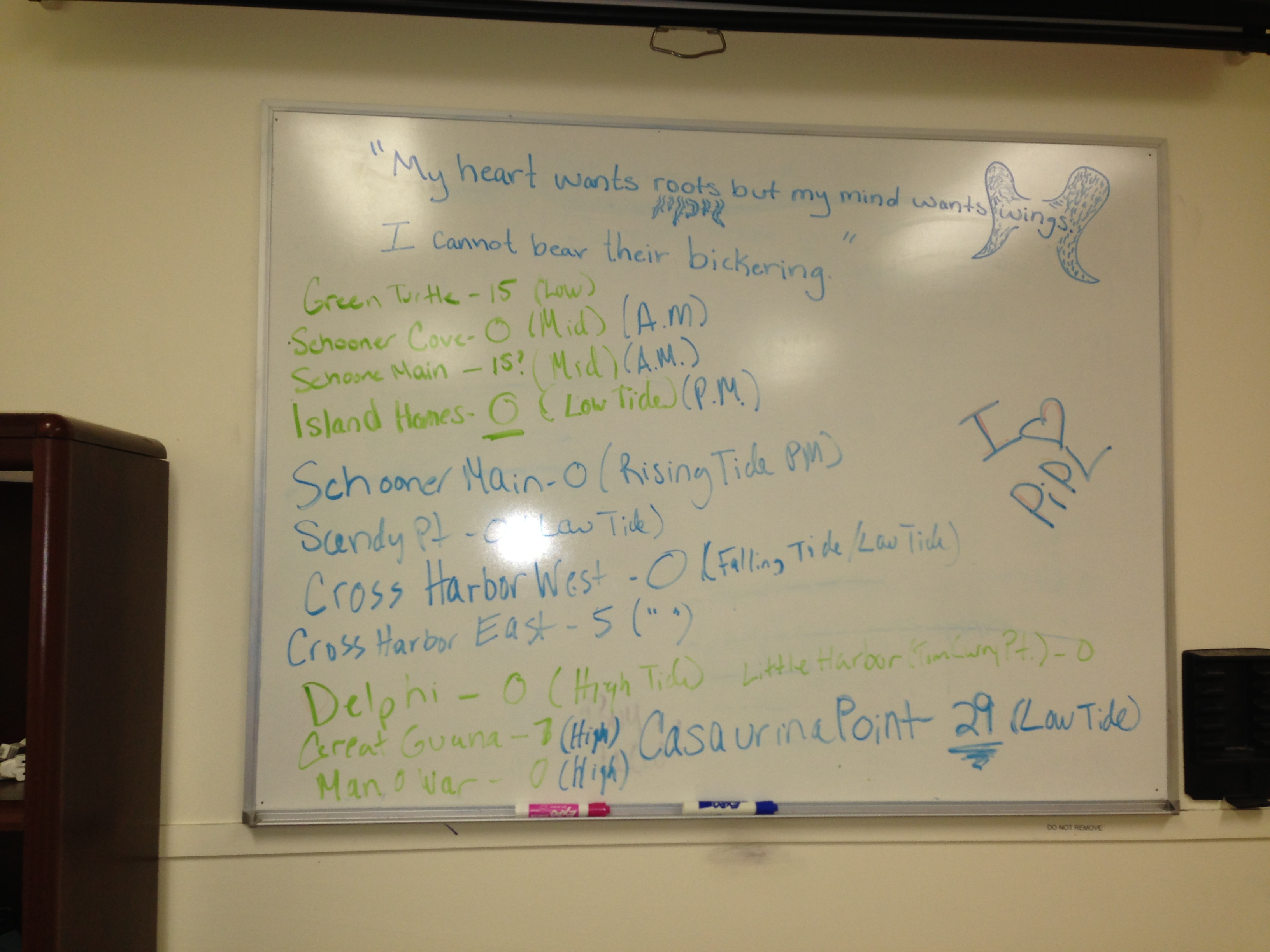
The Bahamas piping plover survey tally board in the “central command” room at Schooner Bay Institute.

An integral part of this Bahamas trip entailed surveying several sites not previous covered on Abaco and revisiting some sites not checked since the 2011 International Piping Plover Census. Although we didn’t find large concentrations of piping plovers at any one new site, we did make some noteworthy discoveries.

One of the most exciting find was the resight of a piping plover that was banded on the breeding grounds last summer in Massachusetts as part of a flight behavior study. New Jersey also participated in this research and we briefly thought it might be one of the birds banded in our home state – but it turned out that it was banded (and nested) on Chapin Beach, Cape Cod and is wintering at Schooner Bay, Abaco (amongst 15 other piping plovers found on our survey). Continue reading “BAHAMAS PIPING PLOVER PROJECT”

Volunteer Guest Bloggers – Bahamas Piping Plover Project!

Connecting with Piping Plovers in a New Setting

This trip to the Bahamas we had three volunteers, piping plover experts, to help us survey stretches of Abaco that we have either not been able to survey or had limited opportunity to survey in the past. Our volunteers have a wide range of experience ranging from the U.S Fish and Wildlife Service, Pronatura Noreste A.C. Mexico, and a wildlife consulting company in Virginia. Below is their experiences from the week. Enjoy!

Annette Scherer, Retired U.S. Fish and Wildlife Service Endangered Species Biologist

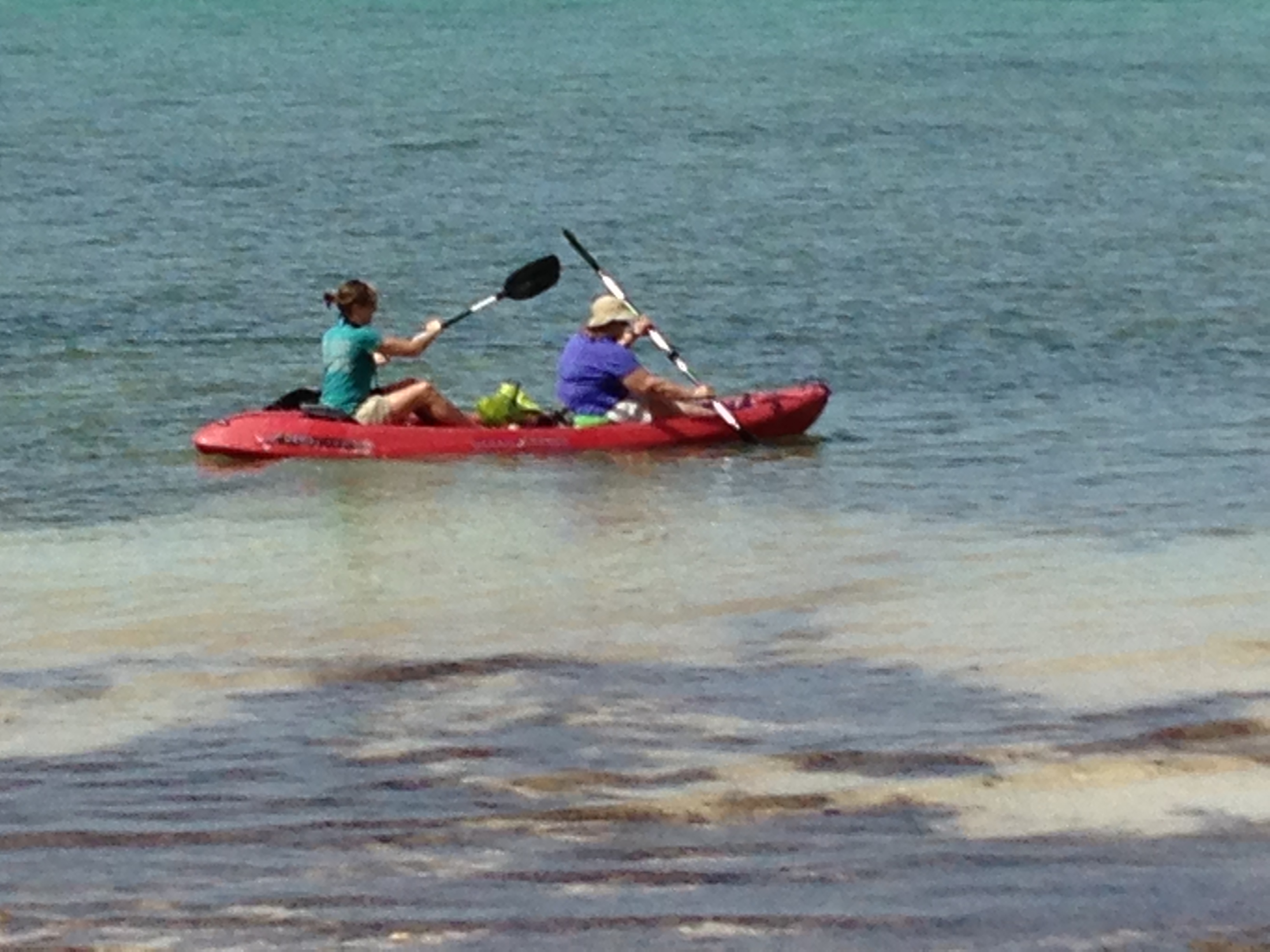
Annette Scherer, retired U.S. Fish and Wildlife Service Endangered Species Biologist (R), kayaking with Stephanie Egger, CWFNJ Biologist (L), to the marine flats in search of Piping Plovers.

When I retired a year ago after spending the better part of my career negotiating with stakeholders and regulatory agencies to balance piping plover protection with shoreline stabilization projects and human recreational use, I often joked that I was going to move somewhere with no plovers- no piping plovers, no snowy plovers, and not even mountain plovers.  But when CWFNJ invited me along to survey for piping plovers in Abaco, Bahamas I jumped at the chance to learn more about piping plovers on their wintering grounds. My work with plovers in the northeast U.S. had focused on plovers on their breeding grounds where individual pairs of plovers fiercely defend their nesting territory. As a result, its unusual to see more than a pair of plovers and their brood of up to 4 chicks in a single spot. Here on the wintering grounds the bird’s habitat characteristics are very similar to that of their breeding areas – wide sandy coastal beaches, but their behavior is very different. The plovers congregate in small groups, roosting and feeding together. On my first survey day, I was thrilled to observe a group of eleven plovers roosting high on the beach. It was strange to see so many plovers calmly sitting together. Each bird was nestled down in a small depression that gave protection from the wind, reminding me of the shallow scrapes they make when building nests. It was great to finally see where the birds go when they leave the northeast and personally rewarding for me to now have observed the birds throughout their entire annual cycle. Continue reading “Volunteer Guest Bloggers – Bahamas Piping Plover Project!”

Bahamas Piping Plover Project

Eleuthera Edition

By Todd Pover, Beach Nesting Bird Project Manager
Stephanie Egger, Wildlife Biologist

Piping plover roosting beach on the island of Eleuthera, Bahamas.

Up until now, nearly all of our piping plover conservation work in the Bahamas has been focused on the island of Abaco.  One of the objectives of our Disney Worldwide Conservation Fund grant is to identify other islands and partners where and with whom the model we are developing on Abaco might be implemented as well.  With this in mind, we spent the past several days on the island of Eleuthera.

Although we believe the basic elements of our Abaco work are transferable to other islands, a “one size fits all” approach may not entirely work.  The various major islands are unified under the Bahamas flag, but each also has its own flavor, history, and way of life.  The best analogy would be that they operate much like the individual states in the U.S.

On Abaco, we have been partnering with Friends of the Environment, a non-profit organization with a strong education and outreach component to all of their work – not so different from what we do here at the Conserve Wildlife Foundation.  On Eleuthera we are hoping to partner with the Cape Eleuthera Institute (CEI) and The Island School.  Although education is at the core of their work as well, it is also different in that they carry out and support primary research and host visiting scientists and students at their campus. Continue reading “Bahamas Piping Plover Project”

Piping plover sister school project

Dispatch from Green Turtle Cay, Abaco, The Bahamas
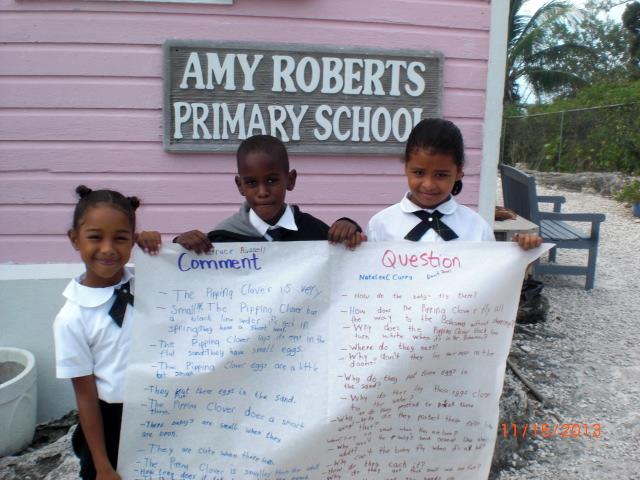
Sister School students of Amy Robert Primary School
Sister School students of Amy Roberts Primary School, Abaco, The Bahamas, working hard on their Piping Plover Unit!

The Conserve Wildlife Foundation of NJ continues to be extremely excited about our sister school project which links a school on Green Turtle Cay in Abaco, The Bahamas and one in Ocean City, New Jersey, USA through piping plover conservation. We particularly like how it is shaping up to be a multi-disciplinary educational initiative. Below is a report we received last week from Jan Russell, the project teacher from the Amy Roberts Primary School on Green Turtle Cay:

Today was the first official in-class activity to start the Joint Piping Plover Unit.  On Monday the students were placed in groups based upon their strengths and identified cooperation skills. The first activity included a review of the Power Point presentation presented by Todd Pover and Stephanie Egger of CWFNJ when they visited us on November 5, 2013.  As each slide was presented, each group recorded a comment or question on a large sheet of poster paper.  The comments and questions will be used to develop our research direction and our final product choices. Continue reading “Piping plover sister school project”

Plovers in Paradise

The Bahamas Blog – Trip 1, Day 7

By Todd Pover, Beach Nesting Bird Project Manager and  Stephanie Egger, Wildlife Biologist

The Bahamas Flag.
The Bahamas Flag.

Those of us who study and work with piping plovers on the breeding grounds are pretty attached to “our” plovers. In truth, piping plovers spend more than half of their time in migration or on their wintering grounds, so for our Atlantic Coast population they are as much birds of the Bahamas as they are of the U.S. and Canada.

Shorebirds are not necessarily on the radar in the Bahamas, as much as more iconic birds like the flamingo or Bahama Parrot, but the public is slowly becoming more aware of them. A major part of our project is to elevate local awareness of piping plovers and the important role the Bahamas plays in their long-term survival.

To this end, we have developed a number of products and strategies to achieve this goal: a postcard, decal, in-school programs, sister school program, public presentations, and traditional and social media exposure. Lastly, we are producing a short video about the piping plover in the Bahamas that will be shown to students, the public, and visitors. Continue reading “Plovers in Paradise”