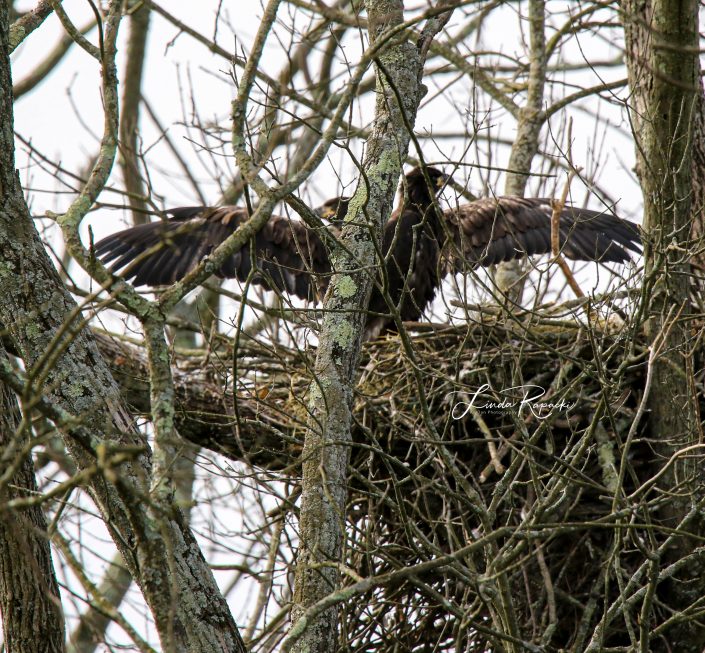
Empty Nest Syndrome: NJ Eagle Chicks Fledge
by: Larissa Smith, CWF biologist
by: Larissa Smith, CWF biologist
by: Larissa Smith, CWF biologist


Since 2003 Conserve Wildlife Foundation has been coordinating the Delaware Bay Shorebird Stewards. Shorebird Stewards are posted at the beaches with restricted access during the shorebird season. This is done so that the shorebirds can feed undisturbed on horseshoe crab eggs. The beach restrictions are from May 7th to June 7th. The Delaware Bay is an important stopover for these birds on their way north to their breeding grounds. Stewards educate the public about the need for the beach restrictions. Once most people learn about the connection between the horseshoe crabs and shorebirds, they are more than happy to accept the restrictions. This season there were thirty-one stewards on 10 beaches in Cape May and Cumberland Counties. They are dedicated and on the beaches despite the weather, bugs and sometimes lack of shorebirds. Stewards are on beaches through Monday, so stop by and say “hello”.
Thank you Shorebird Stewards

by Meaghan Lyon
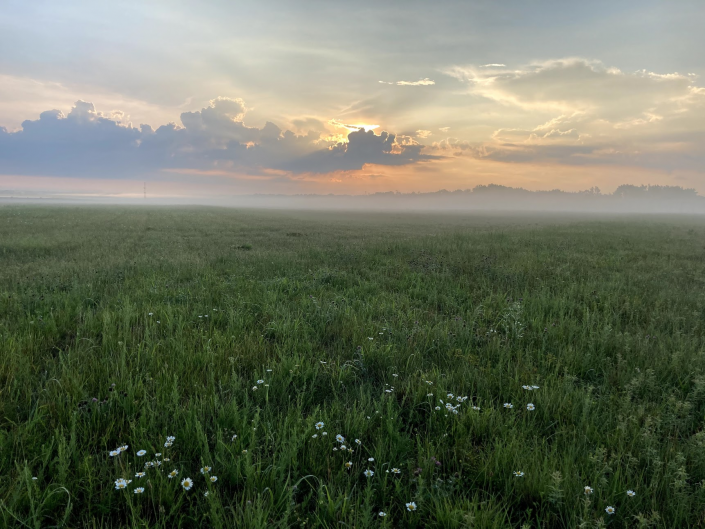
Earlier this week CWF and USFWS biologists joined forces to start off the season with a grassland bird survey in Burlington County, New Jersey. The vast grassland habitat, doubling as an airfield, is home to the state endangered upland sandpiper, state threatened grasshopper sparrow, savannah sparrow, and bobolink, as well as the eastern meadowlark, a species of concern. These bird species, among many others, can all be found nesting at this site in the clumps of grass during the months of May, June, and July. Many of the management practices at the airfield, like consistent mowing, help maintain this grassland habitat and keep it an early successional state for grassland birds to nest in year after year.
For the survey, biologist met on site just before sunrise with binoculars hanging from their necks and clipboards with data sheets in hand. Male birds were already perching on tall blades of grass and singing to attract mates and defend territory as we dispersed to our survey points. At each point it was our job to distinguish what bird song and calls we were hearing and record any focal species activity onto our data sheets.
Between the three surveyors and 25 survey points, all of the target species were identified as well as hundreds of red-winged black birds, two great egrets, and a few mallard ducks. Of particular note, one upland sandpiper pair was sighted in its usual nesting area.
Three more surveys will follow between now and the end of the grassland bird nesting season. Follow along for updates throughout the season!
by Todd Pover
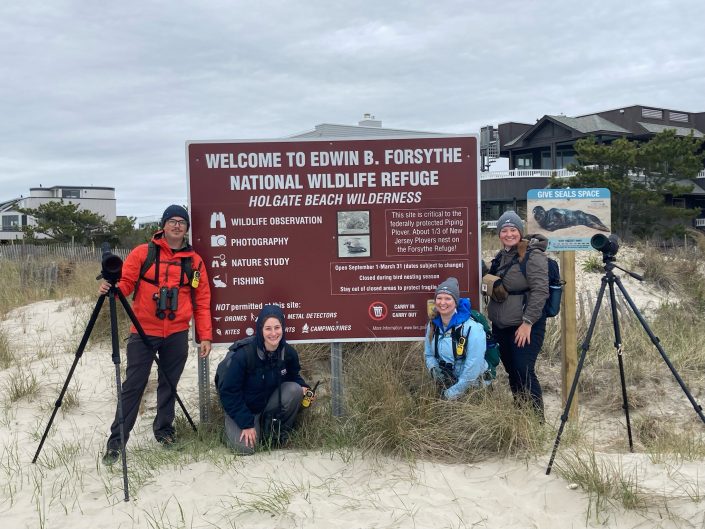
For the past eight years, CWF has been contracted by the U.S. Fish and Wildlife Service through a cooperative agreement to provide monitoring and management of beach nesting birds at the Edwin B. Forsythe National Wildlife Refuge. The Refuge nesting sites – both the Holgate and Little Beach Island Units – provide some of the only habitat in the state closed to the public and free of human disturbance and detrimental beach management practices. The habitat at the sites is especially suitable for the state endangered piping plover as a result of optimal nesting conditions created by Superstorm Sandy and largely sustained since then through winter storms. As of the 2021 season, the Refuge sites had the highest concentration of piping plovers in the state, with Holgate having by far the most pairs (46). Furthermore, on average in recent years, Holgate has produced a higher fledgling rate than many sites in the state.
Continue reading “Beach Nesting Bird Monitoring is Underway at the Edwin B. Forsythe National Wildlife Refuge”by Sherry Tirgrath, Wildlife Biologist

As the piping plovers of New Jersey return to their coastal breeding grounds from their wintering range, a familiar pair has been spotted at the National Guard Training Center (NGTC) in Sea Girt. The pair, dubbed “Joey” and “Hamlet”, have nested at NGTC for 3 consecutive years and are back for their 4th nesting season in 2022. The first of the pair was noticed on site on March 22nd, seemingly resting after a long journey. The second plover was spotted the morning of March 25th and the two have been foraging and roosting together since. The same day that the second plover of the pair arrived, 7 more piping plovers were found roosting near the south boundary of NGTC’s beach. That group has moved on, but Joey and Hamlet have remained to reclaim their territory.
Joey and Hamlet were both banded as chicks in 2018 at Sea Bright, NJ. They have successfully raised chicks at NGTC since they began nesting there in 2019. Prior to their initial arrival, piping plovers had not nested at that site for over a decade. Upon their first arrival at NGTC’s beach in 2019, Joey and Hamlet were paired with different mates. Joey nested with an unbanded female and fledged 2 chicks, while Hamlet nested with a male plover named “Bo”. However, the chicks from their nest did not survive to fledging. Joey and Hamlet paired up in 2020 and fledged 3 chicks together that year and 3 again in 2021. Overall, the pair is highly productive at this site, which signifies that piping plovers will continue to nest here in the future.
Other beach-nesting birds also frequent the site. Least terns, a state-endangered species, and American oystercatchers, a species of special concern, have both nested on site in the past. However, in 2019, predation by red fox resulted in a least tern colony losing 14 nests and 5 chicks, with only one chick surviving to fledge. Since then, the terns have roosted on site but have not attempted to nest. American oystercatchers also roost on site each year but have not had any successful nest attempts in the last few years. Red fox caused nest failures in 2019 and 2020, with no attempt made to nest last year in 2021.
To encourage beach-nesting birds to return and nest at NGTC, a variety of management strategies have been carried out to provide a more optimal nesting habitat. Vegetation thinning was performed in an established protection area to create more space for shorebirds to choose from with plenty of vegetation left to provide shelter and camouflage from people and predators. Shell fragments were deposited in the habitat for use by the shorebirds for lining their nests. The fragments are used to disguise nests as the eggs blend in well with the sand and broken shell pieces. Least tern decoys were also placed around the protection area to encourage the terns to roost and hopefully nest on site again. Although plovers are territorial and won’t nest together, least terns prefer to roost and nest in colonies to maximize protection and defense. The decoys may draw them to investigate the site and stick around.
Fingers are crossed for another productive season for Joey and Hamlet at NGTC, and there’s hope for other beach-nesting birds to return to utilize the site for raising chicks, as well.
by Larissa Smith, CWF Biologist
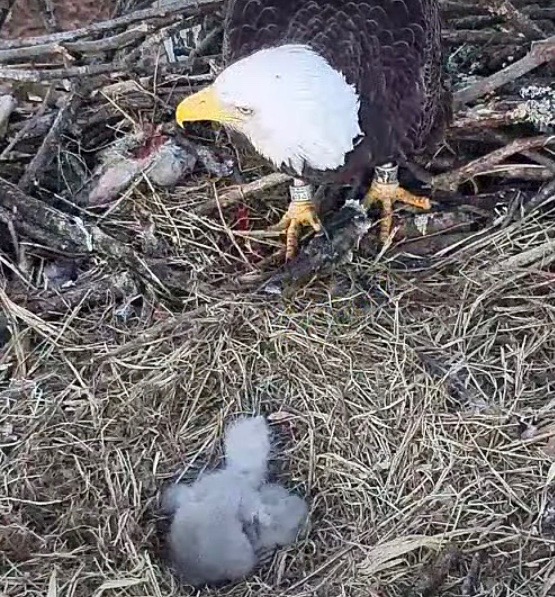
As I write this there are two fluffy little chicks in the Duke Farms nest. They will have an audience of millions of eagle cam viewers watching them as they grow and fledge. As the adult eagles step around the nest, look closely and you will notice that one of them is banded. The male is A/59 and he is twenty-two years old. Twenty-two years ago I began my career with the Conserve Wildlife Foundation working with the New Jersey Eagle Project. In March 2000, A/59 hatched in a nest located in Greenwich, Cumberland County. When he was two weeks of age, he was fostered into a nest along the Rancocas River in Burlington County. The Rancocas pair had failed to produce their own young for a few years and fostering a healthy chick into the nest would help to keep the pairs fidelity to the nest site.
On May 15, 2000, he was banded and a radio transmitter was attached with a harness which was designed to eventually fall off. A/59 fledged on June 3 and was tracked until the transmitter’s signal was last recorded on October 22. You can read more details about the telemetry in the 2000 Bald Eagle Report.
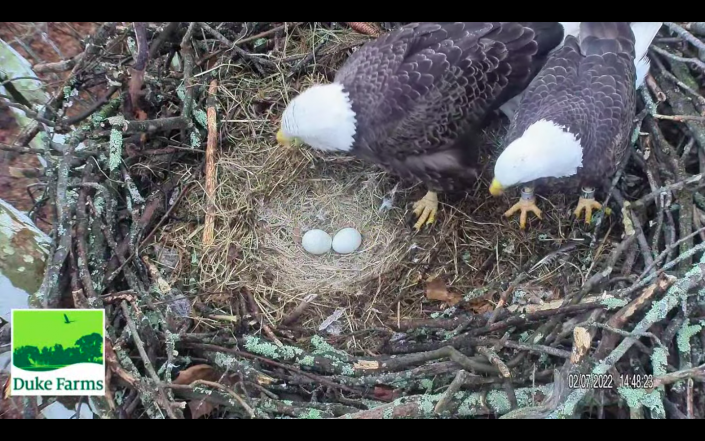
In 2000, when he hatched and I started working with eagles there were 25 nesting pairs of eagles that fledged 29 young. Compare that to last year’s numbers of 247 pairs we monitored and 296 young fledged. As the number of eagles increases in New Jersey so does the competition for nest sites. A/59 has been able to defend and hold onto his territory at Duke Farms since 2009.
It’s very interesting to know the history of this eagle. I feel a bond with him since we both started our “eagle” journey at the same time.
by Todd Pover, Senior Wildlife Biologist
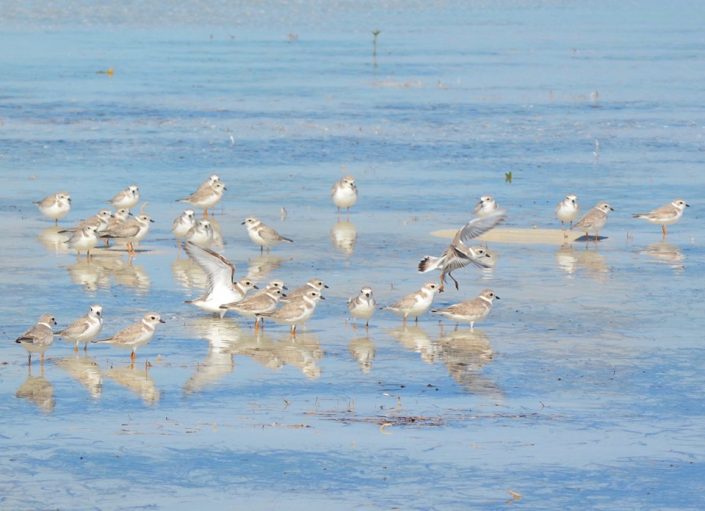
Just a few hours after landing on the island of Abaco in the Bahamas in early February, I had my scope focused on several dozen piping plovers scurrying across an expansive sand flat. This was good news; the foraging flat still supported a healthy number of wintering plovers. The last time I had been at this site was almost exactly three years ago. A lot has happened since then.
On September 1, 2019, a major Category 5 storm, Hurricane Dorian, struck and lingered over the island of Abaco, and then Grand Bahama, bringing with it sustained winds of 185 MPH and gusts of 220 MPH, the strongest storm on record to hit the Bahamas. As expected from a storm of this intensity, lives were lost and devastating damage occurred to buildings and infrastructure. The natural environment took a beating too. As just one example, the pine forests, typical of these two Bahamian islands, that were in the direct path of the storm were nearly entirely destroyed – even today, 2 ½ years later, the sight of a “ghost forest” as far as the eye can see is a shocking sight.
Continue reading “A Return to the Bahamas in Search of Wintering Piping Plovers”by Todd Pover, Senior Wildlife Biologist
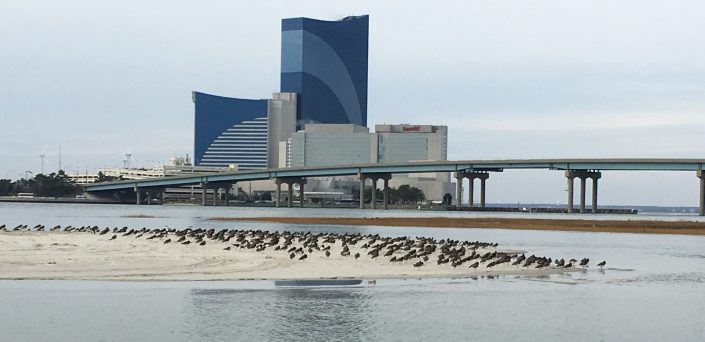
Most people are surprised to hear that American oystercatchers are present in New Jersey in the winter. They usually associate the charismatic shorebird as a breeding species here. Our state’s wintering oystercatchers, a combination of breeders from further north and our own, are at the northern extent of the Atlantic coast wintering range.
Continue reading “CWF Assists the State with Wintering American Oystercatcher Survey”By Meghan Kolk, CWF Wildlife Biologist
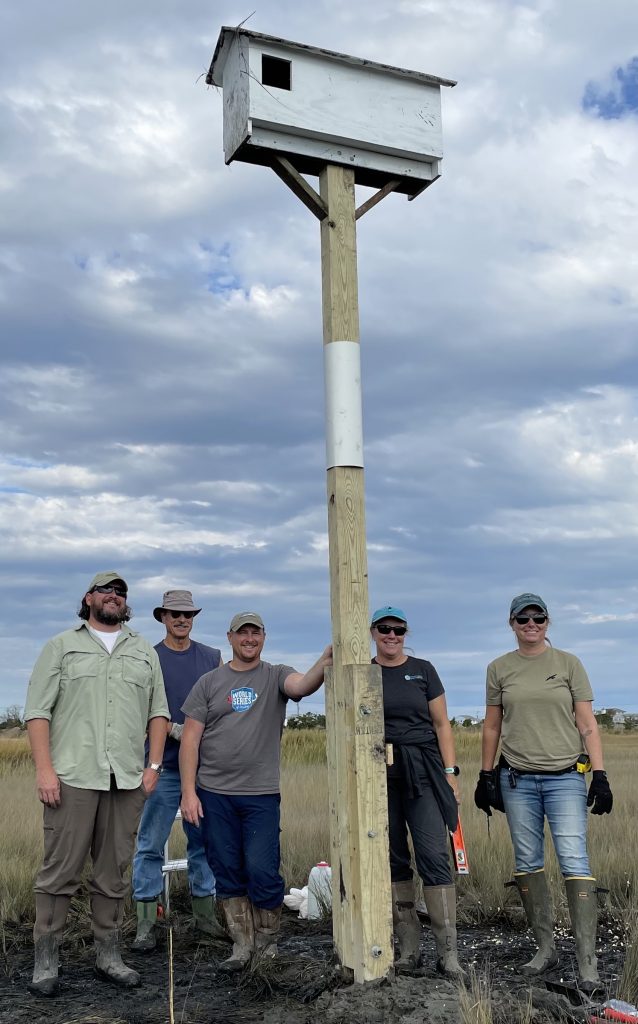
The Coastal Barn Owl Project team is gearing up for another round of nest box installations in coastal southern New Jersey. After a successful fundraising appeal, we can now thank our donors by adding more potential nesting opportunities for barn owls, a species in population decline.
Our fourth and most recent box was just installed on October 22 in the saltmarshes of Cape May County. With each install, the team is becoming more efficient, and we hope to get several more boxes up in key locations before early spring when the owls begin their search for suitable nesting sites.
By Todd Pover, Senior Wildlife Biologist

The 2021 New Jersey piping plover breeding season was a classic “good news, bad news” result. According to the annual report released by the state’s Endangered and Nongame Species Program earlier this month, the breeding population increased to 137 pairs in 2021, third highest since federal listing in 1986. That is an unprecedented 33% rise over the previous year and just short of the record high of 144 pairs in 2003. On the downside, the number of chicks fledged statewide was just 0.85 chicks per pair, the lowest since 2013 and about half of the 1.50 federal recovery goal. The low productivity was largely the result of a severe Memorial Day weekend nor’easter and persistent predator activity throughout the season.
Holgate, a unit of the Edwin B. Forsythe National Wildlife Refuge, hosted 46 pairs, the most in the state. This site, which is monitored and managed by CWF through a cooperative agreement with the Refuge, has seen an astounding increase in piping plover pairs in recent years, up about 2.5 times from the 18 pairs it had in 2018. CWF also monitors Little Beach, the adjacent Refuge-owned site, where another 13 pairs nested in 2021. Combined the two sites had 59 nesting pairs, a new record, by far, for the Refuge. Unfortunately, like the statewide results, productivity was very low this year at both Refuge sites, combined only 0.80 chicks fledged per pair, about half the rate just a year ago. The Memorial Day weekend nor’easter flooded those sites, wiping out most nests, and although most of the pairs nested again afterwards, many of those renests (or hatched chicks) were lost to predators, especially coyotes at Holgate.
CWF also oversaw piping plover breeding at the National Guard Training Center, which had just one pair in 2021, but that nest successfully hatched and fledged three chicks, helping boost the state average. Overall, CWF was responsible for monitoring 44% of the statewide population, giving it a significant role in helping guide conservation of this highly vulnerable state endangered (and federally threatened) species.
Although CWF does not conduct the daily on-the-ground monitoring and management of piping plovers at the Barnegat Inlet nesting site, it was a co-leader of the habitat restoration that was completed there two winters ago, and as such has had a big role in the nesting outcomes at the site. The number of pairs using the site has noticeably grown, up to five pairs in 2021 from just one pair when the project began. Productivity has also been consistently high at the restoration site and 2021 was no different with the pairs exceeding the federal recovery goal and statewide average with 1.6 chicks fledged per pair this year.
With the breeding results for 2021 now “in the books”, we are already looking forward to next year. The biggest question will be whether the state can sustain the progress towards recovery it made this year, especially given the big drop in productivity, which typically drives population. But for now, all we can do is wait until next spring to learn the answer to that question.