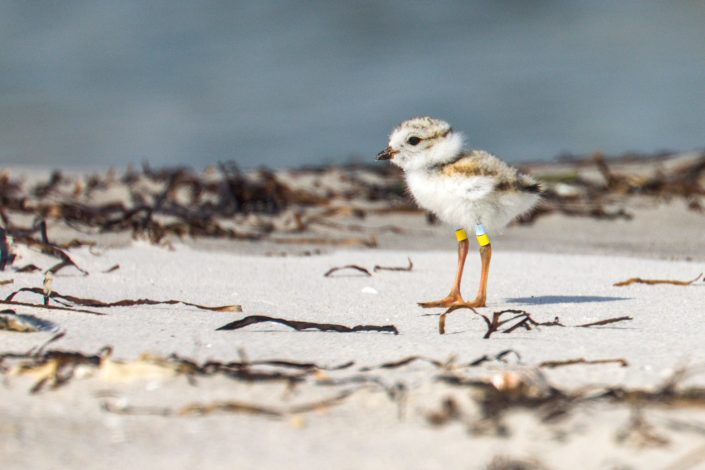
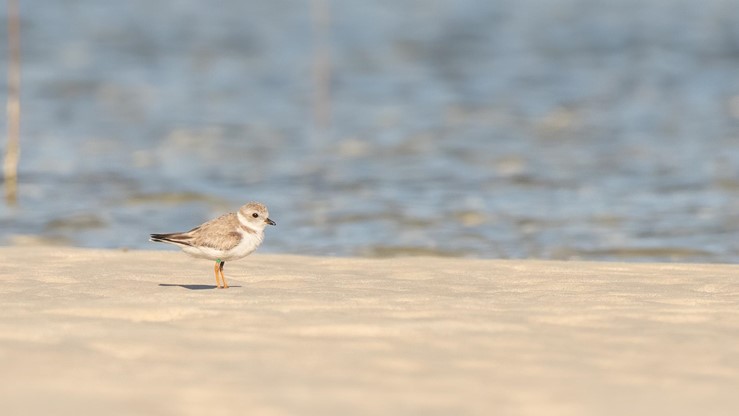
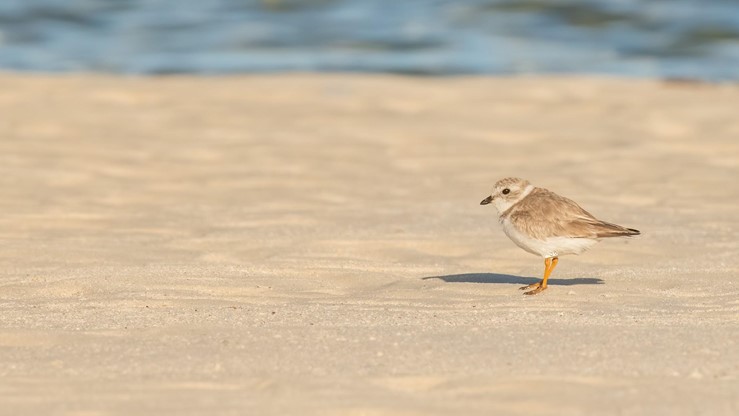
Pi Patel, one of the eight piping plovers chicks that fledged from the Barnegat Inlet Restoration site in 2021. Photo courtesy of Matt Reitinger.
The success of a habitat restoration project is typically measured in numbers, number of acres restored, the abundance of target species, breeding success of the wildlife using it, that sort of thing. And we certainly have good numbers for the Barnegat Light Habitat Restoration Project… 40 acres restored, including two foraging pond, five pairs of piping plovers using the site this year, a substantial increase from one pair just two years ago, and breeding success above the federal recovery goal and well above the state average for two years running since the project was fully completed.
But there’s more to the success than numbers, it can also be told through names. So first a disclaimer; we name our banded piping plovers in New Jersey. This practice is sometimes frowned upon by other researchers who fear anthropomorphism undermines their scientific credibility or leads to misunderstanding about biological processes. Point taken, but in the case of piping plovers, we believe naming can potentially lead to better engagement in their conservation through dynamic outreach, much the way Monty and Rose, Chicago’s famous plovers have garnered huge public support. Also, in New Jersey our banded plovers typically have four bands, so it is much easier for our monitoring staff to identify and communicate about a bird named “Major Tom” than orange over light blue (left), orange over black (right). Finally, some people are just plain curmudgeons about this issue, but endangered species recovery work is hard, so having a little fun with it isn’t such an awful thing! So, let’s get to the names and the “stories” they tell.
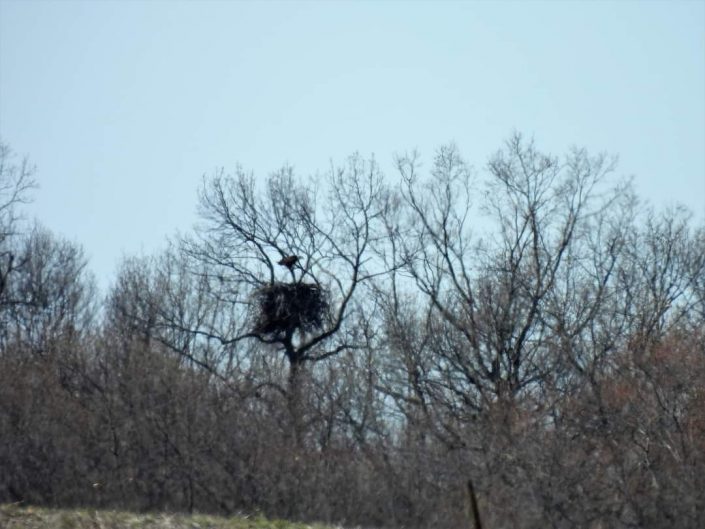
“Jersey Girl” is a NJ banded eagle (B/64). She was reported to us in 2014 by Linda Oughton, who has been keeping track of her and her mate since 2010. They nest is in Montgomery County, Pennsylvania. B/64 was banded in 2004 at a nest in Cumberland County NJ, located along the Cohansey River. ‘Jersey Girl” is seventeen years old.
Rose at Chicago’s Montrose Beach, July 2021. Courtesy of Tamima Itani.
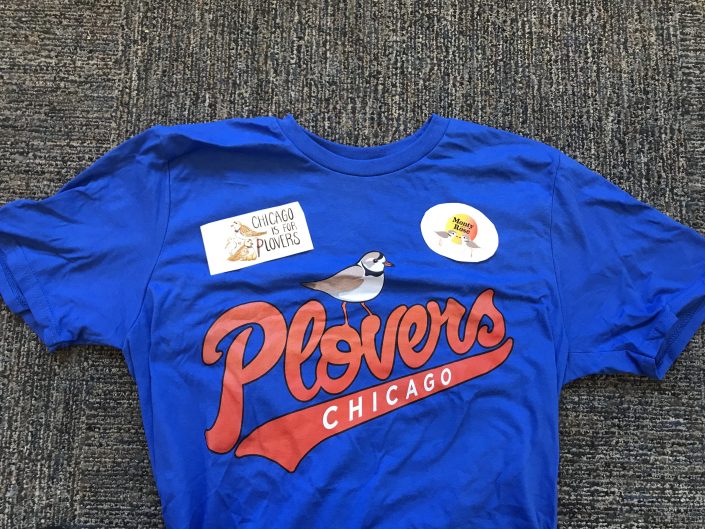
Monty and Rose were hardly strangers when I finally met them “in-person”. I had been admiring Chicago’s famous pair of piping plovers for nearly two years. I had read the adoring newspaper headlines about them and followed them closely on social media. I had seen, even hosted a screening for the short film made about their story. I proudly wore a hat emblazoned with their colorful logo.
From a strictly biological perspective, Monty and Rose aren’t much different than any other piping plovers; they have the same distinct markings, exhibit the same behaviors, and face the same threats that have landed plovers on the endangered species list. But there is nothing ordinary about this pair when it comes to the attention afforded them and the excitement they’ve created.
So early this summer I found myself on a plane headed to Chicago to experience the Monty and Rose phenomenon firsthand. Along for the pilgrimage were Kashi Davis and Emily Heiser, who head up New Jersey’s beach nesting bird program, and with whom I’ve share nearly my entire career. With nearly 60 years of “plovering” between us, you wouldn’t think we’d have much to learn from yet another pair of plovers. To be honest, the trip was as much about being inspired by Monty and Rose and the people involved in their story, as it was about anything else. But on the practical side, I was especially interested in how they managed to pull off a dawn to dusk volunteer monitoring program from incubation to hatch to fledge. And I really wanted to know how they generated all that excitement.
The novelty factor accounts for some of the appeal, the first plovers nesting in Chicago in many decades. But interest in Monty and Rose has continued to rage on several year running now, and a second film is scheduled for release in September, so it isn’t just that. Improbability also plays a part, a small pair of shorebirds and their even tinier chicks nesting on a busy city beach in the shadow of skyscrapers. The naming of the birds, a reference to Montrose Beach, where they nest, also seems to play an important role in the connection people feel for them. There is a great sense of pride – they are their plovers. And with just one pair at this site (and in the entire region), all the attention is funneled to them.
You feel the excitement the moment you walk on “their” beach. People constantly pop by to ask how Monty and Rose are doing. The volunteer monitors happily trade personal stories about them or offer a look in their scope to get a closer peak. Strangers wander over to ask what everyone is looking at. We met Bob Dolgan, the creator of the Monty and Rose film (and its upcoming sequel), and Tamia Itani, the pair’s “plover mother”, organizer of the volunteer effort, and now author of a Monty and Rose children’s book. Both had their own take on why the Monty and Rose story has gone viral, although I’m not sure I’ll ever know exactly what that “secret sauce” is. No matter, I left Chicago completely inspired by Monty and Rose and their protectors, recharged and ready to carry on with my own plover projects back home.
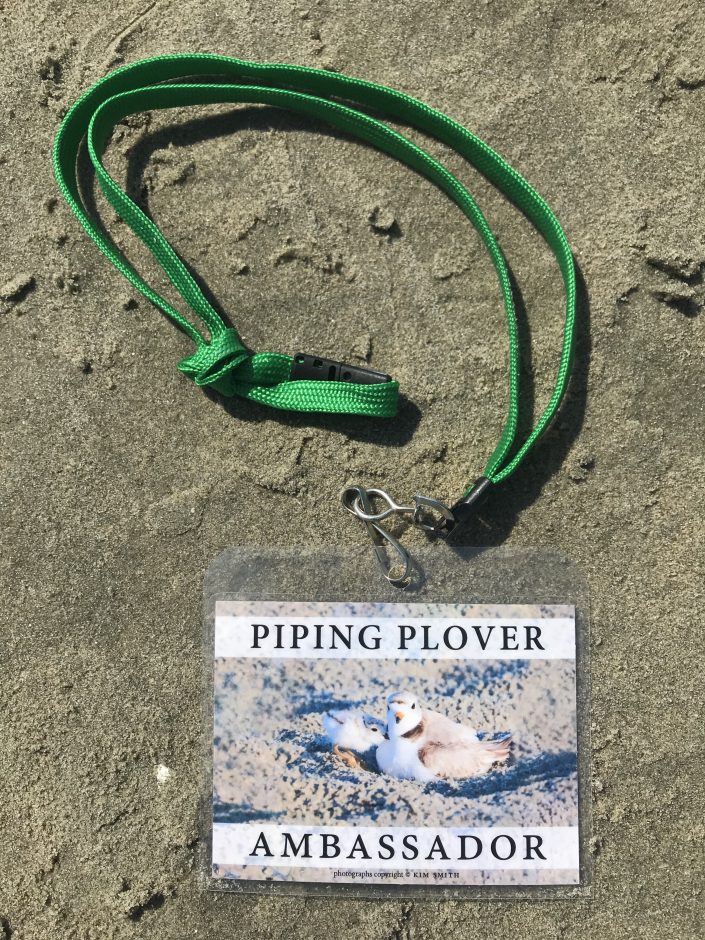
A few days after returning from Chicago, I took a day trip up to Gloucester, Massachusetts to meet some members of another piping plover volunteer group. Like the Monty and Rose crew, they annually help shepherd one pair of plovers (actually, they have two pairs this year) through the perils of nesting on a city beach, although Good Harbor Beach is decidedly quieter than Montrose Beach in Chicago, at least on the mid-week morning I visited. This group also manages to staff the beach with monitors from dawn to dusk on most days and has its own Facebook page that it maintains to educate the public and generate enthusiasm for their community’s plovers. They have been doing this longer than the Monty and Rose effort, but quietly out of the spotlight. They proudly wear their Piping Plover Ambassador badges.
Seeing those badges made me realize that although the Monty and Rose story has been invaluable for creating interest in plover conservation – piping plovers are definitely having a “moment” thanks to their story – it’s the hundreds of monitors who are the real piping plover ambassadors. I started my own “plover career” 28 years ago as a volunteer. I was immediately and inexplicably smitten by piping plovers, although I didn’t realize it would completely change my life. I’m just as captivated by piping plovers today and I remain equally inspired by my fellow protectors, paid and volunteer, who steadfastly fight to help maintain a place for piping plovers in our world. And provide them a voice.
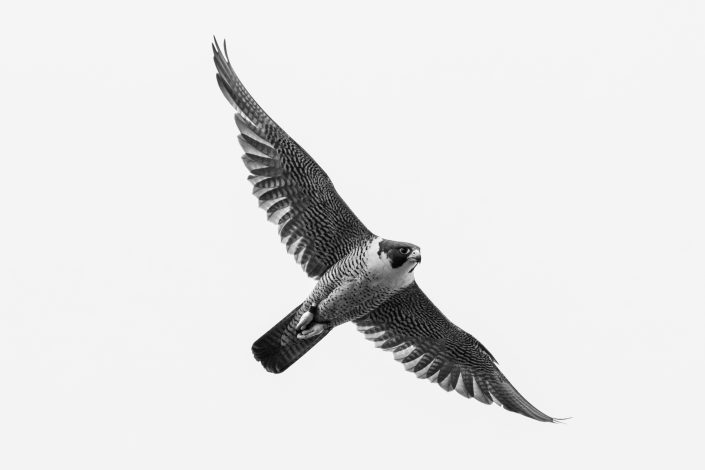
Female falcon 02/AN. She originated from a coastal nest in Bass River in 2011. Here she was photographed at her nest in May 2020 at Sedge Island.
Just imagine having to defend your home from an invader who wants to steal your home and mate. All you have to protect yourself and home are your bare hands (or talons). You fought this same battle several years ago and staked your claim here. It was a hard won battle that could have been the end.
Conserve Wildlife Foundation’s Delaware Bay Shorebird Stewards will be on Restricted access beaches in Cape May and Cumberland Counties from May 15th through the 31st. We will be educating beach goers about the horseshoe crabs and shorebirds.
Plan a visit to the bay in May to witness this spectacular wildlife phenomena!
Union County Falcon Cam female, “Frida,” stands over her clutch.
Last Friday, Union County Department of Parks & Recreation Environmental Specialist Betty Ann Kelly sent us an exciting update on the Union County Falcon Cam.
It looks like our famous peregrine pair are officially expecting!
Great news!
As some of you know, the rooftop of the Union County Courthouse has been home since 2006 to a pair of peregrine falcons, a threatened bird of prey species. Our female, nicknamed “Frida” because of her large “unibrow” between her eyes (reminding us of the South American artist) has laid her first egg of the season on March 19th, 2021 at 9:45 a.m.!
We can expect possibly two or three more eggs over the course of the next few days with hatching occurring sometime in late April.
Go toucnj.org/falcon to catch a glimpse of the falcons and possibly the egg on our falcon cam!
We will keep you posted!
Betty Ann Kelly
Just two days later, this past Sunday, we received even more good news!
Today at around 2:20 p.m. after what seemed like considerable effort, our female peregrine falcon laid egg # 2.
All is well.
We expect another egg or two in the next few days. When the last egg is hatched, both male and female falcons will consistently incubate.
By the way, this egg only looks bigger because of the camera’s wide angle lens.
Due to overwhelming demand, our first screening of the film about Monty and Rose, Chicago’s famous piping plovers, has REACHED CAPACITY.
In light of this, a second virtual showing has been added on Thursday March 25 from 7:00-8:15 pm EST.
Once again, the short film will be followed by a Q&A with Todd Pover, CWF’s Senior Wildlife Biologist and Bob Dolgan, the film’s creator. And just like the first showing, one lucky participant will also be chosen at random to win a Piping Plover Prize Pack! Prizes include a newly designed CWF PIPL hat and other assorted beach nesting bird goodies to be shipped right to your home.
Admission is free, but you’ll need to register at the link below.
Written and directed by Bob Dolgan, “Monty and Rose” tells the story of a pair of endangered piping plovers that nested at Chicago’s Montrose Beach in the summer of 2019, becoming the first of the species to nest in the city since 1955. With a music festival scheduled to take place within feet of the plovers’ nest site, volunteers, advocates, and biologists get to work in order to protect the vulnerable pair. The documentary follows these efforts, including interviews with those there to help this special pair nesting on one of the busiest beaches in Chicago.
About the Hosts:
Bob Dolgan is a life long birder and filmmaker from Chicago. He’s the founder of Turnstone Strategies, author of the This Week in Birding newsletter, and a past Board Member of Chicago Ornithological Society.
Todd Pover has been involved in research, monitoring, and management of beach nesting birds for over 25 years in New Jersey and other portions of the flyway. He heads up the CWF beach nesting bird project and leads our Bahamas piping plover wintering grounds initiative.
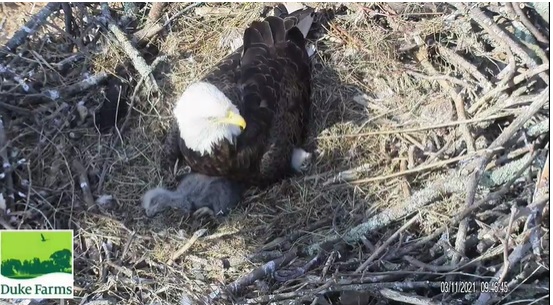
The two Duke Farms bald eagle chicks peek out from under their parent to catch some sun.
It looks like the Duke Farm’s nest will only have two chicks this season.
One egg remains in the nest bowl and is still being incubated, but based on when the second chick hatched, March 1st, it should have hatched by now. We won’t know for certain why the egg didn’t hatch, but one theory is that it was the first egg laid.
There had been intruder eagles at the nest and fights between the adults and intruders. At one point both adults were off the nest for 20 minutes while an immature was in the nest. Perhaps something happened to the egg during these incidents.
The egg will eventually get buried in the nest or shoved to the side. The adults are busy bringing food to the nest for feedings and both chicks are getting plenty of food.
Portion of flock coming in for a landing. Photo by Chris Johnson
Starting in 2011, Conserve Wildlife Foundation of NJ, led by Senior Wildlife Biologist Todd Pover, has been working in the Bahamas, primarily Abaco, to help study the habitat and distribution of wintering piping plovers.
Band resighting surveys are one of the important aspects of this work. As a result of severe damage from Hurricane Dorian in 2019 and current safety issues due to the Covid pandemic, regular surveys were not conducted this winter, either by CWF or the group of local volunteers who have assisted over the years.
With this in mind, we were delighted to get a very late winter report from Chris Johnson, a local resident and accomplished young birder. You can read his account of the survey and enjoy his photos below.
On February 26th, 2021 a large group of Piping Plovers was sighted and documented on a sand flat near Cherokee Sound on the island of Abaco in the Bahamas by local residents Christopher Johnson and Michael Knowles. The flat was teeming with bird life as many migratory shorebirds were preparing to begin their journeys back to the breeding grounds. Short-Billed Dowitchers, Black-Bellied Plovers, Least Sandpipers, and Semipalmated Sandpipers were a great find. However, the pinnacle of the birding trip was a grand total of 46 Piping Plovers!
Among the 46 plovers were three notable, returning plovers, recognizable from their leg bands: Squid (Right Leg-Green over Red, Left Leg-Blue over Black), Joe (Green Flag 70E) and White Flag 36. The behavior of these plovers surely indicated that they are on the brink of beginning their migrations northward. Many were beginning to gain their summer breeding plumage and were feuding over crustaceans and worms, while others were bickering for a mere resting place.
“Squid”
“Joe”
“White Flag 36”
The substantial group of plovers stuck around on the sand flat that was slowly diminishing due to the rising tide and continued to rest and feed on the flat for another 25 minutes. It was apparent as the first flock congregated and took to the wing due east that they were bound for their roost in nearby Casuarina Point. After the majority group of 30, including Joe and White Flag #36 departed, a small group of 16 remained resting on the last segment of the flat. Within another ten minutes the second group of plovers had hightailed it for the Cherokee Creek System. The “Cherokee Group”, including Squid, would vanish into the dense mangrove ecosystem to get a good night’s rest.
A group of this size would suggest that many of these birds will begin their migrations back north within the coming weeks. Hopefully a successful breeding season lies ahead!
Piping plover marches along the beach. Photo by Chris Johnson.
Join us onMarch 18, 2021 at 7pm,for a virtual presentation of the 23-minute documentary hosted by “Monty and Rose” director Bob Dolgan and CWF Senior Biologist Todd Pover. This will mark the film’s first screening on the East Coast!
Written and directed by Bob Dolgan, “Monty and Rose” tells the story of a pair of endangered piping plovers that nested at Chicago’s Montrose Beach in the summer of 2019, becoming the first of the species to nest in the city since 1955. With a music festival scheduled to take place within feet of the plovers’ nest site, volunteers, advocates, and biologists get to work in order to protect the vulnerable pair. The documentary follows these efforts, including interviews with those there to help this special pair nesting on one of the busiest beaches in Chicago.
The screening will include an introduction to “Monty and Rose” provided by the director prior to the film screening. After the film, Bob Dolgan and Todd Pover will host an audience Q&A and conversation about the film, piping plovers, and beach nesting birds!
One lucky participant will also be chosen at random to win a Piping Plover Prize Pack! Prizes include a newly designed CWF PIPL hat and other assorted beach nesting bird goodies to be shipped right to your home.
We hope you’ll join us for an evening celebrating piping plovers and those who work to protect them.
Bob Dolgan is a life long birder and filmmaker from Chicago. He’s the founder of Turnstone Strategies, author of the This Week in Birding newsletter, and a past Board Member of Chicago Ornithological Society.
Todd Pover has been involved in research, monitoring, and management of beach nesting birds for over 25 years in New Jersey and other portions of the flyway. He heads up the CWF beach nesting bird project and leads our Bahamas piping plover wintering grounds initiative.