Rare Species Spotlight
Eastern box turtle (Terrapene carolina carolina)
By Ben Wurst, Habitat Program Manager
Key Features
Highly domed carapace (upper shell) and a hinged plastron (lower shell). Most terrestrial turtle found in New Jersey.
Identification
Box turtles range in length from only 4″ up to 8.5″. The shell of the box turtle is unique. It’s carapace is high and shaped like a dome. It’s keel, or the ridge along the backbone is weak or very flat. The plastron is hinged and can close very tightly, in front and in rear. This is meant to protect the turtle from predators, especially the neighborhood dog.

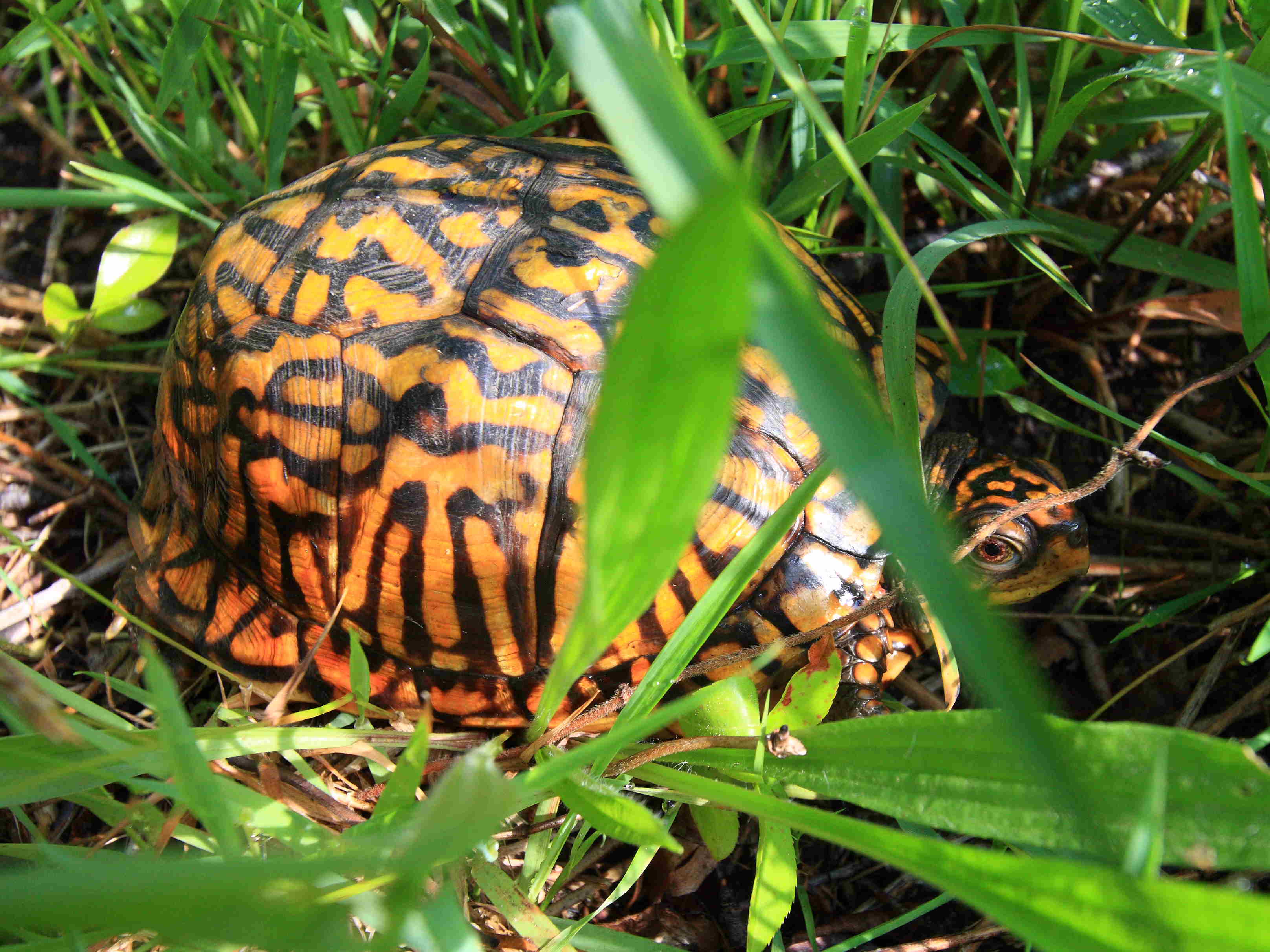
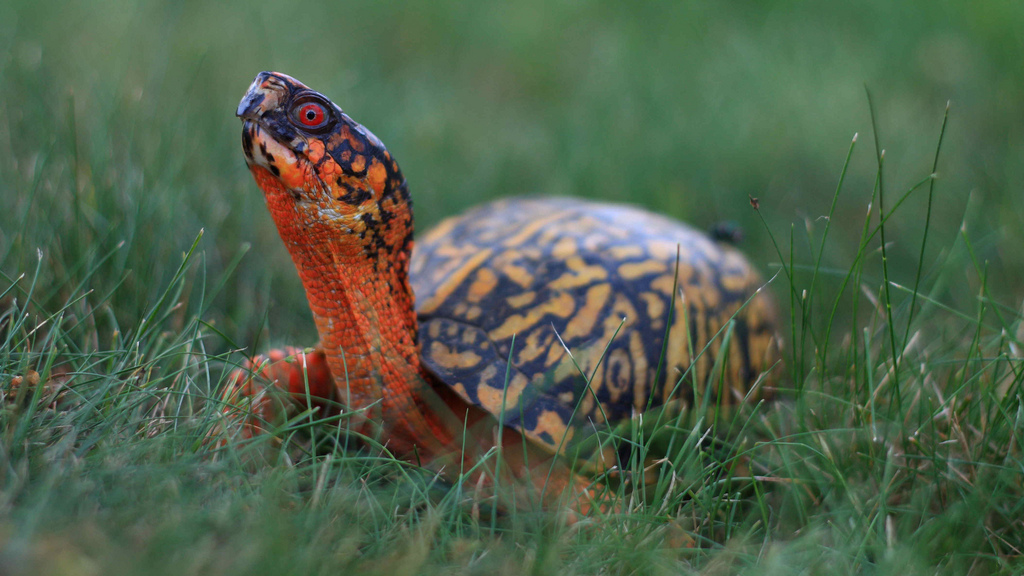
Box turtle at a restoration site in Burlington County, NJ. © Ben Wurst Sexes are slightly similar in appearance. Both have yellow, orange, olive, or tan on their carapace and plastron that is contrasted by a light or dark black background. Individuals can appear very different in coloration. The male (pictured above) is very vibrantly colored. Younger turtles are more vibrantly colored than older ones. Males have a longer and wider tail than females. Their carapace is often more flattened than females. Males have a more vibrantly colored (orange or red) eyes. The plastron of males is slightly concave. Females have lighter colored (light brown to light orange) eyes and their plastron is flat. Their carapace is often more domed in shape.
Distribution and habitat
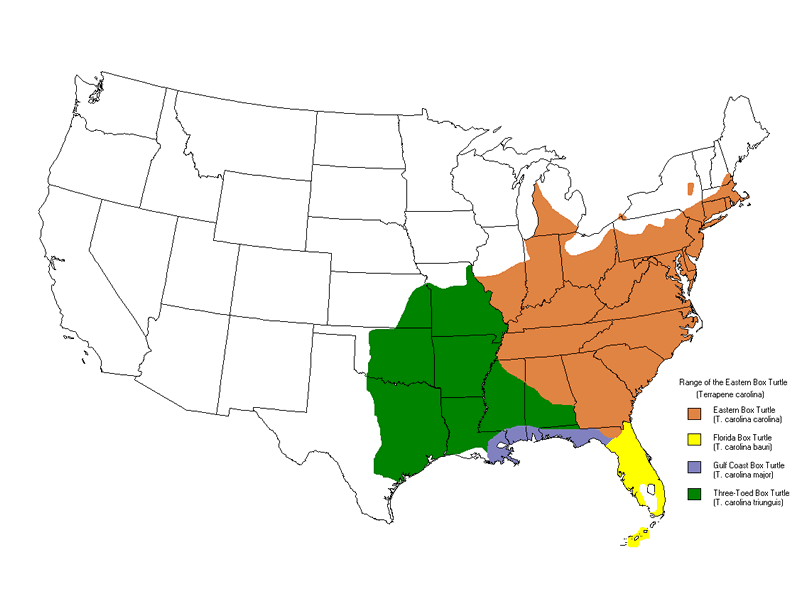
The Eastern or Common box turtle occurs in the eastern United States from central Maine south to southern Georgia and Alabama, west to central Michigan and southern Wisconsin and then south into parts of Illinois, all of Kentucky, Tennessee, and then parts of Mississippi. It can be found in all of the 21 counties in New Jersey.

Range of the Eastern box turtle. Image courtesy Davidson College Herpetology Lab. Box turtles inhabit open woodlands and meadows. They are often seen in neighborhood backyards in rural and suburban areas. They are usually not far from streams or ponds, however, during rainy weather they may roam farther from water. They are the most terrestrial turtle found in New Jersey. They like water, but are not adapted for swimming in water.
Studies have shown that box turtles have very small home ranges. Researchers found that their territories are around 250 square yards or less. If box turtles are removed from their territories and placed in an unfamiliar area, then they may die while trying to find their way back home. It is very important to not take a box turtle from its habitat and relocate it. If you find an injured one and do transport it to a state certified rehabilitator; record the animals location and make sure to inform the rehabilitator so it can be re-released where it was found.
Diet
Box turtles are omnivores. Changes in food preference occur during different seasons and life stages. Young turtles eat more insects, while adults eat more plant matter. Young turtles eat earthworms, snails, insect larvae, and some vegetative matter. Adults eat large quantities of fungi and particularly like berries and fruits from trees and shrubs.
Life Cycle
Box turtles, like other reptiles are cold-blooded and in the northern parts of their range hibernate from late October or November until April. During hibernation they burrow into loose soil, vegetative debris, and/or loose sand, and sometimes in the mud of stream bottoms. They dig burrows with their front legs, instead of their back legs (which are used to dig holes for laying eggs). Some hibernate at depths up to two feet deep. They can arise during warm spells.
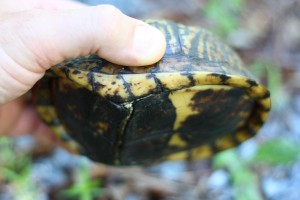
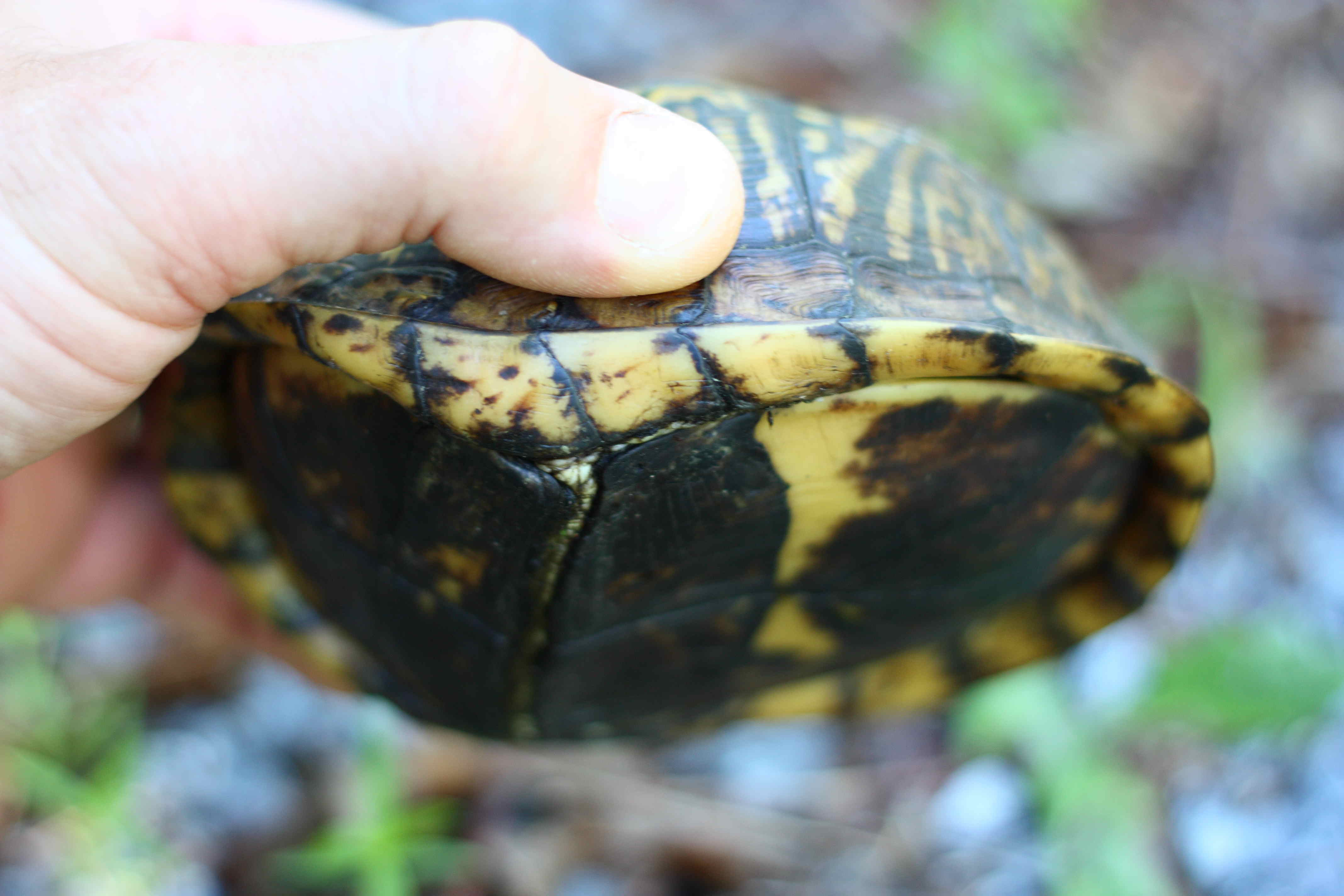
The plastron of the box turtle helps indicate the sex of the individual. © Ben Wurst Individuals become reproductive at 4 to 5 years in age. They can live to be older than 20 years in age. Mating begins shortly after individuals emerge from hibernation. During courtship, males chase or follow females to mate. Males often bite the edges of the females carapace, head, and neck. The male mounts the female (males have the concave plastron that helps during copulation) and hooks his back legs under the back edge of the females shell. During copulation the males body becomes upright and reproduction occurs. There has been evidence that females can remain fertile for two or three years after mating.
Eggs are laid in June and July. Nesting usually occurs in the late afternoon. Females deposit eggs in a hole that she digs in loose or sandy soil and sometimes in lawns. The cavity is around 3 inches deep, or about as long as the back legs of the adult female turtle. They lay between 2 to 7 eggs. Most hatching occurs in September or average incubation is around 87 to 89 days. Young either remain in the nest after hatching, emerge and go directly into hibernation, or emerge and explore for a few days to weeks, then hibernate. They do not require food during their first summer or fall before going into hibernation.
Current Status, Threats, and Conservation
Box turtles are fairly common throughout their range; however, they’re population is declining in New Jersey. Habitat destruction and fragmentation isolate individuals from finding mates and food. This causes local populations to decline in numbers or become extirpated from an area. Their slow reproductive rate does not allow for a fast recovery if a local population losses several individuals in a given amount of time.
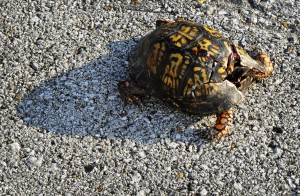
Be aware for box turtles while driving! Another threat to box turtles is the illegal collection for use as pets. They are highly sought for their use in the illegal pet trade (one of the world’s most profitable markets). Many people collect box turtles to breed in captivity for use as pets. Another conservation concern is the impact of high mortality rates from impacts with motor vehicles. Many roads transect suitable habitat for box turtles and many turtles that enter roadways die each year.
These threats have exacerbated their decline and the fact that the NJ Division of Fish and Wildlife, Endangered and Nongame Species Program have listed them as a Species of Special Concern. This listing will mostly importantly help garner protection through enhanced habitat protection of suitable or critical habitat for box turtles.
How to help
The Endangered and Nongame Species Program would like for individuals to report their sightings of box turtles. Record the date, time, location, and condition of the animal and submit the information by submitting a Sighting Report Form. The information will be entered into the state’s natural heritage program, commonly referred to as Biotics. Biologists map the sighting and the resulting maps “allow state, county, municipal, and private agencies to identify important wildlife habitats and protect them in a variety of ways. This information is used to regulate land-use within the state and assists in preserving endangered and threatened species habitat remaining in New Jersey.”
References
Carr, Archie. 1952. Handbook of Turtles, The Turtles of the United States, Canada, and Baja California. Cornell University Press.
Schwartz, Vicki and Dave Golden. 2002. Field Guide to Reptiles and Amphibians of New Jersey. NJ Division of Fish and Wildlife. Available in our online store!
The Davidson College – Herpetology Laboratory. Eastern box turtle information.