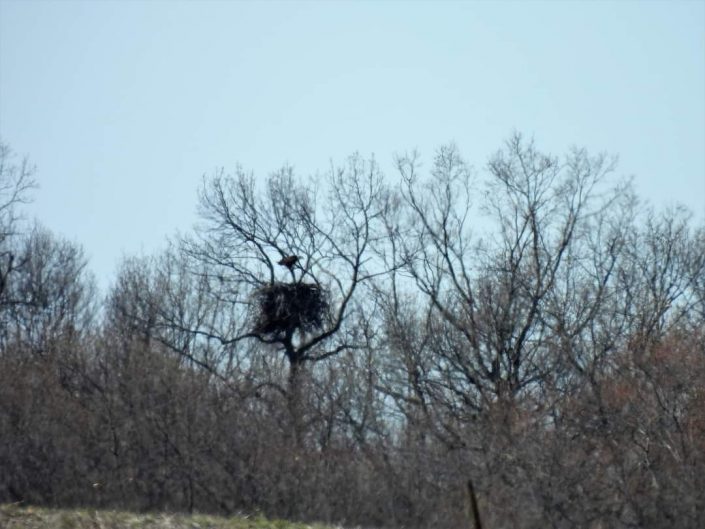
The 2021 New Jersey eagle nesting season was another good year for NJ’s eagle population. The final numbers and details will be available in the 2021 Annual Bald Eagle report published in December. There are over 100 eagle project volunteers who monitor eagle nests/s during the season. They are an extremely dedicated group who not only monitor eagle nests but help to protect the nests. Volunteers become familiar with their pairs and get to witness all kinds of eagle (and other wildlife) activity. I asked the volunteers to send me their one favorite photo from this season.
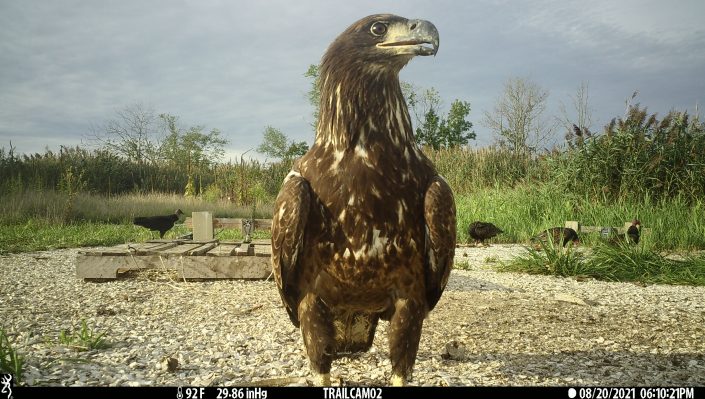
This is the second year that the NJ Endangered & Nongame Species program along with the Conserve Wildlife Foundation of NJ have set up a “soft release” area for juvenile eagles that were found grounded and cared for at Rehabilitation centers. The site is in a remote area of Cumberland County where staff and volunteers provide supplemental food (fish and road-killed mammals) in a safe place, and where other juvenile and sub-adult eagles would provide the social learning they needed. Trail cameras were installed to document eagle use.
This eagle nesting season we have been following the story of the Three Bridges eagle pair in a blog series. A camera on the nest allowed viewers to get an up-close view of the nesting activities. The pair successfully raised two chicks, who biologists banded (green bands H/04 & H/05), and they fledged the end of June.
On July 4th, eagle H/05, was found injured near the nest. He was taken to The Raptor Trust where he was treated for a fracture of the left coracoid bone, which supports powered flight in the wing. He remained in the care of The Raptor Trust until he was fully healed and had regained some of his flight strength.
Three Bridges nest monitors continued to observe the nest area and determined that the adults and H/04 were still around the nest platform. In a very quick and quiet manner, H/05 was released back at the nest site last past week. It was necessary to have adults in the area, so he can continue his post-fledging period with them, learning to hunt and survive on his own.
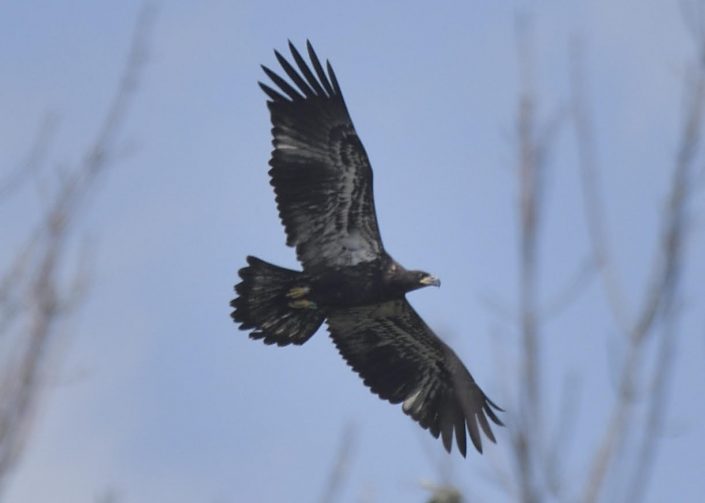
H/05, August 12, 2021@ Mary Ellen Hill
Since his release, H/05 has been seen flying and perching in the nest area. It is very important for people to view the nest platform from a distance and not approach the nest tower or any eagles perched in the area. We all need to keep this nest area “eagle-safe” for the next month, giving H/05 and his family time to reacquaint and re-learn eagle skills! We thank everyone who has supported this eagle family.
“Jersey Girl” is a NJ banded eagle (B/64). She was reported to us in 2014 by Linda Oughton, who has been keeping track of her and her mate since 2010. They nest is in Montgomery County, Pennsylvania. B/64 was banded in 2004 at a nest in Cumberland County NJ, located along the Cohansey River. ‘Jersey Girl” is seventeen years old.
I started writing the Three Bridges blog series at the end of November 2020. At the time we had no idea if the eagle pair would return to the newly installed nest box, nest somewhere else or nest at all this season. In the last blog post Part 5, the eggs had hatched. Since that last blog a lot has happened at the nest. On April 2nd nest monitors determined that hatching was occurring and on April 14th it was determined that there were two chicks. On May 14th, the nest was visited by PSE&G and NJ Division of Fish and Wildlife, Endangered and Nongame Species Program. The chicks were banded with silver federal bands and green NJ bands H/04 and H/05. Both chicks were determined to be males. During the nest visit the camera was fixed and a whole new close up view of the nest appeared.
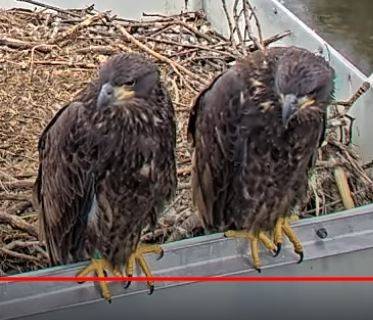
Three Bridges eagle cam; June 13th, 2021
Cam viewers got to watch the young eagles as they learned to feed themselves and started preparing their wing muscles for flight, by flapping and hopping around the nest. When eagles are nesting in a tree the young will perch on branches which is called “branching”. In this case the chicks don’t have any branches, so the perches were built as substitute branches. Nest monitor, Mary Ellen Hill, got the below screen shot of one of the chicks perched for the first time. The young eagles also used the metal arm of the pole for perching.
On June 20th, H/04 took his first flight and his brother H/05 followed on June 22, all of which was caught on camera. Eagle Project volunteer Diane Wilson Cook has made a webpage, Bald Eagles at Three Bridges with the video clips from these flights. The fledges have been returning to the nest platform since fledging. The parent’s are still bringing food to the nest for the young eagles as they will be in the nest area for the next few weeks as they learn to hunt and survive on their own.
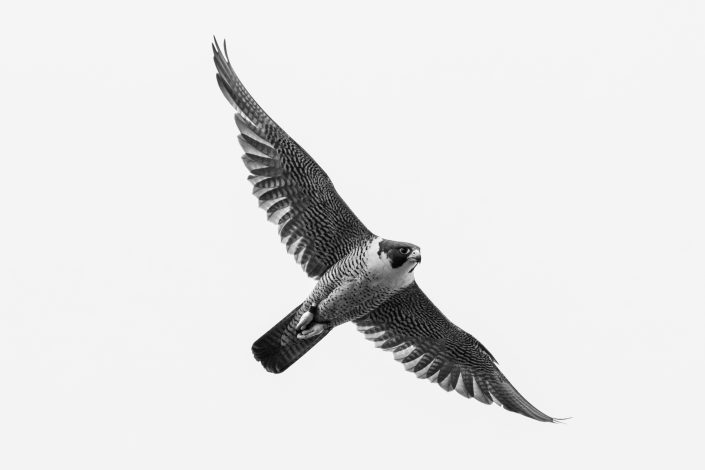
Female falcon 02/AN. She originated from a coastal nest in Bass River in 2011. Here she was photographed at her nest in May 2020 at Sedge Island.
Just imagine having to defend your home from an invader who wants to steal your home and mate. All you have to protect yourself and home are your bare hands (or talons). You fought this same battle several years ago and staked your claim here. It was a hard won battle that could have been the end.
Ben Wurst, CWF Habitat Program Manager (right) with local volunteers, AC Electric and DuBois Environmental Staff who helped install this osprey nest platform in Atlantic City.Continue reading “Photo From the Field: #213”
Union County Falcon Cam female, “Frida,” stands over her clutch.
Last Friday, Union County Department of Parks & Recreation Environmental Specialist Betty Ann Kelly sent us an exciting update on the Union County Falcon Cam.
It looks like our famous peregrine pair are officially expecting!
Great news!
As some of you know, the rooftop of the Union County Courthouse has been home since 2006 to a pair of peregrine falcons, a threatened bird of prey species. Our female, nicknamed “Frida” because of her large “unibrow” between her eyes (reminding us of the South American artist) has laid her first egg of the season on March 19th, 2021 at 9:45 a.m.!
We can expect possibly two or three more eggs over the course of the next few days with hatching occurring sometime in late April.
Go toucnj.org/falcon to catch a glimpse of the falcons and possibly the egg on our falcon cam!
We will keep you posted!
Betty Ann Kelly
Just two days later, this past Sunday, we received even more good news!
Today at around 2:20 p.m. after what seemed like considerable effort, our female peregrine falcon laid egg # 2.
All is well.
We expect another egg or two in the next few days. When the last egg is hatched, both male and female falcons will consistently incubate.
By the way, this egg only looks bigger because of the camera’s wide angle lens.
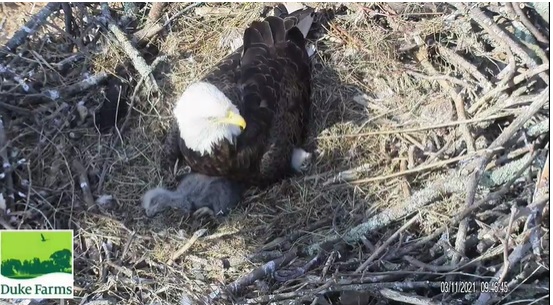
The two Duke Farms bald eagle chicks peek out from under their parent to catch some sun.
It looks like the Duke Farm’s nest will only have two chicks this season.
One egg remains in the nest bowl and is still being incubated, but based on when the second chick hatched, March 1st, it should have hatched by now. We won’t know for certain why the egg didn’t hatch, but one theory is that it was the first egg laid.
There had been intruder eagles at the nest and fights between the adults and intruders. At one point both adults were off the nest for 20 minutes while an immature was in the nest. Perhaps something happened to the egg during these incidents.
The egg will eventually get buried in the nest or shoved to the side. The adults are busy bringing food to the nest for feedings and both chicks are getting plenty of food.
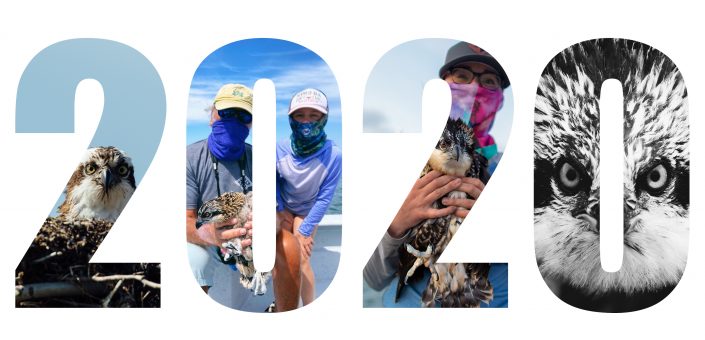
For every dark day there was always hope for a brighter future. Results from the 2020 New Jersey Osprey Project.
Ben Wurst, Habitat Program Manager
This was likely one of the most challenging, at least in recent years, in the history of the New Jersey Osprey Monitoring Project. From social distancing and working from home (with children) to severe wind events and dealing with the impacts of humans on ospreys, 2020 turned out to be quite the year. Overall, our work was largely unaffected by the global covid-19 pandemic. Most of our work is conducted outdoors and away from mass gatherings of people. It was important for us to ensure the safety of our volunteers and the general public safe.