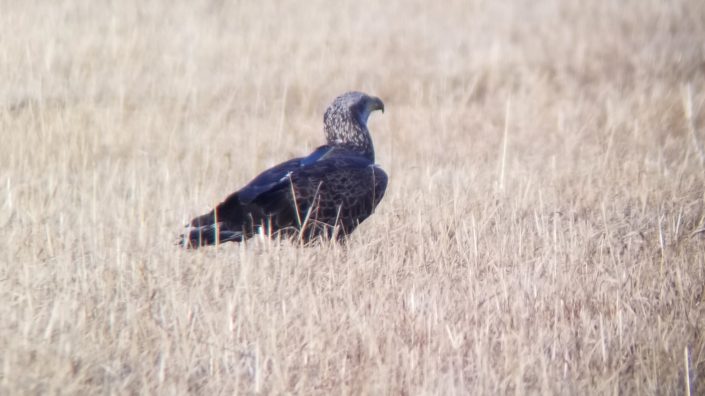
A year ago November I began tracking Duke. I was fortunate to see and photograph him more than a dozen times and wrote two blogs for CWF about these adventures.
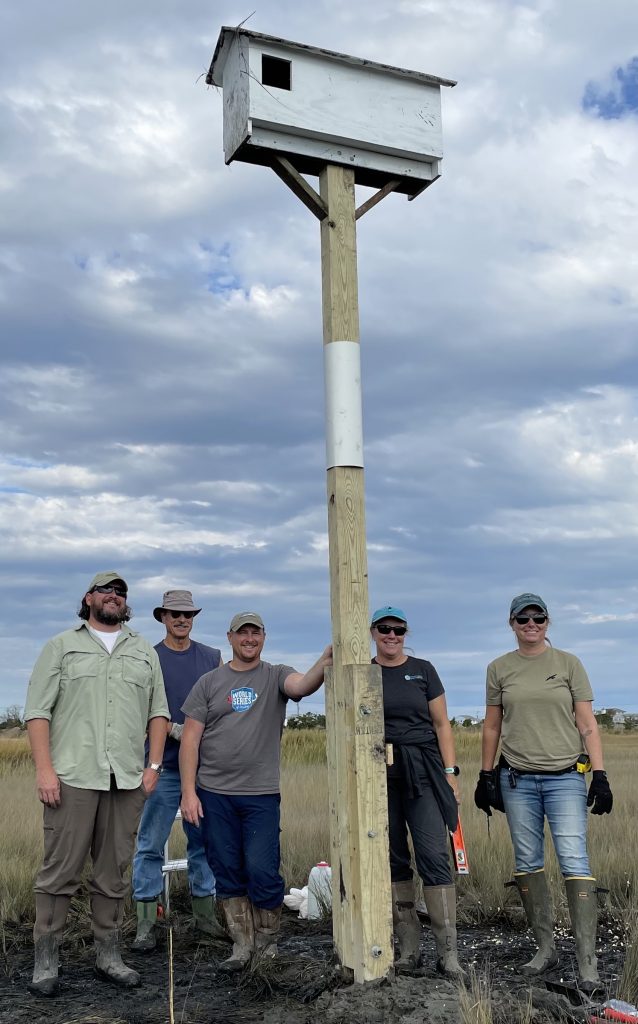
The Coastal Barn Owl Project team is gearing up for another round of nest box installations in coastal southern New Jersey. After a successful fundraising appeal, we can now thank our donors by adding more potential nesting opportunities for barn owls, a species in population decline.
Our fourth and most recent box was just installed on October 22 in the saltmarshes of Cape May County. With each install, the team is becoming more efficient, and we hope to get several more boxes up in key locations before early spring when the owls begin their search for suitable nesting sites.
The newest barn owl nest box with volunteers Kevin Knutsen, Steve Eisenhauer and Mike Lanzone on left. Team leaders Tricia Miller and Meghan Kolk on right. Photo by Lisa Ferguson.
Coverboards are typically placed along ecotones, where species diversity is expected to be greatest. The corrugated tin board, pictured above, was positioned along a forest edge where larger deciduous trees meet a more open, sandy landscape.
How do you survey for animals that spend most of their time hidden under leaf litter or wedged between fallen tree limbs and rocks?
In the case of reptiles and amphibians, the answer is to use coverboards!
Coverboards are materials that are intentionally placed within a potential habitat, often along ecotones (where different habitat types- e.g., wetland and forest, field and forest, etc. come together) that trap moisture and retain heat, creating favorable conditions for our “cold-blooded” (ectothermic) friends. Researchers often arrange coverboards in long transects or arrays and collect data on the diversity of the community underneath the boards as compared to the surrounding environment. This technique was used by NJDEP Division of Fish and Wildlife to survey for herptiles in 17 wildlife management areas in the early 2000s (Golden, 2004). A total of 30 species were recorded during the first year of the study, including long-tailed salamanders, pine barrens tree frogs, and northern pine snakes, all of which are listed as threatened in New Jersey.
Pair of Piping Plovers Tending Nest. Courtesy of Northside Jim
The 2021 New Jersey piping plover breeding season was a classic “good news, bad news” result. According to the annual report released by the state’s Endangered and Nongame Species Program earlier this month, the breeding population increased to 137 pairs in 2021, third highest since federal listing in 1986. That is an unprecedented 33% rise over the previous year and just short of the record high of 144 pairs in 2003. On the downside, the number of chicks fledged statewide was just 0.85 chicks per pair, the lowest since 2013 and about half of the 1.50 federal recovery goal. The low productivity was largely the result of a severe Memorial Day weekend nor’easter and persistent predator activity throughout the season.
Holgate, a unit of the Edwin B. Forsythe National Wildlife Refuge, hosted 46 pairs, the most in the state. This site, which is monitored and managed by CWF through a cooperative agreement with the Refuge, has seen an astounding increase in piping plover pairs in recent years, up about 2.5 times from the 18 pairs it had in 2018. CWF also monitors Little Beach, the adjacent Refuge-owned site, where another 13 pairs nested in 2021. Combined the two sites had 59 nesting pairs, a new record, by far, for the Refuge. Unfortunately, like the statewide results, productivity was very low this year at both Refuge sites, combined only 0.80 chicks fledged per pair, about half the rate just a year ago. The Memorial Day weekend nor’easter flooded those sites, wiping out most nests, and although most of the pairs nested again afterwards, many of those renests (or hatched chicks) were lost to predators, especially coyotes at Holgate.
CWF also oversaw piping plover breeding at the National Guard Training Center, which had just one pair in 2021, but that nest successfully hatched and fledged three chicks, helping boost the state average. Overall, CWF was responsible for monitoring 44% of the statewide population, giving it a significant role in helping guide conservation of this highly vulnerable state endangered (and federally threatened) species.
Although CWF does not conduct the daily on-the-ground monitoring and management of piping plovers at the Barnegat Inlet nesting site, it was a co-leader of the habitat restoration that was completed there two winters ago, and as such has had a big role in the nesting outcomes at the site. The number of pairs using the site has noticeably grown, up to five pairs in 2021 from just one pair when the project began. Productivity has also been consistently high at the restoration site and 2021 was no different with the pairs exceeding the federal recovery goal and statewide average with 1.6 chicks fledged per pair this year.
With the breeding results for 2021 now “in the books”, we are already looking forward to next year. The biggest question will be whether the state can sustain the progress towards recovery it made this year, especially given the big drop in productivity, which typically drives population. But for now, all we can do is wait until next spring to learn the answer to that question.
To read the state’s entire 2021 piping plover report:
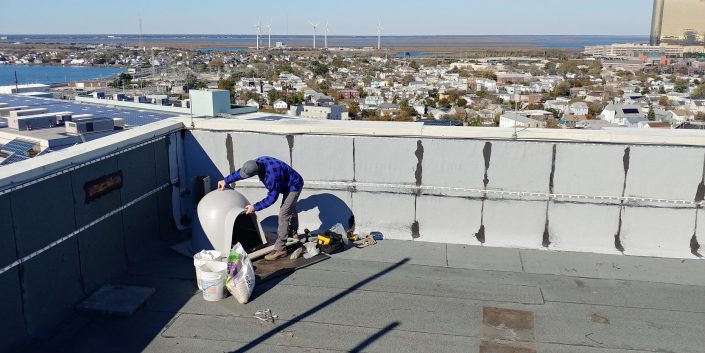
Putting the final touches on a new nestbox for peregrine falcons in Atlantic City, NJ. photo by Kathy Clark/ENSP
This past week I had the pleasure of assisting Supervising Zoologist, Kathy Clark with NJ Fish & Wildlife’s Endangered and Nongame Species Program to install a new nestbox for state endangered peregrine falcons. The new nestbox was installed atop the Sheraton Atlantic City Convention Center Hotel. Peregrine falcons are not new to Atlantic City. They have nested in A.C. since 1987, where the first pair nested on the 23rd floor of the Hilton/Atlantic Club. Since then new pairs have established nests on other tall buildings and structures, like the Hard Rock Casino and A.C. water tower.
The Board of Trustees of Conserve Wildlife Foundation of New Jersey (CWF) is pleased to announce the appointment of Liz Silvernail to Executive Director. In this role, Silvernail will guide the organization in its work to preserve rare and at-risk wildlife in New Jersey through field science, habitat restoration, public engagement, and education.
“I am honored to have this opportunity to lead CWF as executive director,” said Silvernail. “With the support of our dedicated and hard-working biologists, the leadership of our board, and the commitment of our supporters and volunteers, we’re ready to take on the daunting challenges facing our rare wildlife and the habitats on which they depend.”
A part of CWF for nearly 12 years, Silvernail was most recently Acting Executive Director. Previously, she was Director of Development where she formed strong corporate and donor partnerships to build organizational capacity and impact. Through her leadership, CWF developed and implemented highly successful STEAM educational programs throughout New Jersey schools as well as the annual Women & Wildlife Awards and a host of outreach initiatives to promote public awareness of at-risk wildlife.
“Liz is uniquely qualified to lead CWF in the implementation of our strategic plan,” stated Steve Neumann, President of the Board of Trustees for CWF. “Her passion for environmental causes, depth of experience, vision and collaborative approach will be instrumental in our partnerships and donor support.”
Silvernail brings over 30 years of non-profit experience to the role. Prior to joining CWF, she championed environmental advocacy for both Scenic Hudson and NJ Keep it Green. A graduate of Boston College, she serves on the board of EarthShare New Jersey and has volunteered with the Garden Club of America, Junior League of Greater Princeton, and Girl Scouts of Eastern Pennsylvania.
Amy Greene of Amy Greene Environmental and a CWF Trustee offered, “Liz’s deep understanding of the organization’s mission, her strong relationship with CWF and NJDEP staff and donors, her commitment to restoring New Jersey’s rare species populations, and her compassion for educating its human inhabitants about the importance of rare species protection makes her a natural to lead CWF to continue to help New Jersey’s most threatened wildlife thrive.”
A season of change and hope at the Barnegat Light Osprey Cam.
by Ben Wurst, Habitat Program Manager
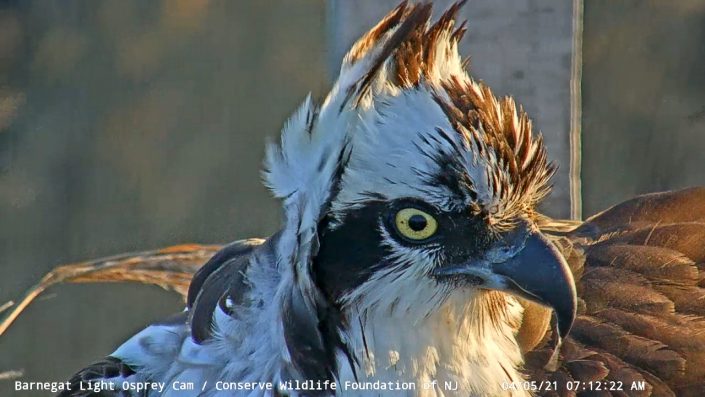
The “new” female at the BL Osprey Cam. April 5, 2021. Note the small dark fleck on her right iris.
By far, this was the most viewed season of the Barnegat Light Osprey Cam, with over 360,000 views and 111,000 hours watched! It was a season of change. Viewers throughout the world watched as the mated pair successfully fledged two healthy young. We witnessed the trials and tribulations of a new pair, especially the female, who we believe attempted reproduction for the first time in her life. We saw that life as a young osprey was not always guaranteed, which is something we rarely get to witness but know is quite common at many nests throughout the world; however, with an experienced male and plentiful prey, the surviving young thrived. As we work on a season long highlight video, here is a brief summary of their nesting season.
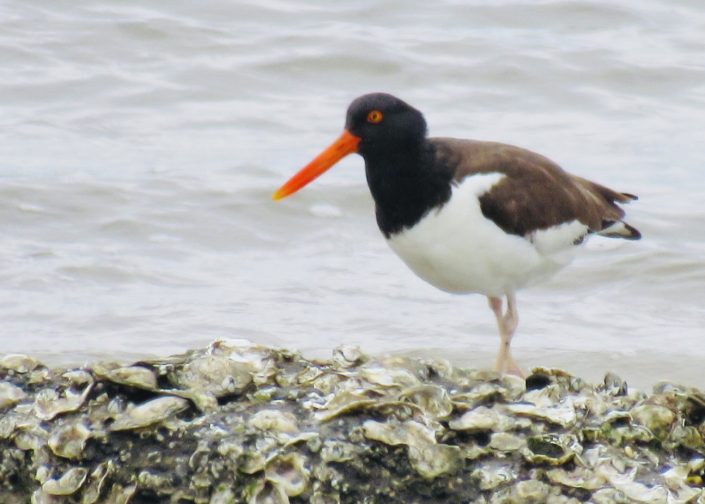
American oystercatcher foraging for oysters along the Delaware Bay. Photo credit: Meghan Kolk.
The Delaware Bay is well known for the spectacular phenomenon of spawning horseshoe crabs and migrating red knots every May, but in recent years the American oystercatchers (Haematopus palliatus) have also discovered the allure of the Bayshore and made it their home. American oystercatchers, a State Species of Special Concern, have been monitored and managed by CWF and the NJDFW’s Endangered and Non-game Species Program along the Atlantic coast beaches for nearly two decades, resulting in a steady population increase. However, the population that breeds along the Bayshore, first documented in 2016, has not received the same attention and had never been fully surveyed until this year.
CWF’s interest in this newly discovered population led to a small pilot study of a few known breeding pairs in 2018. Then this past May, we launched a bay-wide survey of the sandy beaches of the New Jersey side of the Bay from Cape May Point up to Seabreeze, the northernmost beach in Cumberland County. The purpose of the bay-wide survey is to determine a baseline of the number and distribution of breeding pairs along the Bayshore. The data gathered from this survey will add to the Statewide population estimate and help determine the amount of time and funding needed to fully monitor and manage the Bay’s population. More monitoring will be necessary to assess risk factors and reproductive success. Reproductive success can then be maximized by managing for risk factors such human disturbance, predation and tidal flooding.
This survey was made possible due to the efforts of dedicated volunteers and could not have been completed without their help. Unlike the Atlantic coast, the Bayshore beaches are often difficult to access, and many can only be reached by boat, making this survey more challenging. In fact, two sites that we planned to survey proved to be too difficult to reach and were skipped for this year. Each of the 33 remaining sites were surveyed just once within a specific timeframe, giving only a snapshot of the breeding season. We hope to be able to collect much more information in the future when more funding for this project is available. Based on the survey that was conducted, 13 pairs were documented at 8 different sites and 8 nests were documented at 5 different sites.
In addition to the formal survey, I was able to collect some observations as I spent every day in May on the Bay working with red knots. I took notice of the prey items that the oystercatchers were choosing. I often observed them feasting on oysters, which were plucked off exposed rubble at low tide. They also spent time at the man-made oyster reefs that were constructed at several beaches to act as breakwaters to slow the erosion of beaches. They also favored ribbed mussel beds, which become exposed as the tide recedes. The most interesting foraging behavior I witnessed was an oystercatcher plucking a fresh slipper shell off a horseshoe crab as it came to shore to spawn. It seems the Bay offers a variety of good food sources for a bird that mainly preys on bivalve mollusks.
I also noticed that flocks of up to 11 oystercatchers were traveling together up and down the Bayshore. This is a peculiar behavior since oystercatchers are highly territorial during the breeding season and are typically only seen in flocks once the breeding season is over. Could it be that the Bayshore is a popular spot for non-breeding young adults to hang out?
So much more research is needed to answer the many questions we have about the mysterious Bayshore oystercatchers.
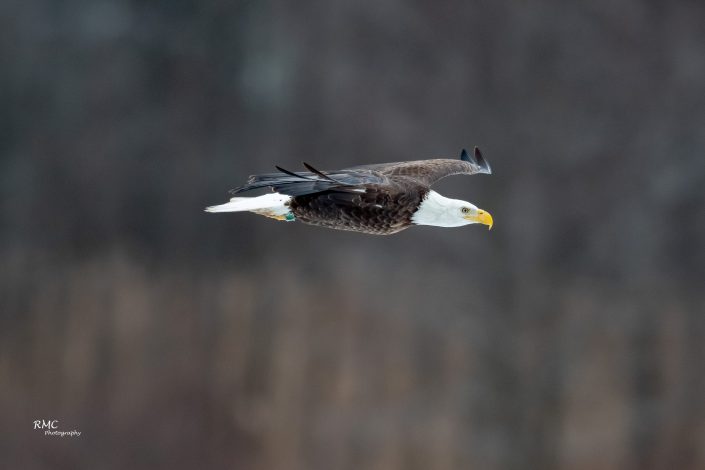
On Sunday January 13th, 2019 photographer, Bob Cook was taking photos of the ~20 eagles at a lake in a Mercer County park. He noticed that one of the eagles had a green tag on it’s right leg. After reviewing the photos it was established that the band was D/99.
D/99;1/13/19@ Bob Cook
D/99 is from the Duke Farms nest located in Somerset County. He and his two siblings grew up as a celebrities their every move being watched by viewers of the Duke Farms eagle camera. The three chicks were banded on May 12th, 2014. Measurements showed that there there were two males and one female, D/99 was the youngest male. All three fledged from the nest in June 2014.
chicks at Duke Farms nest 5/12/14. D/99 is in the middle.
Unfortunately, in August of 2014 we received a report that D/98, the oldest male, was found dead up in Maine. He most likely died of injuries that occurred during a fight with another eagle. This most recent sighting of D/99 is the first report of either of the two remaining chicks. D/99 will be five years old in April and reaching the age where he will be looking for a mate and establishing his own territory. It is always nice to know that a chick has survived to adulthood and most likely has come back to NJ to nest.