Capturing peregrines in flight

Photos from the field while monitoring peregrines

By Ben Wurst, Habitat Program Manager

The subject of peregrine falcons have hijacked this blog! On Friday, I visited a nest at Forsythe NWR to medicate the young for prevention of trichomonas, an avian disease carried by pigeons and doves. Adult peregrines can transfer it to their young and if not treated can kill them. Kim Steininger, a renowned and award-winning bird photographer joined me and got some amazing photos! While I was up on the nesting tower, Kim was stationed behind her camera, which was wielding a powerful lens to capture these amazing photos of the adult peregrines in flight while I checked on the nestlings.
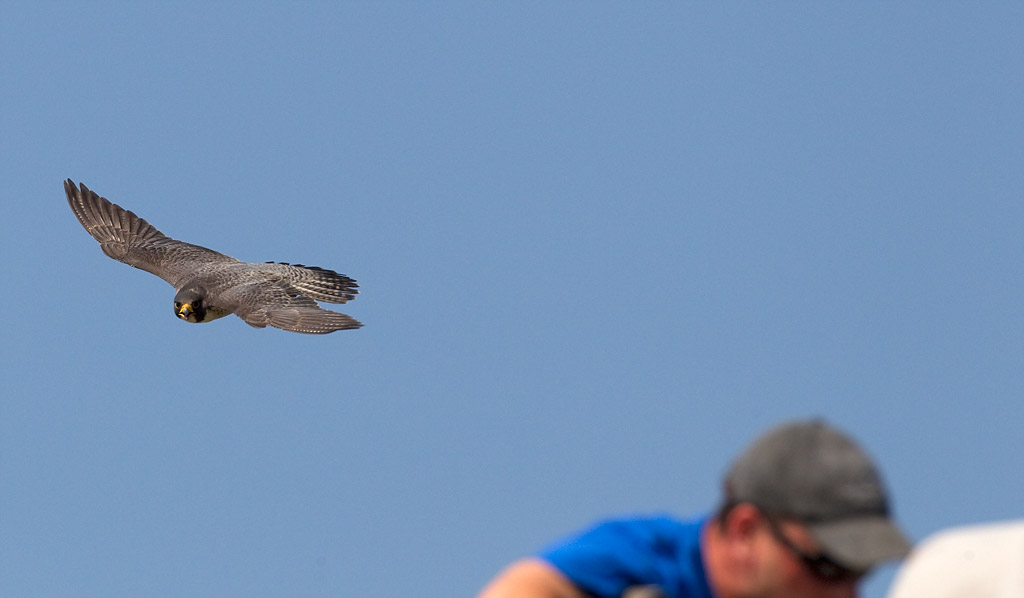
An adult peregrine watches over my every move. © Kim Steininger

This was my third visit to this particular nest. I can attest to the strong parental bond of this female to her young. During my first visit (5/21) she hit me while I was attempting to look for a parasitic fly that has caused hatchlings to die in previous years. The young were about 2-3 days old and were very vulnerable, so the aggressive nature is understood.

Peregrines can reach speeds over 200 mph. © Kim Steininger

Peregrines and other birds of prey, like eagles, owls, ospreys, and hawks see humans as predators. This is because they don’t have any other predators in the wild. This is also why disturbance is a major issue during the nesting season. When an adult leaves the nest; its young are unprotected. They are susceptible to predators like gulls and crows. Never approach a nest and only view from established viewing locations!
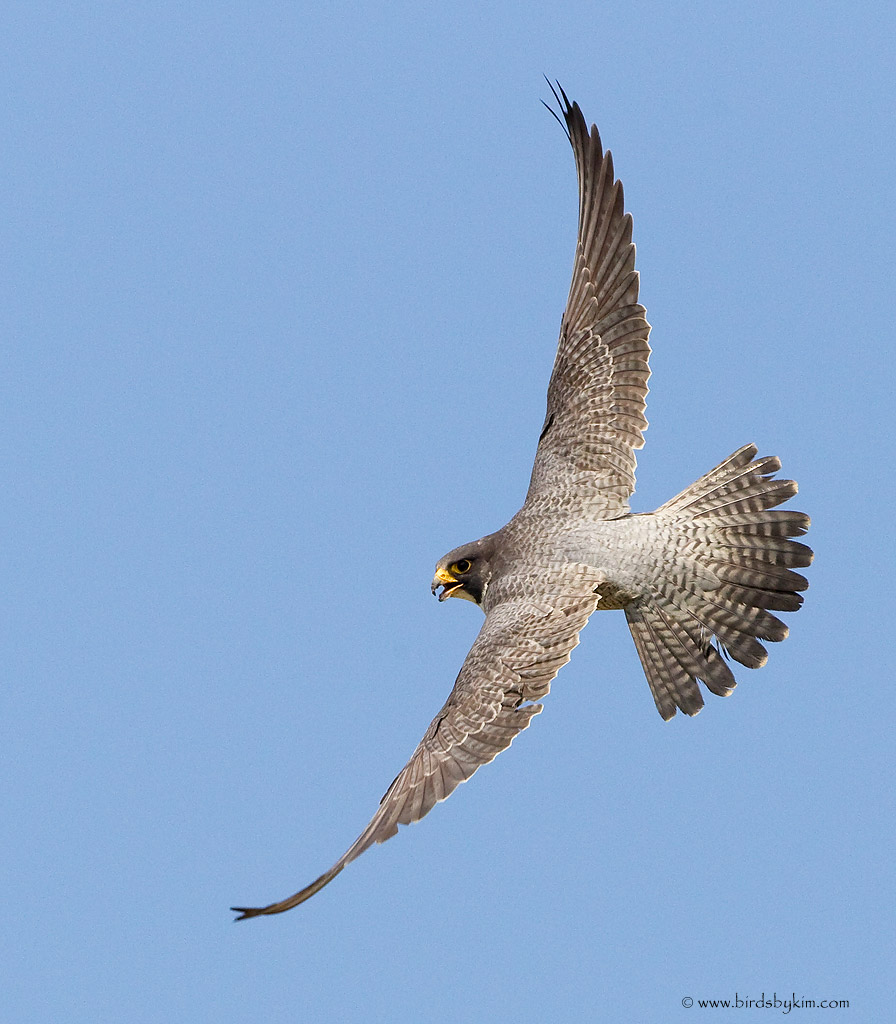
Peregrines have remarkable coloration on their flight and body feathers. © Kim Steininger

On the second visit (5/24) the female landed on the nesting tower, not more than 5 feet away from me! In the nest 2 weeks the young will be banded with federal USGS bird bands and state bi-color bands for future identification.
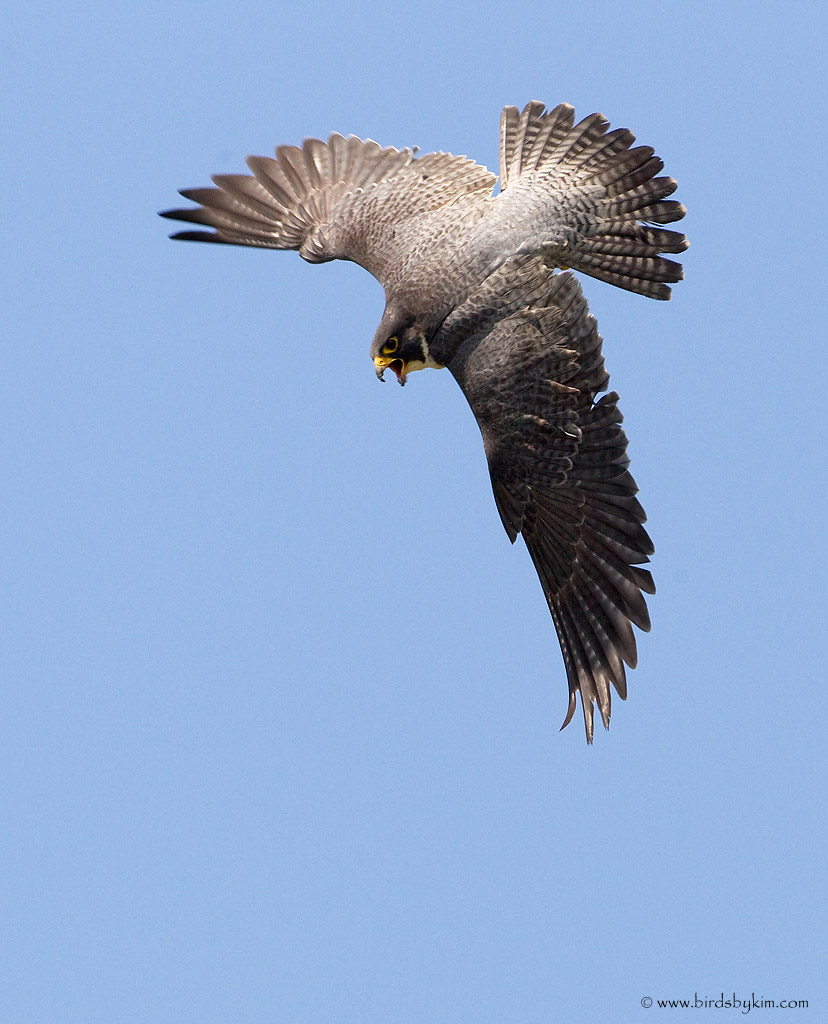
Entering a dive towards me! © Kim Steininger

Thanks to Kim for allowing us to post her amazing images! Check out her website for more incredible images!
Donating falcons

Collecting and transferring peregrine falcons to help recovery efforts in West Virginia

By Ben Wurst, Habitat Program Manager

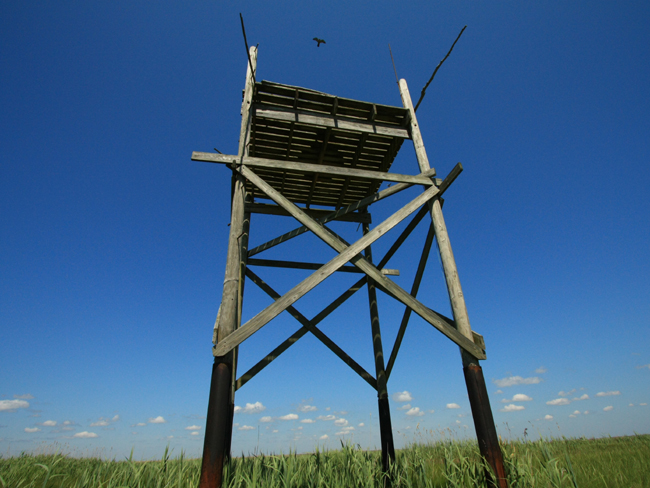
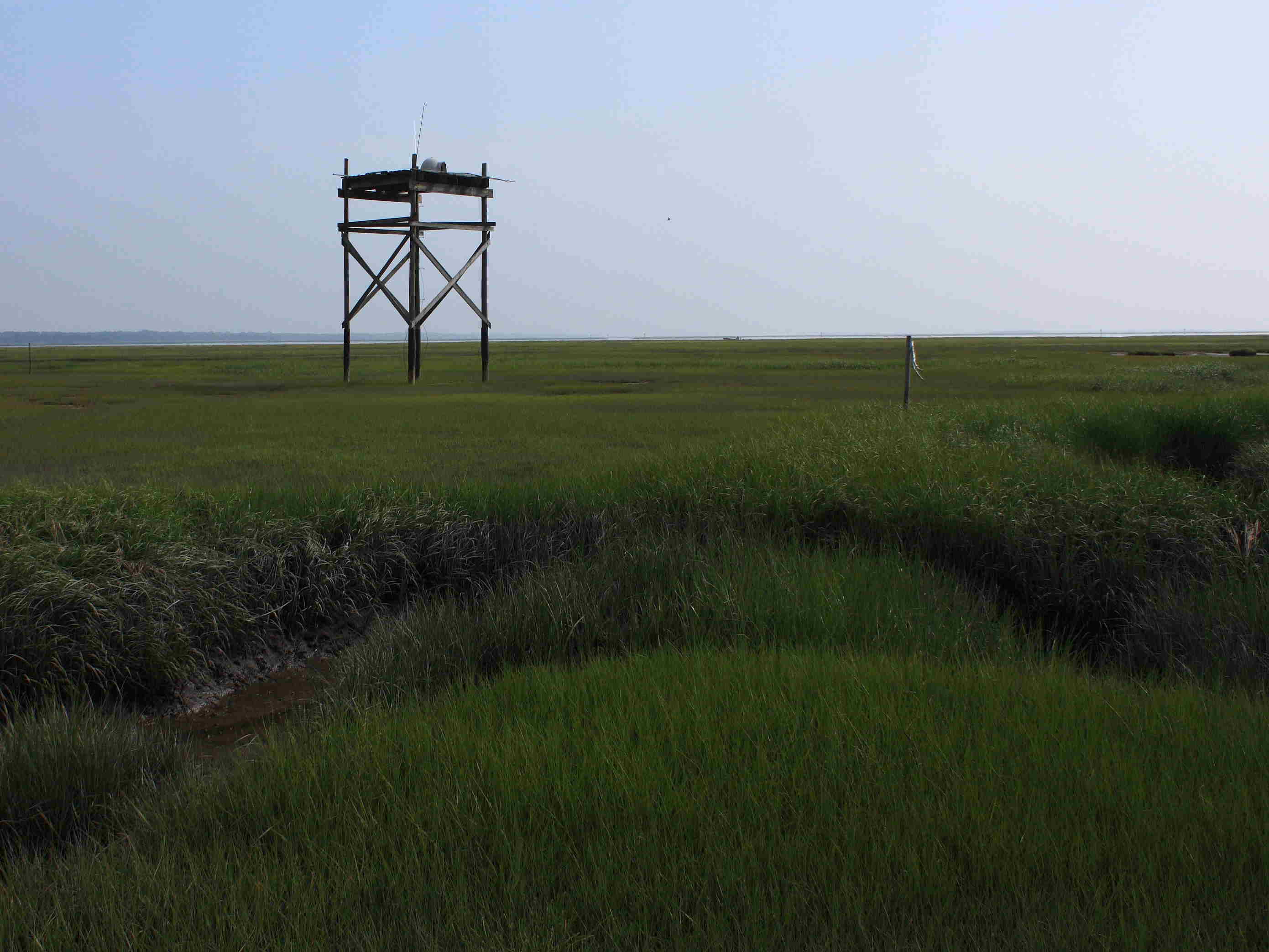
An old hacking tower where peregrine falcons nest in New Jersey. © Ben Wurst

In early June, I assisted Kathy Clark, a zoologist with the Endangered and Nongame Species Program to help collect and transfer peregrine falcon nestlings. The nestlings are being collected to help the recovery of peregrines in New River Gorge National River, West Virginia. The goal of the project is to help promote the recovery of peregrine falcons throughout the Appalachian Mountain range.

The project began in 2006. One fledgling that was found on the ground near the Walt Whitman Bridge New Jersey was contributed to the project. Since then, New Jersey has sent over 30 peregrine nestlings to the recovery project. The falcons are raised at a mountain hack site near Beckley, West Virginia inside New River Gorge.

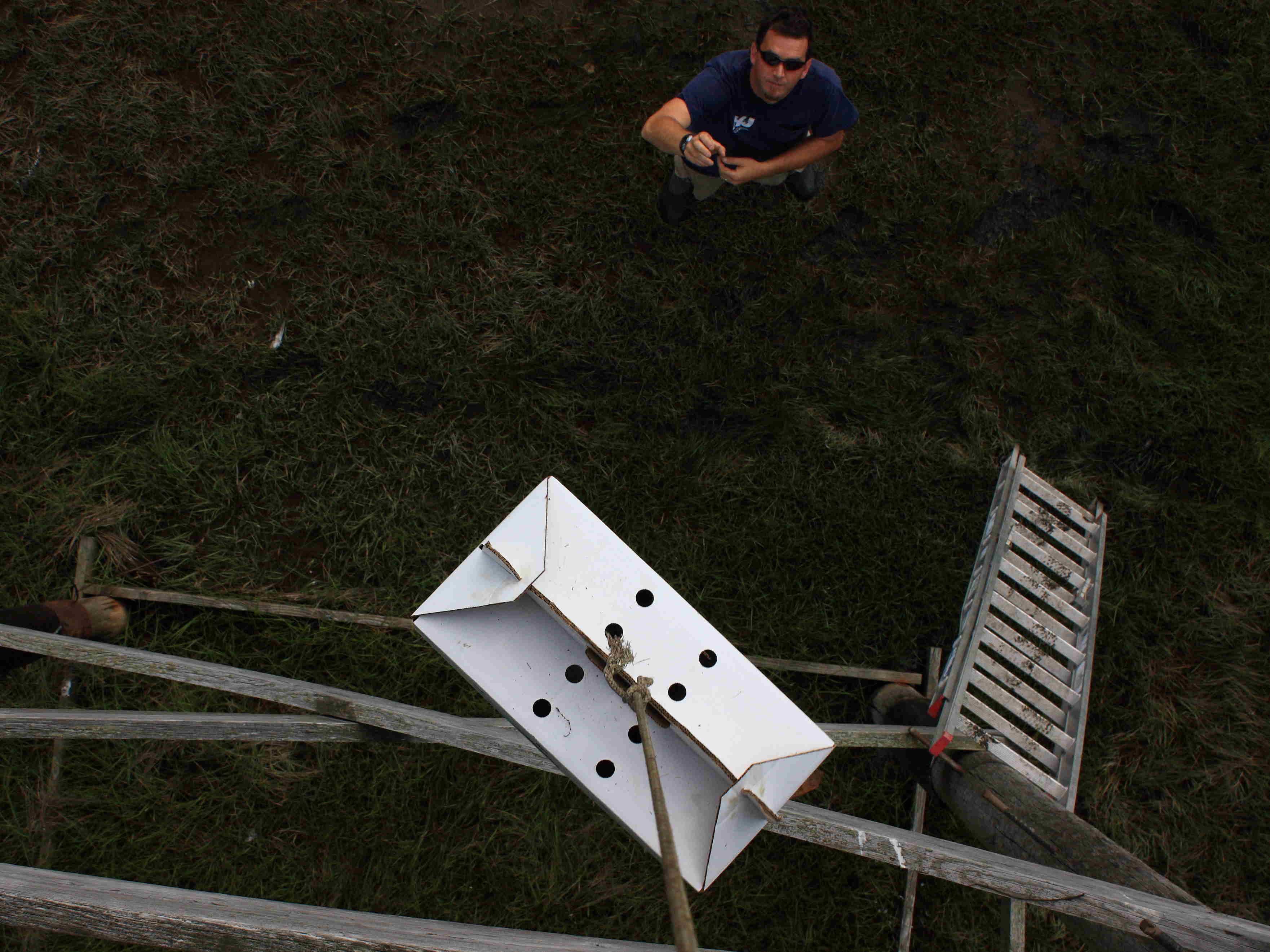
Dave Golden, ENSP Biologist waits while the peregrine nestlings are lowered. © Ben Wurst

Peregrine falcons are listed as endangered in New Jersey. However, over the past few years the population has done very well. Around 20 pairs occur in the state. In West Virginia, they are very rare. Only one nesting pair was found in 2009.

On Wednesday, nine peregrine nestlings were collected at different locations throughout New Jersey. Coordination of these collections can be dangerous. It also requires a lot a planning and preparation. We have to climb on bridges, ledges, and tall towers and carefully collect the young. ENSP and CWF biologists collected falcons from the Walt Whitman & Burlington-Bristol Bridge, The Hilton in AC, and several old hacking/nesting towers along the Atlantic coast.

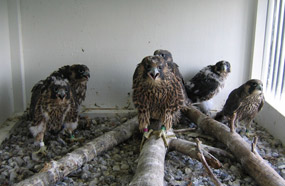
Juvenile peregrines in a hacking tower box. Photo courtesy NPS.

The young were transported to Tri-State Bird Rescue in Delaware. From there they were driven by volunteers to West Virginia where they will be placed in the hacking tower.

“Hacking is the process of placing young falcons in a structure and caring for the birds in a manner that minimizes human exposure until they are mature enough to fly,” explained Matt Varner, NPS wildlife biologist. “The artificial aerie or hack box simulates nesting and feeding conditions on steep rock cliffs – prey is dropped into the box through a tube so the birds don’t see or associate people with the food. This cage-like structure protects the birds from predators during the pre-flight period while allowing them to acclimate to and imprint on the Gorge. When they are ready to ‘fledge’ (fly), they are released from the box, but will return for occasional feedings until their hunting skills allow them to survive on their own.” (http://www.nps.gov/neri/naturescience/peregrine.htm)

Three Little Chicks!

Monitoring Peregrine falcons in New Jersey

By Ben Wurst, Habitat Program Manager

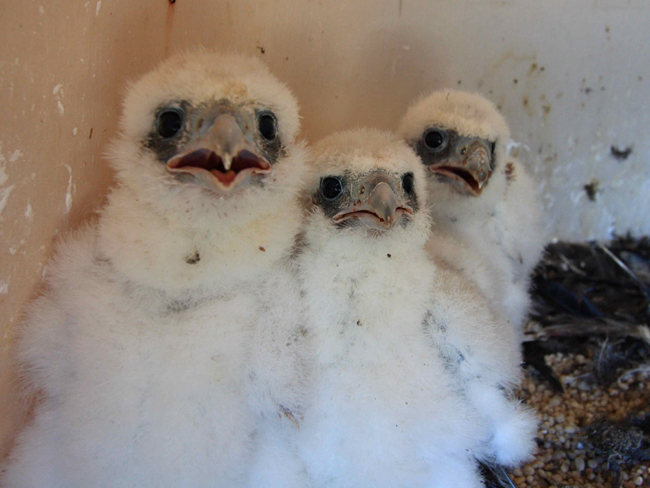
Three peregrine falcon nestlings that are approximately 2 1/2 weeks old. © Ben Wurst

On May 13th, I got the chance to visit a peregrine nest site to perform a “nest check.” The purpose of the visit was to count the number of young, determine age and sex, and check for any other issues (like infestations of a wingless parasitic fly).Over the past few years, the wingless flies have caused nests to fail to produce young. Over the winter, we treated gravel at nest sites to help get the parasites in check. I only observed 3 parasites on the nestlings.

There were three nestlings at the nest site. They are approximately 17 – 20 days old. Age can be determined by the size and feather development of the young. Sex can be determined by the size of the nestlings and the length of the culmen (upper mandible or bill). It looked like there were two males and one female.

Most peregrines nesting in New Jersey are resident birds that remain near the nest site throughout the entire year. Peregrine nests, known as an aerie, have a simple depression in a gravel substrate, called a scrape. Peregrines nest in urban areas on buildings, under bridges and on old “hacking” towers along the Atlantic Coast of New Jersey.

An old "hacking" tower is home to a pair of peregrines along the coast of New Jersey. © Ben Wurst

The young are totally dependent upon their parents until they are ready to fly in approximately seven weeks after hatching. Upon fledging, or leaving the nest, the young remain dependent, to a degree, on the adults until they master their flight and hunting skills.

You can view the live interactions of a pair of peregrines at a nest site in Jersey City by tuning into our Peregrine Cam. Check it out today!