A Tale of Two Seasons: Ospreys and Menhaden on the Mullica River

Posted on
As I finalize our annual report summarizing last year’s data, I often find myself looking back to reflect and compare trends over time. I’ve worked with ospreys long enough to have witnessed their population in New Jersey more than double. Their recovery has long been a clear sign of improving ecological health in our coastal waters.
Wildlife populations fluctuate for many reasons, including adult survival, reproductive rate, prey availability, and habitat suitability. When we examine the link between prey availability and reproduction, one of the most telling indicators is brood reduction — a natural but revealing behavior that underscores the sensitivity of ospreys to food supply. When I first began working with ospreys, I didn’t yet understand this adaptation or what it was signaling about the ecosystem.
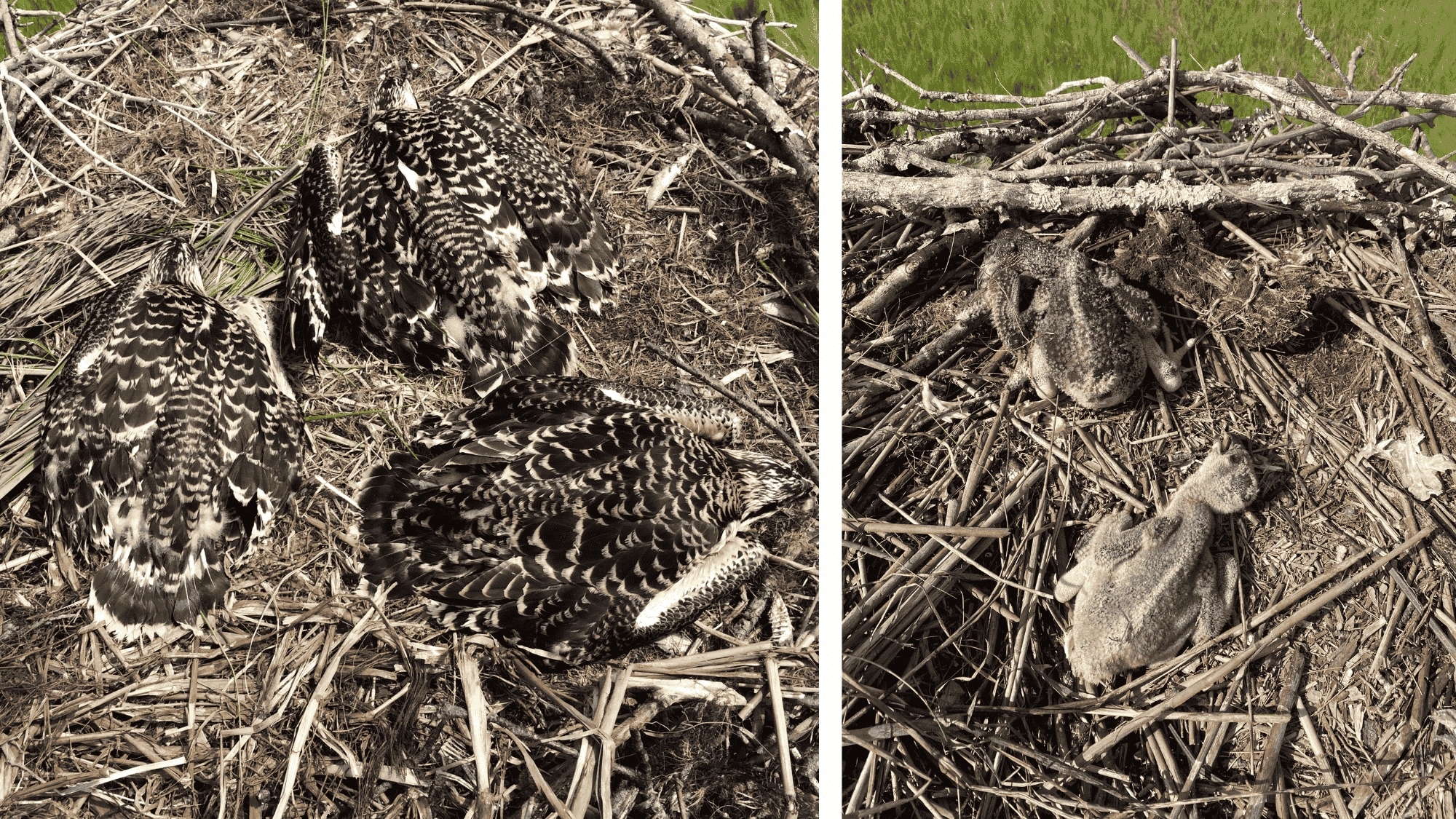
Brood reduction occurs when insufficient prey is delivered to a nest. Ospreys typically lay 2-3 eggs, which hatch asynchronously — often a day or two apart. This slight difference in age establishes a dominance hierarchy. The oldest nestling has a competitive advantage. When food is scarce, that older nestling may aggressively “bonk” its younger siblings into submission, particularly during feedings. The dominant nestling feeds first and most often, while younger nestlings cower and wait. If food is plentiful, all young are fed similarly and survival rates are high. If not, younger siblings may weaken and die from starvation.
In years of abundant prey, brood reduction is less common and broods tend to be symmetrical in size and development. In lean years, brood reduction becomes more widespread and productivity declines.
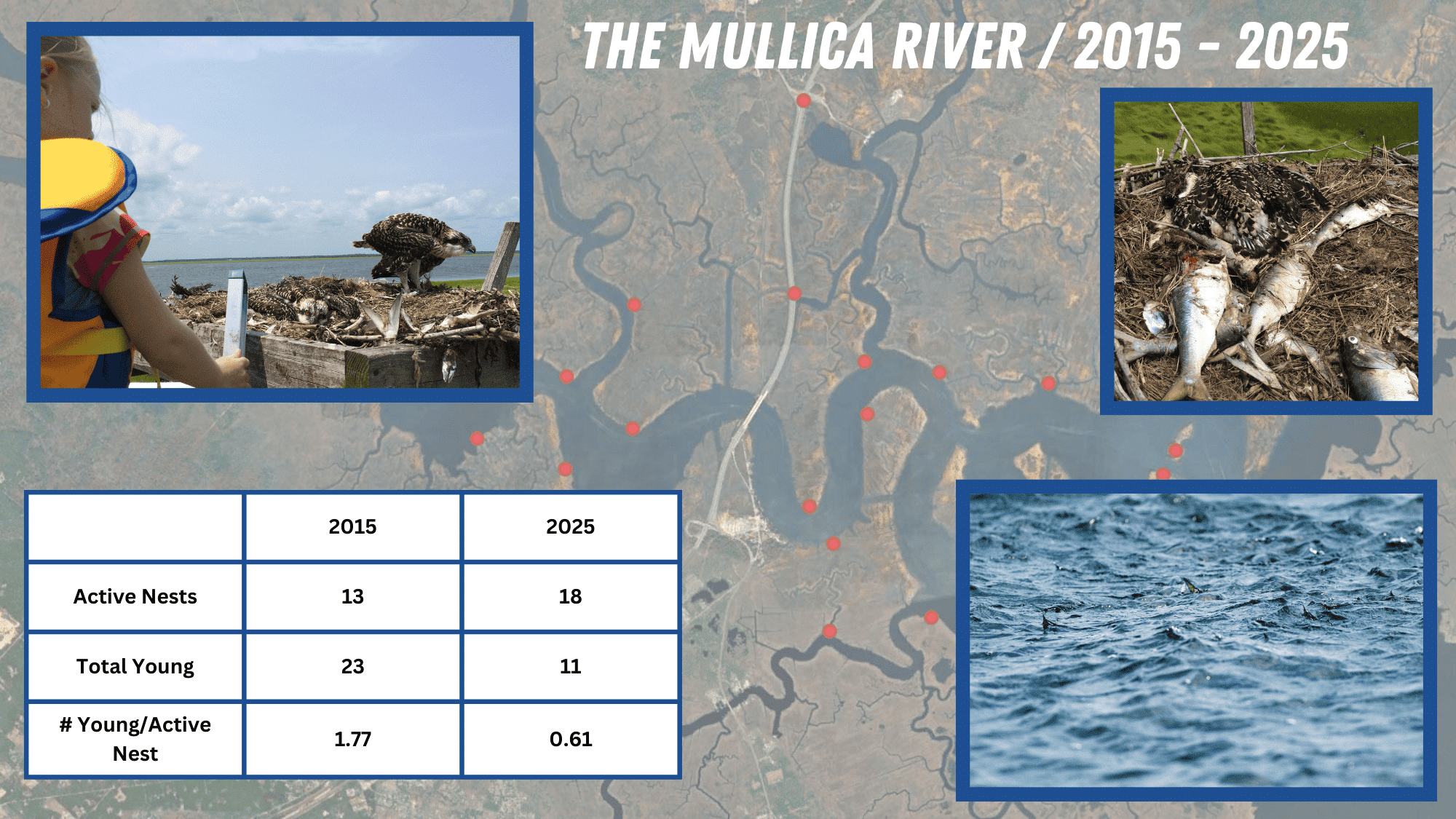
A case study on this adaptation and otherwise great breeding performance of ospreys was observed in 2015 on the Mullica River. Here there are less than 20 osprey nests that are located along the river, which holds prime foraging habitat. That year a remarkable phenomenon occurred. A large group of adult Atlantic menhaden became trapped on the river. I’m not sure how so many adult menhaden wound up in the river but suspect they may have been “pushed” into the bay by striped bass. Some adult menhaden were captured the following winter, suggesting that some overwinter during mild conditions (unpublished data. Able, K. Rutgers University).
In all the years that I’ve monitored ospreys, I’d never seen anything like it. Menhaden were found in very large schools on the river, where they could be observed feeding in large schools at the surface. In some osprey nests, there were piles of dead fish, which is abnormal for ospreys. They are usually very clean eaters and do not leave much prey remains, as it attracts predators. That year, 13 pairs produced 23 young with a productivity rate of 1.77 young/nest, which is more than double the rate needed to sustain the population. In turn, that year there were more symmetrical broods, a sign of sufficient prey.

In contrast, last year, 18 pairs produced only 11 young, with a productivity rate of just 0.61 young/nest. This is below the rate needed to sustain the population. Twelve nests failed to produce young and brood reduction was prevalent. At one nest with a symmetrical brood of three young, they were later found deceased on the marsh beneath their nest, which was likely due to food stress. In 2025, the statewide productivity rate was 0.69 young/nest, which is the lowest productivity rate recorded in the previous 30+ years.
What this illustrates is simple — ospreys can be successful when there is sufficient prey to support them. What we saw last year, through the lens of ospreys, was a scarcity of menhaden in nearshore waters. As discussed in previous posts, ospreys and menhaden evolved together. Menhaden are the crucial bridge in the marine ecosystem — converting phytoplankton into protein and energy that fuel one of the most productive environments in the world: our coastal estuaries and nearshore ocean habitats. If there are not enough menhaden to sustain ospreys, what does that mean for all the other species that depend on this vital forage fish?
Discover more from Conserve Wildlife Foundation of NJ
Subscribe to get the latest posts sent to your email.