Banding Together: Royal Tern Roundup on Horseshoe Island
Story and photos by Meredith Wray, CWF Biological Technician
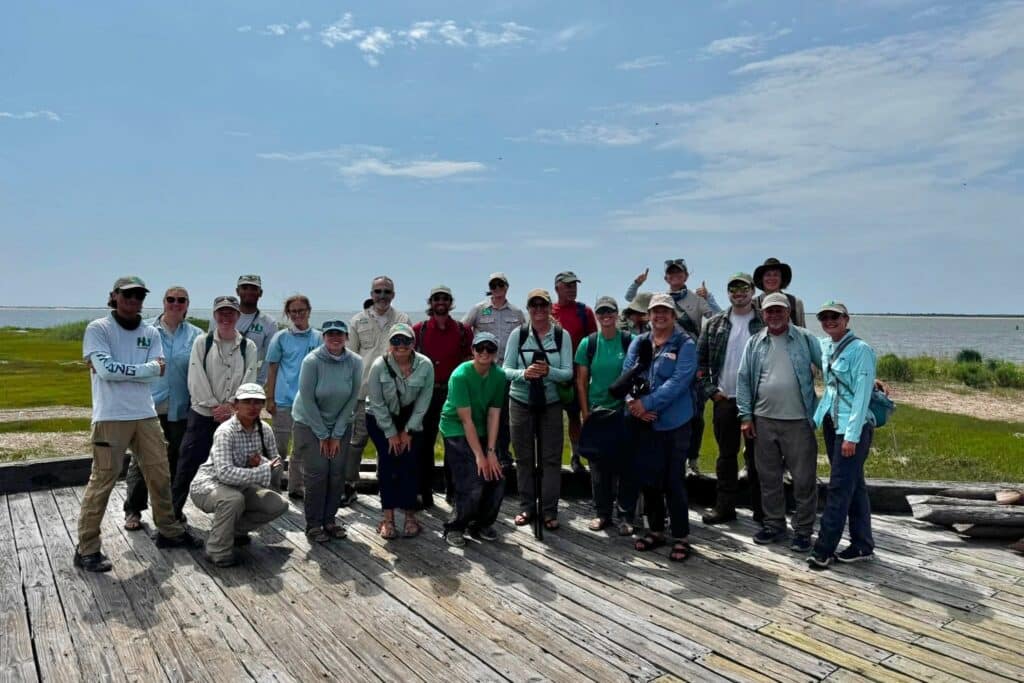
The banding team consisted of staff and volunteers from NJ Fish and Wildlife, Conserve Wildlife Foundation of NJ, and The Wetlands Institute.

Conserve Wildlife Foundation (CWF) joined New Jersey Fish and Wildlife (NJFW), The Wetlands Institute, and the U.S. Fish and Wildlife Service to band royal terns for the third consecutive year in the Garden State this summer. Nesting on the protected shores of Horseshoe Island just outside Little Egg Inlet, these royal terns represent the northernmost colony in the Western Hemisphere for the species. During the 2025 nesting season, the island supported nearly 1,500 breeding adults and successfully fledged 405 chicks. Today, Horseshoe Island remains one of New Jersey’s most important coastal bird nesting sites and is on track to surpass last year’s totals as we begin to finalize data for the 2026 season. Continued management of the island is made possible thanks to the pivotal management rights agreement established in 2022 between the Tidelands Resource Council and NJFW.

Led by NJFW, this year’s banding initiative was a true team effort. Scientists, biologists, conservationists, and technicians from each organization brought their expertise and passion to every step of the process: transporting supplies to the island, orchestrating the safe handling of all birds, keeping watch over chicks, measuring weight, bill length, and wingspan, and carefully recording data.
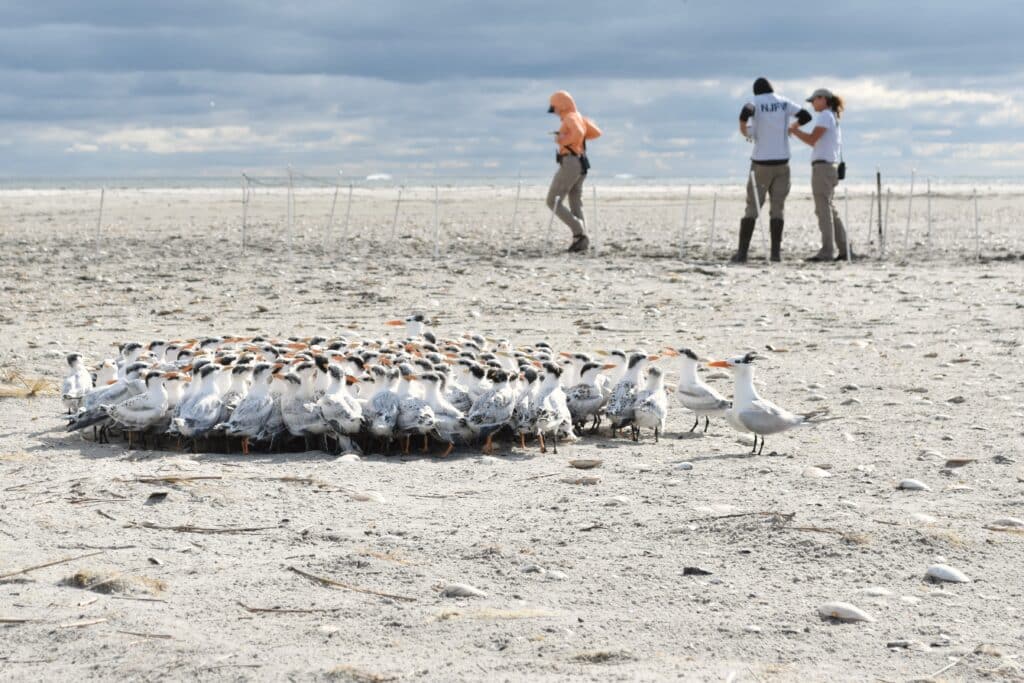
Adult terns watch over the chick creche in the holding pen.

Royal Tern Quick Facts:

  1. Royal terns are seabirds in the Laridae family — which also includes gulls and skimmers — sporting a bright orange bill and shaggy black crest. Highly social by nature, they nest in dense colonies on sandy beaches and isolated islands.
  2. Flightless chicks gather into large groups called crèches, almost like a bird daycare, where safety in numbers helps protect them from predators while adults forage. Even in a noisy crowd of thousands, each parent has the special ability to recognize its own chick’s voice when returning with food.
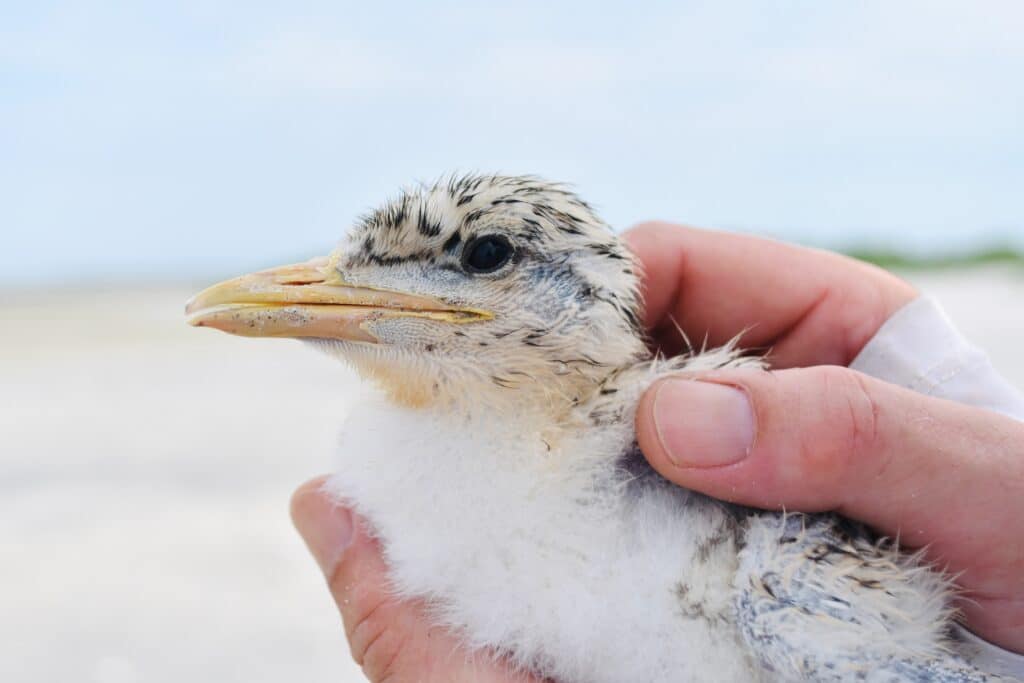
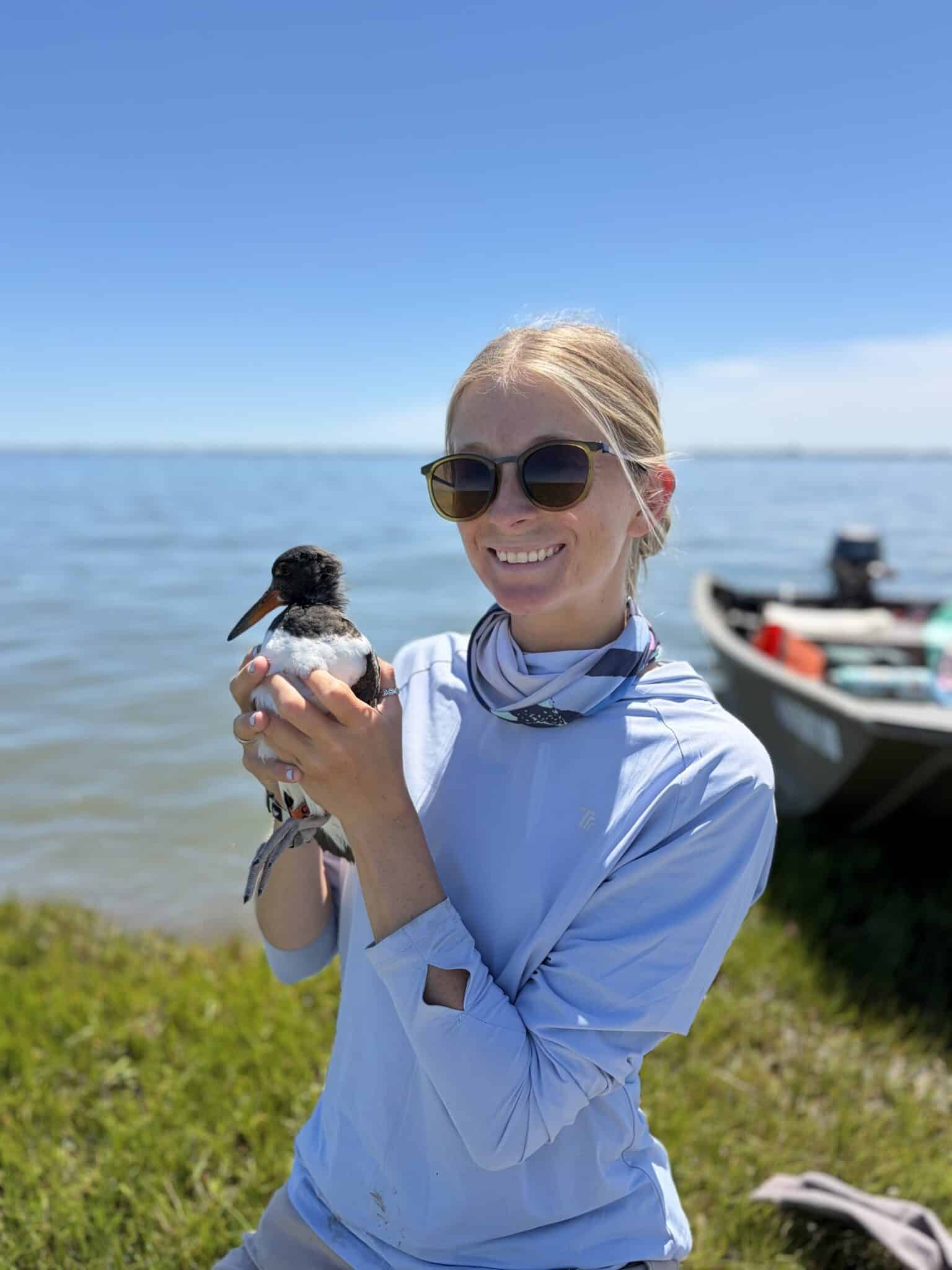
    Royal tern chick
  3. Royal terns primarily feed on small fish and are known for their precise diving abilities, soaring 20–30 feet before plunging into the water to snag a meal. They can be seen foraging in coastal waters, estuaries, and marshes.
  4. Because their breeding range in New Jersey is limited, royal terns are especially vulnerable to habitat loss, human disturbance, and severe coastal storms — which is why their population is closely tracked through ongoing monitoring and banding efforts like this one.
  5. Royal terns are typically banded as chicks, shortly before they’re able to fly. At this stage, they have left the nest but have not fledged yet, making it the safest time to handle, process, and release them.

But why is this work so important? And what exactly is bird banding?
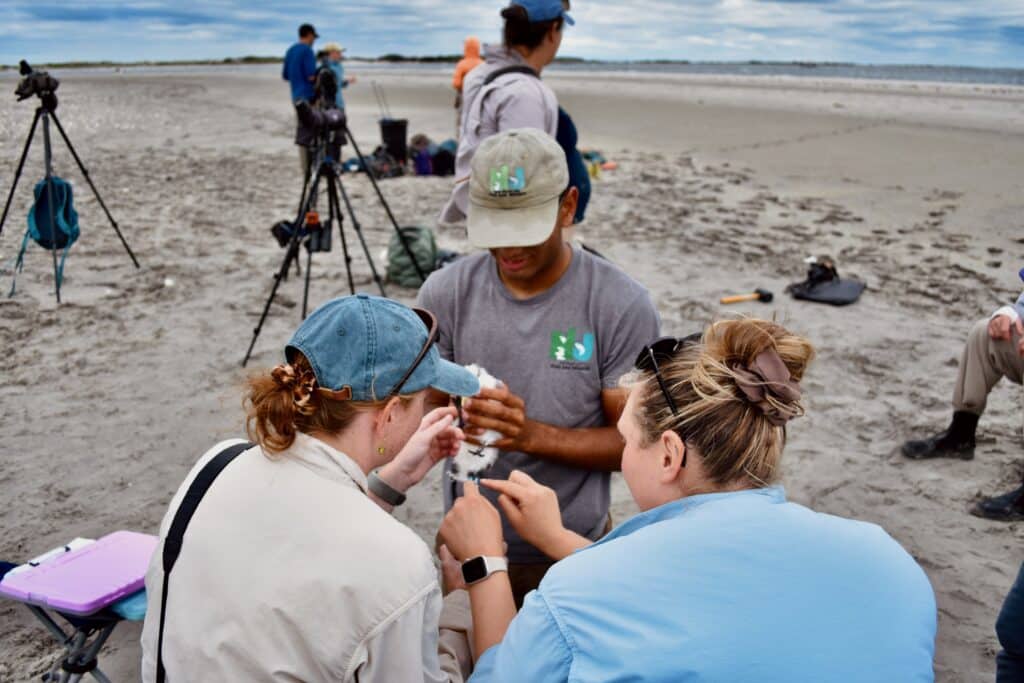
It takes a team to band each bird!

What it is: Bird banding is a long-term research tool that helps scientists map migration routes, estimate survival, monitor population health, and better understand how birds respond to changing environmental conditions. By giving each bird a unique identifier, researchers can follow an individual throughout its lifetime, sometimes for more than 30 years!

The bands: Each chick receives two bands: a numbered aluminum band from the federal Bird Banding Laboratory on one leg and a colored plastic band with a unique alphanumeric code on the other. The metal band serves as the bird’s permanent identification number, while the colored band can be read from a distance with binoculars or a spotting scope. The colored band allows researchers and birders alike to identify individual birds from a safe distance without having to capture them again.

How it helps: Every reported sighting throughout a bird’s lifetime provides critical information, even if it might seem insignificant. Data collected helps biologists identify important breeding sites, determine seasonal beach closures, implement habitat protections, and track ongoing population trends.
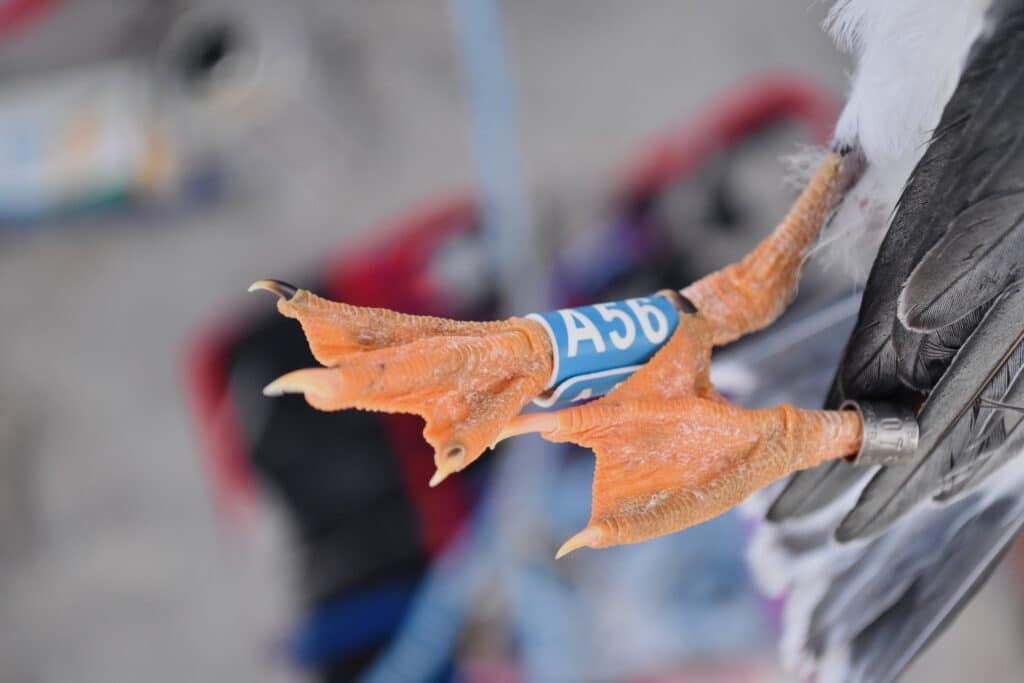
Royal tern chicks receive one blue field-readable band and one aluminum federal band.

Conservation success stories like this depend on a network of dedicated partners working toward a common goal, so we look forward to gaining more valuable insights about the New Jersey royal tern population as a result of this collaborative effort. We encourage birders of all ages and levels to keep their eyes peeled for royal terns and their little blue bands! You can make a positive impact by reporting your sightings to NJFW Senior Zoologist Emily Heiser at Emily.Heiser@dep.nj.gov.

Special thanks to Rutgers University Marine Field Station for assisting in the safe transportation of staff to Horseshoe Island.

All handling and banding of birds was completed for research purposes and under appropriate state and federal permits.
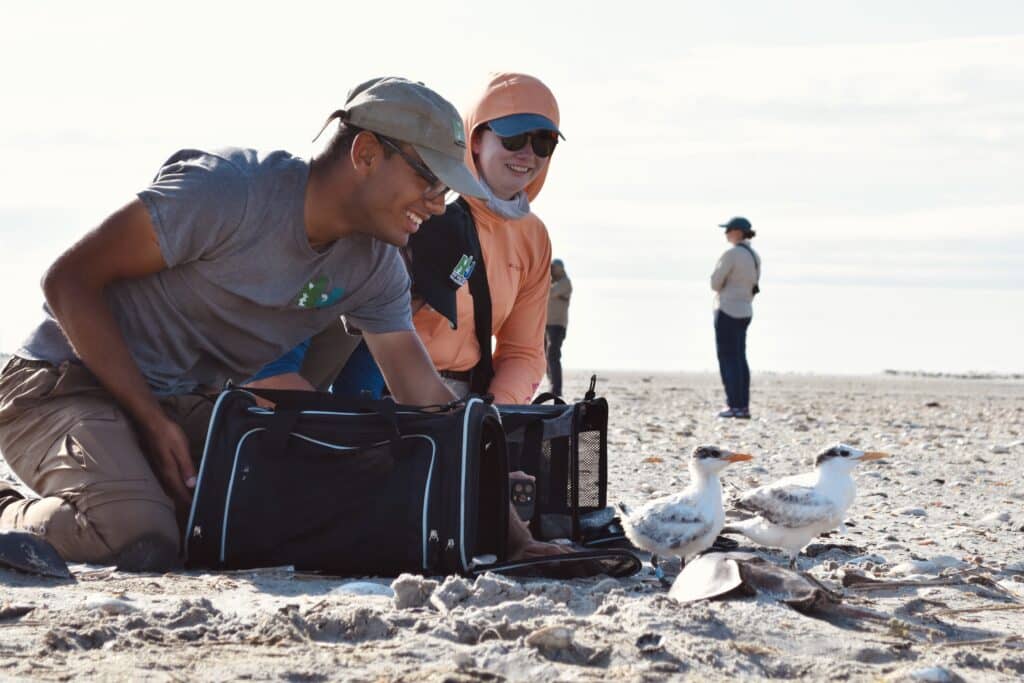
Chicks are released back to the colony shortly after banding.


Celebrating NJ Eagle Project Nest Monitors

2026 NJ Eagle Project Get-Together

Each bald eagle nesting season volunteers monitor eagle nests throughout New Jersey.  Volunteers are the reason that NJ’s bald eagle population continues to thrive. Nest monitors not only keep track of important data, they alert us to any disturbance at the nests and educate the public.  Conserve Wildlife Foundation and NJ Endangered and Nongame Species Program welcomed 46 dedicated volunteers to Assunpink Wildlife Management Area for the annual Eagle Project Appreciation Picnic. Continue reading “Celebrating NJ Eagle Project Nest Monitors”

The 2026 NJ Bald Eagle Nesting Season in Photos

by: CWF Senior Biologist, Larissa Smith

Eagle nest monitors kept watch over bald eagle nests throughout New Jersey during the 2026 nesting season. As with every nesting season there were ups and downs as some pairs failed to hatch eggs or their young didn’t survive, while other pairs successfully raised young. I asked the nest monitors to send me two of their favorite photos from the season. Below is the collection of their excellent photos.

All photos were taken by the trained volunteers at safe distance so as not to disturb the eagles.

Thank you to the nest monitors for providing the photos. Thank you to all the eagle project volunteers for their efforts to protect New Jersey’s eagle population. Continue reading “The 2026 NJ Bald Eagle Nesting Season in Photos”

My Summer of Death and Despair

Three nestlings. Approximately 2.5-3 weeks old. June 17, 2026

My summer has been filled with death and despair.

Every. Single. Day. I have seen or heard about osprey pairs that lost young to starvation. I now carry their stories with me, hoping that somehow they will be okay.

It is not okay.

Ospreys are now in decline in New Jersey. Their remarkable recovery, made possible by reducing pollution, protecting nesting habitat, and conserving our natural resources, is now in jeopardy. We are not alone. At nests all along the mid-Atlantic coast, ospreys are no longer producing enough young to sustain the statewide population, largely because of the scarcity of their primary prey: Atlantic menhaden.


Continue reading “My Summer of Death and Despair”

Photo from the Field: A Setback That Sparked Renewed Determination

Broken but not forgotten.

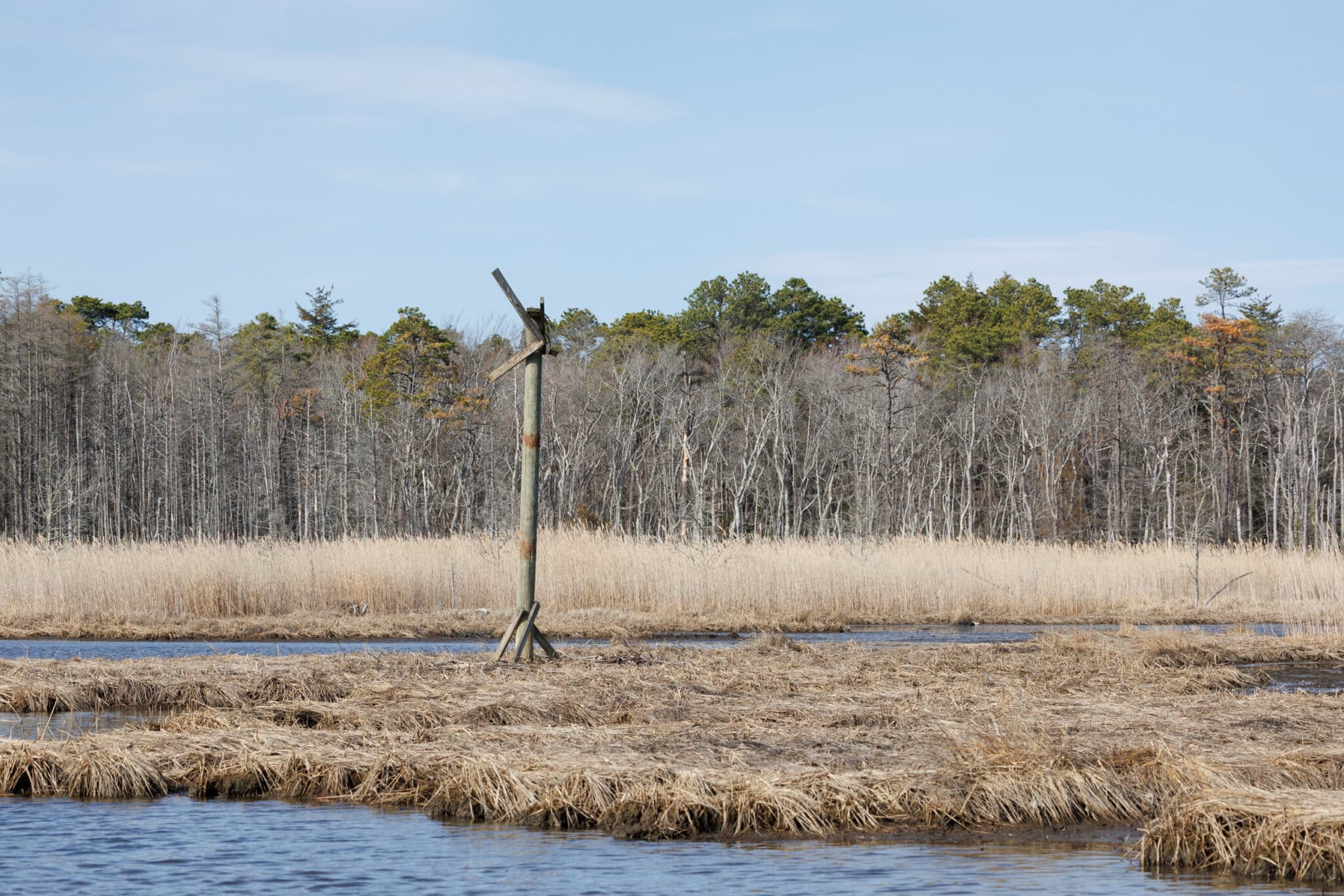
In late March, I set out to repair an osprey nest platform on Barnegat Bay — one I had scouted during the winter while hiking trails in Eno’s Pond County Park. I recently learned that this platform has been in place since at least 2012, when a viewing blind once stood nearby, though it was reportedly destroyed during Superstorm Sandy. Continue reading “Photo from the Field: A Setback That Sparked Renewed Determination”

A Tale of Two Seasons: Ospreys and Menhaden on the Mullica River

As I finalize our annual report summarizing last year’s data, I often find myself looking back to reflect and compare trends over time. I’ve worked with ospreys long enough to have witnessed their population in New Jersey more than double. Their recovery has long been a clear sign of improving ecological health in our coastal waters.

Continue reading “A Tale of Two Seasons: Ospreys and Menhaden on the Mullica River”

Duke Farms Eagle Cam- 2026 Season

By: Larissa Smith, CWF Senior Biologist

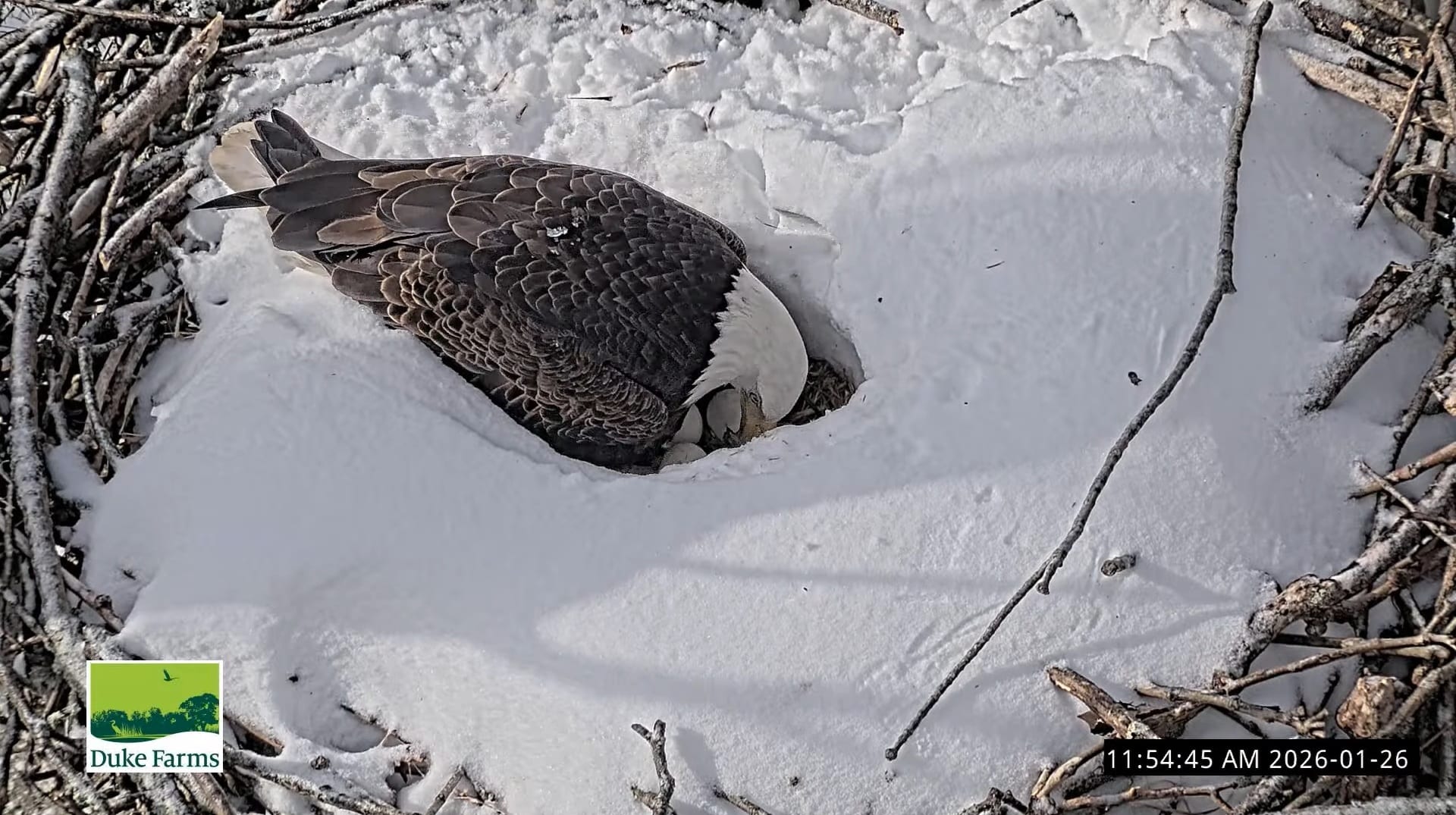
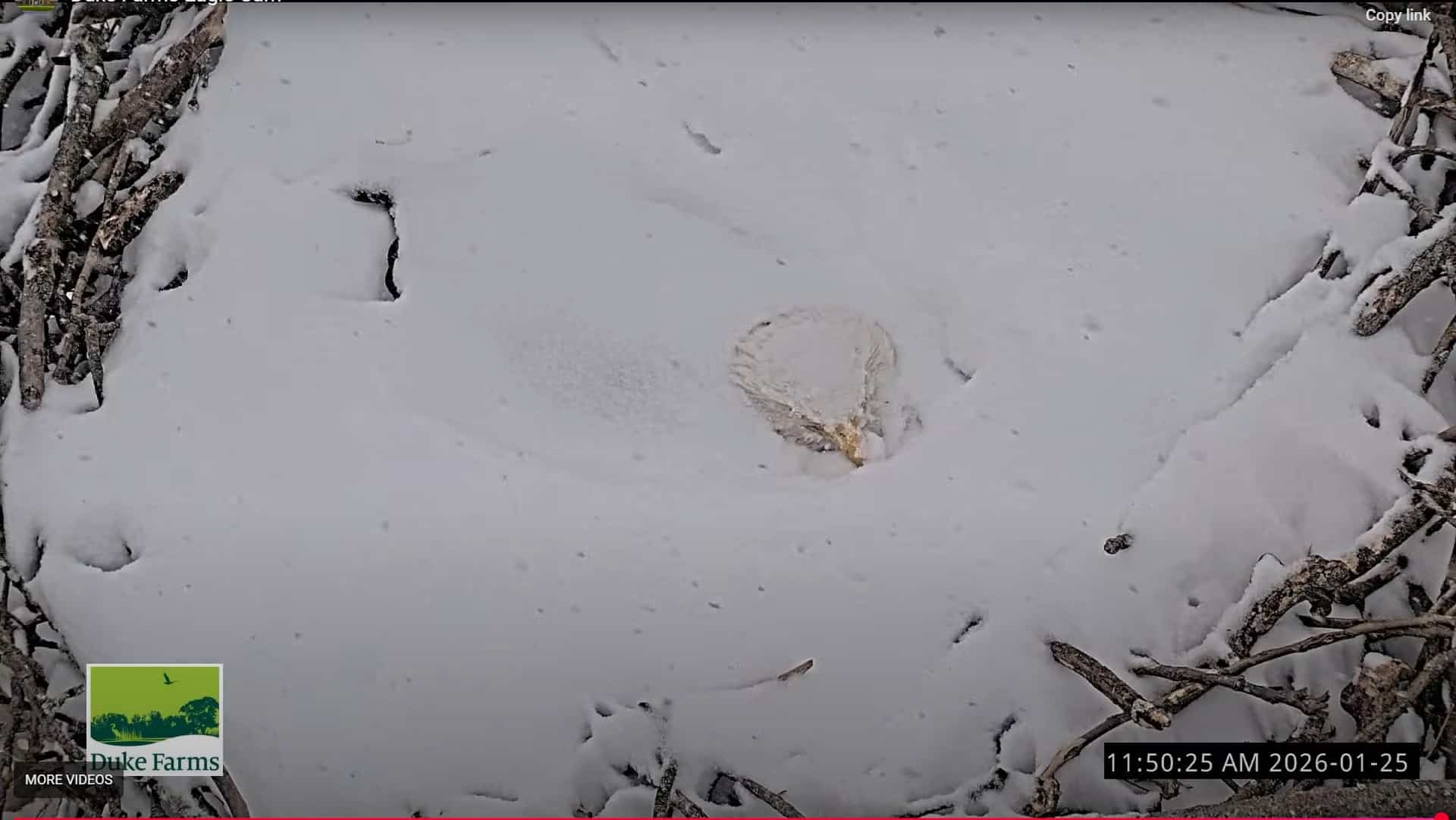
Duke Farms eagle incubates their three egg clutch, despite the snow surrounding the egg bowl 1_26_26

The Duke Farms eagle pair are the stars of their own reality show. The pair has a huge following who tune in each season to watch with anticipation as the pair lays eggs and wait for hatching and fledging.  This cam views a pair of eagles on  Duke Farms property in Hillsborough, New Jersey. Duke Farms has hosted the cam since 2008. Over the years there has been drama and heartbreak at the nest, but despite this viewers tune in to watch the pair every year.  To learn about the history of the cam please see the Conserve Wildlife Foundations Duke Farms webpage and scroll down to Duke Farms Eagle Cam FAQ’s

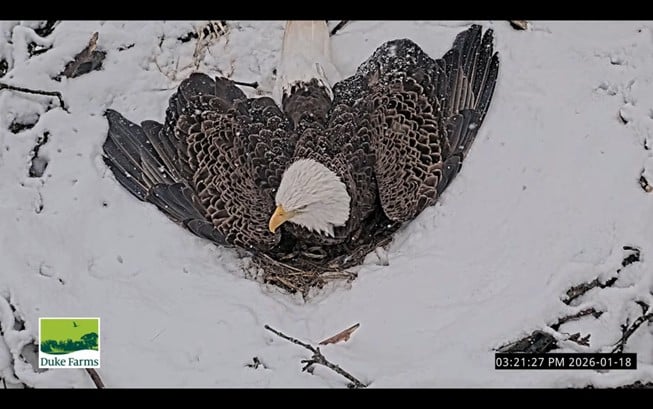
This year the female laid the first egg on January 12th, the earliest for the Duke Farms pair and one of the earliest eagle pairs in NJ in 2026 to begin incubation.  The second egg was laid on January 15th and a third egg was laid in the snow on January 18th.

The female laid her third egg during a snowstorm 1-18-2026

Eagle cam viewers watched in amazement as the pair incubated during the recent snow and ice storm.

Nest monitor, Diane Cook, writes informative and interesting updates on the Duke Farms pair. Some of the updates include, “Eggs and Cold Winter Weather” and  “How to tell the male and female apart”. When on the CWF Duke Farms cam scroll down to the  2026 Nest Updates

Eagles incubate the eggs for 35-40 days and the eggs hatch in the order in which they were laid.  Cam viewers can start to watch for hatching around February 16th.

When will the first egg hatch contest

Conserve Wildlife Foundation is holding a contest to guess when the first egg will hatch. The person who guesses the closest date and time to when the chick is fully out of the egg shell will win a CWF hat and eagle sticker.

Please email Larissa.Smith@conservewildlifenj.org with your guess of date and time am or pm.

All entries must be submitted by February 13th at 12pm

Thank you to Duke Farms and all the eagle cam viewers.