Speak Up for New Jersey’s Ospreys

Posted on
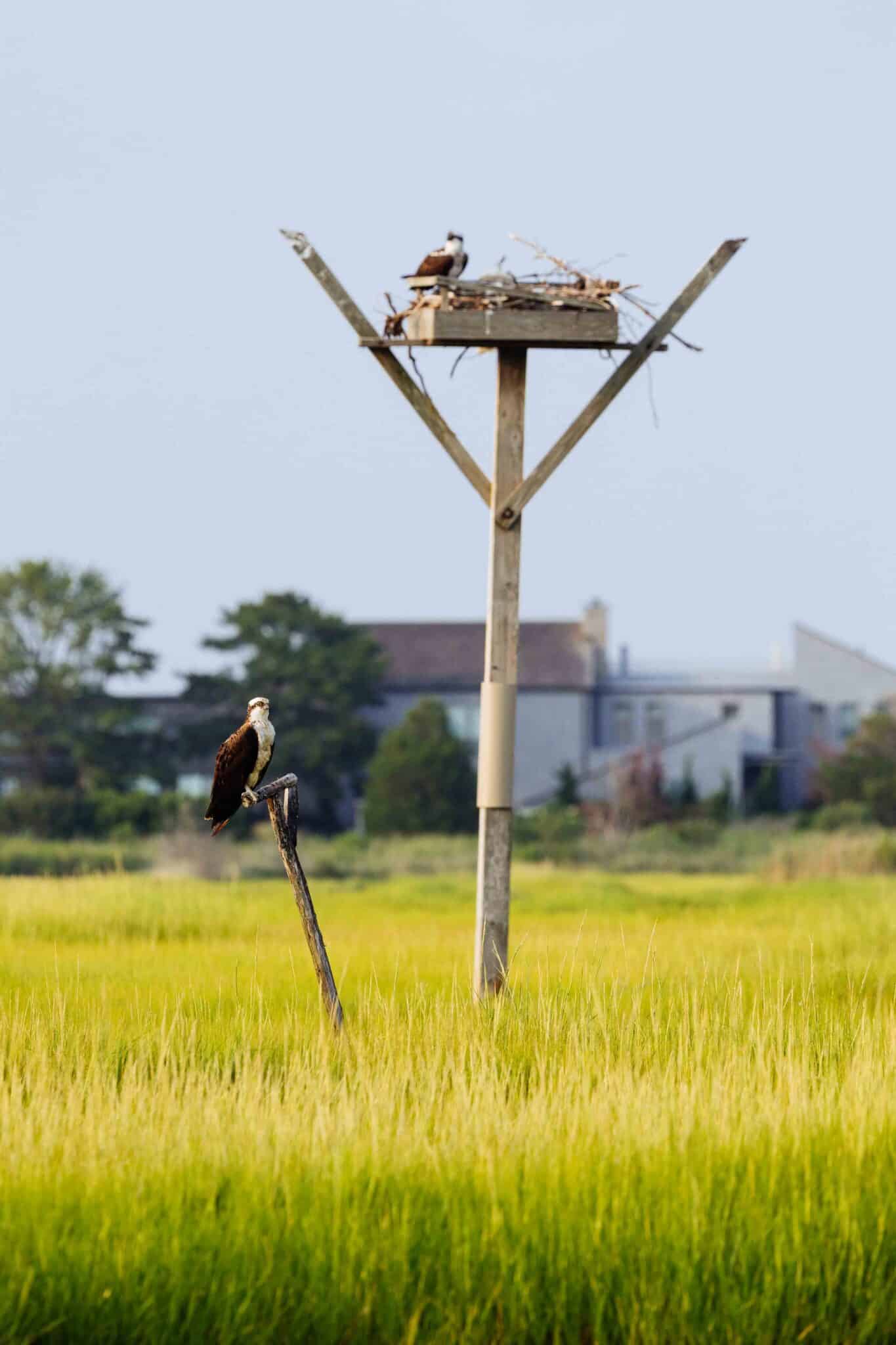
For more than two decades, Conserve Wildlife Foundation of New Jersey (CWF) has worked in partnership with the New Jersey Department of Environmental Protection’s Endangered and Nongame Species Program to monitor and manage the state’s osprey population. Through decades of conservation, habitat protection, nest platform installation/maintenance, and monitoring, ospreys have made a remarkable comeback. In January 2025, their conservation status was upgraded to stable.
But recovery of a species does not guarantee the long-term health of the ecosystem that supports it.
For the past several years, we have observed increasingly widespread signs of food stress among New Jersey’s coastal nesting ospreys. Their declining reproductive success raises questions about the availability of prey in the nearshore waters where they hunt, including Atlantic menhaden, one of the most important forage fish in the marine food web.
At next month’s annual meeting, the Atlantic States Marine Fisheries Commission (ASMFC) will consider the coastwide Total Allowable Catch (TAC) for Atlantic menhaden for 2027–2028. These findings deserve serious consideration, as the decisions made could affect not only ospreys, but also other species that are less visible or more difficult to study. Ospreys serve as vital bioindicators of ecosystem health.
There is still time to submit a public comment and voice your concern for ospreys and abundant forage fish that they depend on.
A troubling pattern along the New Jersey coast
Ospreys are fish-eating birds of prey that depend on accessible, abundant fish to successfully raise their young. In New Jersey, the large majority of ospreys (95%) nest in coastal areas. Their long term recovery and population growth in coastal areas has largely been due to the rich natural resources that have supported them. Since ospreys have a very high level of site fidelity (return to the same nest site, year after year) and live long lives, their breeding performance can provide valuable insight into local prey availability and the health of the surrounding ecosystem.
In New Jersey, the warning signs have become increasingly difficult to ignore.
- 2022: Following a May nor’easter that brought high waves, strong onshore winds, and heavy precipitation, coastal nest failures rose to 37% as foraging became more difficult and prey became more scarce. Productivity averaged 1.16 young per active nest.
- 2023: Another nor’easter struck in June, when many ospreys were raising young. Coastal productivity averaged just 1.08 young per active nest. Viewers of CWF’s Barnegat Light Osprey Cam also documented a decline in menhaden delivered to the nest through a citizen-science prey monitoring project.
- 2024: Despite more favorable weather, concerns about food availability grew. Surveys of 25 occupied nests on Barnegat Bay found that 40% contained no eggs or young. In the Great Egg Harbor watershed, only 17 of 50 surveyed nests contained eggs or young. A sign of food stress in the spring is delayed or reduced egg laying in breeding females.
- 2025: Coastal osprey productivity fell to just 0.64* young per active nest, the lowest recorded in New Jersey since 2003. Follow-up surveys on Barnegat Bay found only four young at three nests among 24 occupied territories surveyed in May.
- 2026: Preliminary statewide results showed coastal productivity of just 0.74* young per active nest, compared with 2.04 inland. Although the statewide population included 850 territorial nesting pairs, coastal colonies continued to struggle to raise young.
These are not isolated observations from a single nest or one difficult breeding season. They represent a troubling pattern across multiple years and coastal locations.
*the minimum productivity needed to sustain a population is considered to be around 0.9 young/active nest.
Witnessing the crisis first hand
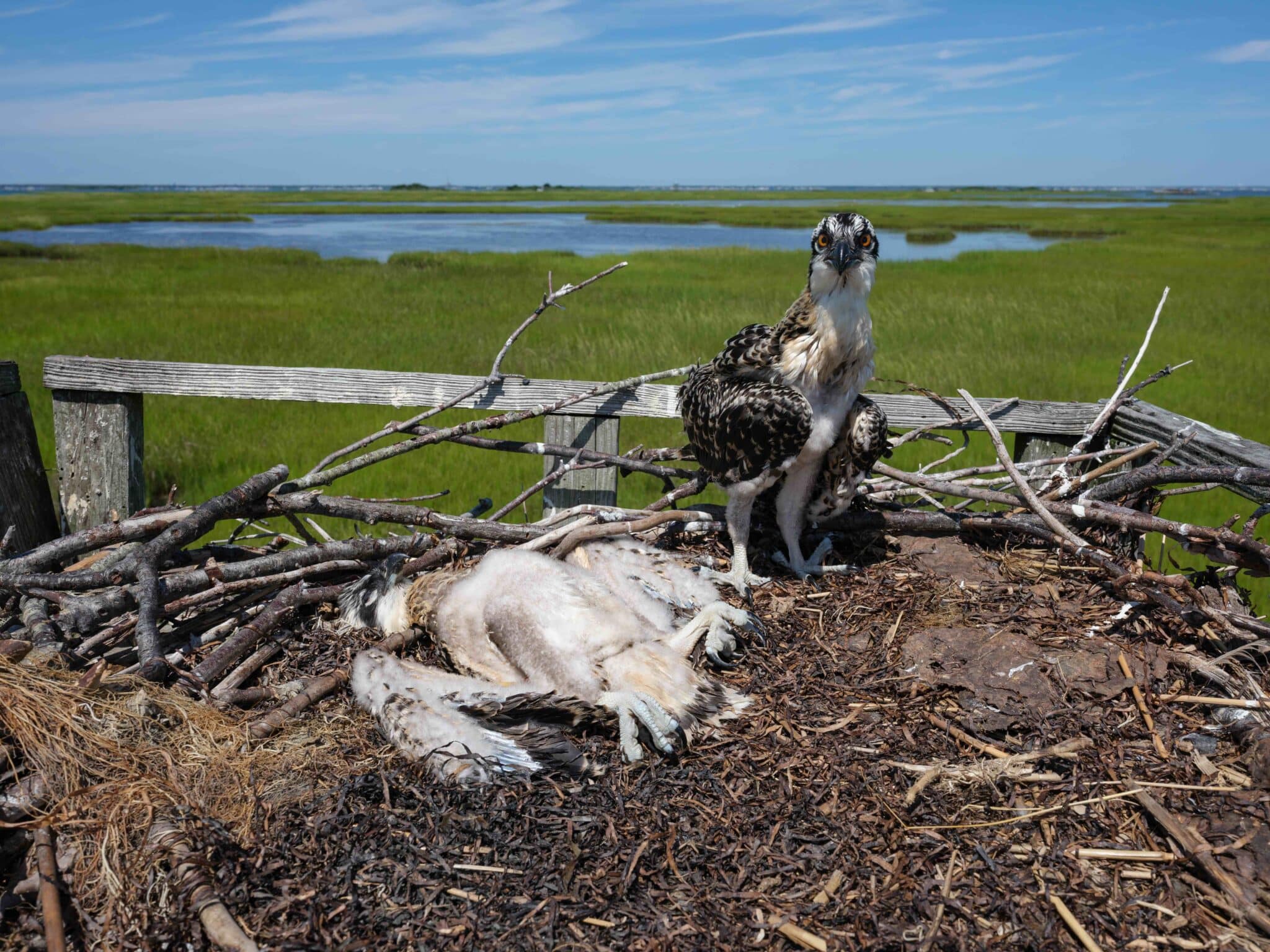
During the 2026 breeding season, we observed food stress at numerous osprey nests on Barnegat Bay, where multiple nest checks were conducted throughout the breeding season. Nineteen nests had territorial pairs but no eggs, more than half of them at Sedge Island, New Jersey’s only Marine Conservation Zone.
At Sedge Island, 18 pairs laid eggs or produced young. Ten young hatched, but only two survived to fledge.
I personally witnessed the six-week-old nestling (pictured above) so emaciated that it was attempting to feed on its recently deceased sibling. I removed the nestling and brought it to Don Bonica at Toms River Avian Care for emergency treatment. Two other underweight, fledgling-age ospreys from Monmouth County were brought to the facility that same day. All three juveniles later died.
From 2014 through 2024, the Sedge Island colony averaged 25 breeding pairs producing 41 young annually. The contrast with 2026 is alarming.
These observations do not establish that menhaden harvest alone is responsible for the current crisis. Weather, prey distribution, and other ecological factors can influence breeding outcomes. However, the persistence and severity of reproductive failures along New Jersey’s coast warrant urgent attention to the availability of menhaden and other forage fish.
A historical warning we cannot ignore
New Jersey’s ospreys have faced similar crises before.
Following the peak menhaden harvest in 1956, the state’s osprey population began to decline. By the mid-1960s, large purse-seine vessels had replaced pound nets along coastal beaches. Herbert Mills, founder of The Wetlands Institute in Stone Harbor, documented the changes he observed while studying ospreys along Seven Mile Beach.
In 1972, Mills wrote that close observation of ospreys since 1966 indicated that nearby fish were scarce and small. He also noted the coincidence between the loss of the pound nets and the decline of ospreys along the southern New Jersey coast.
By the late 1960s, New Jersey’s osprey population had fallen to a historic low of approximately 50 pairs, and the species became one of the first listed as endangered in 1974.
Decades later, a July 1997 New York Times headline warned, “Ospreys May Be Starving.” Biologists documented high nest failure rates along the Atlantic coast, where ospreys were reproducing below sustainable levels even as inland colonies continued to thrive.
In 2002, New Jersey enacted legislation banning the industrial harvest of menhaden from state waters. The goal was to protect a resource of immense ecological value, one that supports wildlife, recreational fishing, birding, whale watching, and ecotourism.
Today, results from our osprey surveys are raising troubling questions once again. We should take these warning signs seriously before further ecological damage occurs.
Why Atlantic menhaden matter
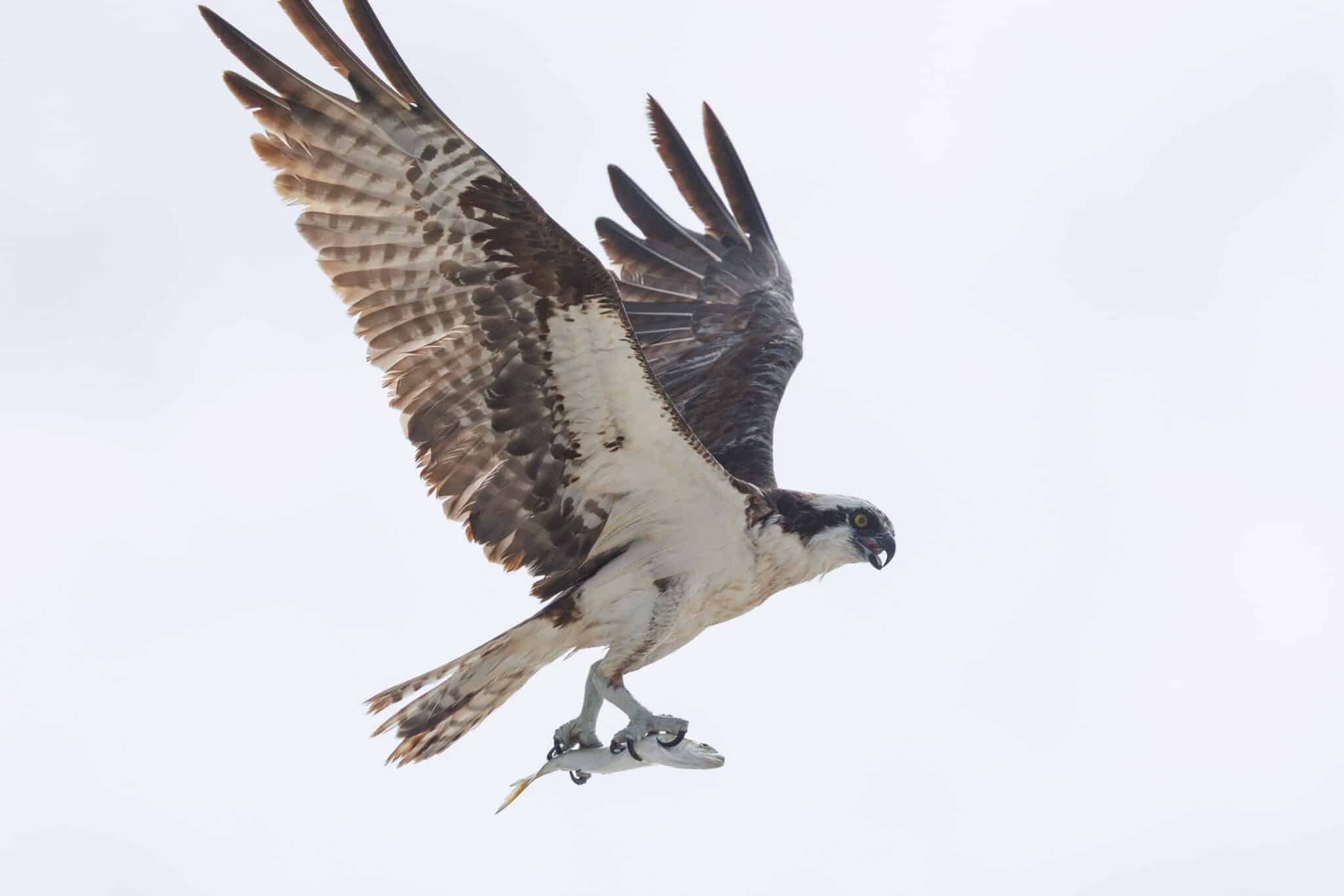
Atlantic menhaden are a critical forage fish, providing essential food for ospreys and many other marine predators, while filtering our coastal waters to improve water quality. Their value extends far beyond the reduction fishery that harvests them for processing into fish meal and fish oil.
Menhaden help sustain the marine food web, supporting wildlife and recreational fisheries that contribute to the ecological and economic health of coastal communities.
The coastwide TAC is one of the most important tools the ASMFC has to manage this shared resource. Decisions about how many menhaden can be harvested should account not only for the needs of the fishery but also for the needs of the predators and ecosystems that depend on them.
A coastwide harvest limit that does not adequately account for forage needs risks overlooking the ecological consequences of removing this essential prey fish. And even when a fish population is managed within established limits, that alone does not necessarily demonstrate that sufficient fish are available to predators in every coastal area.
Osprey breeding performance can help reveal these localized problems. As visible, fish-dependent predators, ospreys offer a valuable biological indicator that complements fishery-dependent and fishery-independent data.
When coastal ospreys repeatedly struggle to raise young while inland colonies fare better, we should be asking what is changing in the marine environment.
A call for precautionary menhaden management
As the ASMFC considers the 2027–2028 coastwide TAC, we urge the Atlantic Menhaden Management Board to take a precautionary, ecosystem-based approach.
Specifically, we recommend that the Board:
- Adopt a precautionary coastwide TAC that prioritizes adequate menhaden availability for the marine food web, including ospreys and other dependent predators.
- Account for ecosystem needs and uncertainty when setting harvest limits, treating persistent food stress and poor osprey reproductive performance as serious warning signs.
- Strengthen monitoring of menhaden availability and ecological impacts, including the use of wildlife indicators such as osprey breeding performance alongside fisheries data.
- Apply adaptive management that responds to emerging evidence of localized prey shortages, changes in prey availability, and ecosystem stress.
- Recognize the full ecological and economic value of menhaden, including their importance to wildlife, recreational fisheries, wildlife viewing, and coastal communities.
New Jersey’s osprey recovery demonstrates what decades of sustained conservation can accomplish. But the reproductive failures we are now documenting remind us that protecting a species requires protecting the natural resources it depends on. Our goal is not to attribute the poor breeding performance observed in coastal nesting ospreys to the harvest of menhaden, but the persistent and widespread failures do warrant investigation of localized depletion and more precautionary management.
The ASMFC has an opportunity to make management decisions that reflect the ecological importance of Atlantic menhaden and the needs of the broader marine food web.
Leaving more menhaden in the water is an investment in healthy fisheries, abundant wildlife, resilient coastal ecosystems, and the communities that depend on them. We should not wait for another wildlife population to approach the brink before acting to protect the resources that sustain it.
The public can submit written comments for consideration by the Menhaden Management Board. To ensure your comments are included in meeting materials, ASMFC has established the following deadlines:
- October 19, 2026: Comments received by this date will be included in briefing materials.
- November 3, 2026, by 5 p.m.: Comments will be included in supplemental materials.
- November 6, 2026, by 10 a.m.: Comments will be distributed electronically to Commissioners and Board members before the meeting.
Comments may be submitted by email or mail. Clearly state that your comments should be distributed to the appropriate Commissioners and Board members. You can submit your comments to:
Mr. Joseph Cimino, Chair
Members of the Atlantic Menhaden Management Board
Atlantic States Marine Fisheries Commission
1050 North Highland Street, Suite 200 A-N
Arlington, VA 22201
Re: Public Comment on the 2027-2028 Coastwide Atlantic Menhaden Total Allowable Catch (TAC)
via the form on this website or: comments@asmfc.org
Discover more from Conserve Wildlife Foundation of NJ
Subscribe to get the latest posts sent to your email.