USING CARTOGRAPHY TO ILLUSTRATE WHERE SPECIES LIVE
By Michael Davenport, Marine Species & GIS Programs Manager
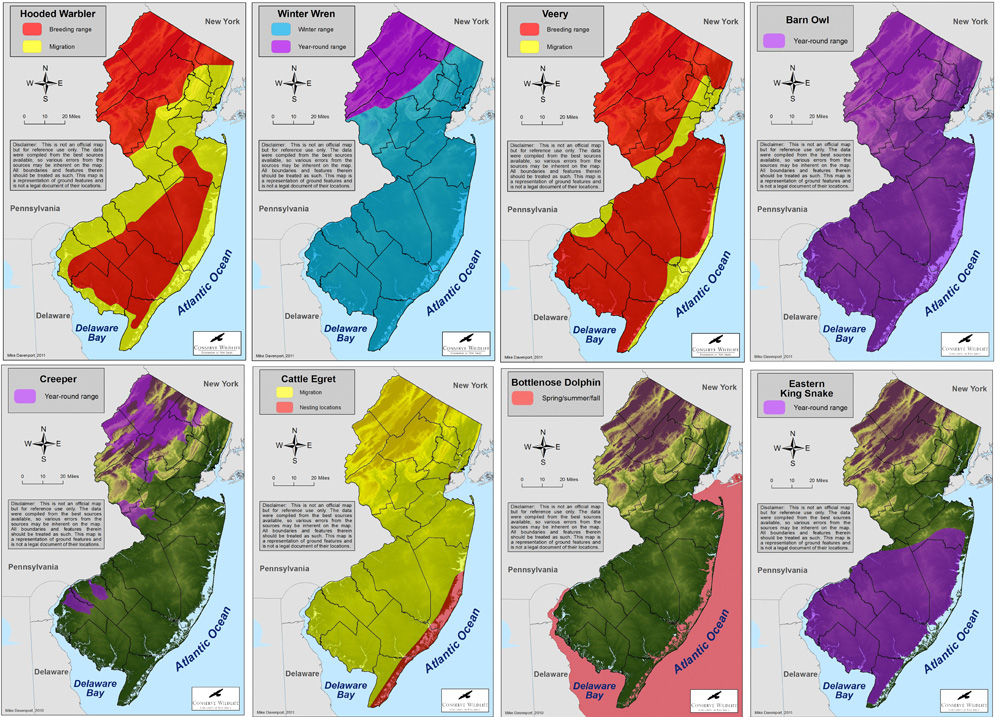
Several range maps found on the CWF on-line field guide.
Conserve Wildlife Foundation of NJ (CWF) staff have been busy updating the CWF website’s on-line field guide with additional species’ profiles in order to add descriptions for New Jersey’s Species of Special Concern. One important component of the on-line field guide, like almost any other field guide, is the inclusion of a range map.
Our Online Field Guide
The CWF on-line field guide is specific to New Jersey, so the only portion of each species’ range illustrated is that portion within the boundary of the state. For a species’ full range, there are numerous additional sources of information. CWF, being focused on New Jersey wildlife, is uniquely able to provide more specific range information based upon the data available to our staff as well as our first-hand knowledge.
The range maps within the on-line field guide are created using Geographic Information Systems (GIS) software and multiple sources of data. First, we begin with the raw species observation data which is maintained within the NJ Endangered and Nongame Species Program’s (ENSP) Biotics database, a database which CWF staff maintains in partnership with ENSP. Then, like any range map, some generalization needs to be made to account for the fact that animals cannot be observed 24 hours a day, 365 days a year. In order to do so, data such as land cover types, hydrology, and/or topology is considered in order to fill-in the areas between observation points or omit other areas. Continue reading “Creating Range Maps for NJ Wildlife”
New Jersey is home to at least 16 species of freshwater bivalves (freshwater mussels and clams), half of which are listed as endangered or threatened within the state. The presence of freshwater mussels within a water body is an indication of water quality so determining where they occur is important for protecting water resources within the state. In fact, the NJ DEP’s “Category One” (C1) designation for some state waterways is often based on the presence of some freshwater mussel species. C1 waters are protected from any measurable change in water quality because of their exceptional ecological significance, exceptional recreational significance, exceptional water supply significance, or exceptional fisheries resources.
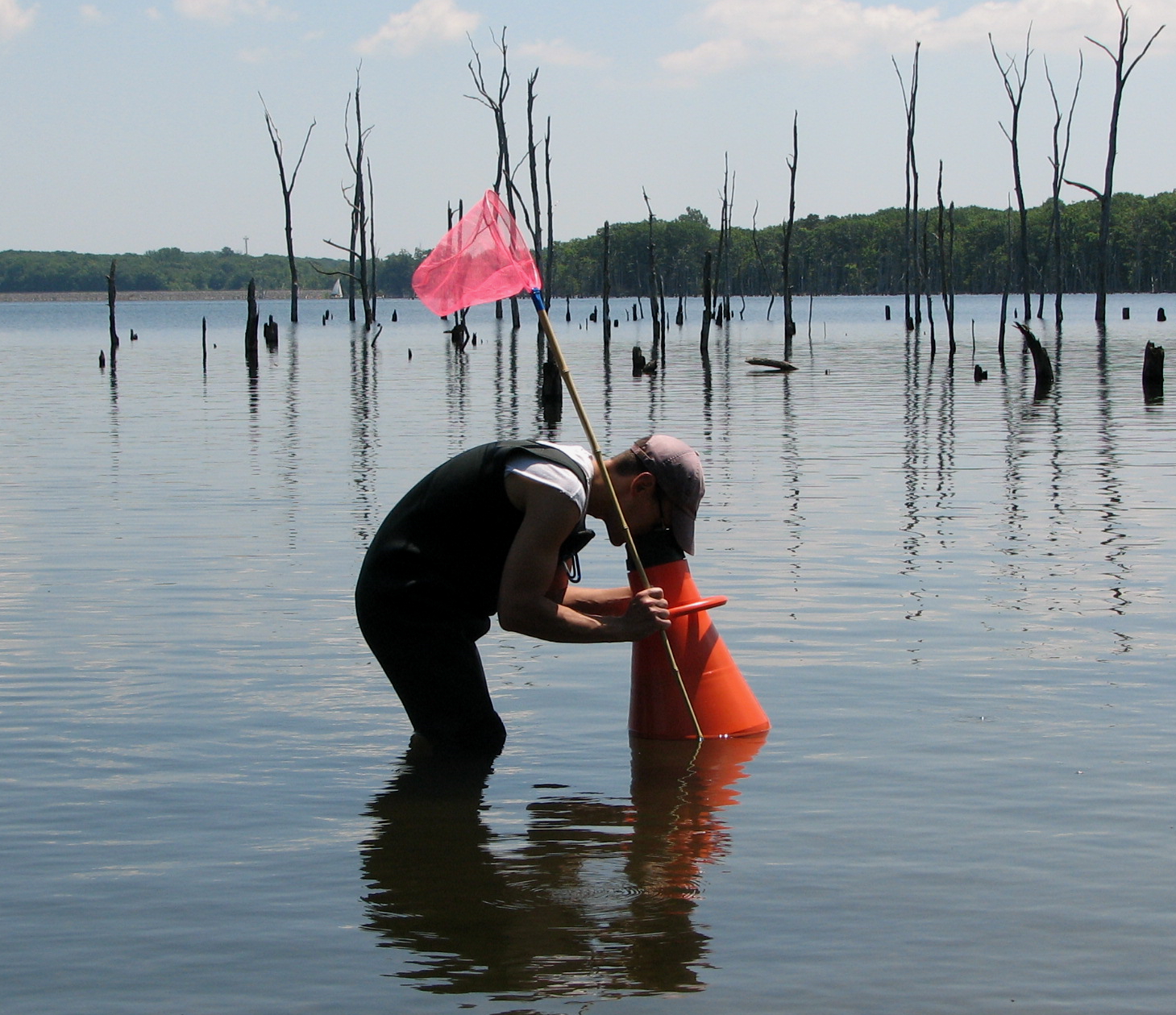
Last week, I accompanied the Endangered and Nongame Species Program’s freshwater mussel biologist, Jeanette Bowers-Altman, and another survey team member to conduct a preliminary survey of the Manasquan Reservoir in Monmouth County for both freshwater mussels and crayfish. I had visited the reservoir several times before and had confirmed the presence of at least three bivalves: the Asian clam, eastern floater, and paper pondshell. Of those three species, only the eastern floater is native to New Jersey.
We surveyed several areas around the perimeter of the reservoir. We took readings of the water’s temperature, pH, and dissolved oxygen as well as documenting the substrate type and GPS coodinates. Unfortunately for our survey efforts, the water level was higher than ideal for locating mussels and the only species which we found was the paper pondshell. However, the clarity of the water and the nature of the substrate indicate that future efforts, when the water level is lower, may be more productive.
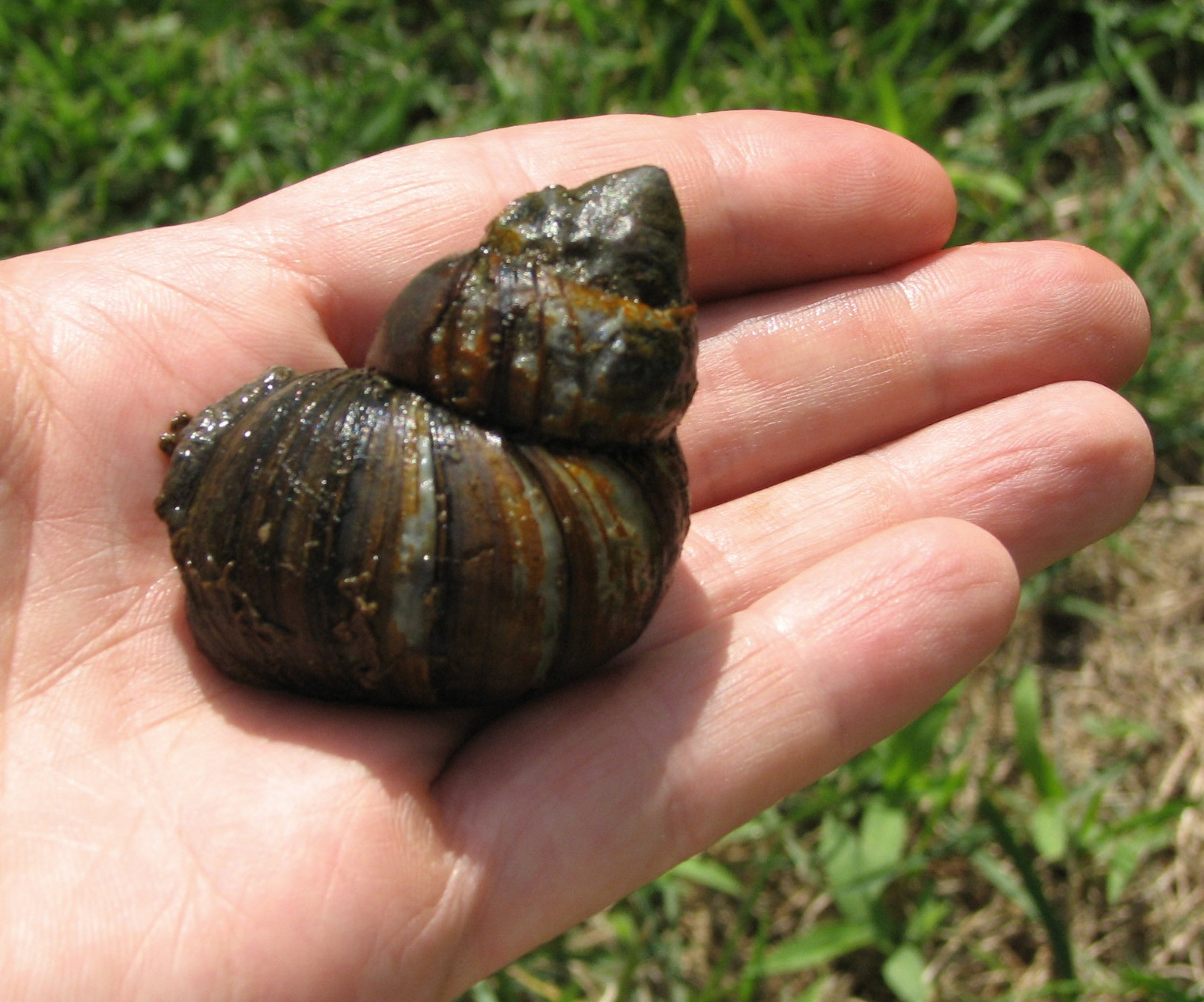
One interesting find was a rather large (~2.5 inches) freshwater snail which I have never encountered previously. Thanks the ID skills of Jay Cordeiro at the University of Massachusetts – Boston, the snail has been identified as the Chinese mystery snail (Cipangopaludina chinensis), a non-native species introduced to the U.S. via San Francisco in the late 1800’s. It has since spread into at least 37 U.S. states and 4 Canadian provinces and was first documented in New Jersey in 1926. According to Jay, the species has been “implicated in vegetation decline, competition with native species, and are hosts for certain parasites. Current populations are spread through the aquarium trade or on ornamental aquatic plants.”
Scientists today released a report announcing that a decrease of at least 5,000 red knots was observed at key wintering grounds in Tierra del Fuego, Chile from the previous year. Scientists reported population counts of wintering knots in other locations declined as well. The estimated current total population for the migratory shorebird is now unlikely to be more than 25,000.
The decline in red knot numbers elevates the importance of implementing stronger protections at Delaware Bay, a key U.S. stopover where migrating knots depend on an abundant supply of horseshoe crab eggs to fuel the final leg of their migration to breeding grounds in the Canadian Arctic.
The scientists’ report concludes that despite horseshoe crab harvest restrictions put in place by the Atlantic States Marine Fisheries Commission over the past decade “there is still no evidence of recovery of the horseshoe crab population, either in numbers of spawning females or in all sub-adult age groups including juveniles.” Restrictions to date have only been enough to stop the population from declining further, are insufficient to recover the population and will continue to be insufficient unless the harvest is greatly reduced.
WASHINGTON (May 23, 2011) – Conservation groups are calling on the U.S. Fish and Wildlife Service (FWS) to take immediate steps to list the red knot under the Endangered Species Act. A listing would initiate the development of a recovery plan and require federal agencies whose actions affect red knots to consult with the FWS. A listing would also require the Atlantic States Marine Fisheries Commission, housed under the National Marine Fisheries Service, to consult with the FWS on the regulations it establishes for the horseshoe crab fishery. The following are statements from groups pursuing an endangered species listing:
“It’s simple, to halt this decline and imminent extinction, we must list the red knot now and view all shorebird protection through the same lens,” said Margaret O’Gorman, executive director for Conserve Wildlife Foundation.
“This year’s huge decline in wintering red knots provides clear evidence that the status quo is not working. Unless action is taken now, red knots may be on an irreversible slide to extinction,” said Bob Irvin, senior vice president for conservation programs at Defenders of Wildlife. “The U.S. has a responsibility to the global community to protect this migratory shorebird, which stops along our coast to rest and feed while making one of the longest migrations in nature, from the tip of South America to the Arctic.”
“The bad news demands we redouble our efforts to rebuild the horseshoe crab population of Delaware Bay,” said Tim Dillingham, Executive Director of the American Littoral Society. “A listing of the red knot under the ESA will allow for management of the horseshoe crab population to be directed toward recovery of the shorebird populations, and not simply the local fishing interests. We urge the USFWS to make this a priority.”
“Until recently, the Delaware Bay resplendent with spawning horseshoe crabs and over a million shorebirds was the land of plenty – our Serengeti,” said Eric Stiles, vice president for Conservation and Stewardship for New Jersey Audubon Society. “The red knot is one of the shorebirds whose very existence is teetering on the brink of survival. Unlike special interest naysayers, we have full faith in the Endangered Species Act. Only through listing will the robin-sized, chestnut colored shorebird be enjoyed by future generations.”
“The decline of the shorebirds and the horseshoe crabs that sustain them is not speculation; it is a proven reality documented by science and history. The Atlantic States Marine Fisheries Counsel, among those charged with protecting the species, has ignored the science and the harm in order to assuage their political allies. In the absence of strong and earnest action from the ASMFC, we need strong action from our states. While New Jersey has taken that strong action to protect the crabs and the birds, Delaware’s actions leave a lot to be desired when the politics heats up” expresses Maya van Rossum, the Delaware Riverkeeper.
“The rufa red knot, which once darkened the skies during their migration, now stands on the very knife-edge of extinction. The states along the east coast, with the exception of New Jersey, dithered for decades and now the only way to save this subspecies is for the U.S. Fish and Wildlife Service to place it on the Endangered Species List. With this new report, it is clear that if the federal government doesn’t act soon, the next generation of Americans will never see this amazing long-distance migrant. People who want to see this bird in the wild best make plans in the near future because the way things are going, it will be gone sooner rather than later,” said Darin Schroeder, Vice President for Conservation Advocacy for ABC.
“A population decline this large and this rapid is almost unequalled in our lifetime,” said Greg Butcher, Director of Bird Conservation for National Audubon Society. “Surely such a bird requires the immediate protection of the Endangered Species Act and needs to be a top conservation priority for all of us.”
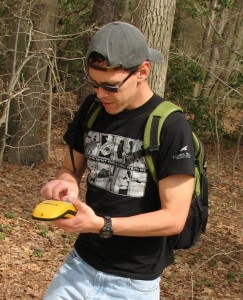
Having accurately mapped rare species data is essential for insuring that critical habitat for those species remains protected. For that reason, I recently accompanied Kris Schantz, a biologist from the NJ Endangered and Nongame Species Program, in documenting two timber rattlesnake den locations in northern New Jersey using a GPS (global positioning system) unit. Our goals were to see if the rattlesnakes had emerged from hibernation, survey how many were present, and to accurately map their locations in the heavily wooded area less than 30 miles outside New York City.
Timber rattlesnakes (Crotalus horridus horridus), like other reptiles, are cold-blooded. In order to survive through the long, cold winter in New Jersey, they hibernate in dens. Research has shown that rattlesnake dens in the northern part of the state can vary from rocky outcroppings with crevices, ledges or boulders to forest interior dens consisting of a few rocks and a hole in the ground. In New Jersey’s Pinelands, however, rattlesnake dens are quite different. Rattlesnake dens in the Pinelands are usually underground crevices near bodies of water, often underneath large tree roots.
Rattlesnakes will almost always use the same den year after year. In addition, rattlesnake young typically follow the scent trail of their mother in order to find their way to her den their first fall, or may follow any timber rattlesnake to a suitable den. As a result, a good den site may provide a winter refuge for a number of rattlesnakes of all age classes, as well as other species of snakes.
Since the goal of our mission was to map den locations, we had to make sure we arrived at the den site once it was warm enough for the rattlesnakes to come out of their crevasses to bask but before they had enough warm weather to travel away from the den site. Timing was crucial. After a week with some fairly warm days mixed with very cool nights and a few cool days, we ventured out during the last week of April on a day when the air temperature climbed into the lower 80’s.
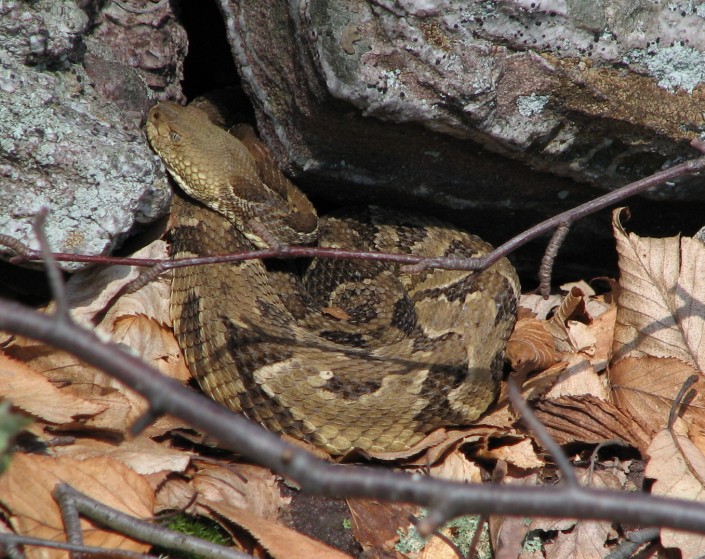
The first den site we visited required a fairly long hike through a rocky, deciduous forest. Fortunately, Kris had visited both den sites several years earlier so she had a good idea of where we needed to go. We were fortunate to find two individuals at the den site, one yellow-phase juvenile and one yellow-phase sub-adult or young adult. While I GPSed the den site, Kris attempted to determine their sex based on their appearance (the young adult was a female but the juvenile’s sex could not be determined).
GPS units work when there is an unobstructed line of sight to four or more GPS satellites. With 7-8 satellites being detected by the GPS unit, my task of mapping the site was fairly easy and took little time. The trees had yet to leaf-out so my GPS unit had a clear signal from above. We also observed a northern black racer (Coluber constrictor constrictor) at the den site.
The second den site required a much longer and more strenuous hike accompanied by swarms of black flies. At that location, we observed three rattlesnakes – one black-phase adult (sex undetermined), one yellow-phase adult male, and one yellow-phase sub-adult or young adult (sex undetermined). GPSing this location took a little more effort though due to the terrain both because it was more difficult to get to the site and once there, the terrain made getting a clear signal on the GPS unit a little more tricky and it took far longer than at the first den.
Out of the five rattlesnakes we observed, only one ever rattled. Rattlesnakes rely on their camouflage as their first line of defense. Even when we were close by, they remained motionless. At no point did any of the snakes approach us or attempt to strike. The only two individuals which moved at all during our survey, moved away from us into rock crevasses and that was likely due to our prolonged presence staring at them.
Snakes, and venomous snakes in particular, have an undeserved bad reputation. At no point during our survey did I ever have any fear of being bitten by a rattlesnake. In all honesty, I was actually far more afraid of being bitten by a tick instead (I only found about four or five on me during the entire day).