Oystercatcher Technician shows diversity of tasks in wildlife conservation
By Alfred Breed, CWF Technician
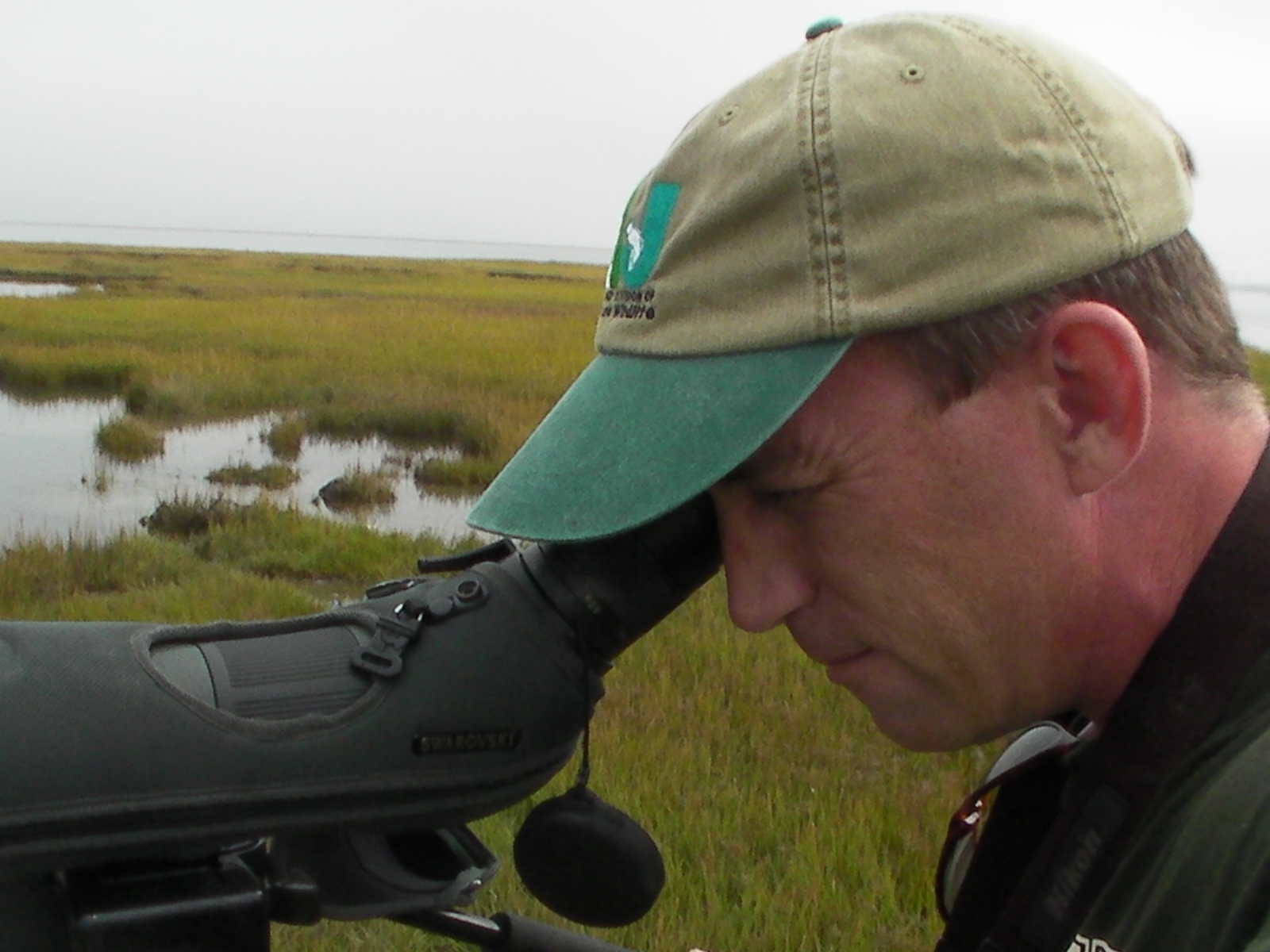
My official job title with Conserve Wildlife Foundation of New Jersey is “American Oystercatcher Technician”. As such I am tasked during nesting season with monitoring Oystercatcher nesting sites, and during migratory season with locating flocks of Oystercatchers, counting them, resighting marked birds in each flock, recording data of field survey results and reporting our NJ counts and resights to a central database that holds data from the other reporting states in the migratory flyway.
As is usually the case in any job that has a “description”, the phrase “and other such tasks as assigned” is included as a catch-all for things that aren’t specifically listed in the description, but can be an important part of the duties of the position nonetheless. In my case these ancillary tasks are different each day, and often involve three of my favorite things: wildlife (of course!), science, and gear. Working around my Oystercatcher surveys, which can only be conducted at high tide, I might be tasked to go to a location anywhere in the state and survey for a particular species of plant or animal; or to site select, construct, install, use, maintain, and troubleshoot various types of data collection or other equipment throughout South Jersey.
Trucks, trailers, boats and kayaks are the big-ticket items that I use every day, but I’m lucky enough to use a large variety of other cool tools and equipment as well. Driving is often a big part of my day, with travel times between sites eating up significant portions of the workday. Sometimes I’m a wildlife EMT or ambulance driver, saving sick or injured animals from their immediate predicament and/or transporting them to various certified rehabilitation facilities located throughout the state.
Best of all is when I’m asked to assist visiting scientists or other conservation partners in their work, which can mean bio-sampling or banding. Direct human/wildlife interaction is only appropriate when it is for valid scientific or conservation management purposes, and is sanctioned and a permit issued by the appropriate governing body. To be a staff member and so to be included in these sanctioned and permitted activities is a rare privilege indeed.
Each day is different, always interesting, occasionally exciting, and always personally rewarding as I play a small part in the management of threatened and endangered wildlife and the habitat that we share.
Assessing the damage to coastal wildlife and their habitat
By Stephanie Egger, Wildlife Biologist
CWFNJ Wildlife Biologist, Stephanie Egger, surveying American Oystercatchers post Hurricane Sandy.
As we all know Hurricane Sandy caused severe damage and devastation to New Jersey residents, homes, and their businesses, but we must not forget that wildlife can also suffer from the impacts of a hurricane. CWFNJ’s Beach Nesting Bird Project Manager, Todd Pover, Alfred Breed, CWFNJ Field Technician, and myself, conducted wildlife/habitat assessments on beaches from Brigantine to Cape May after the storm. Our nesting sites further north in Ocean and Monmouth Counties were still not accessible at that time to evaluate. We assessed nesting habitat for beach nesting bird species, especially Piping Plover as well beach/inlet habitat used by migratory shorebirds, particularly American Oystercatchers.
A view of the severe erosion at Strathmere Natural Area, Cape May County, NJ.
As expected, many of our nesting sites and sites that are also used by migratory shorebirds for roosting were hit hard by Hurricane Sandy, losing a great deal of sand and suitable habitat. However, in some locations such as Stone Harbor Point and North Brigantine Natural Area, the storm scoured out areas with too much vegetation which is good for beach nesters as they prefer sparsely vegetated areas. Sand was also pushed back into the dunes to create blowouts and overwash areas that may serve as additional habitat. Many of the areas seem to be very low lying now from the loss of sand and might be more flood prone which could impact the beach nesters in the spring.
We also observed migratory songbirds, golden-crowned kinglets, which were taking shelter and flittering through the back dune/bayberry habitat right after the storm. This was a good reminder of the value of New Jersey coastal habitat for songbirds as they migrate down the coast.
American Oystercatchers roosting with juvenile Black Skimmers at Strathmere Natural Area, Cape May County, NJ
As part of our assessment, we conducted American Oystercatcher surveys as a significant number use New Jersey beaches for roosting during the fall and winter. Luckily, approximately 900-1,000 American Oystercatchers were still using our southern coastal inlets after Sandy, about the same number of birds observed the week before the storm. Thanks to funding from the National Fish and Wildlife Foundation we were already conducting fall surveys for American Oystercatchers and in the position to compare their numbers before and after the storm.
Only time will tell if the habitat will build back up enough in time for the spring as the birds begin to arrive for the nesting season or if it will have lasting impacts on migratory bird species. We hope to conduct further assessments to gain a better understanding of the short- and long-term impacts to wildlife from Hurricane Sandy and how that may affect conservation and recovery effort for these species moving forward.
For CWFNJ’s videos of wildlife and habitat assessments click on the links below:
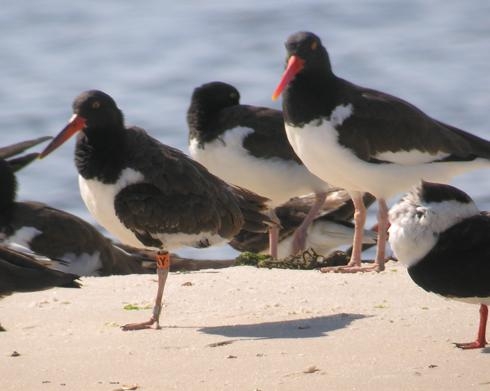
Roost Flock of American Oystercatchers with New Jersey (Orange) Bands Photo courtesy of Pat Leary
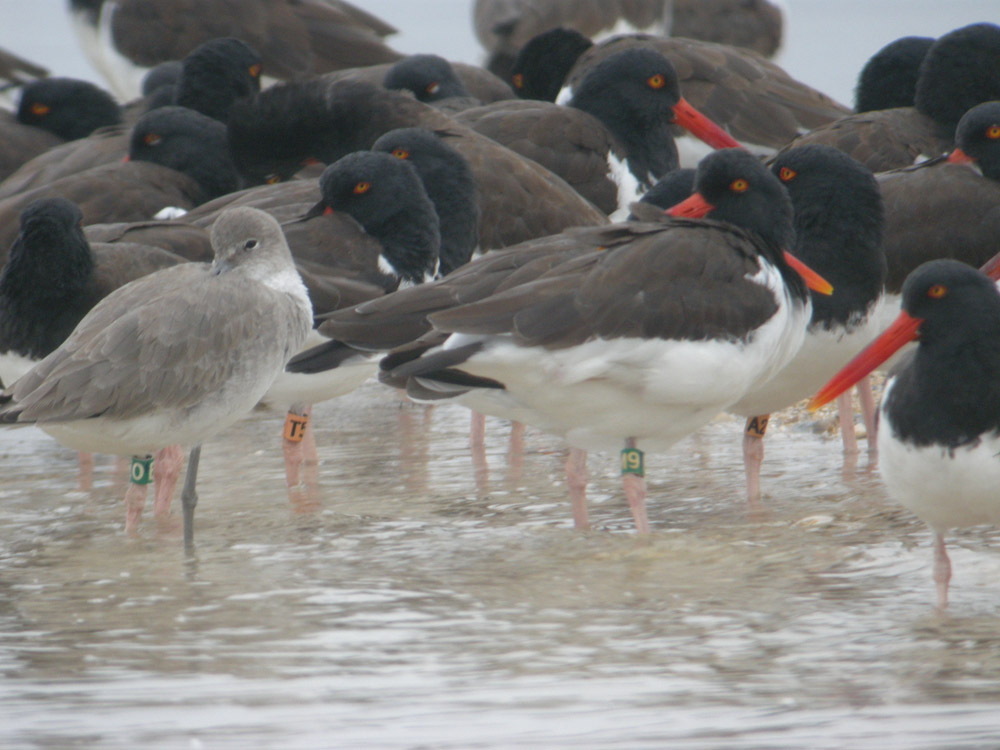
Did you know that American oystercatchers don’t just nest in New Jersey, but that we also have the northernmost wintering population on the Atlantic Coast? Our state’s coastal inlets are also important as stopover sites for migratory oystercatchers. Yesterday, we counted a flock of over 300 oystercatchers on Champagne Island in Hereford Inlet and this morning we surveyed a smaller flock of about 75 birds in Corson’s Inlet. In addition to counting the birds, we also look for (i.e. resight) color bands during the surveys. Most of the bands are from birds that nested here, but a number of bands from other states, such as Massachusetts, are also currently being seen. New Jersey bands are orange colored – you can see two of “ours” in the photo above.
Dr. Virzi and Stephanie Egger (CWFNJ) banding an American oystercatcher chick.
By Stephanie Egger, Wildlife Biologist
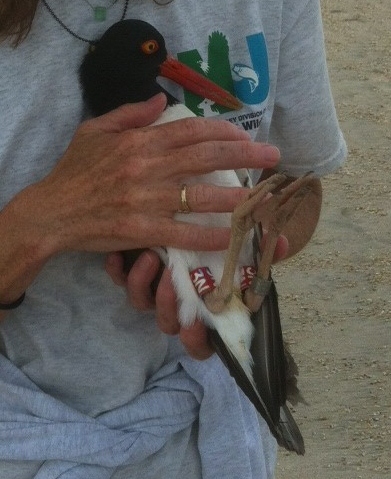
Conserve Wildlife Foundation of NJ (CWFNJ) and the NJ Division of Fish and Wildlife – Endangered and Nongame Species Program (ENSP) assisted in the banding of American oystercatchers chicks and adults this week. Oystercatchers in New Jersey are banded as part of a long-term mark recapture research project by Dr. Tom Virzi of Rutgers University in collaboration with CWFNJ and ENSP. One breeding adult that was recaptured yesterday was originally banded over a winter in Georgia! Data collected included band color and combination, sex, age, weight, other physical measurements (wing, head, culmen, nares, leg) and a feather sample for DNA purposes. Check out our video from that day!
Over the last few years, widespread mark recapture efforts along the Atlantic coast have revealed connections between breeding and wintering sites and information of the complexity of patterns of movement and dispersal. For more information on the New Jersey data and other state efforts please see the American Oystercatcher Working Group website.
Pam Prichard (Monmouth County Monitor for ENSP) ready to release the American oystercatcher chick after all data was collected.An adult American Oystercatcher originally tagged in Georgia, breeding in New Jersey.An adult American Oystercatcher originally tagged in Georgia, breeding in New Jersey.
The month of April has provided the first nests from our beach nesting birds! The first nest found belongs to the American oystercatcher, a species of concern in New Jersey. Like our other nesting shorebirds, the eggs are well camouflaged on the beach. We use symbolic fencing (string and posts) with signs to protect their nesting areas and to alert the public of their presence.
An American oystercatcher nest with 2 eggs.American oystercatcher nesting area with protective fencing.
Piping plovers and American oystercatchers have already begun to return to New Jersey to breed. Least terns and black skimmers will follow in another couple of weeks. This is a busy time for the Conserve Wildlife Foundation’s (CWF) Beach Nesting Bird Project – our program to protect these birds, some of the state’s most at-risk species, kicks into high gear as the birds arrive.
Employees from the Edison, NJ and Philadelphia, PA offices of CDM Smith who helped put up fence and signs at the Belmar Shark River Inlet nesting area.
The first major task at hand is to protect the habitat where the birds nest from human disturbance associated with intensive recreational use of our beaches. Working closely with the New Jersey Division of Fish and Wildlife, CWF typically helps fence off and post 20-25 beach sites annually.
And we couldn’t complete this massive job without the assistance of volunteers. This year we have gotten volunteer help from a diverse group of organizations, ranging from the New Jersey Beach Buggy Association to Wetland Institute to Manasquan High School Environmental Club. A huge THANKS to all those groups and individuals that pitched in to help!
Click here to learn more information about our Beach Nesting Bird Program.
TRACKING THEIR PATH AS THEY HEAD SOUTH FOR THE WINTER
By Allison Anholt, Field Technician, (NJDFW) and Emily Heiser, Field Technician, (CWFNJ)
Color band being placed on oystercatcher chick at Stone Harbor, N.J.
Throughout the fall, there is a remarkable sight to see along New Jersey’s coastline. Thousands of shorebirds group together in huge flocks, using our state’s coastline as a migration stopover point to rest and feed. One particularly interesting shorebird is the American oystercatcher, which is listed as a species of special concern in New Jersey. At the Conserve Wildlife Foundation of New Jersey, we work with biologists from the New Jersey Division of Fish and Wildlife to survey these birds throughout the fall season.
The oystercatcher is an especially easy bird to survey during fall migration due to its distinct features. Not only do they stand apart from other shorebird species with their unique orange bill and striking coloration, but color bands help us determine individuals as well. Banding efforts have been underway in New Jersey since 2004 in order to give insight to researchers regarding the
oystercatcher’s breeding habits, pair behavior, and migration patterns. About 300 oystercatchers have been banded in New Jersey to date, including a significant percentage of the state’s estimated 400 breeding pairs. Continue reading “AMERICAN OYSTERCATCHERS TAGGED AND READY FOR MIGRATION”
Because of the small amount of research undertaken when compared to other more intensely studied bird species, we are still very far from a complete understanding of the American oystercatcher. For several years staff from Conserve Wildlife Foundation of NJ, along with other partners throughout the state have collected data for both breeding and wintering populations of American oystercatcher in New Jersey. Very little data has been collected, however, during the non-breeding/migratory season.
That data gap is now beginning to close. Thanks to a grant provided by the National Fish and Wildlife Foundation, CWF was able to conduct surveys during the post-breeding/migratory season on roosting flocks of American oystercatcher at southern New Jersey Atlantic coastal inlets from Brigantine to Cape May. This data, when combined with data collected by other researchers range-wide, helps us to discern life-span, survival rates, movement patterns, population numbers, age structure and other important characteristics vital to our better understanding of this species.
For this study research staff surveyed inlet flocks of American oystercatchers between late July and early December 2010. Flocks were counted and observed for banded birds. There were just over 400 individual band resights during the survey period, significantly increasing our database of resighted birds. The majority of birds that were resighted were banded in New Jersey, although a number of birds banded in other states were also observed, including from Massachusetts, Delaware, Virginia, Georgia, North Carolina, and South Carolina.
Preliminary analyses of band resights and flock counts suggest seasonal patterns of behavior and show a variety of migration strategies within the species. Some migrants were sighted only once and seem to be passing through relatively quickly en route to roost sites further south. Some individuals resighted here in New Jersey were subsequently resighted a short time later on the Florida Gulf Coast at Cedar Key, indicating impressive migration distances covered in a very short time.
Others banded oystercatchers where resighted during the survey more than once here in New Jersey and spent considerable time roosting at or near our southern coastal inlets before moving on as temperatures dropped towards the end of the survey period. Still others were present during the entire period. New Jersey is the northernmost extent of the wintering range for the Atlantic Coast population of oystercatchers.
During the survey period, Brigantine, Great Egg Harbor, Corson’s, and Townsend’s inlets all showed a gradual increase in oystercatcher numbers to their peak flock counts towards the middle and end of October, when migrants headed for warmer latitudes and winter residents consolidated into New Jersey’s two primary winter flocks at Absecon and Hereford Inlets. These two primary winter roost sites had their flock counts gradually increase to their peak counts shortly before the end of the survey period. Between 350 and 400 birds were seen in each of these flocks at their peak.
As the primary surveyor for CWFNJ, one unexpected discovery I made early in the survey period was the identification of several alternative high-tide roosting sites at vernal marsh ponds close to, but some distance from, the inlets, and away from previously recorded roost site locations. Further research may help clarify if these alternative sites are a normal part of early migratory oystercatcher habitat, or are in response to the documented high levels of human disturbance in their normal roosting locations during the tourist season. Birds were observed regularly feeding at these ponds during the high-tide roost. It is possible that early in migration season the birds are still actively building reserves of energy to take them safely through the winter, and inhabit the vernal ponds to be close to an easily accessed food source. Wintering flocks, in contrast, are less likely to be seen feeding during the high-tide roost, and more likely to assume their energy conservation pose, standing on one leg with bill tucked under a wing, and the other leg drawn up tight beneath the body, with little or no feeding activity observed.
As fall progressed and human disturbance tapered off to some degree, the flocks did move to their more traditional roost sites, which are generally the beaches, sandbar islands and bayside sandflats of our inlets. Frequent shoulder-season human disturbance of the roosting flocks in these areas from watercraft users, beach walkers, anglers, ORVs, and dogs warrants additional systematic quantitative assessment and analysis for possible negative effects on the survival rates of migratory oystercatchers. Such analysis will aid in the evaluation of the need for the implementation of habitat management actions to mitigate any negative effects discovered.
The American oystercatcher precariously inhabits a narrow ribbon of coastal habitat which is also used by many other threatened and endangered plants and animals. It thus has strong potential as a “sentinel species” to help us to gauge both the current health of our ecosystem and the success or failure of habitat management actions undertaken. Continued data collection and analysis will enable us to take science-based steps in our efforts to understand the American oystercatcher, and to preserve and protect the beautiful barrier-island beaches, bays, and adjacent tidal marsh that make up our southern Jersey Shore.
American Oystercatcher Working Group annual meeting. Photo by Tracy Borneman.
Working closely with wildlife is the “sexy” part of my job. It is what makes me look forward to work on those days when I find myself less than inspired. It is also what the public most wants to hear about. But it is not necessarily the most important part of my job.
A great deal of my conservation efforts happen in meetings, offices, and behind a computer screen. A good case in point is the American Oystercatcher Working Group meeting I attended in Wellfleet, Massachusetts last week. This annual meeting brings together other managers, biologists, researchers, and policy experts from the Atlantic coast states that are specifically focused on oystercatchers. It is a chance for all us to share ideas, compare “notes” so to speak, build partnerships, and in general leverage the collective knowledge of the group.
This particular meeting is small by most standards, typically just 25-35 attendees, and much more informal than others I attend. It is also one of the most effective. Simply put, we get stuff done! Sure, we have spirited discussions and debate, but at the end of the day there is usually a cooperative spirit.
Projects move forward to benefit oystercatchers in individual states from Massachusetts to Florida, but through the prism of what is best for the range wide conservation of the species. This is how it should be. My job is to help monitor, manage, and protect oystercatchers in New Jersey, but since we only host a portion of the overall breeding population and they only spend a small part of each year in our state, we are just one piece of the puzzle.
You cannot effectively recover or conserve a species without partners. So we will keep telling you sexy, up-close-and-personal stories about wildlife, but once in awhile we will also remind you about the behind the scenes work we do to keep wildlife from disappearing from our state (and beyond).
Species diversity is critical for the continued health of any ecosystem. All organisms have a role to play, but defining that role for any species is no easy task. Certain species might act as a keystone, one whose healthy presence is absolutely required. Others might serve the role of an indicator species, the proverbial canary in the coal mine, with the health of that species being a sign of the health of the overall system. Without data, we cannot know. While data has been collected for several years for breeding and wintering populations of American Oystercatcher in New Jersey, very little data has been collected during migration. Collecting that data is my job at the moment.
The American oystercatcher is a species of special concern in the state of New Jersey. Causes for concern include their low population and risky breeding strategy, combined with habitat degradation from pollution, habitat loss from development, as well as increased predation and disturbance directly related to human activities within their habitat.
Although oystercatcher pairs will fiercely defend a territory from other oystercatchers during nesting season, in the fall and early winter they are almost always to be found hanging out together either at the beach or on the marsh. They can generally be relied on during the non-breeding season to roost in flocks near ocean inlets, but locating the flock and approaching to within band-resighting distance during a limited high-tide time frame can be challenging.
An ocean inlet can encompass a very large area; and when your quarry can fly and you can’t, that area can seem even larger! Just finding the flock and getting to an effective observation point (which even with quality optics is surprisingly close) without them “spooking” is more than half the battle. Using a boat or kayak, combined with marsh trekking and the occasional swim, there are few places the oystercatchers go where they cannot be followed and discretely observed.
The goal of this field research is to collect data on roosting flocks of American oystercatchers at southern New Jersey Atlantic coastal inlets during migratory season. The data collected also enables further research on life-span, survival rates, movement patterns, population, age structure and other important characteristics.
I’m incredibly fortunate to be a part of this important research collecting data vital to our understanding of this species, while at the same time being privileged to be able to enjoy and become more intimately familiar with our beautiful southern New Jersey coastal ecosystem. We would like to thank the National Fish and Wildlife Foundation for funding this important research.