The perennial was planted in upland areas surrounding vernal pools, which had been previously constructed as Tiger Salamander habitat. In the spring, native shrubs had also been planted around the three vernal pools.
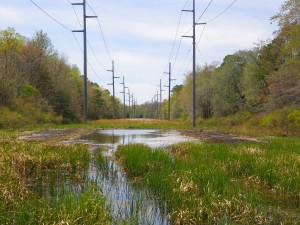
Cape May, New Jersey-Conserve Wildlife Foundation (CWF) in partnership with NJDEP, Mosquito Control, Atlantic City Electric and USFWS recently completed construction of a series of vernal pools in Cape May, NJ. This is the second complex in a series of pools along the “spine” of the Peninsula to create sustainable vernal-pool habitat above anticipated sea-level rise.
Completed vernal pool along Atlantic City Electric right-of-way (c) Karena DiLeo
These pools will also create a migration corridor for assemblages of amphibians, reptiles, and invertebrates to increase meta-population dynamics and allow species to move northward off the Peninsula.
Following excavation of the pools, CWF, USFWS, and Atlantic City Electric held a volunteer
Atlantic City Electric and USFWS volunteers planting native shrubs (c) Wayne Russell
planting day to plant native shrubs along the pools to enhance habitat and stabilize berms. Native shrubs including: buttonbush, low-bush blueberry, inkberry holly, sweet pepper bush, and beach plum were generously donated by Atlantic City Electric.
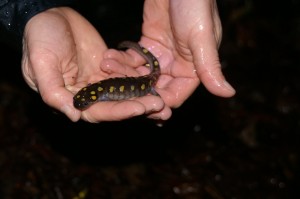
A spotted salamander after being rescued after attempting to cross a road. (c) CWF
Conserve Wildlife Foundation of New Jersey was profiled in a recent article in the The Record about our efforts to protect migrating amphibians.
One of the lesser known signs of spring arrived Monday night on Clinton Road in West Milford: A steady trickle of frogs and salamanders crept through an icy rain in search of love. If not for the teams of volunteers who waited to prod them across the winding road, many would meet a quiet end under the wheels of a passing car. Every year in early spring, champions of the tiny amphibians spend several hours at this spot and dozens like it throughout the Northeast so they can witness — and do their small part to continue — a natural phenomenon that goes largely unnoticed by the greater population. Read more…
On the first rainy nights in Spring, Beekman Road in East Brunswick is closed to vehicle traffic to allow migrating amphibians safe passage between their upland habitat and their breeding vernal pool habitat (c) Friends of East Brunswick Environmental Commission
The temperatures might not be what they should be for this time of year but don’t tell that to the salamanders and frogs that are beginning their migrations to their natal vernal pools to reproduce. I went out on a cold, dark, rainy evening to the town of East Brunswick to be a part of this magical experience.
Every year around mid to late March into early April, these little creatures get ready to begin their annual journey to their breeding pools. Usually the temperatures need to be above 40 degrees Fahrenheit, and on this night activity was a little slow going until the rains came. Vernal pools are an important part of salamander and frog reproduction as they provide the perfect hatchery to lay eggs in shallow water undisturbed by predatory fish. David Moskowitz leads the effort to safely monitor the amphibian migrations with Friends of East Brunswick Environmental Commission, a not-for-profit which provides many earth friendly programs throughout the year. The study area, Beekman Road, is a long winding country road surrounded by woods that runs between the amphibians’ upland habitat and their breeding grounds. The road is closed, thanks to the work of the East Brunswick Environmental Commission, on nights when the migration might occur, allowing the animals to cross the road safely and preventing roadkills. David explained that most of East Brunswick used to be covered by vernal pools, but since development has occurred, the land around Beekman Road is one of the last wildlife refuges in the area so it warrants protection.
A spotted salamander crosses the road to travel to vernal pools for breeding. (c) Sean Grace
All the conditions have to be right for these amphibian migrations, and it seems that tonight is going to a “big night” as families with flashlights in hand gather on Beekman Road by the bunches. David’s enthusiasm is contagious, as he runs around the woods like a little kid, turning over logs to look for spotted salamanders, explaining to onlookers about their biology, diet, and breeding. He leads us on a trail marked with pink flags to the vernal pool to listen to spring peepers calling in the night. At this vernal pool, you will also find Northern gray treefrogs, wood frogs, chorus frogs, and other frog, toad, and salamander species. As the rain begins to get heavier, I begin to notice more spotted
salamanders crossing the road and I save one from being crushed. This leads me to think about CWF’s Amphibian Crossing Project led by Mackenzie Hall, Private Lands Biologist, and I know she must be out in the Northwestern part of the state, doing exactly the same thing, helping these small, yet incredibly important animals, survive in our ever more developed world.
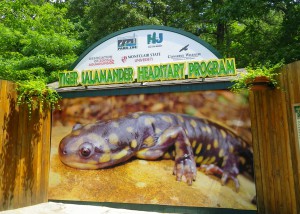
We have begun another season of headstarting eastern tiger salamanders with the Cape May County Zoo. Mature larvae will be released into our constructed ponds in early summer to help establish new, robust populations above anticipated sea-level rise.
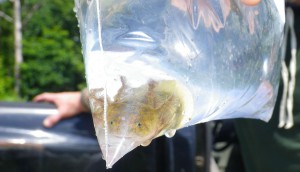
Last week, we released 16 eastern tiger salamander larvae from our headstart program with NJ Division of Fish and Wildlife and the Cape May County Zoo.
Eastern tiger salamander Headstart Program at Cape May County Zoo
Headstarted eastern tiger salamander larva
These larvae were released into newly constructed pools as part of our vernal-pool habitat restoration project to create new vernal pools above anticipated sea-level rise to mitigate for climate change. This project is part of a larger goal to create a stronghold for eastern tiger salamanders in New Jersey.
by MacKenzie Hall, Amphibian Crossing Project Coordinator
Karen Ruzycki gives a salamander a lift. Photo: M. Hall
Easter Sunday is a celebration of rebirth, resurrection, springtime, life. And this Easter Sunday – right on cue – a warm day turned into a mild night, the mild night met with rain, and together they gave rise to lots and lots of life. The amphibian migration was underway…in a big way!
Our teams were ready. Despite heavy bellies and a long day with family, at least 50 trained volunteers came out to “guard” the animals at road-crossing hot spots. From nightfall to around 11:00 pm we escorted, ferried, and tallied more than 3,000 salamanders and frogs across! (Numbers are still coming in from other teams.)
American toad in transit. Photo: Karen Ruzycki
It was a heart-pounding pace, often with multiple animals entering the roadway at once. They didn’t seem to understand the danger, but we humans were darting in and out, racing against car tires and grabbing up slippery critters as fast as slippery critters can be grabbed…while still being safe, orderly, and polite to passing motorists. A lot of drivers stopped to see what all the speed-walking was about. One woman said “God bless!” when I showed her a fat female spotted salamander and told her about the migration. Another guy must have been a local because he just asked “how many tonight?”
Everyone had an exhilarating night – the kind of migration night we plan for but don’t often get. It was a lot of fun and we saved a lot of lives. From the vehicle count, most of those little animals wouldn’t have stood a chance. A few still didn’t.
Before heading home from the site where I was working, I took a midnight stroll down to the vernal pool. It’s so neat to watch salamanders swimming around. Especially the big spotted salamanders. They spend almost their entire year underground in the woods, yet they are graceful and natural in the water. They even look excited to be there, swirling around each other in contest and attraction. I felt lucky to know about this wonderful thing. It felt great to have made some of it possible. Look at those gorgeous animals! And their impossibly bright yellow spots! They are colors lost in the night, but not by our watchful lights.
They made it! Spotted salamanders in the pool. Photo: M. Hall
Following Monday’s all-night amphibian foray – and the prolonged terror/adrenaline rush of playing real-life Frogger – I drove home through a rainy sunrise on Tuesday. According to a weather app on my phone, the rain would keep falling all day and end (wouldn’t you know) right around sunset. “You gotta be kidding me,” I think is what I slurred.
Warm nighttime rain is the simple cue for mass movement, like what we had before dawn that day. But nature is seldom that simple, so the task of monitoring an amphibian migration can get hairy. The warm, soaking daytime rain would get the attention of those slumbering frogs and salamanders. Even if it stopped before dark, the wet ground and road would entice some of them to move. Maybe a lot of them? And right at the time when nighttime traffic would be heaviest on the roads.
So we sided with caution and rallied the teams to hit the streets at dusk. I went back to Byram to lead a group of volunteers there while others covered different hot-spots.
The rain did end early – earlier than expected even – and by nightfall our team was spreading out over a damp road. It was a relief to see that a migration was happening anyway, albeit at a slower pace. And the cars were filing through our setup (cones and signs, buffered by police) in threes and fours…99 vehicles in the first hour! Basically, there was a car for every salamander that dared to cross the white line.
We did our best to stay ahead of the traffic. By 11:00 pm the temperature was dropping, the road was drying, traffic was slowing, and so were the amphibians. We paced the road below a starry sky with Orion front and center. We had tallied another 175 spotted salamanders, 41 Jefferson’s salamanders, and 52 spring peepers. Despite the heavy car flow early on, more than 85% of those animals made it to the safe side of the road – and eventually to their breeding pool below – with a little help from some friends.
The ingress migration to the pools is probably close to half-over across much of NJ, so we’ll be out few more times yet!
THANKS to all the dedicated people who have helped so far. It’s a diverse group of heroes, from long-time amphibian crossers like George Cevera and Carl Bernzweig, to new volunteers like Karen Ruzycki. We have help from local partners like Margaret McGarrity of Byram Township, and engineering students from NJIT who want to help design solutions to the roadkill problem. A couple reporters came out this week to cover the story and ended up shuttling amphibians, too. We thank the Sussex County Division of Engineering for issuing us the permit to assemble on their road. Thanks also to the Byram Police Department for their willingness to provide traffic control and their respect for our project, which I’m sure seems a little unusual. And that’s just at one location. Great job, everyone!