Compiled by Todd Pover, Beach Nesting Bird Project Manager
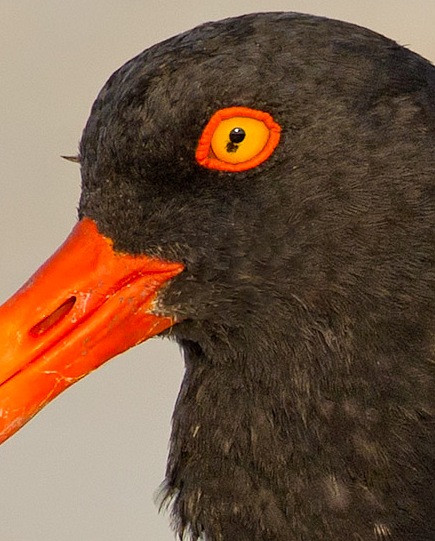
American oystercatcher.
The Beach Nesting Bird Project is one of our major initiatives here at the Conserve Wildlife Foundation of New Jersey. During the spring and summer months, we employ several field technicians to help us carry out our mission of monitoring and protecting endangered piping plovers, least terns, and black skimmers, as well as American oystercatchers. We also help oversee the seasonal staff from the state’s Endangered and Nongame Species Program on this project.
As a slight change of pace for a blog, I thought it would be both fun and insightful to hear a little bit of their perspective from the field. So, I asked everyone from the joint beachnester crew to submit a short entry about what they like and dislike most about the project, as well as a favorite or unique photo. I will kick it off with my thoughts…Because the main goal of the project is to recover at-risk species, obviously the most satisfying aspect of the project is when the birds have a successful year. But that isn’t always the case, so my personal favorite thing is finding the first piping plover nests of the season. Aside from the challenge of actually locating the well-camouflaged nests, those first eggs embody the eternal hope of each new season. Early in the season, before spring tides wash away eggs, predators discover helpless chicks, and the crush of beachgoers squeezes out colonies, you still believe every nest will successfully produce young.We interact with the public on a daily basis on this project and for the most part we meet nice people. But we also deal with our share of people who do not support the effort. Our motto is “share the shore” and, in fact, only a small percentage of our state’s coastline is protected for beach nesting birds and many of the restriction put in place to help the birds are seasonal in nature. Nonetheless, the “plover fence” brings out the worst in some people, and when that anger is directed at you personally it can be pretty unpleasant and frustrating.
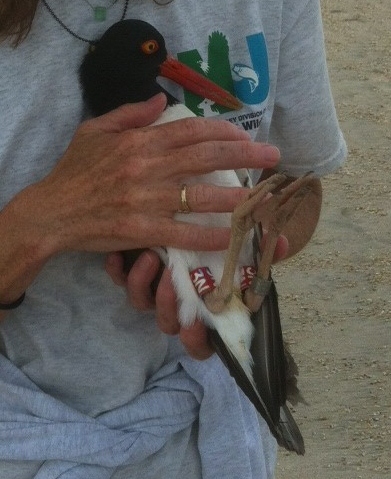
Dr. Virzi and Stephanie Egger (CWFNJ) banding an American oystercatcher chick.
By Stephanie Egger, Wildlife Biologist
Conserve Wildlife Foundation of NJ (CWFNJ) and the NJ Division of Fish and Wildlife – Endangered and Nongame Species Program (ENSP) assisted in the banding of American oystercatchers chicks and adults this week. Oystercatchers in New Jersey are banded as part of a long-term mark recapture research project by Dr. Tom Virzi of Rutgers University in collaboration with CWFNJ and ENSP. One breeding adult that was recaptured yesterday was originally banded over a winter in Georgia! Data collected included band color and combination, sex, age, weight, other physical measurements (wing, head, culmen, nares, leg) and a feather sample for DNA purposes. Check out our video from that day!
Over the last few years, widespread mark recapture efforts along the Atlantic coast have revealed connections between breeding and wintering sites and information of the complexity of patterns of movement and dispersal. For more information on the New Jersey data and other state efforts please see the American Oystercatcher Working Group website.
Pam Prichard (Monmouth County Monitor for ENSP) ready to release the American oystercatcher chick after all data was collected.An adult American Oystercatcher originally tagged in Georgia, breeding in New Jersey.An adult American Oystercatcher originally tagged in Georgia, breeding in New Jersey.
Conserve Wildlife Foundation staff recently assisted researchers from the
State University of New York with a piping plover project that involves
collecting flight pattern data about plovers in New Jersey and
Massachusetts. The information collected will be used to help determine
potential impacts of wind turbines on this federally listed species. The
field work is being headed up in New Jersey by CWFNJ “alumni” Emily Heiser.
The month of April has provided the first nests from our beach nesting birds! The first nest found belongs to the American oystercatcher, a species of concern in New Jersey. Like our other nesting shorebirds, the eggs are well camouflaged on the beach. We use symbolic fencing (string and posts) with signs to protect their nesting areas and to alert the public of their presence.
An American oystercatcher nest with 2 eggs.American oystercatcher nesting area with protective fencing.
Piping plovers and American oystercatchers have already begun to return to New Jersey to breed. Least terns and black skimmers will follow in another couple of weeks. This is a busy time for the Conserve Wildlife Foundation’s (CWF) Beach Nesting Bird Project – our program to protect these birds, some of the state’s most at-risk species, kicks into high gear as the birds arrive.
Employees from the Edison, NJ and Philadelphia, PA offices of CDM Smith who helped put up fence and signs at the Belmar Shark River Inlet nesting area.
The first major task at hand is to protect the habitat where the birds nest from human disturbance associated with intensive recreational use of our beaches. Working closely with the New Jersey Division of Fish and Wildlife, CWF typically helps fence off and post 20-25 beach sites annually.
And we couldn’t complete this massive job without the assistance of volunteers. This year we have gotten volunteer help from a diverse group of organizations, ranging from the New Jersey Beach Buggy Association to Wetland Institute to Manasquan High School Environmental Club. A huge THANKS to all those groups and individuals that pitched in to help!
Click here to learn more information about our Beach Nesting Bird Program.
TRACKING THEIR PATH AS THEY HEAD SOUTH FOR THE WINTER
By Allison Anholt, Field Technician, (NJDFW) and Emily Heiser, Field Technician, (CWFNJ)
Color band being placed on oystercatcher chick at Stone Harbor, N.J.
Throughout the fall, there is a remarkable sight to see along New Jersey’s coastline. Thousands of shorebirds group together in huge flocks, using our state’s coastline as a migration stopover point to rest and feed. One particularly interesting shorebird is the American oystercatcher, which is listed as a species of special concern in New Jersey. At the Conserve Wildlife Foundation of New Jersey, we work with biologists from the New Jersey Division of Fish and Wildlife to survey these birds throughout the fall season.
The oystercatcher is an especially easy bird to survey during fall migration due to its distinct features. Not only do they stand apart from other shorebird species with their unique orange bill and striking coloration, but color bands help us determine individuals as well. Banding efforts have been underway in New Jersey since 2004 in order to give insight to researchers regarding the
oystercatcher’s breeding habits, pair behavior, and migration patterns. About 300 oystercatchers have been banded in New Jersey to date, including a significant percentage of the state’s estimated 400 breeding pairs. Continue reading “AMERICAN OYSTERCATCHERS TAGGED AND READY FOR MIGRATION”
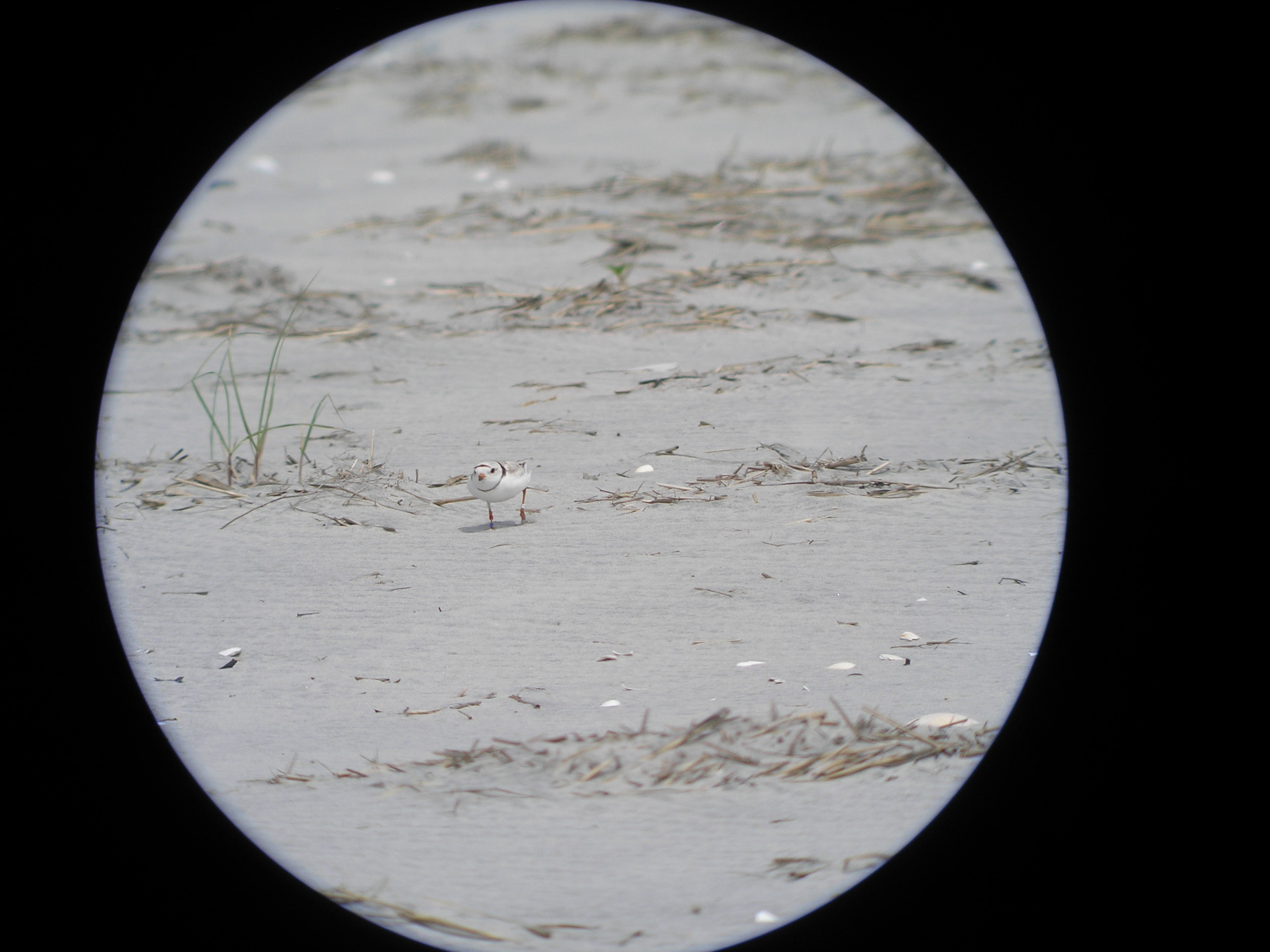
"Bahama Mama" - If You Look Close, You Can Detect The Color Bands On her Legs
reported on a piping plover that had nested four times this
year. One reason we know so much about this individual bird is because it is one of just a few banded piping plovers found in New Jersey-it was originally banded in the winter of 2010 in the Bahamas.
This specific bird, dubbed Bahama Mama by our staff, was first observed this year at North Brigantine Natural Area on March 29. It spend the next several months finding a mate, laying and incubating eggs, and finally trying to raise young, a cycle that ended unsuccessfully near the beginning of August. Normally that would be the end of the story for this year, but because we are conducting post-breeding/migratory piping plover surveys once a week at this site through the end of October, we have more to report.
As of last week, Bahama Mama was still present at the same site, nearly two months after breeding concluded and six months after she first arrived. The fact that she has remained there well after the nesting season ended is a huge surprise and defies conventional expectations. We fully expected her to be on her way back to the Bahamas by now. Continue reading “Update from the field”
Crossing into new territory – Todd Pover, CWFNJ, wading across a mangrove inlet in the Bahamas to conduct the Piping Plover survey.
In earlier installments of this series (It’sBetter in the Bahamas – Part 1 & 2), I reported on the results of the winter segment of the 2011 International Piping Plover Census in the Bahamas, in which I participated, and also the partnerships developed along the way. For this final installment I am foregoing the biological results and conservation lessons, the usual story themes, because sometimes our readers just want to hear about the adventurous side of what we do here at the Conserve Wildlife Foundation of New Jersey.
Having surveyed piping plovers on their breeding grounds in New Jersey for 15 years now, at times it feels like I know every nook and cranny that plovers could possibly be found in our state – to some extent the sense of mystery is gone. I knew that wouldn’t be the case with the Bahamas winter survey. I had never been to Abaco, the island I was assigned to survey along with Massachusetts Audubon Society’s Coastal Waterbird Program, but I knew it had miles of coastline on its main island and numerous offshore barrier islands and cays that needed to be checked as well. Our pre-trip research of the habitat on the islands suggested it was going to be difficult to cover all that ground in one week even with our 4-6 person survey team, but I was excited by the challenge. Continue reading “It’s Better in the Bahamas – Part 3”
New Jersey’s Black Skimmers Survive Hurricane Irene
By Todd Pover, CWFNJ Beach Nesting Bird Project Manager
Black Skimmers liftoff at Seaview Harbor Marina where they survived Hurricane Irene.
Most of us spent the weekend worrying about the potential damage Hurricane Irene might inflict on our homes and loved ones. As a biologist, I was also concerned about the impact of the storm on our state’s wildlife, in my case, the beach nesting birds I help manage and protect.
Hurricanes and other severe weather can be a matter of life or death for nesting birds. Young chicks are particularly vulnerable, but even adults are at risk in the most extreme storms. Although most of our state’s beach nesting birds have completed the breeding cycle for the season, the majority of the Atlantic coast population of piping plovers and many least terns are in the midst of migration and would have been in the path of Hurricane Irene. We have no way of knowing for sure what impact the storm had on them, but long distance migration is tough on birds in the best of circumstances. Survival of young during their first year is typically very low so this was not a good start to the post breeding season.
We had two active nesting colonies remaining in New Jersey heading into the storm – a least tern colony at Townsend’s Inlet (Cape May County) and a black skimmer colony at Seaview Harbor Marina (Atlantic County). Residents in this area had a mandatory evacuation order, but our birds didn’t have that option. Today I completed an assessment of our beaches and nesting birds in the southern portion of the coast and I am happy to report that both the skimmer and tern colony escaped the storm largely unscathed.
Going into the storm, the tern colony was almost done for the season anyhow so any losses there would have been minimal. The skimmer colony, on the other hand, still had a number of chicks remaining and about 800 just fledged (able to fly) young. And over 1800 adults! This is the state’s only major skimmer colony representing nearly the entire state breeding population. So you can imagine it was a big relief when I walked out on the beach and heard thousands of raucous skimmers and saw there was no visible reduction in the colony’s size. Like our homes and loved ones, Irene appears to have spared our beachnesters.
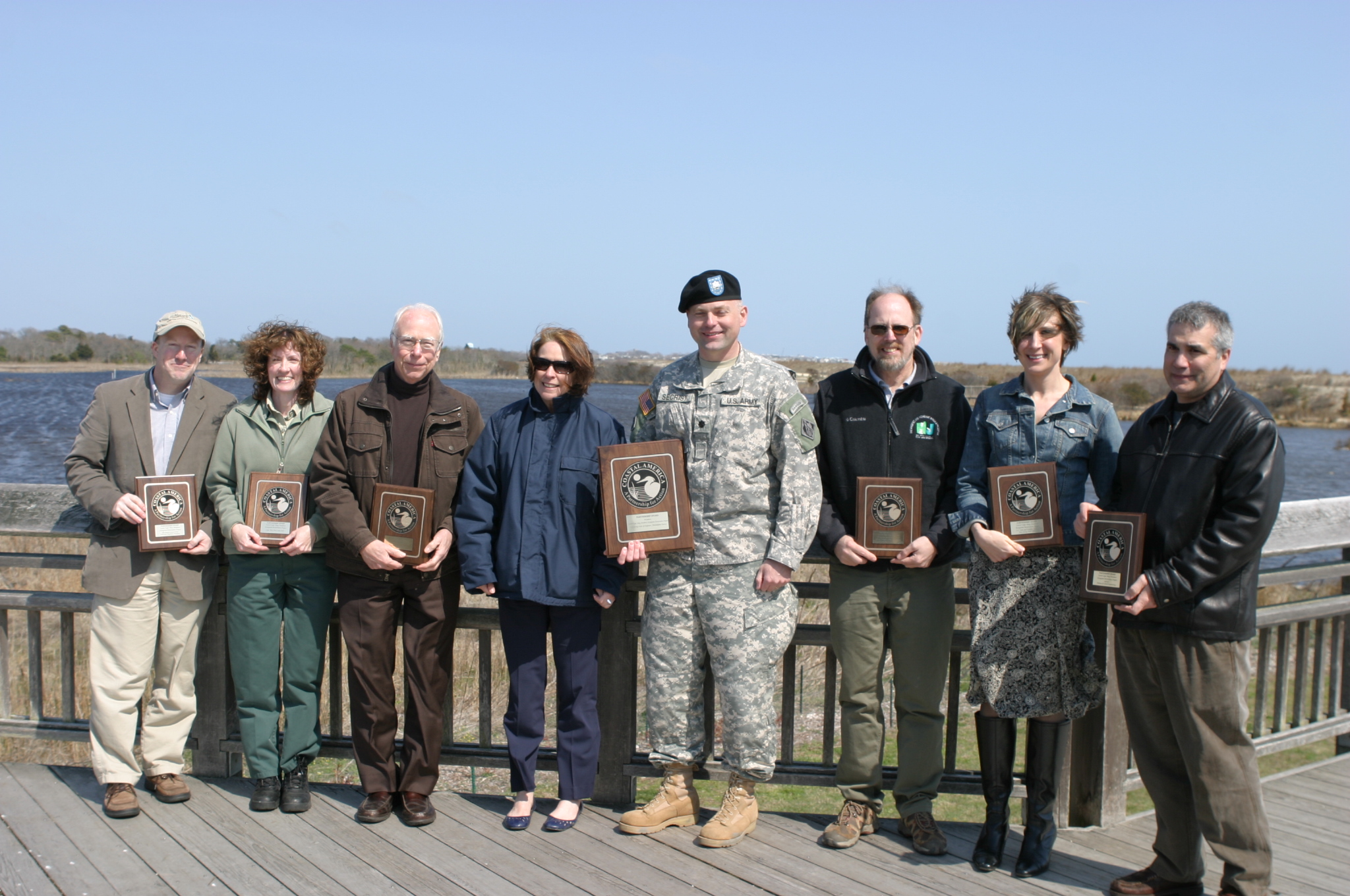
New Jersey partners being honored at the Coastal America Award ceremony for the Lower Cape May Meadows restoration project (Stephanie Egger, second from the right).
As a new staff member of the Conserve Wildlife Foundation of New Jersey (CWF) a blog entry seemed like a good way to introduce myself. So here goes. “The wheel has come full circle,” meaning to go full circle, complete an entire cycle or to return to an original position, is an old adage thought to originate from Shakespeare in King Lear 5:3. Apparently there is some truth to this expression. I really didn’t see it coming though, especially not to my career, my passion, which has focused on endangered species, namely the piping plover, for the last five years.
I actually started working with piping plovers as a monitor for the Beach Nesting Bird Program in 2006. Fresh out of grad school, looking to get my foot in the door, I came across an opening to manage piping plovers on the Jersey shore. Perfect I thought! I can work on my tan while I’m working! Totally kidding! I have to admit at that point in my life I had never even heard of the infamous piping plover (I know, I still can’t believe it myself). How did I miss a bird that’s been protected under the Endangered Species Act since 1986 and nesting on the very same NJ beaches that I spent every summer vacationing since I was a toddler? My previous two years were consumed researching northern diamondback terrapins for my Master’s degree, but this opportunity seemed to be calling me. My then supervisor (CWF’s own Todd Pover, Beach Nesting Bird Program Manager), took a chance on me and little did I know it would set the stage for the next five years of my career and the beginning of that circle.
My job as a plover monitor did not last long, only a few short months, when I had to bid farewell to my life in the field with the birds as a new adventure began for me with the U.S. Fish and Wildlife Service, New Jersey Field Office (USFWS). As luck would have it, the job also focused on plovers. Not so much on the ground, getting down and dirty with plovers, but managing the plovers by helping implement conservation measures to increase their survival and recovery, and minimize or eliminate adverse impacts of numerous beach related projects on the birds. How does one begin to achieve this? Partnering. Continue reading “From Plovers to Partners and Back Again – Coming Full Circle”