There are many aspects to the Delaware Bay Shorebird Project. During the month of May researchers survey, re-sight and band shorebirds as well as conduct horseshoe crab egg counts. Nine beaches in Cape May and Cumberland Counties have restricted access during May, which allows the shorebirds to feed on the horseshoe crab eggs.
Shorebird Steward Bill Reinert@ Dom Manalo
Shorebird stewards are out on the beaches in all types of weather and insect seasons making sure that the restricted areas are respected. They do this through education and explaining to beach goers the importance of allowing shorebirds to have these undisturbed areas to feed. Stewards really make a big difference in shorebird protection on the bay and we thank them for all of their efforts this shorebird season. This season there were plenty of horseshoe crabs spawning with eggs in abundance, but unfortunately the shorebird numbers were down this season. For more details on the 2021 Shorebird season can be found in the article ,Red knot numbers plummet, pushing shorebird closer to extinction.
A couple weeks ago colleagues with NJ Fish & Wildlife shared a video clip of a dark osprey who landed on a nest platform along the Maurice River near Leesburg, NJ. “Looks like an oiled bird” the text read. Indeed it looked like the bird was exposed to some form of petroleum product, which stained its feathers a dark color. At the time, there was no oil spill reported to NJDEP (this was on May 10) and the video shows that the bird was observed on the nest on May 1, 2021.
Ben Wurst, CWF Habitat Program Manager (right) with local volunteers, AC Electric and DuBois Environmental Staff who helped install this osprey nest platform in Atlantic City.Continue reading “Photo From the Field: #213”
Conserve Wildlife Foundation’s Delaware Bay Shorebird Stewards will be on Restricted access beaches in Cape May and Cumberland Counties from May 15th through the 31st. We will be educating beach goers about the horseshoe crabs and shorebirds.
Plan a visit to the bay in May to witness this spectacular wildlife phenomena!
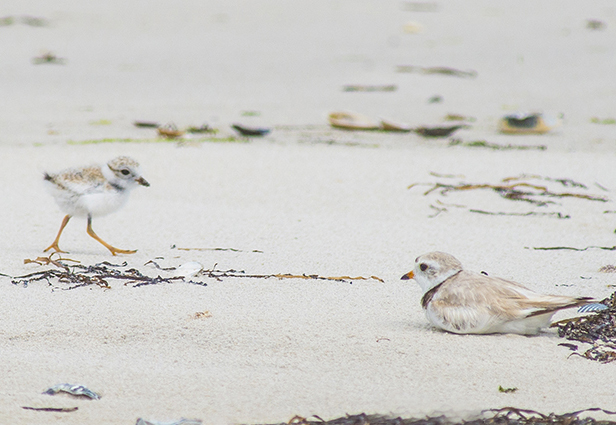
USGS scientists study the nesting habitats of Atlantic Coast piping plovers. This unvegetated patch of sand and gravel allows piping plover chicks and eggs to hide from predators. (Credit: Susan Haig, USGS. Public domain.)
CWF’s on-the-ground conservation efforts, such as the deployment of fence and signage to protect piping plover nesting areas, often get the most attention, and for good reason as our frontline work is one of the most important things we do. At the same time, we are involved in a number of other strategies to protect at-risk species and track their progress towards recovery.
Our biological monitoring data are also used by scientists to support their research; such was the case with a research paper recently published by the USGS and USFWS that looked at nesting habitat used by piping plovers in different portions of the Atlantic coast breeding range, including here in New Jersey.
Researchers concluded there were significant differences in the type of habitat selected by plovers depending on the region where they nested, which has important implications for land use/management policies and can help inform habitat restoration projects.
Read the United States Geological Survey’s story below.
Piping plovers, charismatic shorebirds that nest and feed on many Atlantic Coast beaches, rely on different kinds of coastal habitats in different regions along the Atlantic Coast, according to a new study by the U.S. Geological Survey and U.S. Fish and Wildlife Service.
The Atlantic Coast and Northern Great Plains populations of the piping plover were listed as federally threatened in 1985. The Atlantic coast population is managed in three regional recovery units, or regions: New England, which includes Massachusetts and Rhode Island; Mid-Atlantic, which includes New York and New Jersey; and Southern, which includes Delaware, Maryland, Virginia, and North Carolina.
While the Atlantic populations are growing, piping plovers have not recovered as well in the Mid-Atlantic and Southern regions as they have in the New England region. The habitat differences uncovered by the study may be a factor in the unequal recovery.
USGS studies nesting habitats of the threatened Atlantic Coast piping plover population to help inform species recovery plans. (Credit: Susan Haig, USGS. Public domain.)
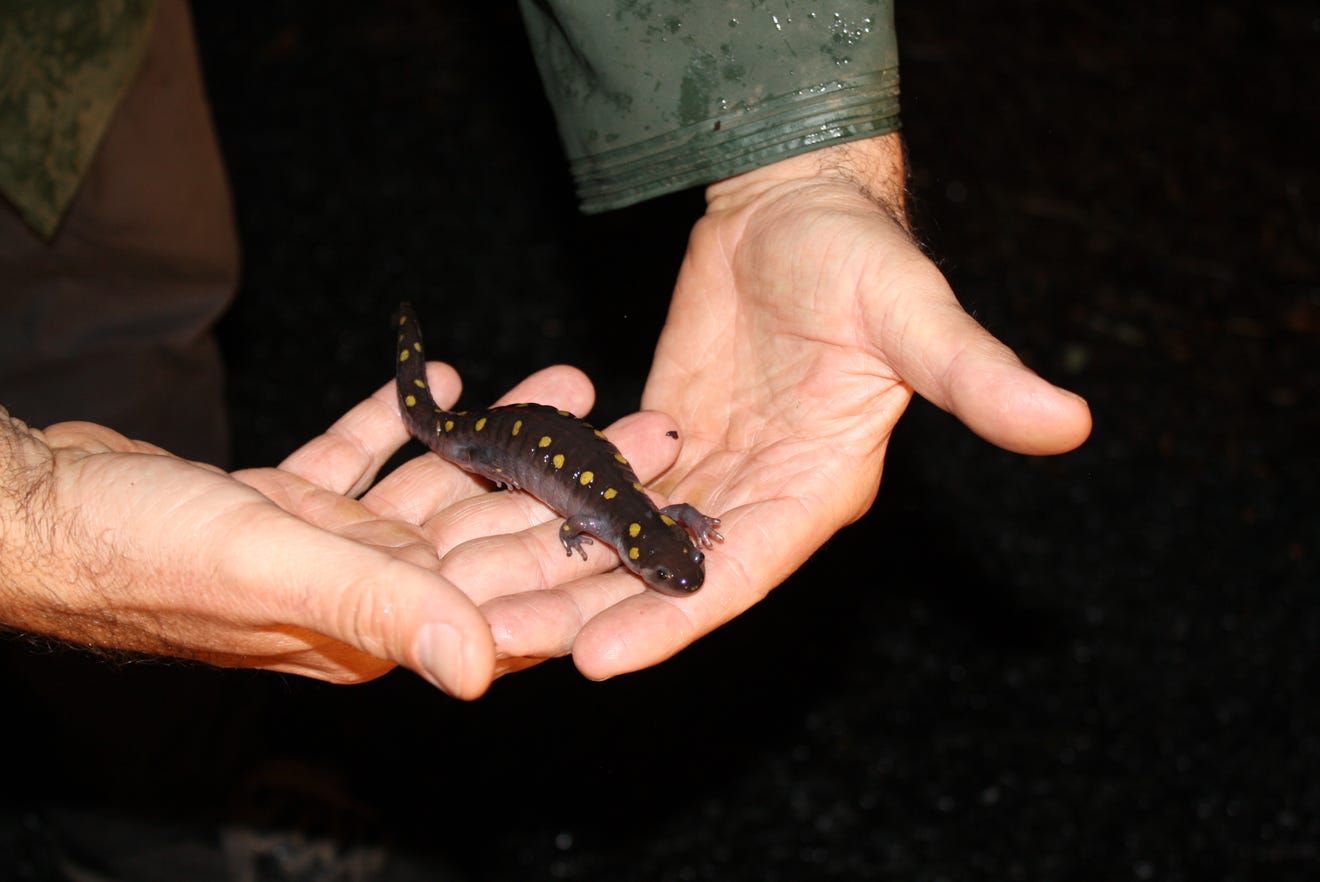
A volunteers handles a spotted salamander. Photo by Mackenzie Hall
The Conserve Wildlife Foundation has been partnering with NJ’s Endangered and Nongame Species Program (ENSP) since 2002 for the annual Amphibian Crossing Project. On warm, rainy nights in the early Spring, we work with a fleet of incredible volunteers to hustle amphibians across the road at three key rescue sites. Still groggy from their winter hibernation, roads can be incredibly dangerous for the slow moving frogs and salamanders trying to reach their breeding grounds.
Over the course of this project, we’ve crossed an estimate 14,000 individuals at the Byram Township site alone!
Commenting on last Thursday’s crossing, the first of 2021, Amphibian Crossing Project Coordinator Christine Healy had the following to say:
“We were a little unsure of what to expect, since the temperature was a little on the cold side, but we crossed 1,215 amphibians at Byram Twp., 1,132 at Stillwater, and 963 at Liberty Twp.
I’d call that a success! Really proud of all the volunteers who made it happen.
Conditions look like they could be good toward the end of this week for round two!”
Bruce A. Scruton of The New Jersey Herald recently spoke with Christine to discuss the Amphibian Croosing Project and its storied history.
You can read the profile over on NJHerald.com to learn more about what it takes to help hundreds of our amphibian friends hop and meander across dangerous roadways.
A resting coyote with typical coloration. Photo by John Picken.
The expansion of Eastern Coyotes (Canis latrans x lycaon) throughout the northeastern United States has been a cause for alarm in some communities, but are they as dangerous as some fear?
A particularly adaptable wild canid, the eastern coyote is distinct from their western cousins and is considered to be a hybrid species, created when western coyotes and other wolf species, like the eastern wolf, interbred in the early 1900s. This new larger coyote species has been able to expand its territory out from its central/western roots and can now be found along much of the eastern coast of the United States.
The eastern coyote’s presence on our coasts now finds itself at odds with the humans who call these more cosmopolitan coastal areas their home, like on Long Beach Island where increasing coyote sightings over the past few years are beginning to worry residents.
Monique M. Demopoulos of TheSandpaper.net reached out to Conserve Wildlife New Jersey for a conservationist’s perspective.
CWF Habitat Program Manager Ben Wurst and Executive Director David Wheeler gave their thoughts in the article published on March 11th.
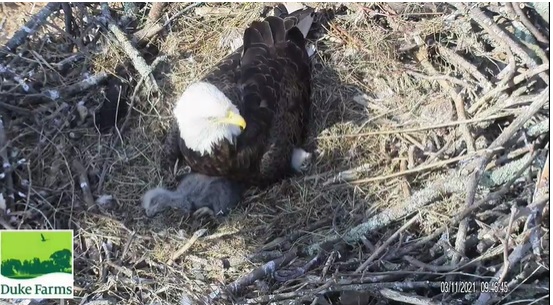
The two Duke Farms bald eagle chicks peek out from under their parent to catch some sun.
It looks like the Duke Farm’s nest will only have two chicks this season.
One egg remains in the nest bowl and is still being incubated, but based on when the second chick hatched, March 1st, it should have hatched by now. We won’t know for certain why the egg didn’t hatch, but one theory is that it was the first egg laid.
There had been intruder eagles at the nest and fights between the adults and intruders. At one point both adults were off the nest for 20 minutes while an immature was in the nest. Perhaps something happened to the egg during these incidents.
The egg will eventually get buried in the nest or shoved to the side. The adults are busy bringing food to the nest for feedings and both chicks are getting plenty of food.
Piping Plover walks through a tidal pool. Photo courtesy of Northside Jim.
Any day now the first piping plover will be returning to New Jersey to nest. It will likely return to the same beach it nested on in previous years, possibly even the same part of the beach. It will be coming from the same wintering location it used in the past. And it probably even used the same stopover sites during migration. This attachment to place or “site fidelity” is one of the marvels of the birding world, not unique to plovers.
In some ways, it’s not so different for us. We order pizza from the same restaurant, time after time. Many of us vacation in the same place, year after year. And yes, we have been known to repeatedly visit our favorite beach. My parents took my sister and I to the beach at Seaside Heights for summer vacation every year when we were growing up. We went on the beach at the same street access, laid our blanket out at pretty much the same spot, ate at the same place on the boardwalk, EVERY time. It wasn’t until I became an adult that I realized I could travel or vacation elsewhere, and so I began visiting places far away, first Los Angeles and the Pacific Ocean, then the desert Southwest, and onto a lifetime of travel to “far flung” places.
And this is where the analogy with piping plovers ends. Plovers don’t travel on a whim. They can’t decide to fly to the west coast this year instead of their usual Atlantic Coast breeding locales. They are hard-wired for efficiency, their behavior is driven by survival and maximizing reproductive success. They return to the same beach because they know there is suitable nesting habitat and good foraging opportunities there, and “knowing that ahead of time” gives them a breeding advantage over other, younger plovers looking for and trying to establish new territories.
Piping plovers do have some capacity for change. They can shift locations if needed, especially if there is a significant alteration to their existing habitat, severe beach erosion, for example, or if they lose a mate in a given year and need to find a new one. There are, however, limits to this. They are “specialists” that require specific habitats and conditions. Furthermore, recent research on the wintering grounds suggest they will remain at the same location even if it is highly disturbed, and even if it negatively impacts their fitness. So, site fidelity usually trumps other factors.
Of course, all of this has conservation implications. Here in New Jersey, development at or near the beach has already limited both the amount and quality of beach habitat available for them to breed. Even if they wanted to “travel elsewhere” they don’t really have an option of other suitable places to go. And, the beaches remaining for them to use, with rare exceptions, are busy with people, which is not a good recipe for a species highly vulnerable to human disturbance. Still, given what we know about site fidelity, our best option is to “pull out all the stops”, put the strongest protection measures in place, at the sites that are left for them to nest.
This is what keeps me up at night, even after more than 25 years on the job. New Jersey is a tough place for piping plovers to succeed. It is not necessarily a losing battle, but it hasn’t always been a winning one either. As I gear up for another breeding season, I know that I and the dedicated community of other plover monitors will do everything we can to protect them and try to secure their future. But…we need your help too. Stay out of the fence or barriers erected to protect their nests, leave your dog at home, off of nesting beaches, and keep your distance when flightless chicks move outside the fence to feed at the waterline. Please enjoy them, but carefully and at a distance.
This reminds me of the lessons we’ve learned with the Covid pandemic this past year. We can’t beat it alone; we need to work together. We have to take actions that help each other, not just ourselves. This is the model for piping plover conservation too. We will keep protecting them, but ultimately, we need everyone’s help if piping plovers are going to succeed and eventually recover.
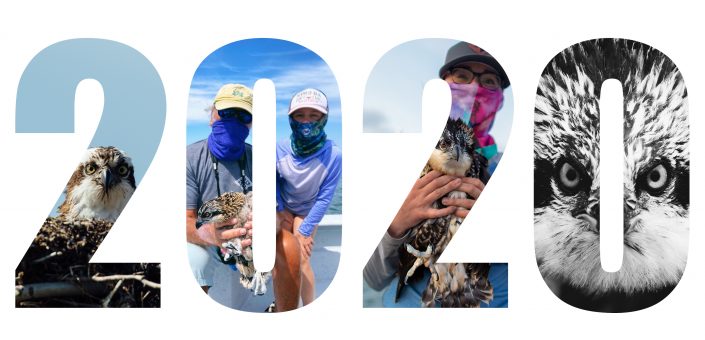
For every dark day there was always hope for a brighter future. Results from the 2020 New Jersey Osprey Project.
Ben Wurst, Habitat Program Manager
This was likely one of the most challenging, at least in recent years, in the history of the New Jersey Osprey Monitoring Project. From social distancing and working from home (with children) to severe wind events and dealing with the impacts of humans on ospreys, 2020 turned out to be quite the year. Overall, our work was largely unaffected by the global covid-19 pandemic. Most of our work is conducted outdoors and away from mass gatherings of people. It was important for us to ensure the safety of our volunteers and the general public safe.