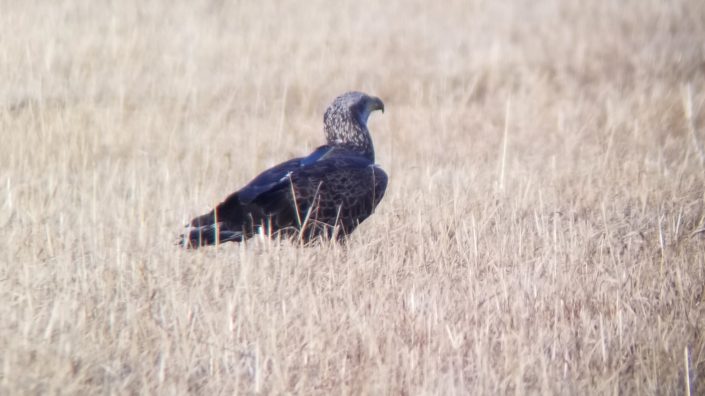
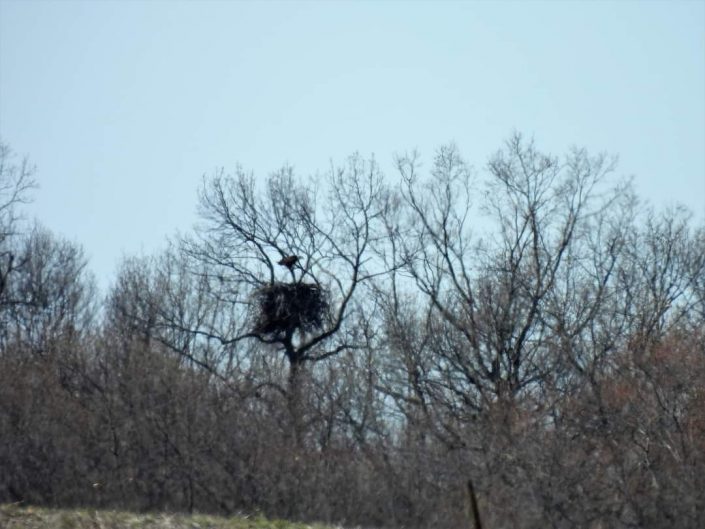
The 2021 nesting season was another successful one for New Jersey’s bald eagles, with the statewide population remaining stable at 247 nest sites. Of these nests, 222 were active (with eggs) with 296 young produced. Twenty-seven new eagle pairs were found.
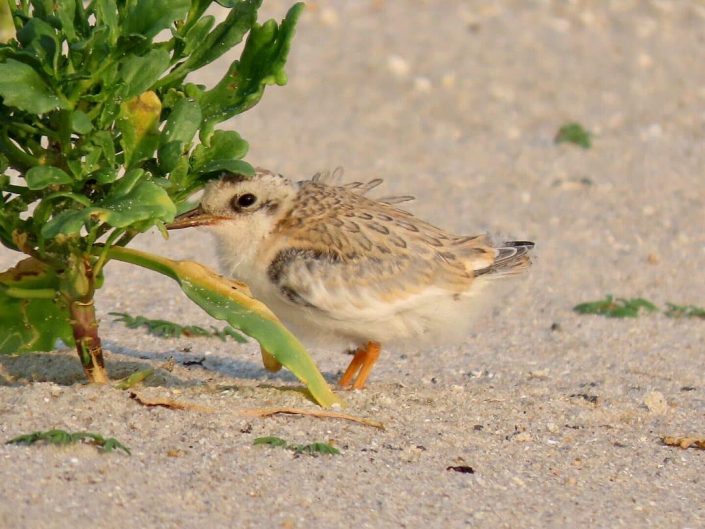
One of the hundreds of least tern chicks at the Pt. Pleasant colony in 2021. Courtesy of Lindsay McNamara.
With 2021 coming to an end, we thought it would be fun to look back at this year’s beach nesting bird season in New Jersey, focusing on some of the surprises.
At the top of the list is the huge jump in our piping plover breeding population, up to 137 pairs from just 103 in 2020, an unprecedented 33% increase in one year and the third highest on record for the state since federal listing. This was a much-needed bump, as productivity has been high over the past few years, but we weren’t seeing any sustained growth in the population as a result as would be typical. So, when the final pair number was tallied this year, we were both relieved and surprised at how big it was! The challenge now will be to maintain that higher level or increase it even more, as it has fluctuated up and down quite a bit in recent years.
A year ago November I began tracking Duke. I was fortunate to see and photograph him more than a dozen times and wrote two blogs for CWF about these adventures.
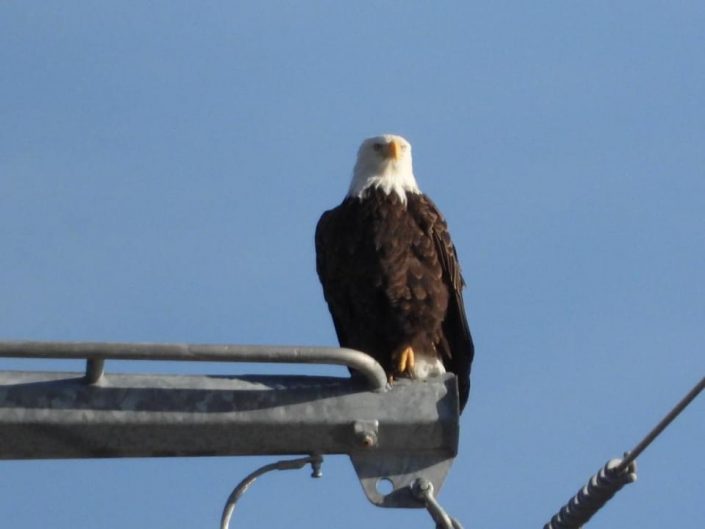
Three Bridges adult perched on tower December 5th 2021 by Lisa Romero
We are happy to announce that the Three Bridges Eagle Cam will go live on December 15th. This fall, the nesting platform atop the transmission tower received some improvements from PSE&G. The perches were moved for a better camera view and replaced with wood to provide better perches for the adults and a second wooden perch was added along one of the sides. A foam baffle was added to the microphone to help buffer wind noise. These improvements will make the platform better for the eagles as well as enhance the viewing experience.
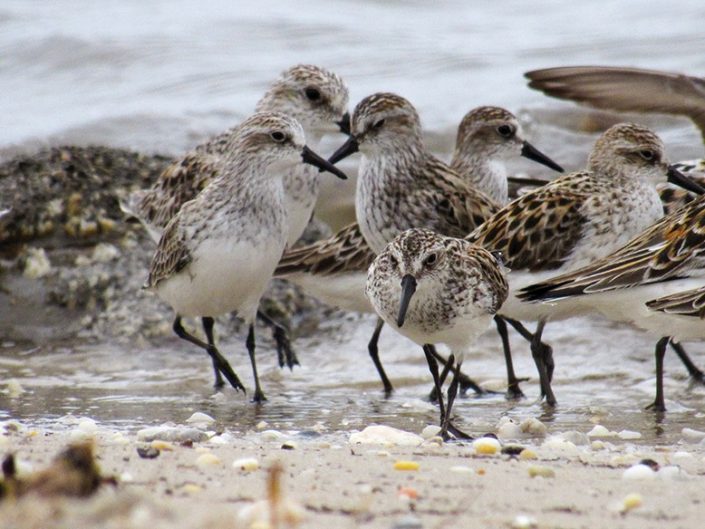
Congratulations to Luke Tan for having his photo Semipalmated Sandpipers Feeding win Runner Up in the Student Category for NJ Monthly’s Cover Search Competition. Luke volunteers as a CWF Shorebird Steward on the Delaware Bay during the spring shorebird migration. He captured this photo while on Reed’s Beach, Cape May County.
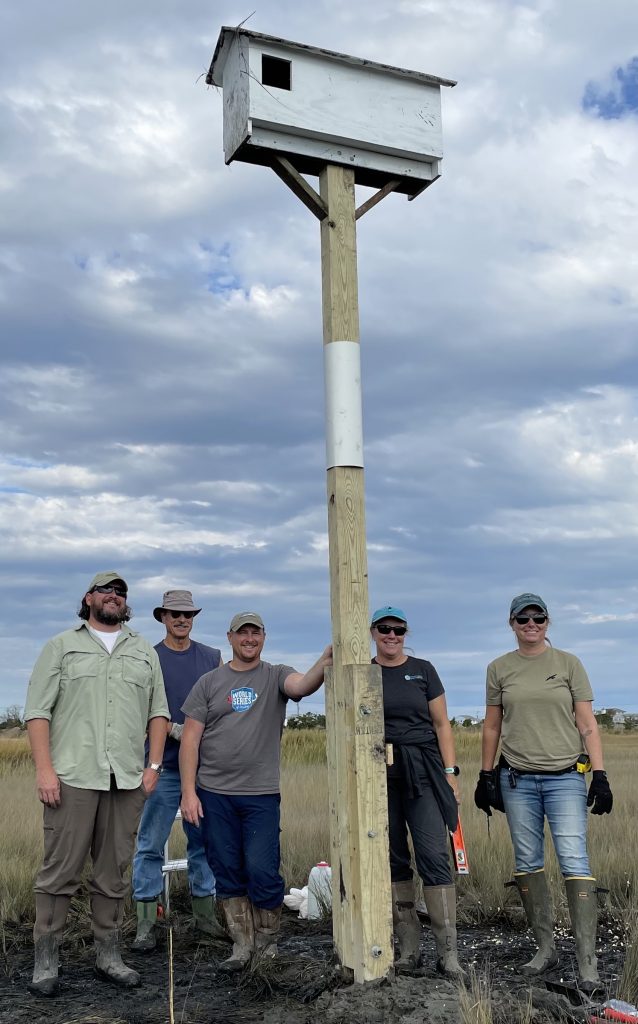
The Coastal Barn Owl Project team is gearing up for another round of nest box installations in coastal southern New Jersey. After a successful fundraising appeal, we can now thank our donors by adding more potential nesting opportunities for barn owls, a species in population decline.
Our fourth and most recent box was just installed on October 22 in the saltmarshes of Cape May County. With each install, the team is becoming more efficient, and we hope to get several more boxes up in key locations before early spring when the owls begin their search for suitable nesting sites.
The newest barn owl nest box with volunteers Kevin Knutsen, Steve Eisenhauer and Mike Lanzone on left. Team leaders Tricia Miller and Meghan Kolk on right. Photo by Lisa Ferguson.
Pair of Piping Plovers Tending Nest. Courtesy of Northside Jim
The 2021 New Jersey piping plover breeding season was a classic “good news, bad news” result. According to the annual report released by the state’s Endangered and Nongame Species Program earlier this month, the breeding population increased to 137 pairs in 2021, third highest since federal listing in 1986. That is an unprecedented 33% rise over the previous year and just short of the record high of 144 pairs in 2003. On the downside, the number of chicks fledged statewide was just 0.85 chicks per pair, the lowest since 2013 and about half of the 1.50 federal recovery goal. The low productivity was largely the result of a severe Memorial Day weekend nor’easter and persistent predator activity throughout the season.
Holgate, a unit of the Edwin B. Forsythe National Wildlife Refuge, hosted 46 pairs, the most in the state. This site, which is monitored and managed by CWF through a cooperative agreement with the Refuge, has seen an astounding increase in piping plover pairs in recent years, up about 2.5 times from the 18 pairs it had in 2018. CWF also monitors Little Beach, the adjacent Refuge-owned site, where another 13 pairs nested in 2021. Combined the two sites had 59 nesting pairs, a new record, by far, for the Refuge. Unfortunately, like the statewide results, productivity was very low this year at both Refuge sites, combined only 0.80 chicks fledged per pair, about half the rate just a year ago. The Memorial Day weekend nor’easter flooded those sites, wiping out most nests, and although most of the pairs nested again afterwards, many of those renests (or hatched chicks) were lost to predators, especially coyotes at Holgate.
CWF also oversaw piping plover breeding at the National Guard Training Center, which had just one pair in 2021, but that nest successfully hatched and fledged three chicks, helping boost the state average. Overall, CWF was responsible for monitoring 44% of the statewide population, giving it a significant role in helping guide conservation of this highly vulnerable state endangered (and federally threatened) species.
Although CWF does not conduct the daily on-the-ground monitoring and management of piping plovers at the Barnegat Inlet nesting site, it was a co-leader of the habitat restoration that was completed there two winters ago, and as such has had a big role in the nesting outcomes at the site. The number of pairs using the site has noticeably grown, up to five pairs in 2021 from just one pair when the project began. Productivity has also been consistently high at the restoration site and 2021 was no different with the pairs exceeding the federal recovery goal and statewide average with 1.6 chicks fledged per pair this year.
With the breeding results for 2021 now “in the books”, we are already looking forward to next year. The biggest question will be whether the state can sustain the progress towards recovery it made this year, especially given the big drop in productivity, which typically drives population. But for now, all we can do is wait until next spring to learn the answer to that question.
To read the state’s entire 2021 piping plover report:
The Board of Trustees of Conserve Wildlife Foundation of New Jersey (CWF) is pleased to announce the appointment of Liz Silvernail to Executive Director. In this role, Silvernail will guide the organization in its work to preserve rare and at-risk wildlife in New Jersey through field science, habitat restoration, public engagement, and education.
“I am honored to have this opportunity to lead CWF as executive director,” said Silvernail. “With the support of our dedicated and hard-working biologists, the leadership of our board, and the commitment of our supporters and volunteers, we’re ready to take on the daunting challenges facing our rare wildlife and the habitats on which they depend.”
A part of CWF for nearly 12 years, Silvernail was most recently Acting Executive Director. Previously, she was Director of Development where she formed strong corporate and donor partnerships to build organizational capacity and impact. Through her leadership, CWF developed and implemented highly successful STEAM educational programs throughout New Jersey schools as well as the annual Women & Wildlife Awards and a host of outreach initiatives to promote public awareness of at-risk wildlife.
“Liz is uniquely qualified to lead CWF in the implementation of our strategic plan,” stated Steve Neumann, President of the Board of Trustees for CWF. “Her passion for environmental causes, depth of experience, vision and collaborative approach will be instrumental in our partnerships and donor support.”
Silvernail brings over 30 years of non-profit experience to the role. Prior to joining CWF, she championed environmental advocacy for both Scenic Hudson and NJ Keep it Green. A graduate of Boston College, she serves on the board of EarthShare New Jersey and has volunteered with the Garden Club of America, Junior League of Greater Princeton, and Girl Scouts of Eastern Pennsylvania.
Amy Greene of Amy Greene Environmental and a CWF Trustee offered, “Liz’s deep understanding of the organization’s mission, her strong relationship with CWF and NJDEP staff and donors, her commitment to restoring New Jersey’s rare species populations, and her compassion for educating its human inhabitants about the importance of rare species protection makes her a natural to lead CWF to continue to help New Jersey’s most threatened wildlife thrive.”
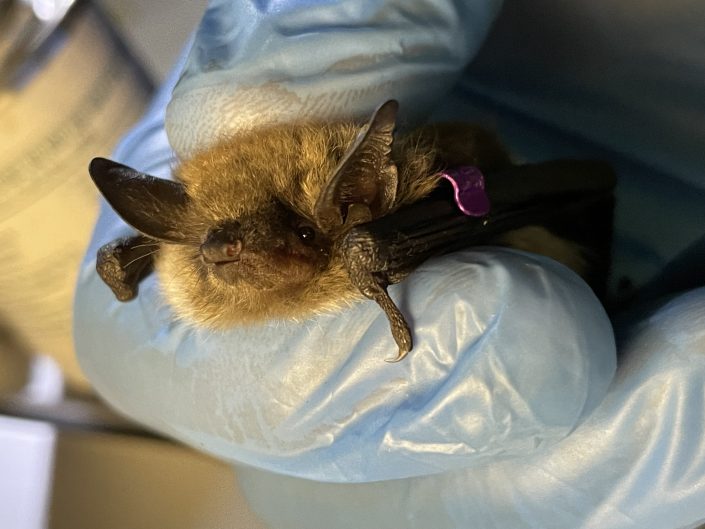
We discussed how bat populations are recovering from White-Nose Syndrome, the difficulties of studying such an elusive species, the projects currently being undertaken by CWF to help our bats, and what makes our bats a special and irreplaceable part of New Jersey’s wildlife community.
We’d like to thank Sandy Perry for conducting this wonderful interview and Michele S. Byers for including us as a part of New Jersey Conservation Foundations’ The State We’re In.
Check out the excerpt below and continue reading this and many other great articles on njconservation.org.
Sit outside on a summer evening around sunset and look up. If you’re in an open area with nearby woods, you may be treated to a dazzling aerial display of bats hunting for flying insects.
“They’re endlessly fascinating,” said Ethan Gilardi, a bat biologist with the nonprofit Conserve Wildlife Foundation of New Jersey. “They’re fun fliers, with all their diving and weaving and hairpin turns.”
Besides being interesting to watch, bats provide priceless insect control services in a state that jokingly refers to the mosquito as its state bird. “A single little brown bat can eat 3,000 insects a night,” noted Ethan. “They eat every kind of insect pest you can think of.”
But many of New Jersey’s bats are struggling to survive. Fifteen years ago, a fungus attacked hibernating bats, leading to a disease known as white-nose syndrome. The disease disrupts hibernation, causing bats to use up their vital energy needed to survive the winter. White-nose wiped out most of the bats in the Myotis genus: little brown bats – once our most widespread species – and northern long-eared bats.
“Jersey Girl” is a NJ banded eagle (B/64). She was reported to us in 2014 by Linda Oughton, who has been keeping track of her and her mate since 2010. They nest is in Montgomery County, Pennsylvania. B/64 was banded in 2004 at a nest in Cumberland County NJ, located along the Cohansey River. ‘Jersey Girl” is seventeen years old.