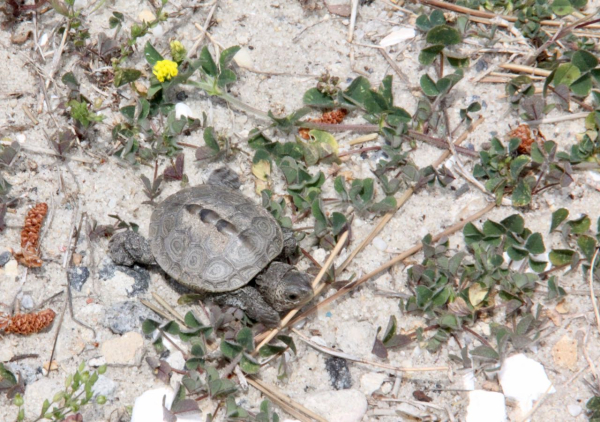
While out on a drive along Delaware Bay friend of Conserve Wildlife Foundation Jim Wright has an unplanned encounter with our biologist Larissa Smith and several baby terrapins.
On his blog Jim says “(Larissa) explained that these tiny terrapins cross this road every late May. We helped save four of the little turtles — including three that would have likely been crushed by a giant tractor-trailer headed for a marina. Alas, we found a few crushed little guys on the way.”
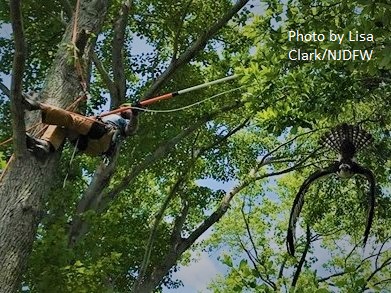
Update May 30, 2019: Another example of the dangers of fishing (or this time crabbing) line unfolded in dramatic fashion in Tuckahoe Wildlife Management Area. CWF biologist Ben Wurst was called upon to put his climbing skills to the test to help an osprey dangling high above the ground. Thankfully Ben was able to get to the bird in time, and our friends at Tri-State Bird Rescue and Research nursed the osprey back to health and were able to re-release him near where he was found. Read more about the daring rescue on our Facebook page.
Ben Wurst puts his climbing skills to the test to rescue and entangled osprey
As thousands of people plan their trips to the Jersey shore for Memorial Day weekend, it is a good time think about how to help out shore and sea birds. Enjoy the holiday weekend!
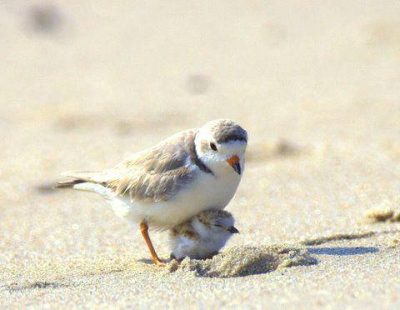
The 141 miles of seashore in New Jersey are home – or at least part-time host – to many of the birds Conserve Wildlife Foundation protects and nurtures. Osprey, oystercatchers, black skimmers, piping plovers, red knots, and many others rely on a healthy coast to thrive.
The third
Friday in May has been a celebration of our nation’s wildlife and wild places
since 2006, when the United States Congress established the holiday. There is a
special urgency this year as the United Nations recently reported that nearly
one million species worldwide are at risk of extinction within decades (read
our post about the UN report for more information).
One of the
main points the report makes is that humans are dangerously degrading Earth’s
ecosystems, the delicate, interconnected webs of life that we all, people and wildlife
alike, need to survive.
A new report into human impacts on nature shows that nearly one million species risk becoming extinct within decades and that current efforts to conserve the earth’s resources will likely fail without radical action, UN biodiversity experts said this week. The report from the United Nations’ Intergovernmental Science-Policy Platform on Biodiversity and Ecosystem Services (IPBES) found that grave impacts on people around the world are now likely.
The report identifies five main drivers of this unprecedented decline: changes in land and sea use, direct exploitation of organisms, climate change, pollution, and invasion of alien species.
Conserve Wildlife Foundation biologist Allegra Mitchell recently wrote about rare herps for Skylands Visitor’s website. Allegra takes you on a tour through the sometimes weird, always wonderful world of amphibians and reptiles.
As the season eases into milder temperatures at the onset of spring, all manner of creatures stretch their bodies and move more freely, searching for food and mates while they patrol their home turfs. Among these creatures are some of the most rare, interesting, and beautiful animals in the Garden State. Though they often go unnoticed or are misunderstood, reptiles and amphibians are vital to the balance of our fragile ecosystems—and some of them are in pretty big trouble.Continue reading on njskylands.com.
A barn owl hatched in captivity in 2008 is among the residents at Woodford Cedar Run Wildlife Refuge in Medford. (Photo: File photo, Courier Post)
The Conserve Wildlife Foundation invites high schools students from across the state to submit an original social media campaign showing the importance of protecting rare wildlife in New Jersey. The “Species on the Edge 2.0” contest is in its fifth year and sponsored by the PSEG Foundation.
Do you have a teen who loves animals and getting out in nature?
You might want to encourage him or her to spend more time on the phone — at least for one specific project.
The Conserve Wildlife Foundation of New Jersey is inviting high school students from across the state to participate in a social-media contest to win scholarship money.
The “Species on the Edge 2.0” Social Media Contest encourages teens to leverage their digital knowledge for the chance to win prizes.
To the trained eye, it was clear Kevin Courts and Michael Riff were illegal terrapin harvesters.
The Hatboro, Pennsylvania, men, one shirtless, were parked next to a marsh off Sea Isle Boulevard last July, with six nets and a long pole leaning against their green truck, the state said. A conservation officer who approached them spotted a turtle crawling under the driver’s side seat and found a cooler packed with hatchlings.
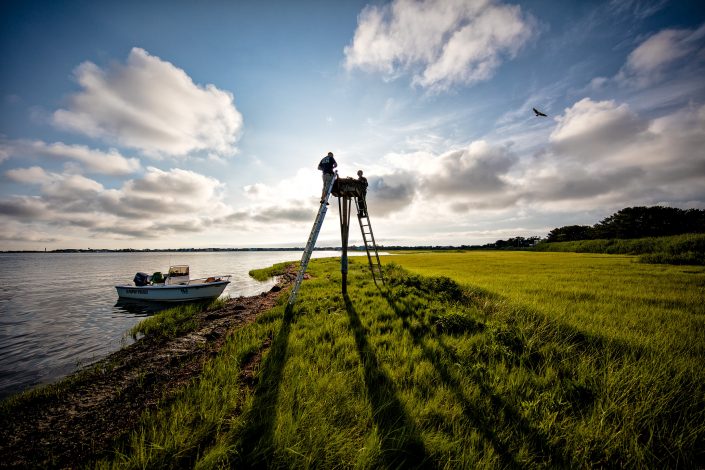
Support New Jersey’s ospreys with donations matching a $12,500 challenge to help Conserve Wildlife Foundation purchase a boat.
by Ben Wurst, Habitat Program Manager
Surveying a nest on Long Beach Island in 2017, the last year we were able to utilize a state owned boat. photo by Northside Jim.
Ospreys are living barometers. They symbolize the resilience of life along the New Jersey coast. As a top tier predator who feeds exclusively on fish, their collective health is a direct link to the health of our coastal waters. Anyone can tell you that a healthy coast is essential to life at the shore. Clean water with abundant and healthy wildlife equals a booming shore economy. We have all benefited from actions and policy that have protected our air, land and water since the 1970s. Ospreys are no exception.
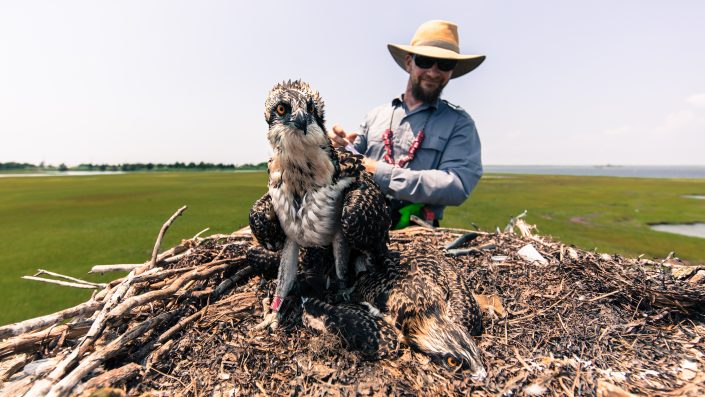
Banding osprey nestlings with red auxiliary bands at a nest off LBI. photo by Northside Jim.
If you live along or visit the coast, then it’s no surprise that ospreys continue to thrive in New Jersey. 2018 was yet another banner year for these coastal nesting raptors. Their large stick nests depict our rivers and estuaries while they indicate that we’re doing a good job of protecting our local environment along the coast. Today we’ve published results from last year’s nesting season in the 2018 New Jersey Osprey Project Report.