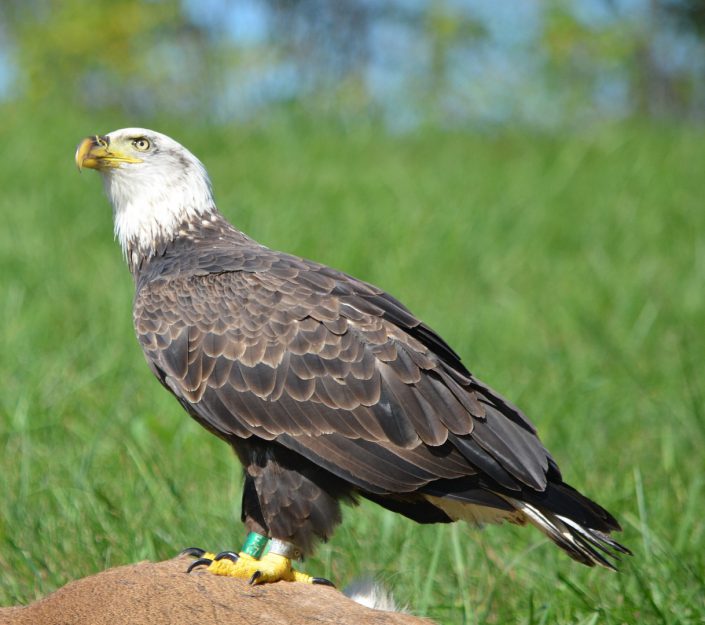
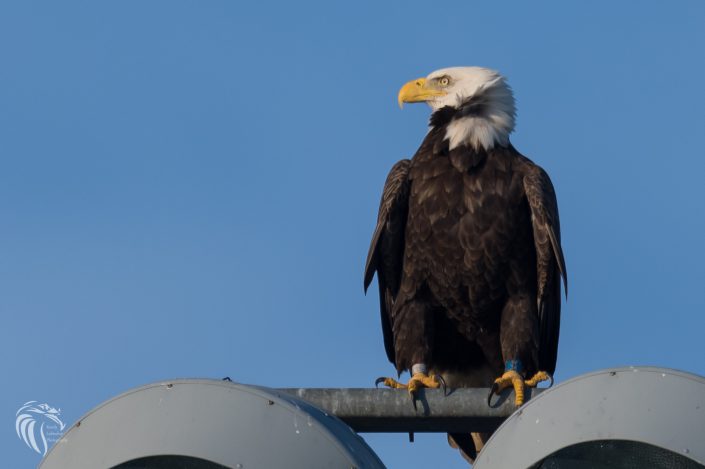
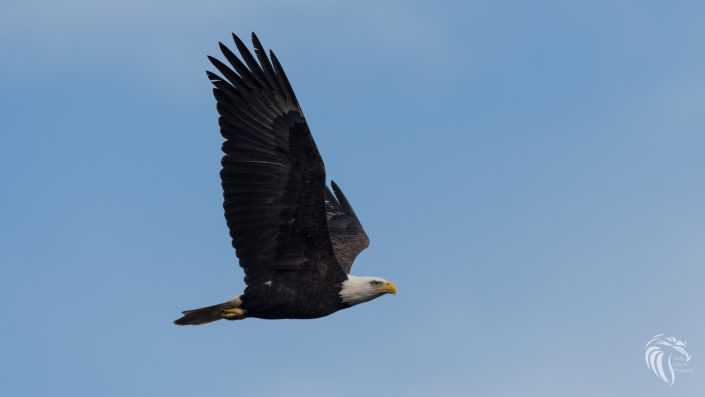
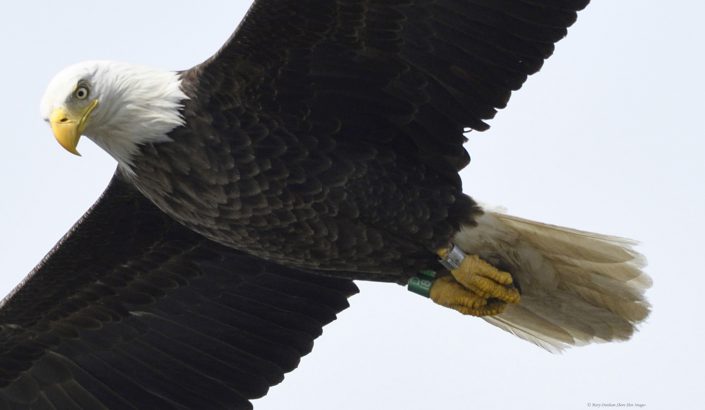
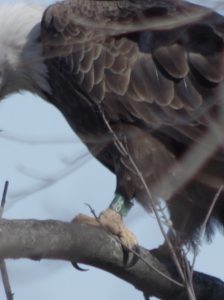
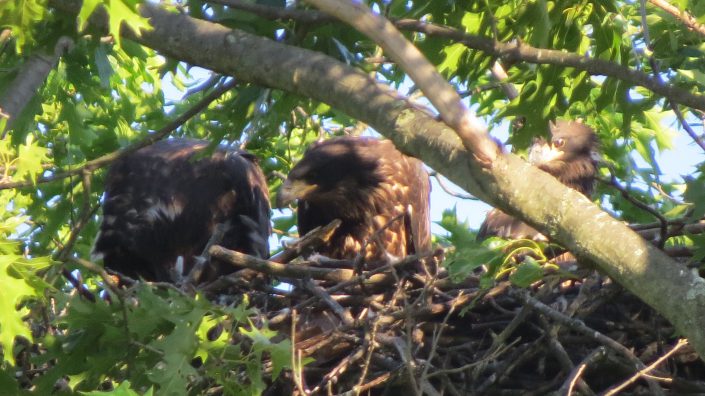
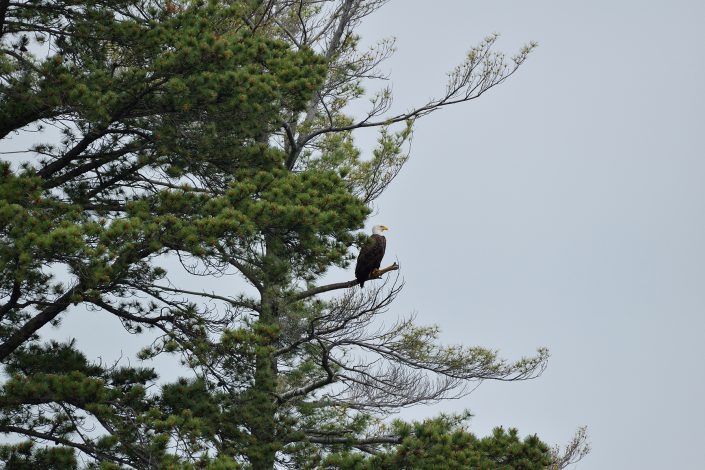
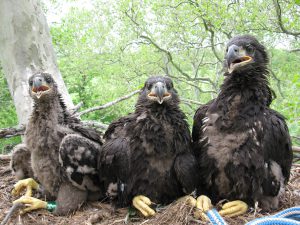
In the end of October, NJ Eagle Project volunteer Randy Lubischer spotted a banded adult bald eagle near his home in Monmouth County. He was able take good photos that showed the bird was banded with a blue (NY) band on the left leg and was able to get a very clear image of the letter and number code on the band. We reached out to the NY Division of Fish, Wildlife and Marine Resources to find out more information on the eagle.
In the fall of 2011, an injured hatch year bird was found on the side of the road in Onondaga County, NY. The bird was rehabbed, banded (NY Blue band W34) and released on October 7, 2011 at the Montezuma NWR. On 11/18/2016, W34 was sighted in Darlington, Maryland and then in in NE Maryland again on 3/1/2017.
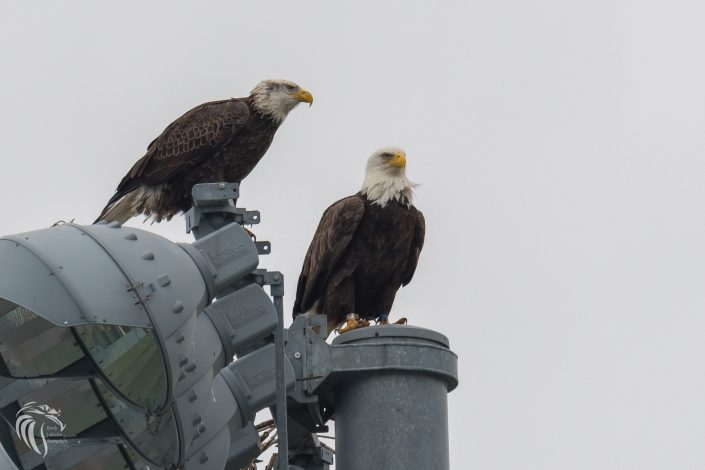
W34& mate 11/7/17@Randy Lubischer
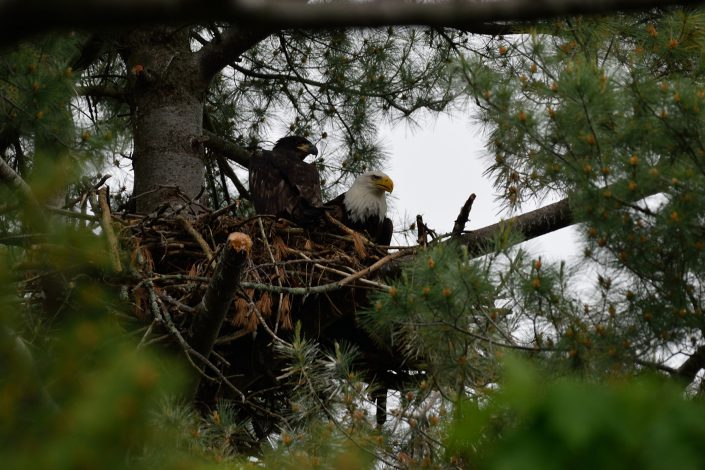
W34 looks to be staying in NJ to nest as he has found a mate, a sub-adult female, who still has dark feathers on her head. They have started to build a nest and have been copulating.
We can’t necessarily assume that W34 was hatched in NY. Since he was found injured and not banded he could well be a NJ bird. We have followed NJ recent fledges outfitted with transmitters, take long flights north after leaving their nest areas. We also know that many NJ banded eagles do return to NJ to nest. So we’ll never know the true origin of W34 but we can piece together some of his story and hopefully have more news about him and his mate in the upcoming nesting season.
ACTION ALERT: Support ecological management of the most valuable public resource for our coastal ecosystem and economy
by Ben Wurst, Habitat Program Manager
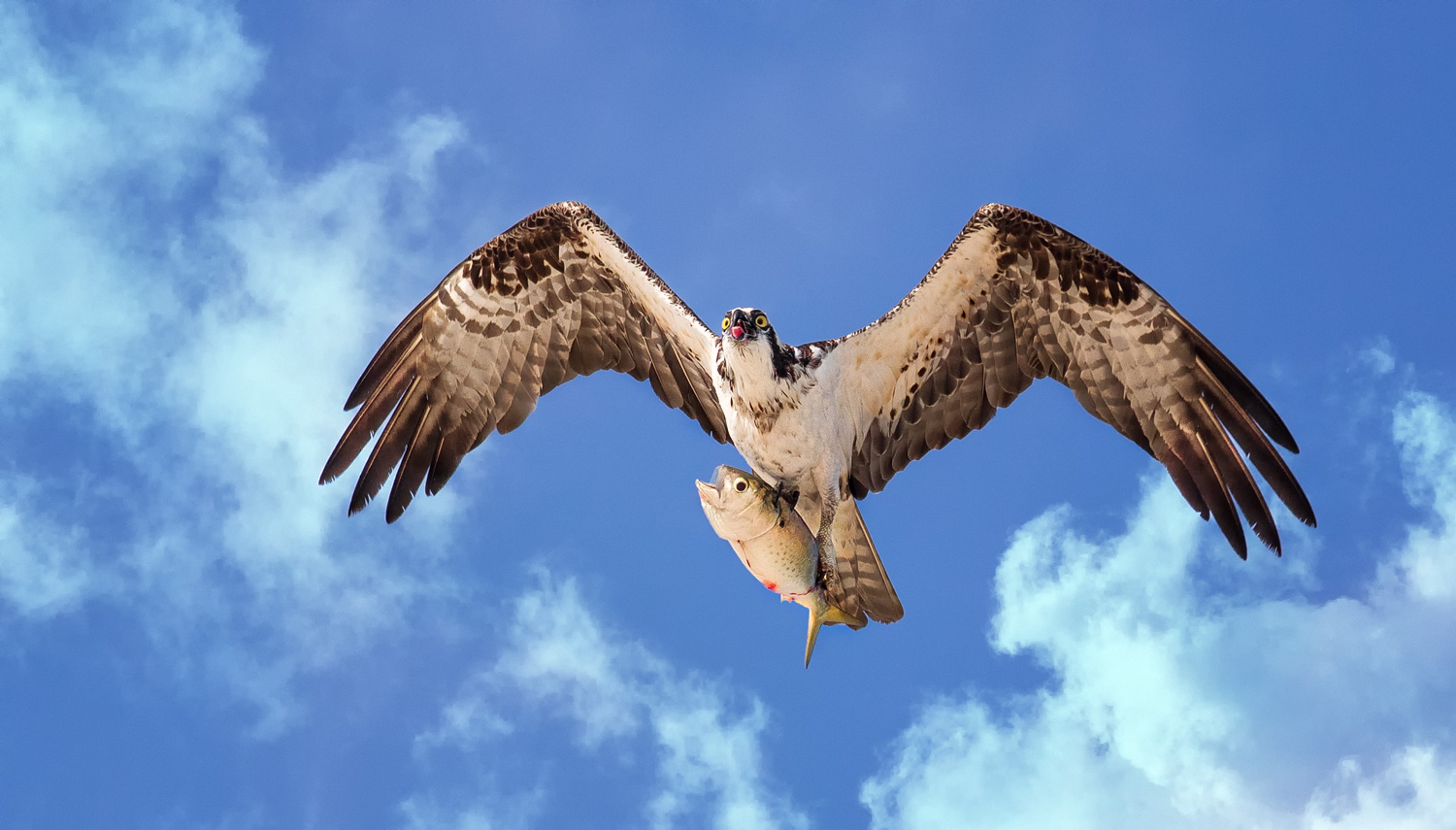
Menhaden is a common food source for ospreys during their nesting season in New Jersey. Photo by Northside Jim.
The Atlantic States Marine Fisheries Commission is accepting public comment on the establishment of ecological management of Atlantic menhaden (Brevoortia tyrannus), which is a keystone species. Basically, a keystone species is one that plays a large role in the ecosystem where it lives. If a keystone species is lost then the ecosystem would dramatically change or cease to function, causing widespread effects to other species that benefit. In New Jersey, ospreyshave largely benefited from a healthy menhaden population as we’ve had relatively high reproductive rates (more than double what’s needed to sustain population) over the past decade. From 2006 to 2016, the population has grown by 30% and above the pre-DDT, historic milestone of over 500 nesting pairs. Around 82% of the state population of ospreys nests along the Atlantic Coast and we observe menhaden at a huge number of nests during our mid-summer surveys. If menhaden numbers drop, then we will likely see osprey numbers follow suite, as reproductive rates will decline, as they are in the Chesapeake Bay.
We keep track of all re-sightings we receive of NJ (green) banded eagles. This information is important as it lets us know where eagles raised in NJ go after leaving the nest and eventually where they end up nesting. In 2017 we have had NJ banded birds sighted in NJ as well as PA and VT.
On April 15, 2017 Mary Dunham photographed NJ banded D/18 near Lake Como in Belmar, NJ. The female was banded in March 2011 at the Manasquan Reservoir, Monmouth County. She was with another smaller adult, assumed to be a male. While Mary watched a third adult eagle came into the area and the pair chased it away. This is an indicator that D/18 was paired up and perhaps was nesting in the area.
D/18 @ Mary Dunham
In August we received a report that D/18 was sighted once again. This time she was up near the NY- Canada border. We don’t know much about the movements of nesting eagles so we can only speculate why she made such a big move north. Perhaps she went north with a recent fledgling or maybe she was kicked out of the pair by an intruder eagle and headed north?
D/40@ Reid Hoffer
In March we were contacted by Reid Hoffer who monitors an eagle nest along a reservoir in Rockland County NY. He was able to get a photo of a green band, D/40, she was banded May 2011 at Newton Reservoir in Sussex County. Mr. Hoffer reports that unfortunately the pair did not produce any offspring this year.
D/40 & mate at nest in NY@Reid Hoffer
Telemetry
We are also currently tracking three NJ eagle with transmitters attached. The New Jersey Bald Eagle Tracking project shows the movements of all three of these birds as well as their history.
Two of the transmittered birds fledged from Merrill Creek Reservoir in Warren County, NJ. Harmony 2, has spent the last four years in a 100-mile swath of western Connecticut and Massachusetts. She fledged in 2012 making her a 5th year bird and breeding age. We suspect she’ll nest in the same area next season. Haliae fledged in 2013 and has spent the past three years mostly around the Eastern Shore of Maryland. Perhaps she’ll stay in that area to nest? So two birds from the same nest, but one has settled to the north and one to the south.
Nacote, a male from the Galloway nest in Atlantic County, has stayed more “local” to his home area. He’s spent the last three seasons in Atlantic, Cumberland and Cape May Counties. He favors the CMC landfill and local sand pits where other eagles are known to roost and feed.
All this information helps us to locate roost and foraging areas and protect them. It’s also fascinating to know where NJ eagles go after leaving their nest area, especially when they begin nesting. Why do some head north, others south and yet others stay near their “home” range? We don’t know, and that’s ok, it’s what makes them wild!
B/64 and mate have a successful 2017 nesting season.
CWF Biologist: Larissa Smith
B/64 & mate@ L. Oughton
In 2014 I first heard from Linda Oughton who watches an eagles in nest near Montgomery, PA. The female in the pair is a NJ banded bird, B/64, nick named “Jersey Girl”. She was banded in 2004 at the Hopewell West nest along the Cohansey River in Cumberland County.
This season Jersey Girl and her mate raised and fledged three chicks. Linda reports that they have fledged a total of 14 chicks since they first started nesting in 2010. It isn’t often that we know what happens to one of NJ eagles and we can only know if they were banded as chicks. Unfortunately many of the NJ banded eagles that are reported to us are either injured or dead. But in recent years re-sightings of green banded NJ birds are more common and we are aware of NJ banded eagles nesting in NJ as well as NY and CT.
The fall is a great time of year to spot a bald eagle anywhere in New Jersey. Eagles that nest and live further north are migrating south. Many will be staying to spend the winter months in NJ where there is usually warmer weather, open water and a supply of food. We’ve had a report of an eagle with an orange band sighted in Burlington County, NJ. The orange band means that the bird was banded in Massachusetts and the plumage shows the bird to be a first year bird banded this past season.
NJ nesting pairs are here year round and we’ve had reports of pairs already sprucing up their nests for the nesting season.
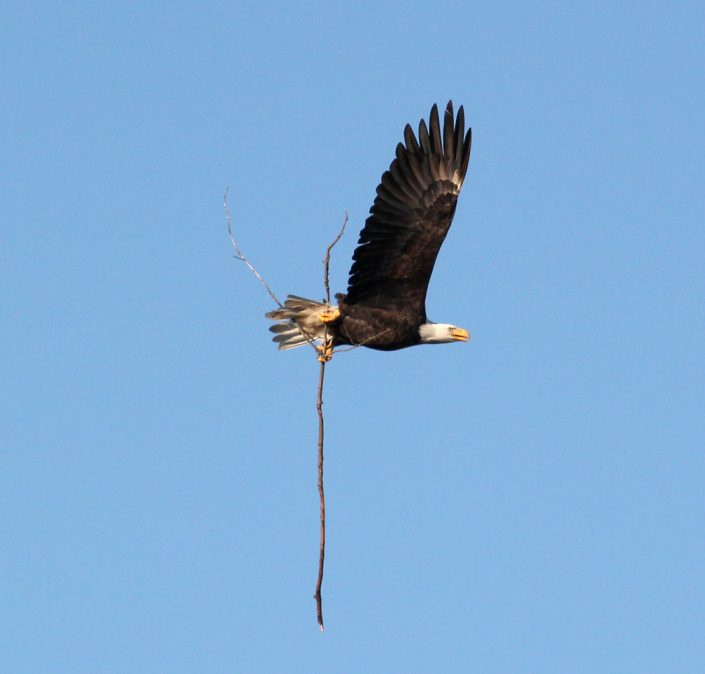
Adult bringing stick back to Nest 10/23/16@Alex Tongas
New Jersey eagles also travel out of state, a green banded eagle (NJ) was spotted down at High Rocks Lake in North Carolina October 16th by Carolyn Canzoniere. The code on the band wasn’t readable, but going by the plumage the bird was banded in 2013. This bird hasn’t yet reached sexual maturity, perhaps it’s checking out the area for future nesting in North Carolina.
NJ Banded eagle 10/16/16, High Rocks Lake, NC@Carolyn Canzonieri
Telemetry
CWF and NJ ENSP have been tracking two eagles outfitted with transmitters. The telemetry maps on the CWF website are currently being updated and redesigned to allow for easier viewing of “Nacote” and “Oran’s” movements. We hope to have the new maps up and running in the next few weeks.
Nacote D/95 continues to spend time around Cape May and Atlantic Counties.
He was photographed by Peggy Birdsall Cadigan on 10/23/2016 at Forsythe NWR, near his old nest site.
“Nacote” 10/23/16@ Peggy Cadigan
“Oran” E/17: From July 18th until September 21st Oran was out of cell range. His last known location was near the Quebec/Maine border and then on the September 21st came back into range along the Maine coast. He made his way back down to southern New Jersey and was at Dennisville Lake, Cape May County on October 3rd. Mid-October he made a trip to Delaware and came back to NJ a day later and has been foraging and roosting in Cumberland County.
“Tiny” has another successful nesting season in Connecticut
By: Larissa Smith: CWF Biologist
C/94 “Tiny” keeps a watch over nest in CT; 6/3/2016@ C.Pratt Didan
In 20015 we were contacted by Cyndi Pratt Didan regarding a pair of nesting eagles she has been observing in CT about 150 miles from Duke Farms. She was able to get a reading of the green band on the male C/94. It turns out that C/94 is a Duke Farms eagle from the 2009 nesting season. In 2009 there were three chicks in the nest and all were male. C/94 was the youngest and considerable smaller in the beginning as he was a week younger than the oldest chick and got the nick name “Tiny”.
May 18, 2009, C/94 after banding with siblings @M.Valent
His mate is also a banded bird from Massachusetts banded on June 11th, 2008. The pair nested in 2014 fledged two chicks and fledged one chick in 2015.
Cyndi reports that the pair built a new nest seven miles away from their old nest. This nest is in a pine tree on an island in a Reservoir. This season they fledged two young birds.
We thank Cyndi for keeping us updated on this NJ bird. It’s always good to get news about one of “our” chicks.
“Tiny” with one of the chicks 6/3/2016@ C.Didan Pratt
Since the spring of 2014 CWF and the NJ Endangered and Nongame Spieces Program have been tracking a transmittered eagle named “Nacote”, D/95. He fledged from the Galloway nest (Atlantic County) in the summer of 2014 and made a trip up to Canada, he returned to NJ in Mid-October of 2014 and has been in southern NJ ever since, spending most of his time in Cape May and Atlantic Counties. He spend some time in April near his nest of origin at Forsythe NWF where he was photographed.
D/95 “Nacote” at Tuckahoe Lake 7/21/16@ Kathy Clark
In the past few weeks he has been in Upper Cape May County spending time at the county landfill and he even made an appearance at Tuckahoe Lake behind our office. NJ ENSP biologist, Kathy Clark was able to get a photo of him perched by the lake.
Another eagle we are tracking “Oran”, fledged from the Egg Island nest, Cumberland County along the Delaware Bay in the summer of 2015. In Mid-November he headed south and spent the winter down in the Chesapeake Bay area and returned to southern NJ in the spring 2016. “Oran” spent most of his time ranging around Cumberland County until making a bold move north in Mid-July. He flew to Maine in two days and then north into Canada, south of Quebec City. He has been out of range and the last signal received was July 18th when he was at the Maine/Canadian Border.