New Jersey Piping Plover Breeding Population Rises Sharply in 2021

By Todd Pover, Senior Wildlife Biologist

Pair of Piping Plovers Tending Nest. Courtesy of Northside Jim

The 2021 New Jersey piping plover breeding season was a classic “good news, bad news” result. According to the annual report released by the state’s Endangered and Nongame Species Program earlier this month, the breeding population increased to 137 pairs in 2021, third highest since federal listing in 1986. That is an unprecedented 33% rise over the previous year and just short of the record high of 144 pairs in 2003. On the downside, the number of chicks fledged statewide was just 0.85 chicks per pair, the lowest since 2013 and about half of the 1.50 federal recovery goal. The low productivity was largely the result of a severe Memorial Day weekend nor’easter and persistent predator activity throughout the season.

Holgate, a unit of the Edwin B. Forsythe National Wildlife Refuge, hosted 46 pairs, the most in the state. This site, which is monitored and managed by CWF through a cooperative agreement with the Refuge, has seen an astounding increase in piping plover pairs in recent years, up about 2.5 times from the 18 pairs it had in 2018. CWF also monitors Little Beach, the adjacent Refuge-owned site, where another 13 pairs nested in 2021. Combined the two sites had 59 nesting pairs, a new record, by far, for the Refuge. Unfortunately, like the statewide results, productivity was very low this year at both Refuge sites, combined only 0.80 chicks fledged per pair, about half the rate just a year ago. The Memorial Day weekend nor’easter flooded those sites, wiping out most nests, and although most of the pairs nested again afterwards, many of those renests (or hatched chicks) were lost to predators, especially coyotes at Holgate.

CWF also oversaw piping plover breeding at the National Guard Training Center, which had just one pair in 2021, but that nest successfully hatched and fledged three chicks, helping boost the state average. Overall, CWF was responsible for monitoring 44% of the statewide population, giving it a significant role in helping guide conservation of this highly vulnerable state endangered (and federally threatened) species.

Although CWF does not conduct the daily on-the-ground monitoring and management of piping plovers at the Barnegat Inlet nesting site, it was a co-leader of the habitat restoration that was completed there two winters ago, and as such has had a big role in the nesting outcomes at the site. The number of pairs using the site has noticeably grown, up to five pairs in 2021 from just one pair when the project began. Productivity has also been consistently high at the restoration site and 2021 was no different with the pairs exceeding the federal recovery goal and statewide average with 1.6 chicks fledged per pair this year.

With the breeding results for 2021 now “in the books”, we are already looking forward to next year. The biggest question will be whether the state can sustain the progress towards recovery it made this year, especially given the big drop in productivity, which typically drives population. But for now, all we can do is wait until next spring to learn the answer to that question.
To read the state’s entire 2021 piping plover report:

Dark Star, the Oiled Osprey

A couple weeks ago colleagues with NJ Fish & Wildlife shared a video clip of a dark osprey who landed on a nest platform along the Maurice River near Leesburg, NJ. “Looks like an oiled bird” the text read. Indeed it looked like the bird was exposed to some form of petroleum product, which stained its feathers a dark color. At the time, there was no oil spill reported to NJDEP (this was on May 10) and the video shows that the bird was observed on the nest on May 1, 2021.

Continue reading “Dark Star, the Oiled Osprey”

A Tribute to Bobby “Twist” Jetton: 2020 Barnegat Light Osprey Cam

by Ben Wurst, Habitat Program Manager

During the peak of my field season last year I exchanged emails with a kind man who reported terrapins nesting in his yard. He wanted to do everything he could to ensure their success. A couple weeks later Bobby reached out to say how much him and mom loved the Barnegat Light Osprey Cam and how “the birds generally wake her up before her alarm.” He also mentioned how she delayed gardening because “dad is due with a fish any minute now. I’m just waiting to note the time then I’ll go play.” She was contributing observations of prey deliveries for research we conducted at the BL Osprey Cam last summer.

Continue reading “A Tribute to Bobby “Twist” Jetton: 2020 Barnegat Light Osprey Cam”

Photos from the Field: Raising up hope in 2021

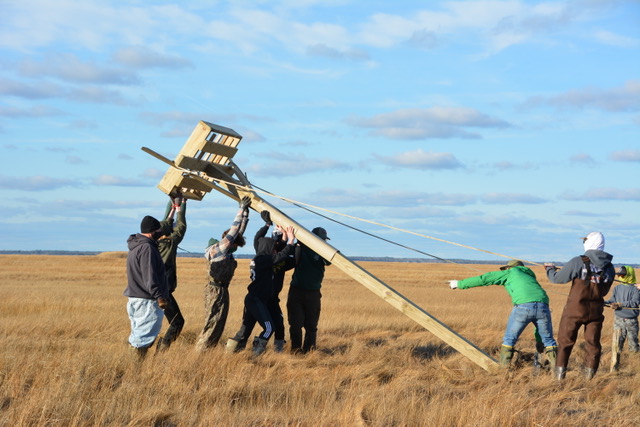
Eagle Scout candidate Kyle Agudo and Boy Scout Troop 61 give ospreys a boost in the new year

Ben Wurst, Habitat Program Manager

Troop 61 lift an osprey nest platform into place on the coastal saltmarsh. photo by Kathy Agudo.

Humans have played a key role in the recovery and stability of nesting ospreys throughout New Jersey and beyond. Today around 75% of the population, close to 500 pairs, rely on nest platforms designed specifically for them. They provide a stable nest platform, adequate perches, and protection from potential ground predators, aka raccoons. Many platforms are located in very close proximity to people, which make for excellent viewing and educational opportunities. Ospreys are a symbol of a healthy coast and resiliency in a dynamic region.

Continue reading “Photos from the Field: Raising up hope in 2021”

Photos from the Field

Grounded: Resurgence of natural osprey nests

by Ben Wurst, Habitat Program Manager

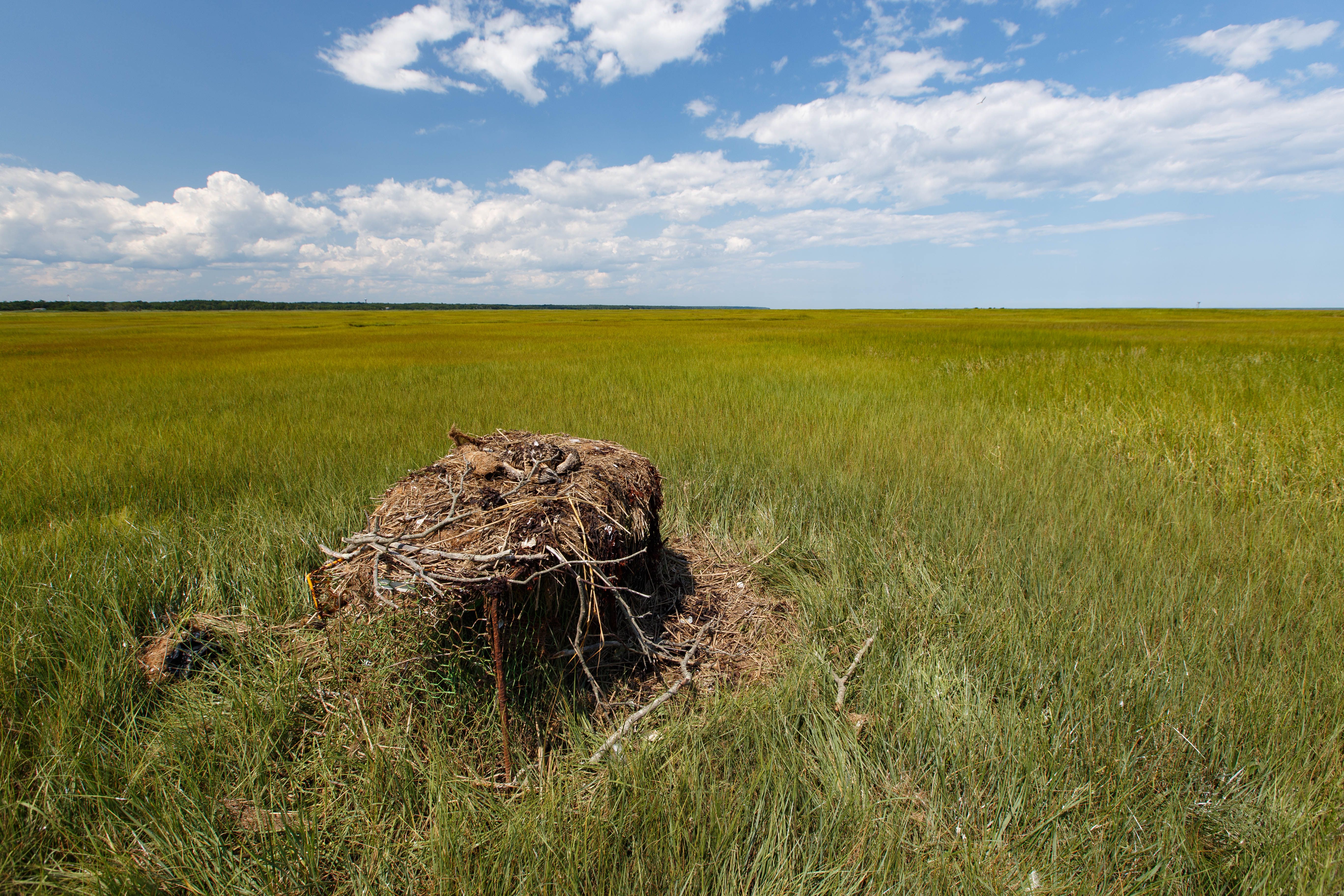
A ground nest with three young. photo by Ben Wurst

It’s not very common to see ospreys, a large predatory bird, nest on the ground. Despite the rarity of these sightings, it has become more common and acts as a glimpse into the past (and future), before humans dominated the landscape. Today, more and more ospreys are building nests on the ground and snags over water.

Continue reading “Photos from the Field”

Ospreys Continue to Thrive in New Jersey

Results from 2019 Osprey Nest Surveys highlight another productive year.

by Ben Wurst, Habitat Program Manager

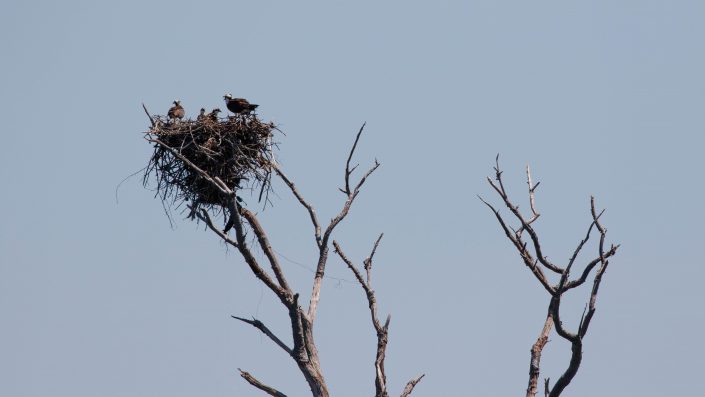
An osprey nest in a snag on Barnegat Bay. July 2019.

Surveys of osprey nests in New Jersey have occurred annually for the past forty five years. They are conducted to help determine the overall size and health of the population. The first aerial survey over Barnegat Bay counted only five active nests. Ten years earlier there had been over 50. The combined effects of DDT and habitat loss had taken their toll. No osprey nests were productive and the population at risk of being extirpated from the state.

“In 1974 there were only five active osprey nests on Barnegat Bay. Today there are approximately one hundred and fifty.”

After ospreys were listed as endangered an innovative effort to transplant viable eggs from the Chesapeake Bay to Barnegat Bay began. In addition, to help replace natural nest sites that were lost to development, man-made nest platforms were designed and installed away from human disturbance. Slowly osprey pairs became productive thanks to the die hard effort of State biologists like Pete McLain, Kathy Clark and many volunteers and partners. It’s encouraging for us to look back to see how far we’ve come in the statewide recovery of ospreys in New Jersey.

Continue reading “Ospreys Continue to Thrive in New Jersey”

My Summer Adventure with Osprey

by Marissa Murdock, 2019 NJ Osprey Project Intern; Rider University ’21

Marissa holds osprey 83/K who was banded after pre-maturely fledging and landing on the ground.

This past summer I was lucky enough to work with Conserve Wildlife Foundation as a volunteer student intern. I worked alongside Ben Wurst, CWF’s Habitat Program Manager, helping with the New Jersey Osprey Project. My internship consisted of assisting with osprey surveys, banding young, and recording data so that we can estimate the health of the population in New Jersey. 

Continue reading “My Summer Adventure with Osprey”

Photos from the Field: Ospreys Nest on Abandoned Crab Pot

Life is precious.

by Ben Wurst, Habitat Program Manager

On the last osprey survey of the season we stumbled upon a new nest — one that was built on an abandoned crab pot. We were drifting on Absecon Bay when summarizing data when we heard an adult making defensive calls at a nest. We looked and saw a low nest on the ground.
Continue reading “Photos from the Field: Ospreys Nest on Abandoned Crab Pot”

WHYY: Ospreys begin returning to the Jersey Shore

Story by Justin Auciello, WHYY

An osprey prepares to land on a natural nest in the Barnegat Bay
Photo from Conserve Wildlife Foundation of New Jersey

Welcome home!

It’s that time of the year again when ospreys — the raptors that have staged a miraculous comeback in New Jersey since the early 1970s — migrate north from their wintering grounds in Central America, northern South America, and the Caribbean.

In recent days, ospreys, also known as fish hawks, were spotted in Ocean County and as far north as the Meadowlands.

New Jersey 101.5: Record number of ospreys last year

Story by Joe Cutter, New Jersey 101.5

Photo by Ben Wurst, CWF Habitat Program Manager

A new report finds that a record number of ospreys were observed in New Jersey during the year 2018. The report was prepared by the state Division of Fish and Wildlife and The Conserve Wildlife Foundation of New Jersey.

Report co-author Benjamin Wurst, of The Conserve Wildlife Foundation of New Jersey, says 932 ospreys were spotted along New Jersey’s coast last year. Wurst says part of the increase has to do with less pollution.

“We are just not seeing the prevalence of these pollutants, in the form where it would actually hurt them,” Wurst said.