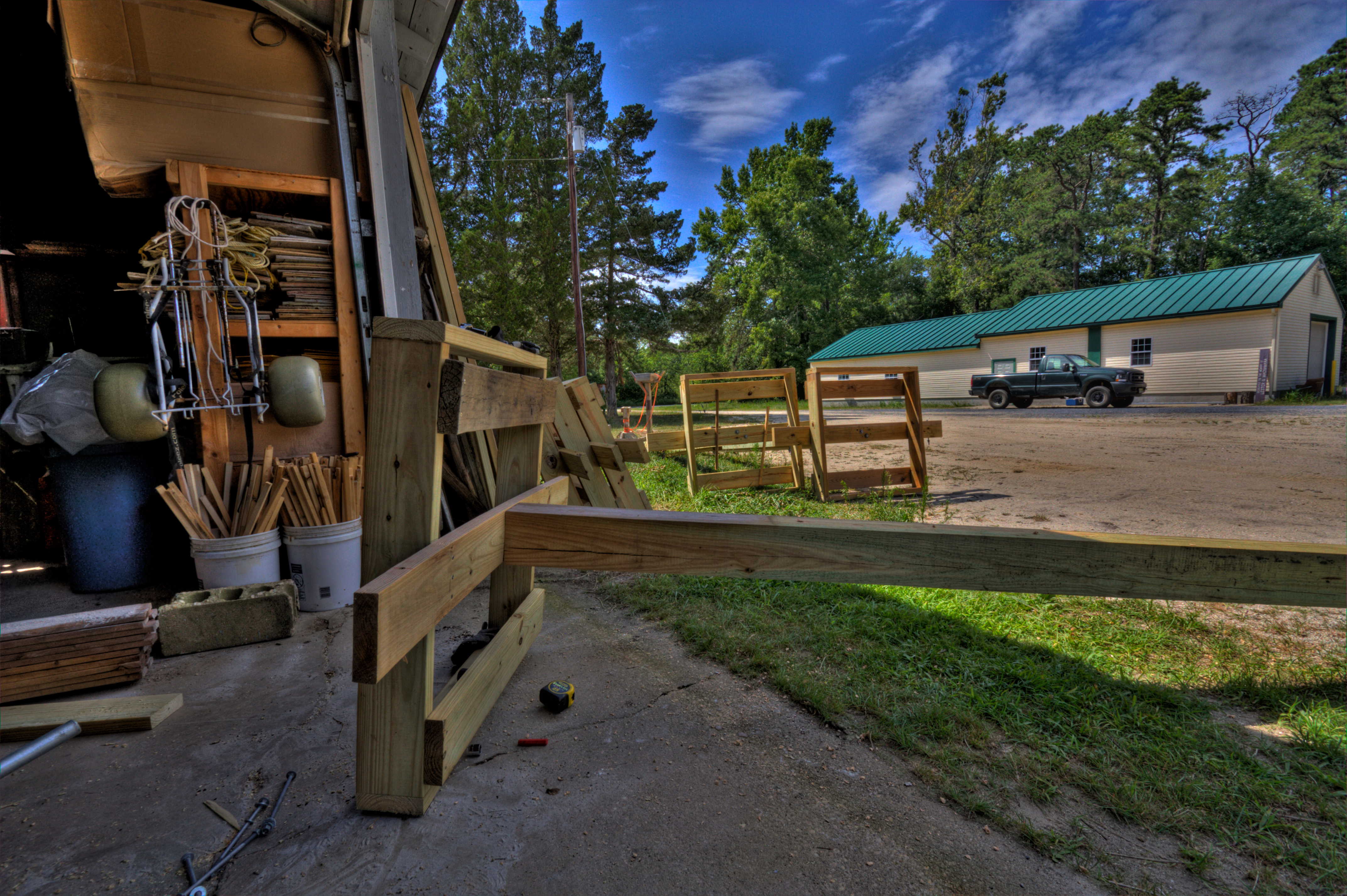
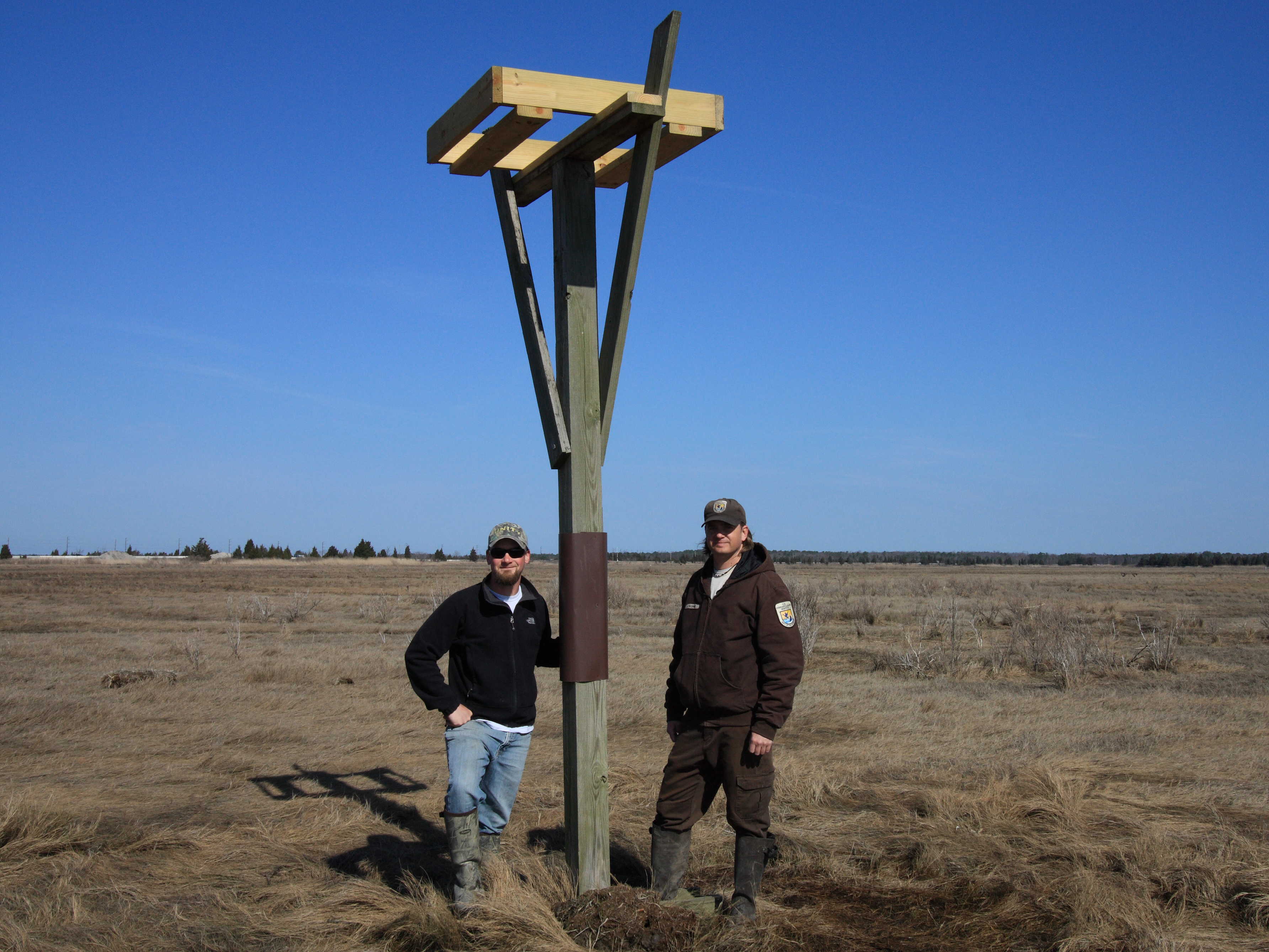
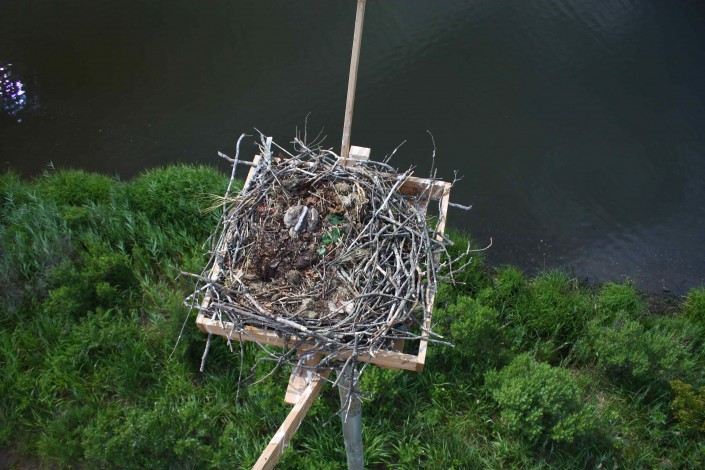
The office where I work, inside Tuckahoe Wildlife Management Area in northern Cape May County, recently lost its connection to the world wide interweb. The office is home to the NJ Division of Fish and Wildlife staff and three CWF employees. Since the demise of our connection to the world wide interweb the office has been ghostly quiet. Some have chosen to work at home, use some vacation time, or get some field work done. I just wrapped up my primary field season surveying osprey nests along the Atlantic Coast of NJ so I chose to be constructive, literally. I started constructing some artificial nesting platforms for ospreys. Normally I do this in the winter when field work is very limited, but finishing these now will give me a chance to install them this fall. Late summer and fall are the best times to install platforms. The water and air are warm and the winds are calm, so boots and bulky clothes aren’t required. So, I’m glad the internet is down because it gave me a reason to construct these platforms earlier than usual.
Two platforms will be going up in Lavallette, one near Tuckerton, and the other has yet to be determined (possibly Sea Isle). Stay tuned for more updates and photos!
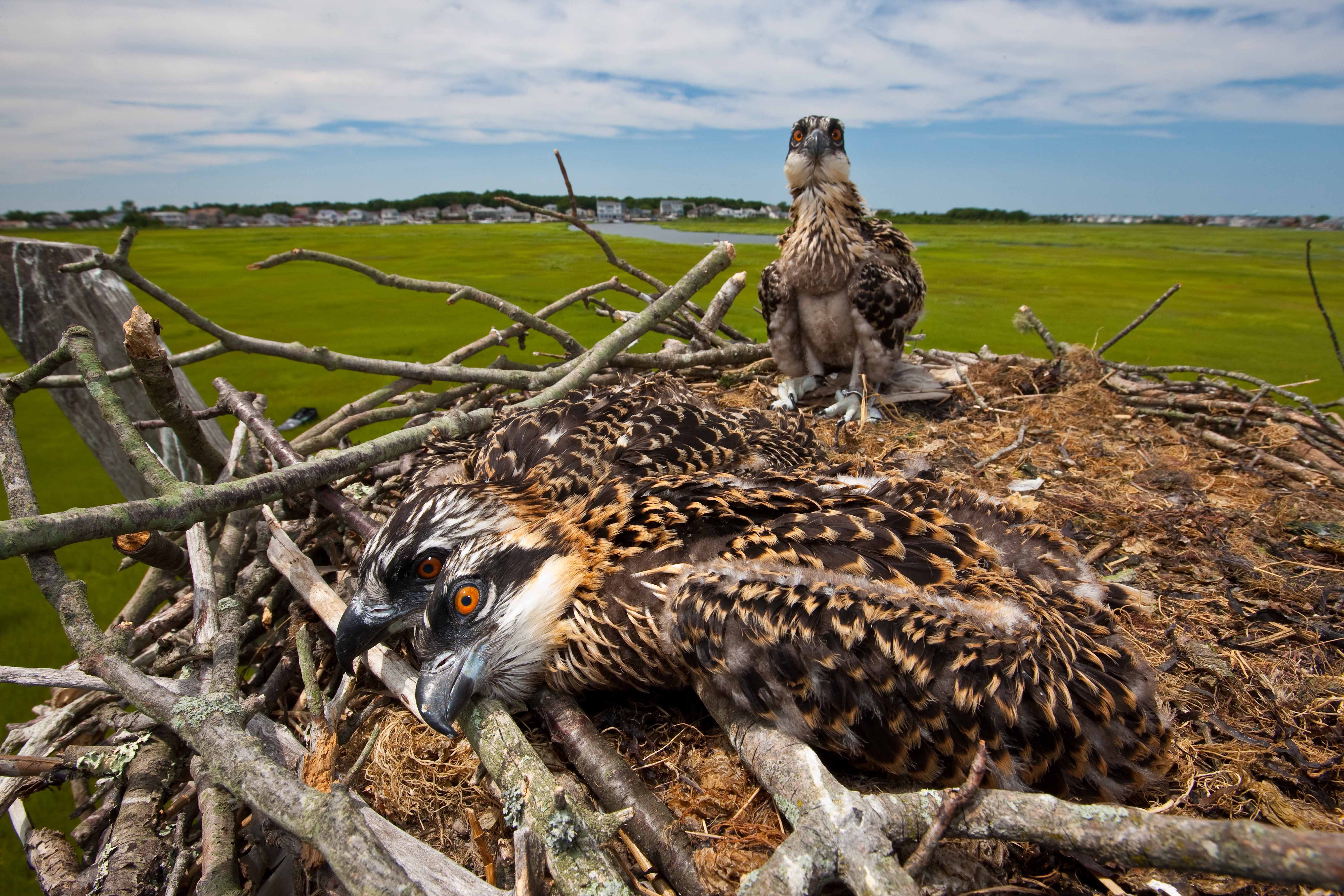
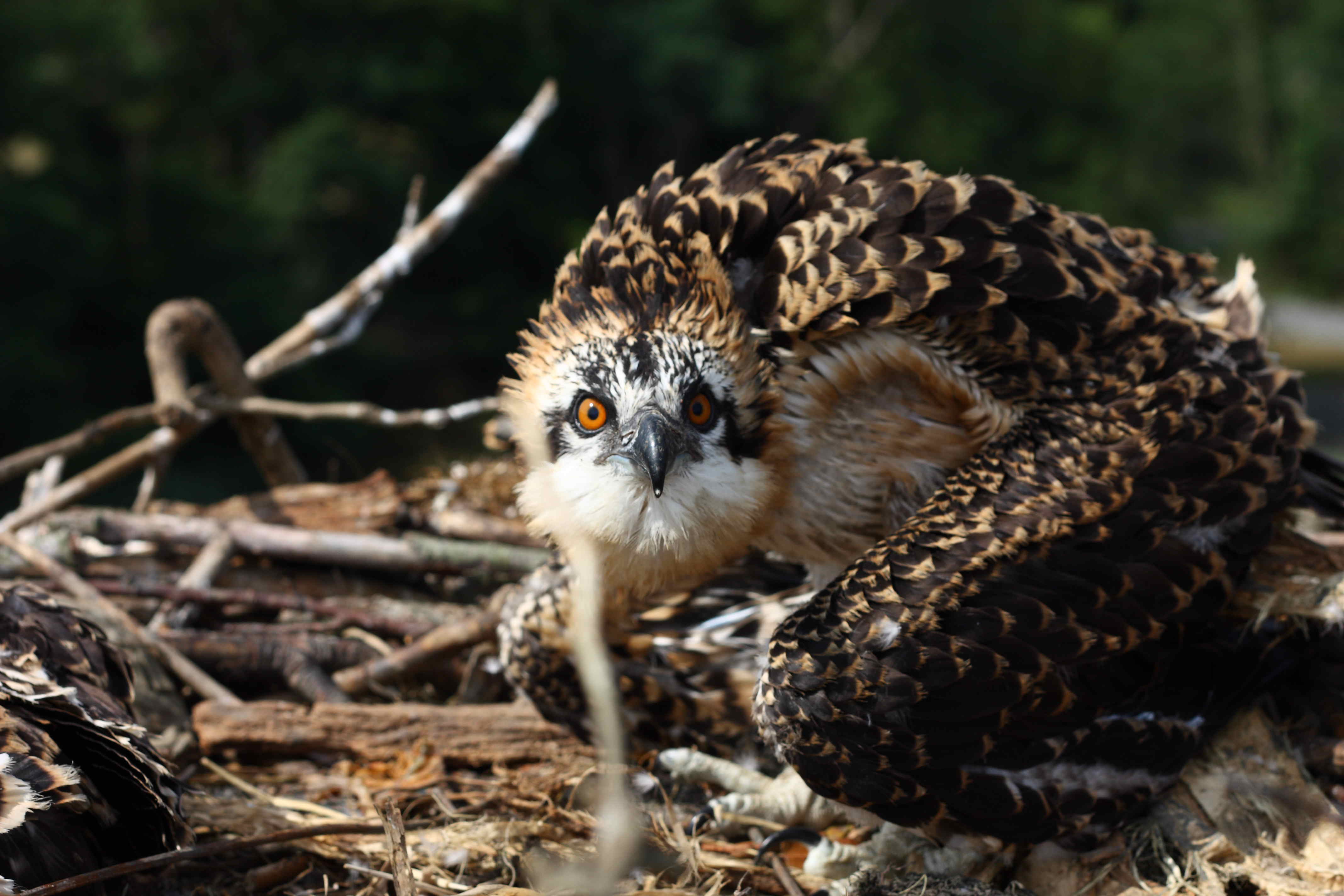
The iris is the thin colored part of an eye that is responsible for controlling the size of the pupil and the amount of light that enters the pupil. As a hatching the iris of an osprey is blood red in color. As a nestling (pictured below) they turn to an amber or orange color. The eye color and plumage of juveniles help distinguish them from adults, which have a yellow iris. Juvenile ospreys also have “buff” or tan feather tips on their contour (body) feathers. This helps camouflage them before they can fly and it also helps distinguish them from adults, who have dark brown body feathers.
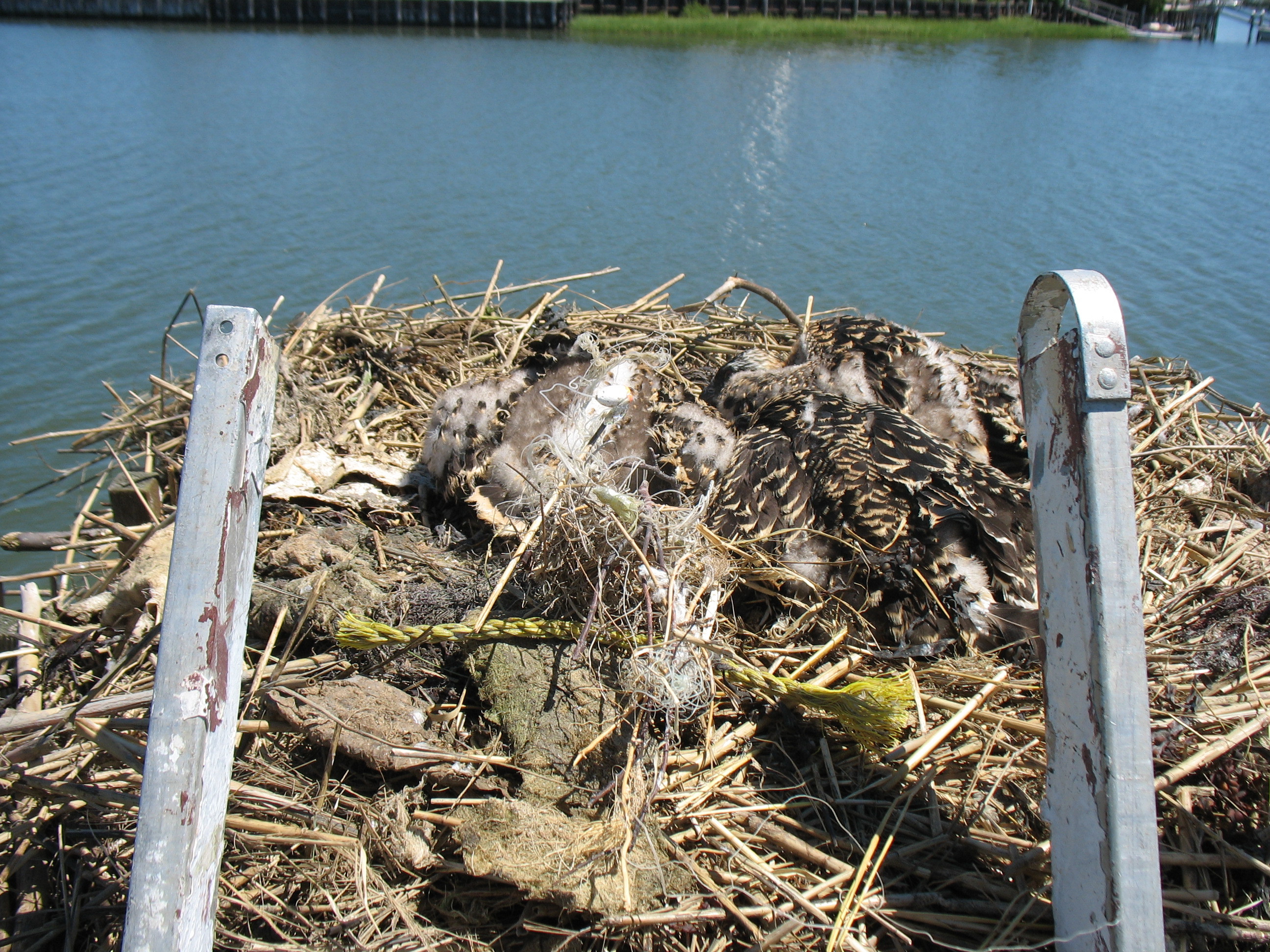
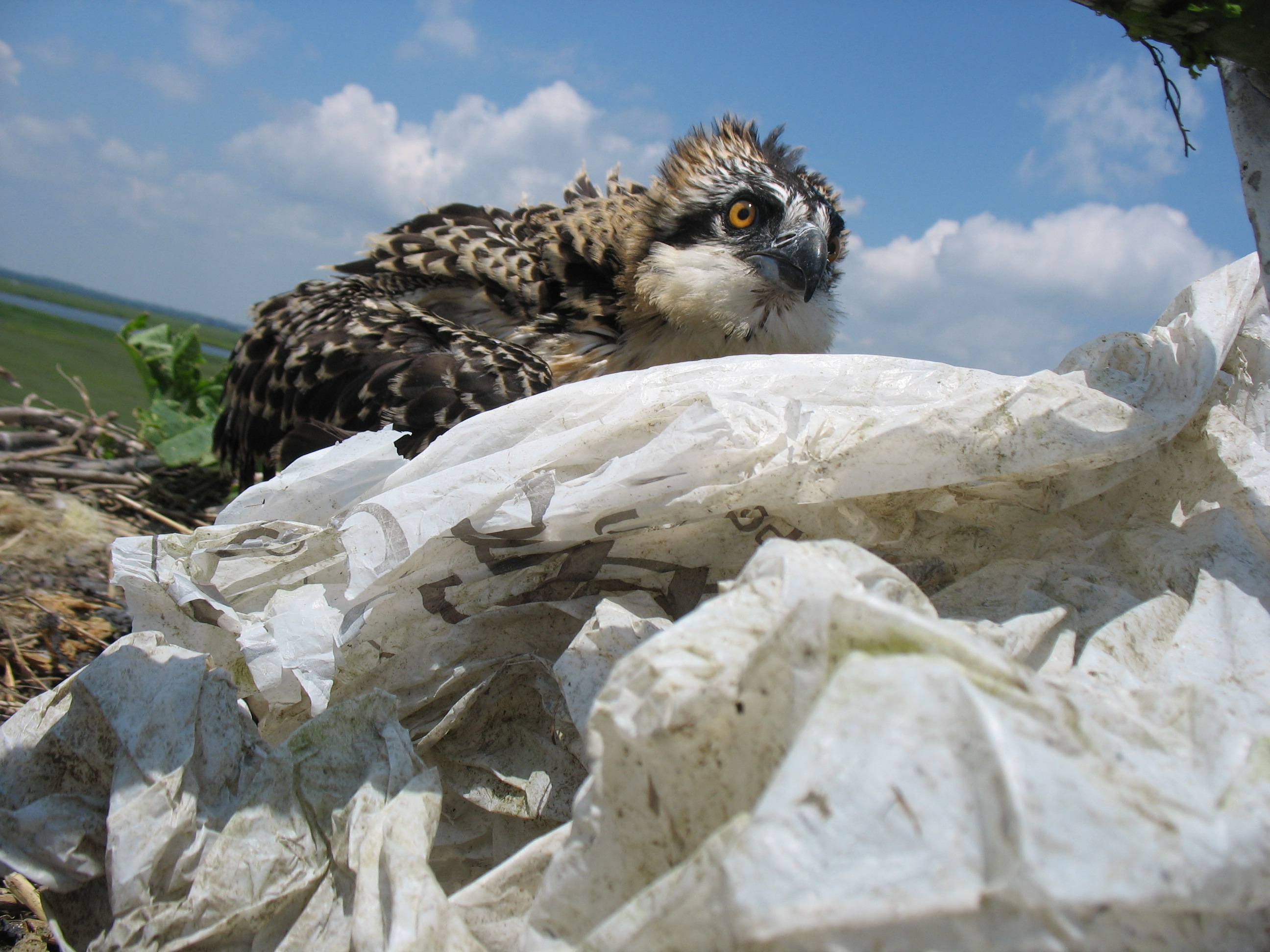
Ospreys love to bring garbage back to their nests. While out checking on nests I’ve found everything from rope, fishing line, flip flops, plastic bags, a Frisbee, hats and even a plastic crab in nests. The problem is that every year while volunteers and staff are checking on nests at least one chick is found entangled in this garbage. Fishing line gets caught around their feet and legs and a plastic bag can entangle a chick. If no one went out to check on these nests most of these chicks wouldn’t make it. It’s not only the chicks that suffer from the garbage we throw out. Adult ospreys have been found dead and hanging from fishing line. Ospreys and other species whose diet consists of mostly fish are particularly vulnerable to injury and death from fishing line and hooks. During a visit to an NJ eagle nest a chick was found with a fishing hook embedded in its mouth. I have also found horseshoe crabs and terrapins entangled in fishing line and these are just a few examples of how garbage effects wildlife.
Over the past few weeks volunteers and biologists have been performing ground surveys to help determine the health of the osprey population in New Jersey. The surveys are part of the NJ Division of Fish and Wildlife, Endangered and Nongame Species Program, Osprey Management Project. Ospreys are listed as a threatened species in New Jersey. They were originally listed as endangered in 1974 after only 50 nesting pairs were found in 1973. By 1986, their status was upgraded to threatened after their population rebounded to 100 nesting pairs. Today there are over 450 pairs of ospreys that we help to monitor in New Jersey.
Ospreys are highly dependent upon humans to provide artificial nesting structures for them and they are highly susceptible to many different heavy metals and persistent organic pollutants like DDT, DDE, PCBs and more recently brominated fire retardants (PBDE) that bio-accumulate in the food chain.
Surveys are performed each year during summer when osprey nestlings are old enough to band (3-6 weeks old) but not old enough to fly. They cover all major nesting areas including, the Delaware Bay, Raritan Bay south to Cape May, and inland. During ground surveys nestlings are banded with USGS aluminum leg bands for future tracking. I survey areas from Great Bay in Little Egg Harbor north to Fort Monmouth in Oceanport and Mantoloking along the Atlantic Coast.
The data we collect (whether or not a nest is active and the # of young produced) is used to calculate the productivity rate. Ospreys need a productivity rate of at least .8 young/nest to sustain the population. In the past 5+ years they have had more than double this rate. The population has grown by 21% from 2006 to 2009. Last year there were 485 nesting pairs in New Jersey. This year we expect there to be even more. Last years results are summarized in the 2009 Newsletter.
Last year was a record-breaking year. Before the effects of DDT, habitat loss and persecution decimated the population in the mid-1900’s there were over 500 nesting pairs. Since the mid-1970’s, when the project began the population has slowly risen to its current level. Each year more platforms are damaged by harsh winter weather and the extremes of being located in saltmarshes. Work is continual and never ending. Repairs to existing platforms occur during the “off” season or non-breeding season from late August to the end of March. New platforms (built with stainless and galvanized hardware, that are meant to last) are placed in areas where suitable habitat exists where little to no available nest sites occur. It is our goal to help the population recover to historic numbers.
Preliminary results show that some areas fared very well this year. The colony from Little Egg Harbor to Atlantic City had 25 active nests that produced 57 young. Last year, 36 nests produced 55 young. The climate has been optimal for ospreys, except for the occasional thunderstorm with high winds. Temperatures have been above normal and precipitation has been below normal. Full results from the season will be available this fall once the survey results are collected and summarized.
Our work would not be possible without the support of our members and volunteers. Thank you!
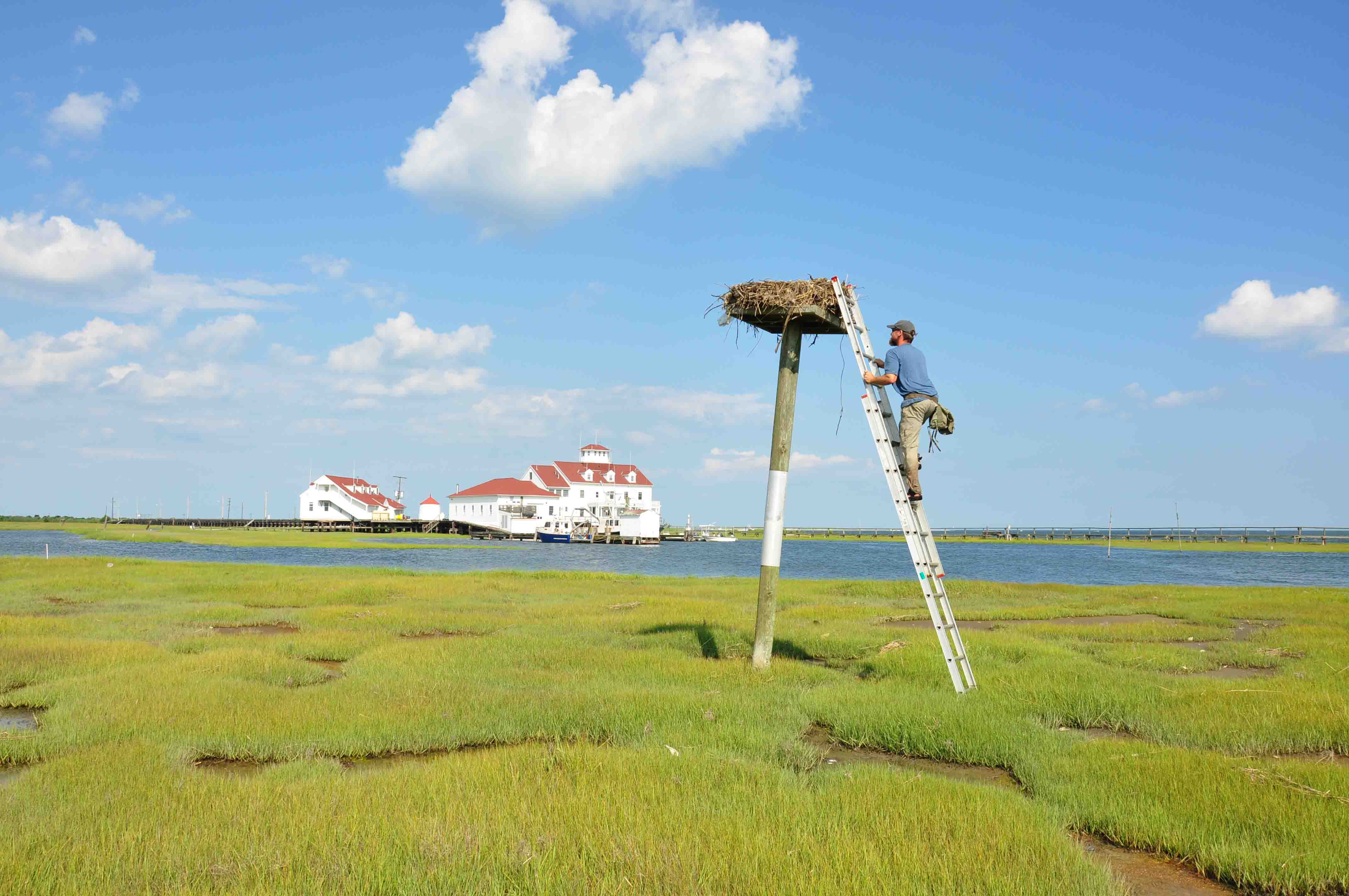
On June 29th I visited Fort Monmouth to survey the nesting platforms there. Four structures were occupied including this platform that was placed along a tributary of the Shrewsbury River, an area in need of more nesting structures for ospreys. A total of 8 young were produced there this year. The young were banded with a federal USGS bird band for future tracking.
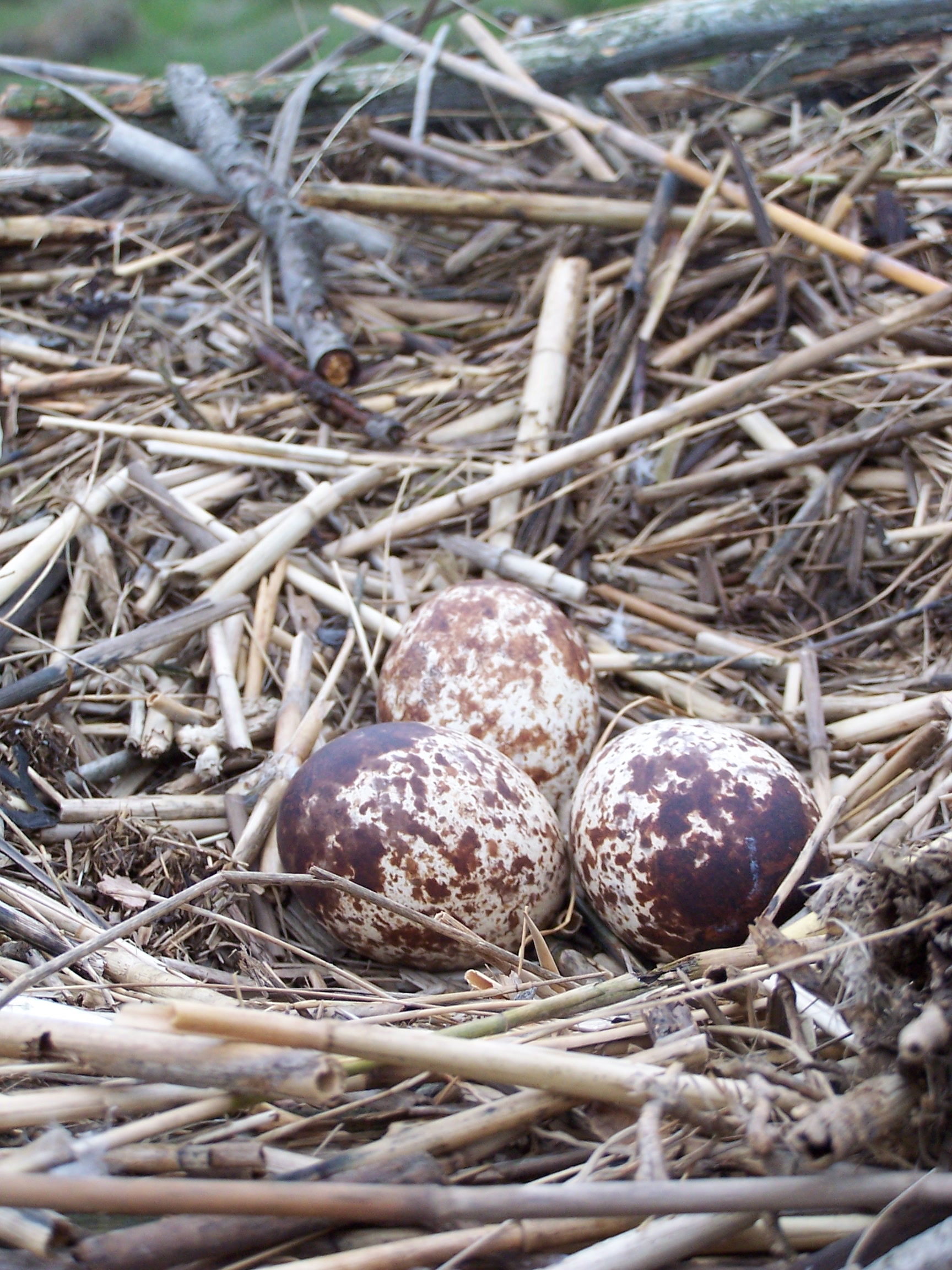
Osprey pairs are very busy this month. Females are hunkered down in nests while incubating their eggs. They must keep their eggs at a temperature of around 99 degrees Fahrenheit. They must maintain this temperature for over 32 days and up to 43 days! Warm air temperature and normal precipitation are crucial during incubation. If there are periods of extended rain and cool temperatures, then the success rate at raising young decreases.
Eggs are incubated immediately after they are laid. This is referred to as asynchrony. This ensures that during times of low prey availability at least one nestling will survive to fledge or leave the nest. Disturbance is critical to incubating females now. If they must leave the nest, then the eggs are very vulnerable to the suns radiation, cool air temperatures, and predators. Females do 70% of the incubation duties.
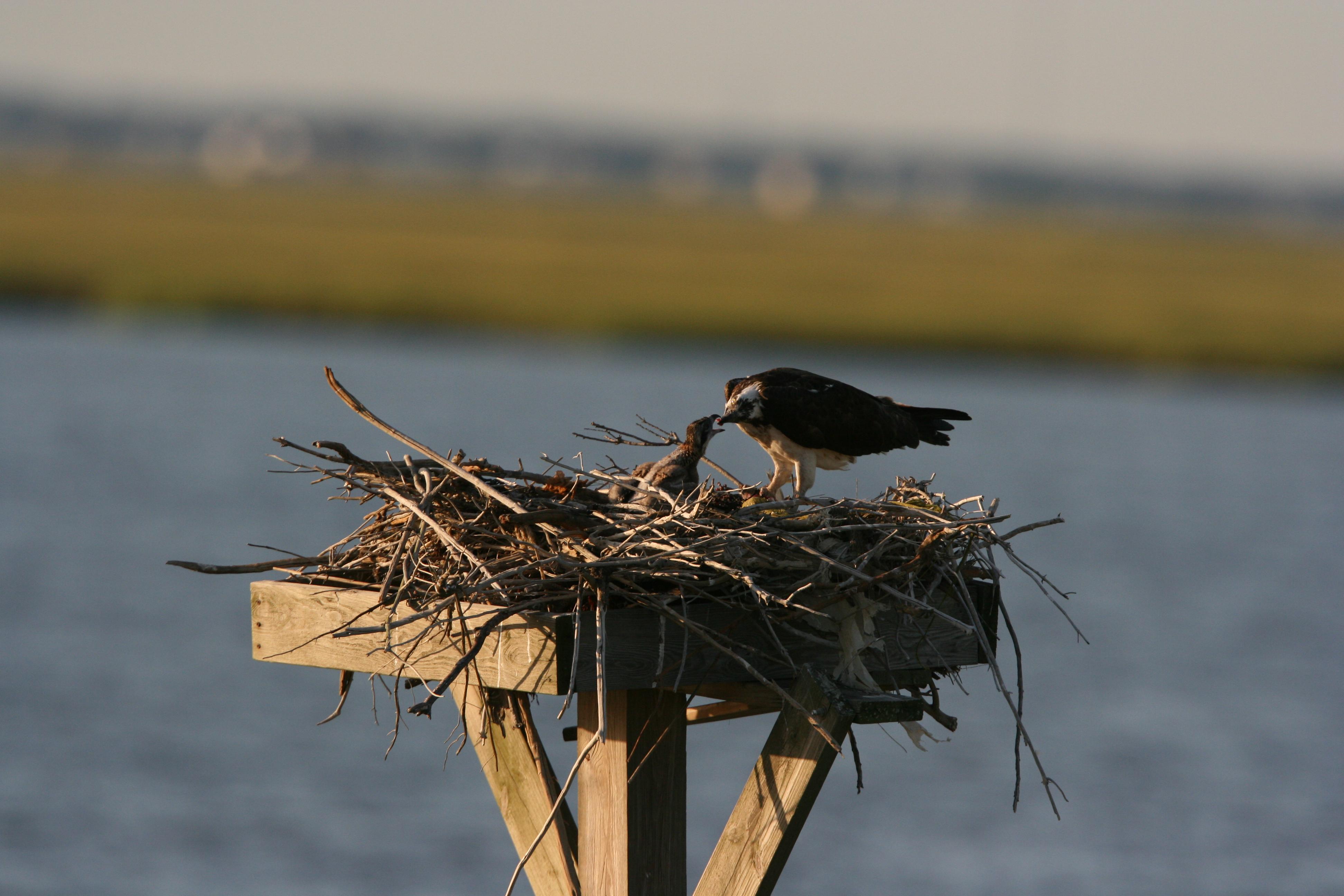
While females are sitting there, incubating those eggs, males are mostly on the wing or perched near the nest. They provide almost all of the food to the female. They can fly a few miles from the nest, or only a few hundred feet to find prey (live fish). This is why ospreys nest near water, their source of food. The males ability to provide food to the female is also crucial to the success of the pair at raising young.
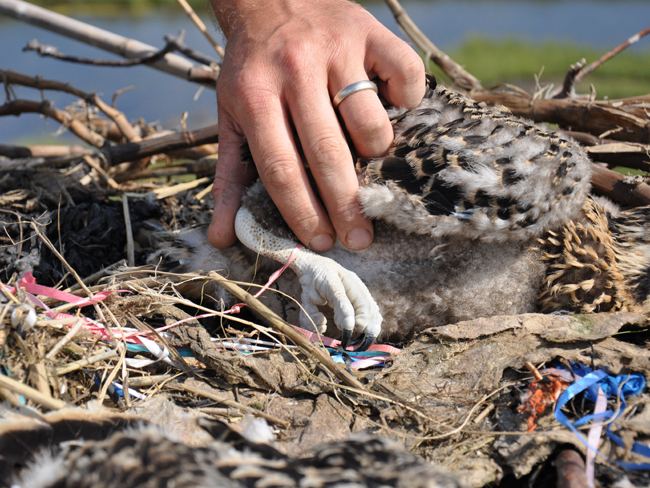
The young hatch (in the order that they were laid) and are born semi-altricial, or blind, feathered, and completely helpless. They are totally dependent on their parents to keep them warm and to provide them with food. They need very close parental care during the first week of life. After the first week the nestlings begin to more around more and begin exploring the surroundings in their nest. At three weeks of age (pictured at right) the nestlings can easily walk around the nest and often raise their heads to look around. Their contour (body) feathers and flight feathers begin to emerge from their protective sheaths during this time. The coloration of their feathers (dark brown with a buff feather tip) give them remarkable camouflage in the nest. Their coloration is very close to the nesting material ospreys use which consists of sticks, seaweed, marsh grasses, and human garbage like plastic bags, fishing line, and other trash.
I find a lot of ribbon from Mylar balloons every year. Some nestlings become entangled in the ribbon. If I do not get to the nest in time and remove the ribbon, then some may lose a limb or even die. It is not clear why adult ospreys choose to use fishing line and ribbon as nesting material. It may be because it is fairly common (unfortunately) in marine and estuarine ecosystems.
Keep an eye for hatching to begin two weeks from now. Females will not be sitting as much and they will be more aware of those eggs that are hatching beneath them. In late June and early July, volunteers throughout coastal areas will perform surveys by boat to determine the health of the population. I’ll post more updates soon on this in the coming weeks.
In the meantime, if you’d like to help, participate in coastal clean-ups or if you’re out for a walk or hike, bring a small trash bag and pick up some trash!