Gearing Up for Year 5 of Bird Monitoring at Horseshoe Island
Posted on
Just yesterday, as February comes to a close, I saw my first pair of American oystercatchers on breeding territory on Long Beach Island. The first piping plover of the season will likely be sighted in New Jersey sometime next week or so. Still, as we remain in the midst of one of the harshest and snowiest winters in a long time here on the New Jersey coast, it’s hard to believe that CWF staff will be back out at Horseshoe Island in just over a month to start biological monitoring for the 2026 beach nesting bird season.
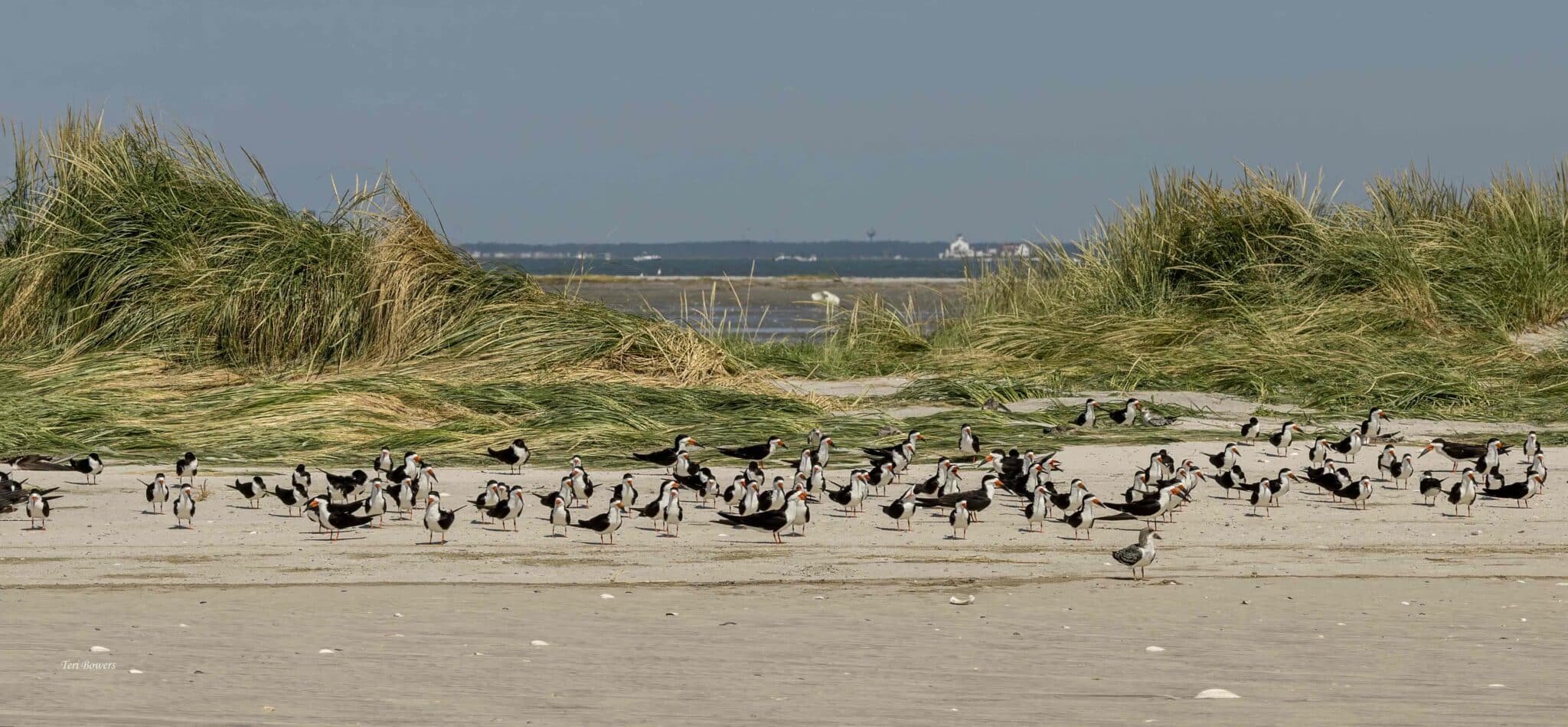
As a reminder, Horseshoe Island is situated just outside the southern edge of Little Egg Inlet and it only became viable as a bird nesting area, not regularly “disappearing” underwater at high tide, less than a decade ago. It is now one of the most important beach nesting bird sites in New Jersey, hosting a significant number of breeding American oystercatchers, black skimmers, common terns, least terns, and royal terns, as well as migratory shorebirds, such as red knots.
Some of the highlights of last year’s breeding season at Horseshoe island include the state’s largest black skimmer colony, the continuing presence of the northernmost royal tern colony in the Western Hemisphere, and the third largest concentration of breeding American oystercatcher in the state (18 pairs). Productivity varied depending on the species with skimmers chicks mostly succumbing to a major late season storm, while oystercatchers had another banner year producing enough fledglings to surpass the recovery goal for that species. The island itself continues to grow in size and morph in shape and now features stable dunes that persisted over the winter.
The upcoming season marks an important landmark in the monitoring and management of Horseshoe Island. It is the fifth and final year of an existing agreement between the state’s Tidelands Resource Council and New Jersey Fish and Wildlife (NJFW) to manage the island for the protection of at-risk wildlife. The agreement allows for the seasonal closure of the island to the public, including boaters, from March 1 to September 30 to help insure protection of breeding and migratory birds. Because it is one of the most important coastal breeding sites in the state, unique in New Jersey because of the public closure and lack of mammalian predators, conservation partners, including CWF, have already initiated efforts to extend the protections into the next decade.
Monitoring and management of the island is done as a partnership between CWF, NJFW, and Edwin B. Forsythe National Wildlife Refuge. For more information about the island, including the recently released 2025 report.
Discover more from Conserve Wildlife Foundation of NJ
Subscribe to get the latest posts sent to your email.