Every spring and summer, CWF’s staff swells as we hire seasonal field technicians to assist with our biological monitoring and conservation management. Nowhere is that more evident than on the beach nesting bird project.
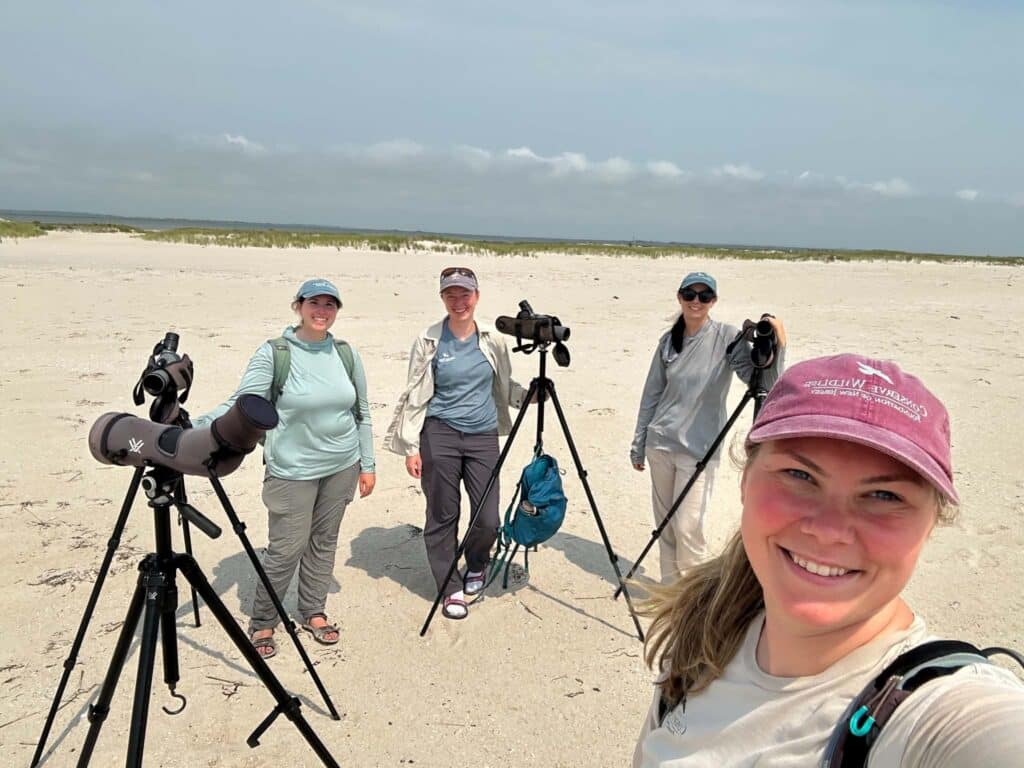
This year we hired four technicians for the monitoring we conduct on behalf of the U.S. Fish and Wildlife Service at the Holgate and Little Beach Units of the Edwin B. Forsythe NWR, as well as for colonial nesters at Horseshoe Island in partnership with New Jersey Fish and Wildlife (NJFW). In a new twist, we split one seasonal staff member between the Forsythe crew and to assist with surveys of American oystercatchers nesting in the nearby marshes of Great Bay and southern Barnegat Bay. And finally, we hired one seasonal technician to help monitor American oystercatchers nesting along the Delaware Bayshore. They worked under the combined guidance of our biologists Todd Pover and Emmy Casper.
Audrey Randazzo, Kaiulani Sund, Star Schaeffer, and Lina White
Every summer, volunteers across New Jersey spend their evenings watching the skies as bats emerge from their roosts. Through the Summer Bat Count, these observations help us better understand the status of New Jersey’s bat populations.
The Summer Bat Count is a volunteer-driven program led by the Conserve Wildlife Foundation of New Jersey and the New Jersey Endangered and Nongame Species Program (ENSP). Volunteers monitor known summer bat roosts such as attics, barns, bat houses, and churches, and count the number of bats that emerge at dusk.
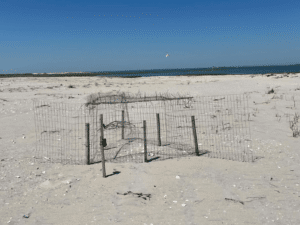
Earlier this spring, CWF received a grant from The Boston Foundation to study a new predator exclosure design to assist with piping plover recovery. Exclosures or nest “cages” have been used over the past several decades to protect plover eggs from predators such as red fox and crows. Although nest exclosures greatly increase hatch success, they can also increase the likelihood of an adult being killed by a predator. Unfortunately, over the years, New Jersey has struggled with high adult mortality associated with the traditional round exclosures.
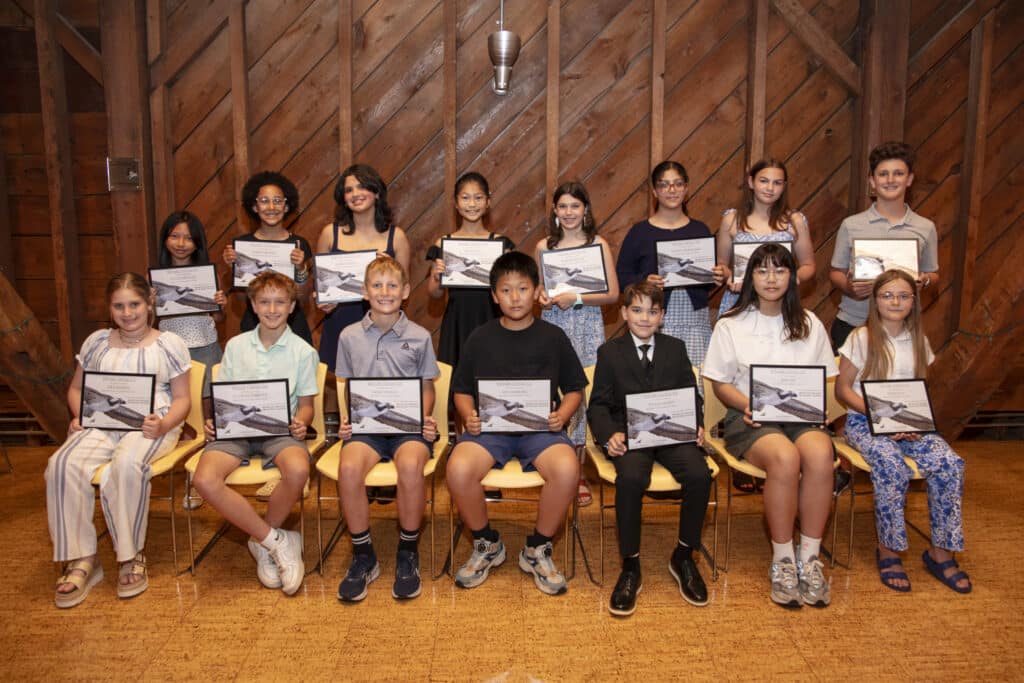
Winners of the 24th Annual Species on the Edge Art & Essay Contest gathered on June 12, 2026, to celebrate their achievements at an awards ceremony held at the D&R Greenway Land Trust Johnson Education Center in Princeton, New Jersey.
The Species on the Edge Art & Essay Contest is open each year to fifth-grade students across New Jersey. Participants select a threatened, endangered, or special concern species found in the state, research its conservation needs, and advocate for its protection through an original essay and artwork. A panel of judges selects first- and second-place winners from each participating county.
This year’s first-place winners and their families joined Conserve Wildlife Foundation board and staff members for a special celebration recognizing their outstanding work. Students received certificates honoring their accomplishments, and guests had the opportunity to view the winning artwork and essays on display. As part of their award, the first-place winners will also enjoy a special educational trip to Sedge Island in Barnegat Bay this summer.
We extend our sincere thanks to our generous sponsors—Atlantic City Electric, Church & Dwight, and Phillips 66 Bayway Refinery—whose support makes this longstanding program possible.
For more than two decades, the Conserve Wildlife Foundation of New Jersey has inspired fifth graders across the state to celebrate wildlife through the Species on the Edge Art & Essay Contest. Each year, students combine creativity, research, and conservation awareness to highlight New Jersey’s threatened and endangered species through original artwork and essays.
This year, students representing counties throughout New Jersey submitted impressive entries that reflected both artistic talent and a deep understanding of wildlife conservation. Participants selected a wide range of species to feature in their projects, showcasing the incredible diversity of wildlife found throughout the Garden State.
To enter the contest, students created an original piece of artwork and wrote an essay about a threatened, endangered, or special concern species, describing its habitat, challenges, and the importance of protecting it for future generations. Entries featured many remarkable species, from marine wildlife and migratory birds to reptiles, amphibians, and mammals native to New Jersey.
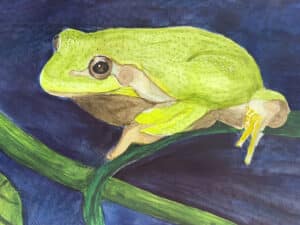
Artwork – Pine Barrens Tree Frog by Juha Lee of Morris County
A panel of judges, including CWF biologists and conservation professionals, carefully reviewed each submission. Judges evaluated the creativity and quality of the artwork and essays, along with the accuracy of the species representation and conservation information. After thoughtful consideration, one winner and one runner-up were selected from each participating county.
We are grateful to our contest sponsors Atlantic City Electric, Church & Dwight, and Phillips 66 Bayway Refinery.
We are excited to announce the winners of the 2026 Species on the Edge Art & Essay Contest and celebrate the outstanding efforts of all participating students, parents, teachers, and schools who helped make this year’s contest a success.
Atlantic County
First Place: Karsyn Priestley (Belhaven Middle School)
Second Place: Avalon Rendfrey (Belhaven Middle School)
Bergen County
First Place: Grace Lian (Manito Elementary School)
Second Place: Celine Cho (East Brook Middle School)
Camden County
First Place: Thomas Mohen (Homeschool)
Second Place: Hirva Patel (Mary E. Volz Middle School)
Cape May County
First Place: Chloe Cooper (Crest Memorial School)
Second Place: Avery Shapiro (Crest Memorial School)
Essex County
First Place: Samuel Aronoff (Yantacaw Elementary School)
Second Place: Arnav Mahajan (Yantacaw Elementary School)
Gloucester County
First Place: Leila Pacheco (J. Mason Tomlin Elementary School)
Second Place: Mira Gale (J. Mason Tomlin Elementary School)
Hudson County
First Place: Noreen Abdelmonem (Miftaahul Uloom Academy)
Second Place: Bhavya Golellu (Golden Door Charter School)
Hunterdon County
First Place: Emerson Pringle (Thomas B. Conley Elementary School)
Second Place: Reilly W. Evangelista (East Amwell Township School)
Mercer County
First Place: Alexander Ren (Stony Brook Elementary School)
Second Place: Riaan Puhan (Stony Brook Elementary School)
Middlesex County
First Place: Anthony Yurkovic (Hammarskjold Upper Elementary School)
Second Place: Isabella Osorio (Greater Brunswick Charter School)
Monmouth County
First Place: Emma Smith (Manasquan Elementary School)
Second Place: Shane Shelly (Manasquan Elementary School)
Morris County
First Place: Juha Lee (Valley View Elementary School)
Ocean County
First Place: Grady Pearsall (Nellie F. Bennett Elementary School)
Second Place: Delaney Fitzgerald (Nellie F. Bennett Elementary School)
Salem County
First Place: Lila Jusko (Creativity CoLaboratory Charter)
Second Place: Anderson Ale (Creativity CoLaboratory Charter)
Somerset County
First Place: Beverly Medina (School of Saint Elizabeth)
Second Place: Charlotte Yang (Mount Horeb Elementary School)
Sussex County
First Place: Violet Csencsits (Sandyston-Walpack Consolidated School)
Second Place: Imanol Cornejo (Sandyston-Walpack Consolidated School)
Union County
First Place: Noelle Mendoza (St. Theresa School)
Second Place: Nyah Harris (St. Theresa School)
Warren County
First Place: Hazel Ochs (Ridge and Valley Charter School)
Second Place: Bayla Philips Moraa (Memorial Elementary School)
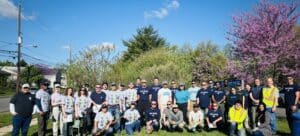
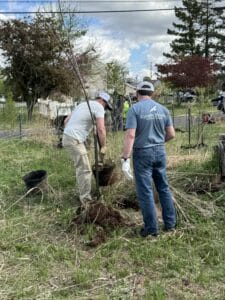
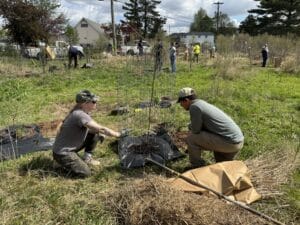
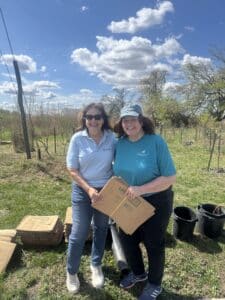
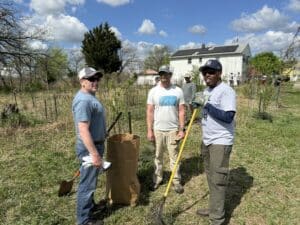
On April 17, the Conserve Wildlife Foundation of New Jersey gathered at Tremley Point in Linden for the Blue Acres Floodplain Restoration Spring Planting and Clean-up Day. In partnership with Phillips 66, Infineum, FirstEnergy, Groundwork Elizabeth, and the City of Linden, volunteers planted trees, cleared invasive weeds, and enhanced green spaces.
This ongoing restoration project, launched in 2020, focuses on protecting flood-prone areas, creating wildlife habitat, and strengthening climate resilience. During the event, the team planted 60 native trees and shrubs and removed debris, improving site conditions and supporting the return of native vegetation. These efforts help reduce pollution and create a healthier environment for both wildlife and the surrounding community.
The New Jersey Department of Environmental Protection’s Blue Acres Program focuses on acquiring properties in flood-prone areas, relocating residents, and converting those vulnerable lands into natural floodplains. These restored areas serve as buffers during storms, absorbing excess water and reducing flood risks for surrounding communities.
The April 17th visit brought together a great group of partners and volunteers, all working toward a shared goal of restoring the ecological function of the site while enhancing its value for the community. Each planting contributes to stabilizing the soil, improving water quality, and rebuilding habitat for native wildlife. Over time, these efforts help transform previously developed land into thriving green space.
Native plants play a big role in this work. By reintroducing species adapted to local conditions, the team helps outcompete invasive plants while creating habitat for pollinators, birds, and other wildlife. These plantings also improve the site’s ability to filter runoff and reduce erosion which is an important function in areas that regularly experience flooding. Rain gardens and low-lying areas across the site further enhance stormwater management while supporting biodiversity.
Projects like Blue Acres highlight how conservation and climate resilience go hand in hand. By restoring floodplains and wetlands, these sites not only provide critical wildlife habitat but also help safeguard nearby communities from the increasing impacts of severe storms and sea-level rise. The work completed on April 17th is one piece of a much larger effort. One that will continue to evolve as native vegetation establishes and the landscape gradually returns to a more natural state.
Installing bat houses along utility rights-of-way can seem like a natural fit, these open, linear corridors often provide ideal flyways for bats and can support abundant insect life. However, getting bats to actually use those structures is another story. Even with thoughtful placement and a variety of bat house designs, occupancy is never guaranteed.
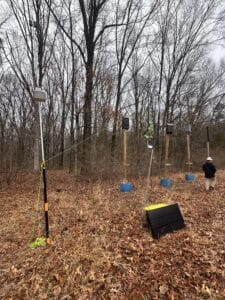
Light lure set up with the array of bat houses, hobo logger, and acoustic device
Last year, EPRI, DuBois Environmental Consultants, and First Energy Corp installed bat houses along FirstEnergy rights-of-way, with multiple designs grouped together to increase the chances of success. To better understand how bats were interacting with these sites, acoustic monitoring devices were also deployed. The acoustic data confirmed that bats were actively using these corridors for foraging and movement, highlighting that the habitat itself was suitable.
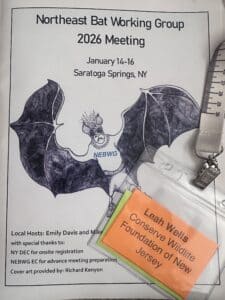
This year marked my third time attending the Northeast Bat Working Group (NEBWG) annual meeting, held in Saratoga Springs, New York. Over the past few years, this three-day conference has become a valuable space for connection, learning, and collaboration among bat biologists, researchers, and educators from across the region. Once again, the meeting was both engaging and energizing, offering new perspectives while building on conversations from years past.
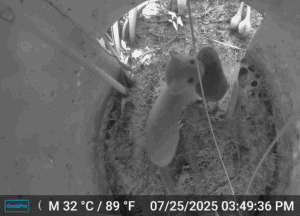
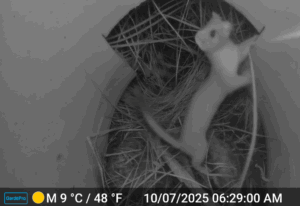
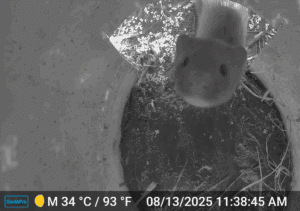
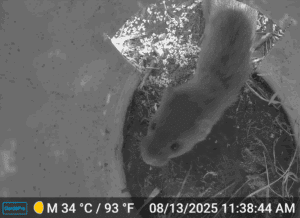
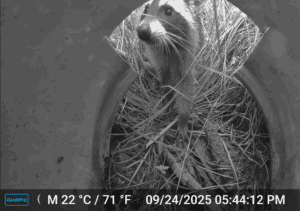
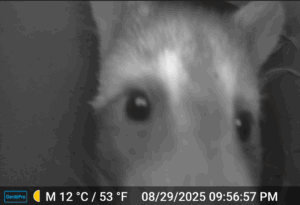
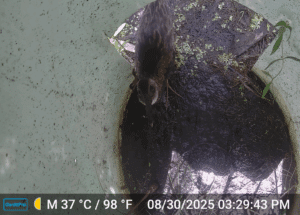
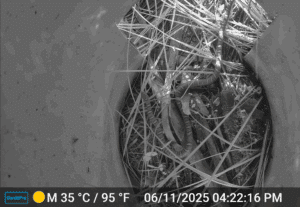
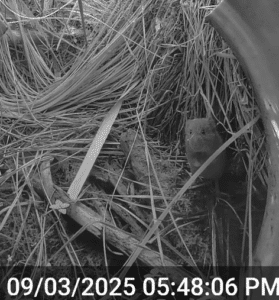
A collection of some of my favorite camera trap photos from the field, capturing candid moments of New Jersey wildlife and offering a glimpse into the species we encounter through our monitoring work.
Enjoy!
Short-tailed weasel with a moleShort-tailed weaselAmerican minkAmerican minkRaccoonRaccoonVirginia RailEastern milk snakeA meadow vole
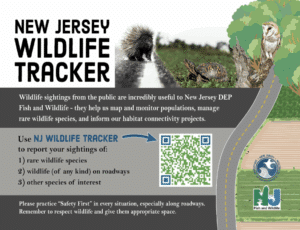
The New Jersey Endangered Species List just got expanded, which leaves more data to be submitted to the New Jersey Wildlife Tracker! The NJ Wildlife Tracker is our go-to place for submitting: 1) rare wildlife species sightings as well as 2) observations of wildlife (of any kind) on roadways.
Our biggest submissions of commonly known species are bobcats, box turtles, and Bald Eagles! Bobcats are found in over half of New Jersey counties and are native wild cats historically found throughout New Jersey.
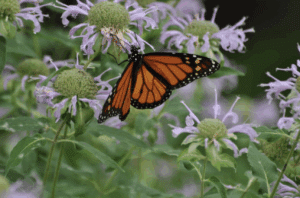
We also have a significant number of commonly known species that were added to the Endangered Species List that you might be surprised to see listed there. A few of these that you might be familiar with include: Green Heron, Purple Martin, Northern Diamond-backed Terrapins, Bottlenose Dolphins, and the Monarch Butterfly.
Monarch Photo submitted by Janet Hammond through the NJ Wildlife Tracker.
A fact that is even more surprising than this precious butterfly being listed as Special Concern is that ALL bat species in New Jersey are now on the list, Yikes! If you happen to encounter on any of these precious bat species injured, please contact a NJ Licensed Wildlife Rehabilitator who treats bats. If you would like to learn more about how New Jersey Fish and Wildlife are combatting this, you can read all about it on their website NJDEP| Fish & Wildlife | Bat Conservation.