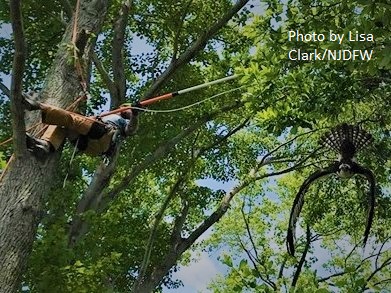
Update May 30, 2019: Another example of the dangers of fishing (or this time crabbing) line unfolded in dramatic fashion in Tuckahoe Wildlife Management Area. CWF biologist Ben Wurst was called upon to put his climbing skills to the test to help an osprey dangling high above the ground. Thankfully Ben was able to get to the bird in time, and our friends at Tri-State Bird Rescue and Research nursed the osprey back to health and were able to re-release him near where he was found. Read more about the daring rescue on our Facebook page.
Ben Wurst puts his climbing skills to the test to rescue and entangled osprey
As thousands of people plan their trips to the Jersey shore for Memorial Day weekend, it is a good time think about how to help out shore and sea birds. Enjoy the holiday weekend!
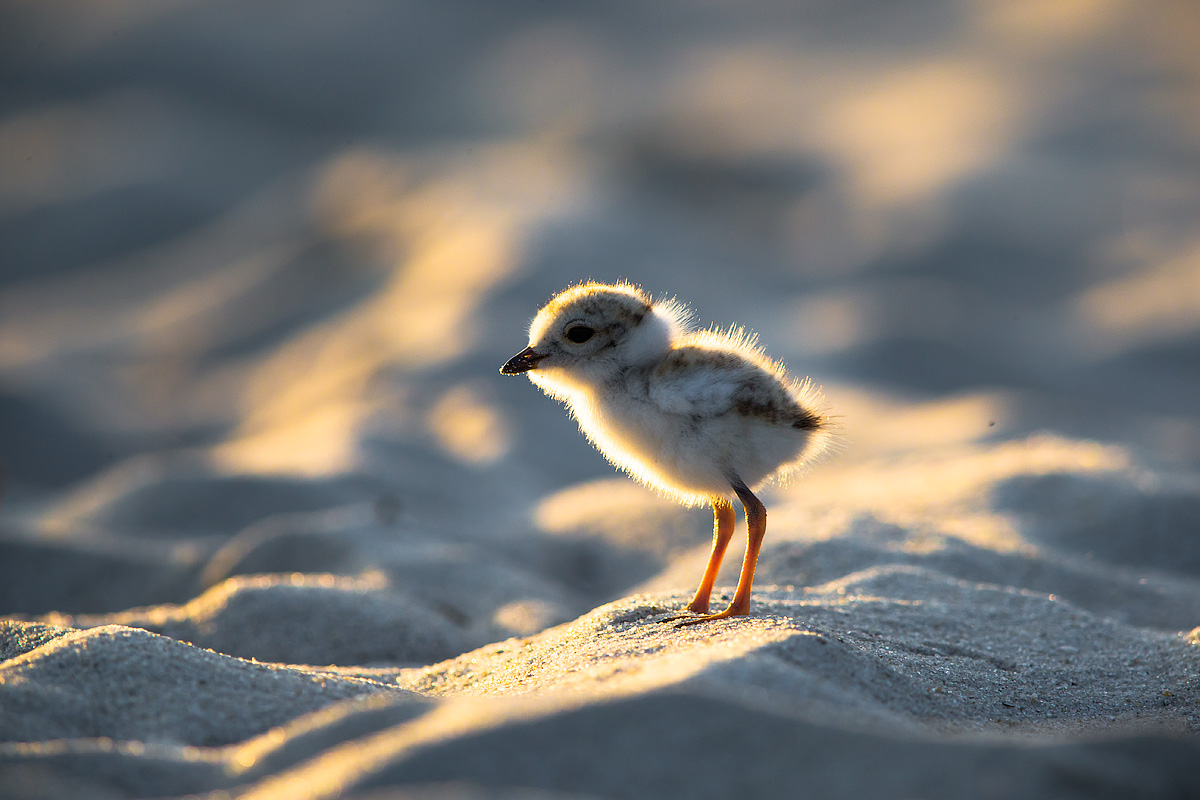
The 141 miles of seashore in New Jersey are home – or at least part-time host – to many of the birds Conserve Wildlife Foundation protects and nurtures. Osprey, oystercatchers, black skimmers, piping plovers, red knots, and many others rely on a healthy coast to thrive.
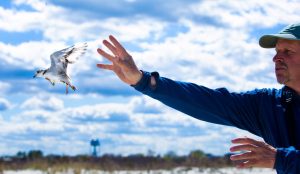
Senior biologist for the Conserve Wildlife Foundation of New Jersey Todd Pover releases a piping plover, a species he has helped monitor for 25 years. (Jim Verhagen)
On October 29, 2012, Hurricane Sandy plowed ashore near Atlantic City, N.J., with sustained winds of 75 miles per hour. In its wake, state officials declared it the most destructive natural disaster in the history of New Jersey. It changed communities dramatically.
Natural features of the coastline underwent significant changes too, but in some cases, those changes presented new conservation opportunities that could protect people and wildlife in the face of future storms.
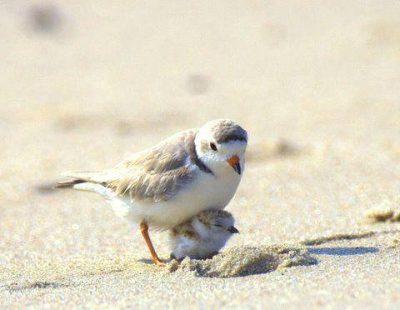
“We were able to identify places where piping plover habitat had been enhanced by the storm,” explained Todd Pover, a senior biologist for the Conserve Wildlife Foundation of New Jersey who has been involved in monitoring the federally threatened shorebird for 25 years. Places like Edwin B. Forsythe National Wildlife Refuge, where the storm erased the dunes in a three-quarter mile stretch of beach, creating an open expanse from ocean to bay.
A new study investigates the habitat preferences of endangered Red Knots in their vast, remote Arctic breeding range. Credit: M. Peck for Phys.org
by The American Ornithological Society, via Phys.org
Rutgers University’s Richard Lathrop, Conserve Wildlife Foundation of New Jersey’s Larry Niles, and their colleagues attached radio tags to 365 knots captured while migrating through Delaware Bay in 1999-2006. To learn where and in what sort of habitat the tagged birds nested, they then conducted surveys via small airplane across the south and central Canadian Arctic, a vast study area spanning from Victoria Island in the west to Baffin Island in the east.
The study shows that there are more than 74,000 square kilometers of suitable rufa Red Knot habitat across their Central Arctic breeding range—enough space for at least that many breeding pairs, assuming one square kilometer of territory per nest.
With the stopover period winding down, we can say the red knot and other shorebird species left the bay in better condition than the disastrous condition of last year. So what does it mean?
First, the last four years have been a sort of ecological roulette for the birds. Horseshoe crab numbers remained at only 1/3 the potential population possible on Delaware Bay leaving birds at the mercy of good conditions to get enough eggs. Last year, water temperatures stayed low during the mid-May depressing the spawn and the density of eggs. Although the average was 8000-eggs/square meter, there were less than 2000 eggs/ meters square in the month of May. Continue reading “Birds in better condition than last year but still face an ecological roulette”
The best news is a direct consequence of these good conditions, the number of knots and turnstones increased this year. Our season-high estimates show that there are 34,500 knots in the bay and 21,000 ruddy turnstones. These may be the highest counts on the bay in at least 15 years.
Why? At first one would conclude the increased numbers on the bay represent a real increase in the size of the population, but it is not. Shorebirds need time to respond to improving conditions because they are relatively slow breeders, as are most Arctic breeders. Knot numbers on Delaware Bay basically depend on the availability of crab eggs. In bad years, numbers go down because birds come to the bay and leave quickly. Continue reading “Good horseshoe crab egg densities draw 34,500 Red Knots to the bay”
The horseshoe crabs extended their breeding period into the neap tide phase after the cold weather of mid-May decreased water temperature during the spring tides. The crabs roughly require a water temperature of about 59 degrees F before breeding begins in earnest. Crabs still breed at a lower temperature, but many more will breed above the temperature threshold.
At the same time, crabs also look for spring tides, the higher high tides that come with full and new moons, because they can breed in sandy places unavailable at lower tides. This year the water cooled during the new moon spring tide and warmed in the neap. Good spawning during the neap tides of the last week was welcome good news. This May good spawning conditions will raise average egg densities about 50% higher than last year. Continue reading “Horseshoe crabs expanded breeding into neap tides”
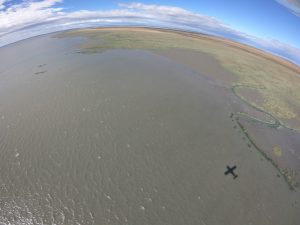
Just above and to the right of the plane shadow, thousands of shorebirds gather. Photo by Joe Smith
CWF scientists recently returned from a trip to Tierra del Fuego where they studied red knots and other migratory shorebirds that spend the month of May at New Jersey’s Delaware Bayshore.
CWF consultant Joe Smith captured some incredible aerial images of the coastline holding a flock of thousands of shorebirds in his blog story. See more photos of the flock and read Joe’s introductory overview about the trip here. Stay tuned for more installments about this vital trip.
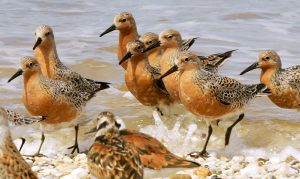
The Press of Atlantic City covered the troubling findings of Conserve Wildlife Foundation’s recent expedition to Tierra del Fuego in Chile to survey wintering red knots.
The numbers of red knots – an endangered migratory shorebird that spends every May along New Jersey’s Delaware Bay coast feasting on horseshoe crab eggs – declined by more than 20 percent between the team’s counts last year and this year.
As part of the Beach Nesting Birds team last season, I had grown accustomed to scouring the beach daily for signs of birds: tracks, scrapes, nests and eventually adorable chicks. On my free time, my beach walks are spent combing the beach for various treasures. Yesterday, I had a new reason to walk the beach and I had to re-train my focus to something that never caught my interest before. It was my first survey for the endangered beach plant, seabeach amaranth (Amaranthus pumilus). Continue reading “Beach Plants Need Love, Too”

 The Press of Atlantic City covered the troubling findings of Conserve Wildlife Foundation’s recent expedition to Tierra del Fuego in Chile to survey wintering red knots.