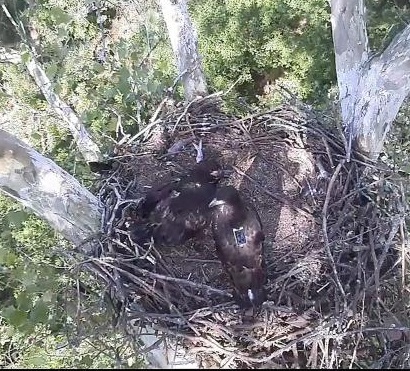
May 25th, 2019. Duke getting fitted with transmitter
A transmitter was placed on a chick from the Duke Farms Eagle Cam nest for the first time this year. This nest cam has been watched by thousands of people over the years and now cam watchers will be able to follow the movements of “Duke” after fledging.
January 13, 2019, Mercer County Park. NJ D/99banded at Duke Farms in 2014 @Bob Cook
Conserve Wildlife Foundation of NJ in partnership with the
NJ Division of Fish and Wildlife’s Endangered & Nongame Species Program, is
releasing results of the 2019 NJ Bald Eagle nesting season.
2019 was a record year for NJ eagles with the highest number
of active nests and young fledged in the history of the project. This year, 238 eagle nests were monitored, of
which 189 were active (laid eggs) and 248 young fledged. This is the highest number of fledges ever,
surpassing the previous high of 216 in 2016.
Bald eagle nesting population and young produced in New Jersey, 1982-2019.
We owe the incredible amount of information about NJ eagle success
to the NJ Eagle Project nest watchers. An
extremely dedicated group of approximately 85 volunteers monitor nests during
the season, recording the important dates and watching for possible issues at
nest sites.
This season two eagle cams were available to watch on the CWF website: one at Duke Farms and another at Mercer County Parks. The Duke Farms nest produced two chicks, and one was outfitted with a satellite transmitter; the movements of this eagle are on CWF’s Eagletrax website .
More details on the 2019 nesting season will be available in
the annual eagle report to be posted by December. The report will include individual nest data, state
totals, and eagle recoveries and resightings.
CWF partners with PSEG, the Mercer County Park Commission, Mercer County Wildlife Center, and Wildlife Center Friends and Duke Farms to protect bald eagles in New Jersey. Thank you to the Wakefern Food Corp./ShopRite Markets, Wells Fargo, Chemours and the American Eagle Foundation for additional eagle program funding.
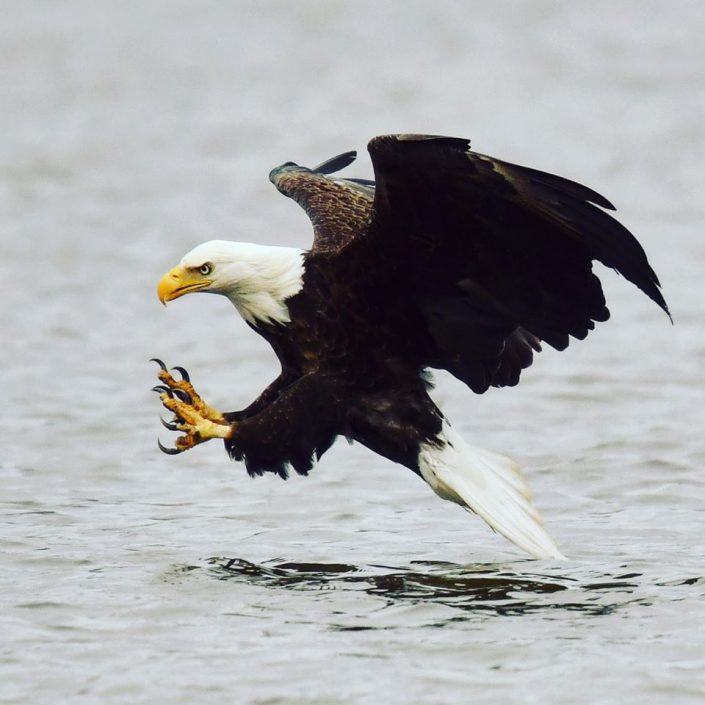
Asbury Park students and staff pose with their “talons up” after seeing an Osprey snatch a fish from the ocean.
Conserve Wildlife Foundation of New Jersey (CWF), the Asbury Park mayor’s office and public schools, and New Jersey Natural Gas hosted Wildlife Wednesdays Field Experience at North Beach at the end of July. The hands-on, project-based outing taught elementary school students about Asbury Park’s rare wildlife, and how to protect and preserve the environment the kids – and wildlife- call home.
The breeding season started off well enough for the peregrine
family that star on our Falcon Cam in Jersey City this year. Four eggs were
laid, three sisters hatched, were banded and were growing up high atop the
skyscraper at 101 Hudson Street. Thousands of viewers enjoyed seeing them
flapping and jumping, strengthening their flight muscles for their first flight
to fledge from the nest.
Eagle enthusiasts in New Jersey have plenty to celebrate
today on National Bald Eagle Day. Thanks to our dedicated Bald
Eagle Project volunteers we know that so far this year 96 bald eagles have
fledged from their New Jersey nests! Eagles have come a long way in the Garden
State since the early 1980s when there was only one active nest in the whole state.
Two sets of peregrine falcon chicks were recently banded high atop buildings in Elizabeth, Union County, and Jersey City. Biologists from Conserve Wildlife Foundation (CWF) and the New Jersey Department of Environmental Protection’s Endangered and Nongame Species Program (ENSP) checked the health and measurements of the falcons, while also placing both United States Geological Service bird bands and state auxiliary bands so the birds can be identified in the future.
Two bald eaglets at the site of our Eagle Cam at Duke Farms were recently banded by biologists from Conserve Wildlife Foundation (CWF) and New Jersey Department of Environmental Protection, Endangered and Nongame Species Program (NJDEP ENSP).
This year’s banding was special, as in addition to a band the male eaglet was also fitted with a transmitter which will allow him to be tracked on our Eagle Trax page.
View of transmitter on the male eaglet, on the right
Kathy Clark, (NJDEP ENSP), and Larissa Smith (CWF) wrote about the experience, and the benefits of transmitters on the Duke Farms blog. Their FAQ’s are reprinted below.
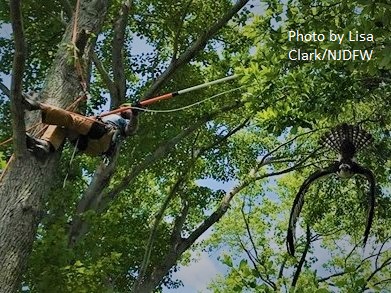
Update May 30, 2019: Another example of the dangers of fishing (or this time crabbing) line unfolded in dramatic fashion in Tuckahoe Wildlife Management Area. CWF biologist Ben Wurst was called upon to put his climbing skills to the test to help an osprey dangling high above the ground. Thankfully Ben was able to get to the bird in time, and our friends at Tri-State Bird Rescue and Research nursed the osprey back to health and were able to re-release him near where he was found. Read more about the daring rescue on our Facebook page.
Ben Wurst puts his climbing skills to the test to rescue and entangled osprey
As thousands of people plan their trips to the Jersey shore for Memorial Day weekend, it is a good time think about how to help out shore and sea birds. Enjoy the holiday weekend!
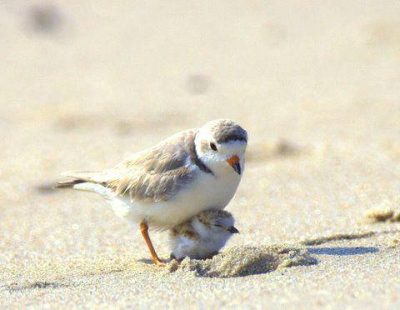
The 141 miles of seashore in New Jersey are home – or at least part-time host – to many of the birds Conserve Wildlife Foundation protects and nurtures. Osprey, oystercatchers, black skimmers, piping plovers, red knots, and many others rely on a healthy coast to thrive.
The third
Friday in May has been a celebration of our nation’s wildlife and wild places
since 2006, when the United States Congress established the holiday. There is a
special urgency this year as the United Nations recently reported that nearly
one million species worldwide are at risk of extinction within decades (read
our post about the UN report for more information).
One of the
main points the report makes is that humans are dangerously degrading Earth’s
ecosystems, the delicate, interconnected webs of life that we all, people and wildlife
alike, need to survive.
Ospreys have made great progress toward recovery in New Jersey, rebounding from a low of 50 nests in 1974 to 589 active nests in 2018. This progress should be celebrated, and victory can and should be declared, as The Press of Atlantic city suggested in their March 1 editorial “Maybe it’s time NJ declares victory in restoration of ospreys.”
But as a biologist who has studied ospreys for many years I also know that declaring victory doesn’t just mean we should walk away and abandon them.