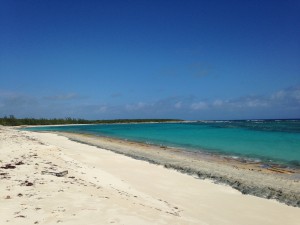
Piping plover roosting beach on the island of Eleuthera, Bahamas.
Up until now, nearly all of our piping plover conservation work in the Bahamas has been focused on the island of Abaco. One of the objectives of our Disney Worldwide Conservation Fund grant is to identify other islands and partners where and with whom the model we are developing on Abaco might be implemented as well. With this in mind, we spent the past several days on the island of Eleuthera.
Although we believe the basic elements of our Abaco work are transferable to other islands, a “one size fits all” approach may not entirely work. The various major islands are unified under the Bahamas flag, but each also has its own flavor, history, and way of life. The best analogy would be that they operate much like the individual states in the U.S.
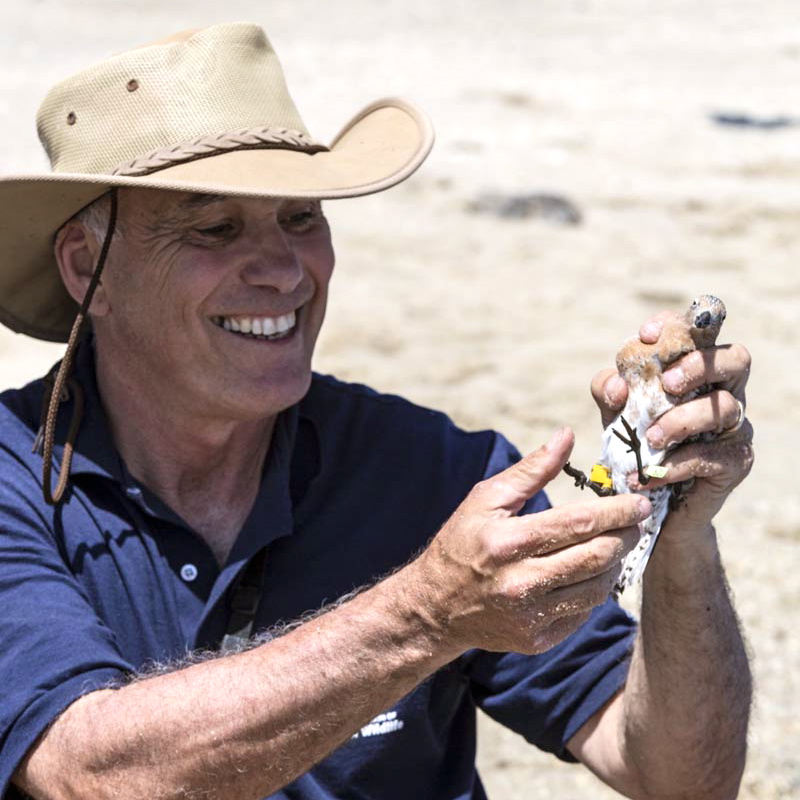
On Abaco, we have been partnering with Friends of the Environment, a non-profit organization with a strong education and outreach component to all of their work – not so different from what we do here at the Conserve Wildlife Foundation. On Eleuthera we are hoping to partner with the Cape Eleuthera Institute (CEI) and The Island School. Although education is at the core of their work as well, it is also different in that they carry out and support primary research and host visiting scientists and students at their campus. Continue reading “Bahamas Piping Plover Project”
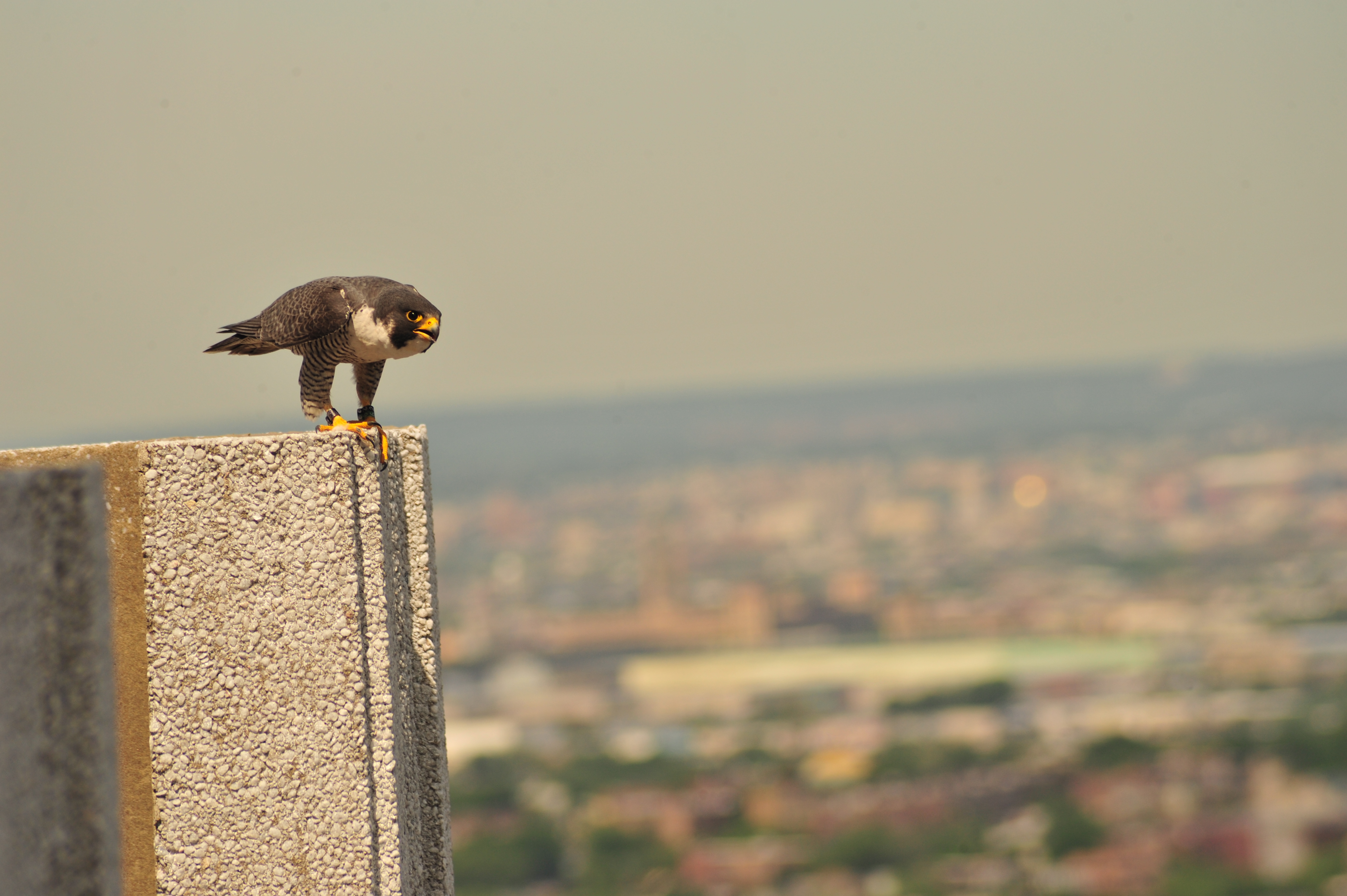
Since 2000, a pair of state endangered peregrine falcons have nested on a building in Jersey City, New Jersey. Peregrine falcons are drawn to urban areas since there are high levels of prey (pigeons) and suitable areas to nest (building ledges and outcrops). To follow along with their daily life cycle a webcam was first installed in 2001. Since then it has broadcast their success and struggles over the years to reproduce and help bolster the population in the state.
Peregrines have made a remarkable recovery in New Jersey since their reintroduction in the 1970s, and the Falcon Cam has allowed us to help raise awareness for their conservation. This past year we learned that the NJ Division of Fish and Wildlife, who hosted the camera since it’s installation, no longer has funding to maintain the webcam. Over the next month we’ll be fundraising to help keep the webcam online! At the same time we’ll also be featuring a weekly series “The Month of the Falcon” with insight from biologists and awesome photos of peregrines from New Jersey.
Dispatch from Green Turtle Cay, Abaco, The Bahamas
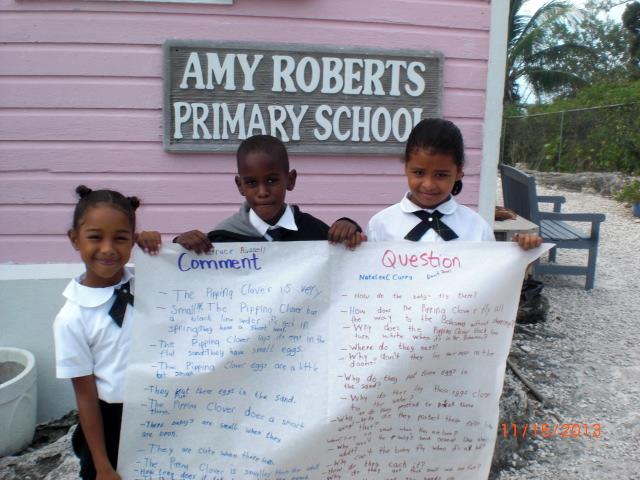
Sister School students of Amy Roberts Primary School, Abaco, The Bahamas, working hard on their Piping Plover Unit!
The Conserve Wildlife Foundation of NJ continues to be extremely excited about our sister school project which links a school on Green Turtle Cay in Abaco, The Bahamas and one in Ocean City, New Jersey, USA through piping plover conservation. We particularly like how it is shaping up to be a multi-disciplinary educational initiative. Below is a report we received last week from Jan Russell, the project teacher from the Amy Roberts Primary School on Green Turtle Cay:
Today was the first official in-class activity to start the Joint Piping Plover Unit. On Monday the students were placed in groups based upon their strengths and identified cooperation skills. The first activity included a review of the Power Point presentation presented by Todd Pover and Stephanie Egger of CWFNJ when they visited us on November 5, 2013. As each slide was presented, each group recorded a comment or question on a large sheet of poster paper. The comments and questions will be used to develop our research direction and our final product choices. Continue reading “Piping plover sister school project”
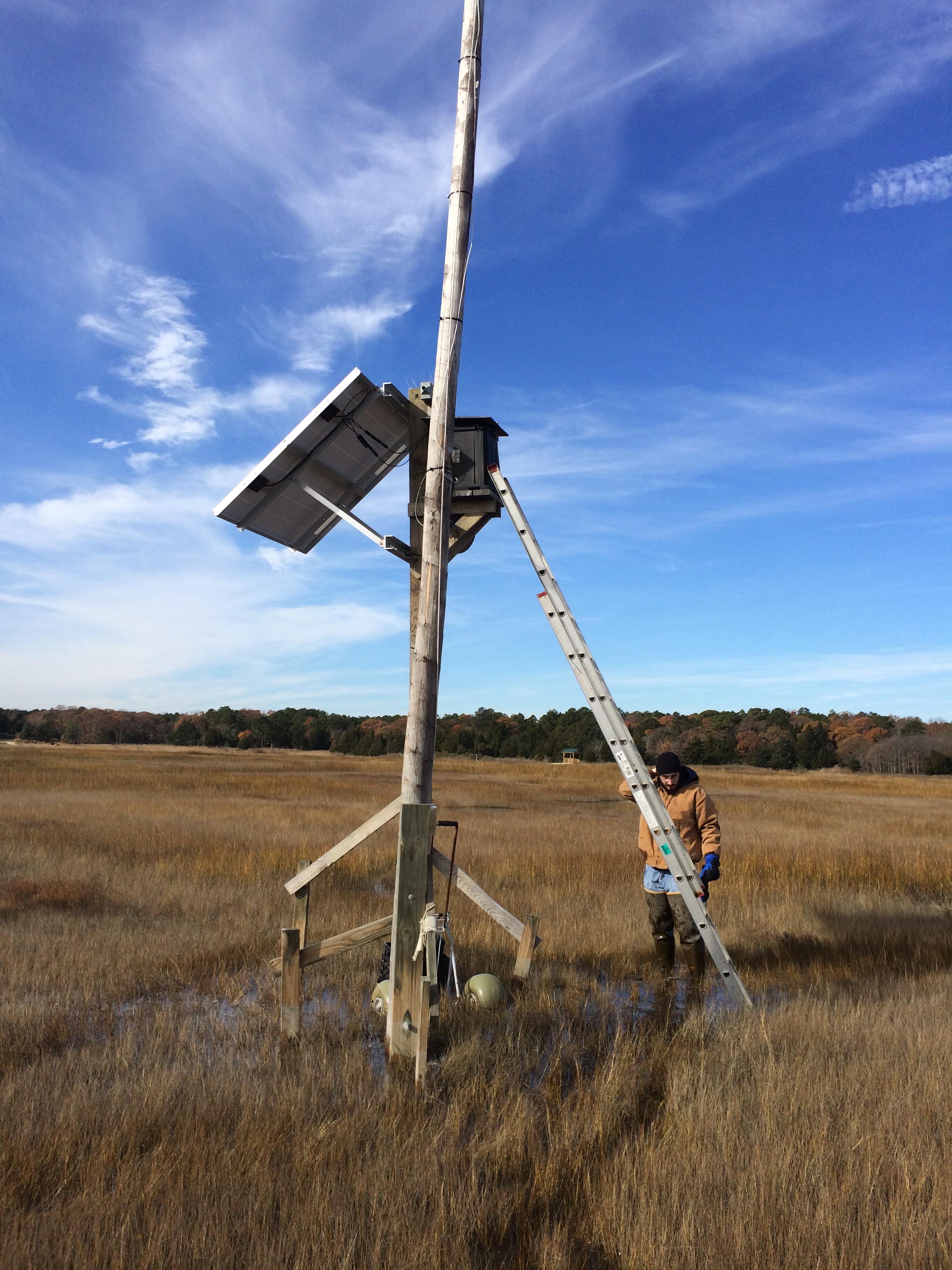
Last week we set out to finally repair the osprey cam at Edwin B. Forsythe NWR. (Note: we do all of the technical repairs and maintenance to the camera system) Initial repairs were delayed to protect the osprey young. Timing restrictions are set in place to reduce disturbance to nesting ospreys and nests cannot be disturbed from April 1 – August 30. This is a good thing! When we finally set out to figure out the issue with why the camera suddenly lost power, we had to wait until it was safe to enter the nest. When we first went out (August 15) for a quick diagnosis (after we knew all young were flying and not relying on the nest as much) and got the cam online again…but it died after 30 minutes of streaming…
We went out again in late September and determined it was the solar charge controller but had to wait to get a new one. In October we went out out to replace the charge controller but the system was still down and the equipment was not getting power. The two batteries only had 6 volts of charge and needed to be recharged. So, the two 50lb. batteries were lugged a pretty long distance and charged up. Once they held a charge we made plans to go back to re-install them and hoped it would work. Success!! The batteries powered up the system and within minutes the camera was streaming online!
Special thanks to volunteer Joe Bilotta for helping out with the re-installation of the batteries!
Encourage your 5th graders to find out by entering the Species on the Edge Art & Essay Contest!
by Maria Grace, Education & Outreach Manager
Now in its 11th year and open to all 5th graders throughout New Jersey, the very popular Species on the Edge Art & Essay Contest encourages students to think about rare wildlife in New Jersey.
To enter the contest, students research a species of wildlife that is rare or endangered in New Jersey. They write an essay detailing the needs of the species and the challenges to its future existence. They then create artwork – a painting or collage – depicting their chosen animal in its natural habitat.
Over the past 10 years, over 25,000 students have entered the contest and have expanded their knowledge about New Jersey’s imperiled wildlife. Hundreds of teachers throughout the state have participated in the contest and have praised its interdisciplinary approach and its ability to create a deep appreciation for nature:
“My students love the Species on the Edge Contest because they enjoy learning about the many endangered animals in New Jersey, which fits into our curriculum. The contest helps raise their awareness about how humans interact with the natural world. My students take ownership of one species, and through artwork and research, they express their concerns about the environment and how to protect it.”
–Mary Keyser, Maple Road School, West Milford, NJ
A winner is chosen from each county in NJ, 21 winners in all. The winning artwork and essays become part of a statewide traveling exhibit, helping to raise awareness for New Jersey’s endangered wildlife.
The contest is free and it’s easy to participate! Download your contest kit today from our website. The kit contains everything you need to participate – lesson plans, entry forms, and a list of approved resources for research.
A young Barn Owl, healed of a leg fracture and about to be returned to its nest. Photo by MacKenzie Hall
Wildlife rehabilitation is the process of caring for injured, ill and orphaned native wild animals with the goal of releasing each back to their natural habitat. This course is designed for individuals interested in becoming licensed wildlife rehabilitators, rehabilitators who wish to include additional species to their current permit and any person wishing to obtain knowledge about native New Jersey wildlife. Over the course of five (5) weekdays, students will have the opportunity to be taught by, interact with, and build relationships with some of the foremost experts in wildlife rehabilitation.
Course Description
The Basic Training Course for Wildlife Rehabilitation focuses on the skill sets necessary to become a successful wildlife rehabilitator. This course offers information and professional training provided by some of the most knowledgeable instructors in the field of wildlife rehabilitation. It includes history, licensing requirements and regulations, mammal, bird and reptile species identification and anatomy, proper handling, care and nutrition, medical procedures, and much more. Approved by the New Jersey Division of Fish & Wildlife (NJDEP), this course is part of an alternative route program to meet New Jersey State licensing requirements for wildlife rehabilitators. Successful completion of the course will count for 40 hours toward the 200 hour New Jersey apprenticeship licensing requirement. This course will also benefit anyone interested in the handling and care of native wildlife.
Objectives
Upon successful completion of this course, participants will be able to:
better understand all aspects of wildlife rehabilitation
know how to provide safe handling and care of wildlife
have basic knowledge that encompasses mammal, avian and reptile species
The course will run five weekdays Nov 4 through Nov 8, 2013 from 9:00 am to 5:00 pm each day. Completion of the course requires attendance at all classes. The course schedule and instructor bios can be found on the CDI website at www.cditraining.org.
Tuition for this program is $499.00, which includes all materials. Registration will be through Mercer County Community College at 609-570-3311. There is no requirement for prior experience or training to attend this course. Please contact Career Development Institute (CDI) with any additional course content questions that you may have: 732-821-6997, www.cditraining.org.
Wondering how you can learn more about shorebirds? Look no further.
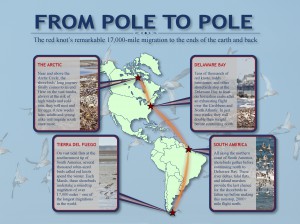
Despite its part in one of the world’s most incredible migrations, the annual arrival of tens of thousands of shorebirds in Delaware Bay remains relatively unknown to many New Jersey residents. Only recently have shorebirds received some news coverage, but it’s not good news – their numbers are declining rapidly. Scientists have begun to fear that without concerted conservation efforts, species like the red knot may soon go extinct.
The Delaware Bay Shorebird Project, a study led by the New Jersey Division of Fish & Wildlife’s Endangered and Nongame Species Program, has documented shorebird activity in Delaware Bay for nearly thirty years. The result has been an extensive knowledge base that documents every aspect of shorebird life – from measuring food availability and weight gains to tracking migration routes and breeding success – in New Jersey and beyond. Now, as a longtime partner on this project, the Conserve Wildlife Foundation of New Jersey is proud to introduce a new way to learn about these wonderful birds and the work underway to save them: a brand new shorebird site!
These new additions are loaded with content to bring you up to date on all the latest developments in the protection of shorebirds. Learn about these special birds on the Key Species page, and find detailed descriptions about their appearance, life cycle, and where to see them on their own pages in our online Field Guide. Check out the Media page for videos, photos, news articles, scientific publications, and more. Take an in-depth look at all the different areas of shorebird study currently underway on the Research page, and click on the Conservation page to discover how these birds are being protected. Finally, visit our Get Involved page to learn how you can become part of the efforts to help save these remarkable species from extinction.
If you haven’t noticed, we now have three healthy osprey nestlings at the nest at Edwin B. Forsythe National Wildlife Refuge in Oceanville, as viewed by our Osprey Cam. The first chick hatched on May 25th, the second on the 26th, and the third on the 28th. The eggs hatched in the order they were laid, referred to as asynchronous hatching. The incubation period was ~38 days for all three eggs (average is 35-37 in NJ; 32-43 throughout their range). With the cooler temperatures the longer period is expected. Osprey young are born semi-altricial, or are downy and require close parental care to survive. The male osprey has been very busy foraging and catching more prey to feed all the hungry mouths. Have you tried to identify the prey that they’ve brought in?
by Larissa Smith, Wildlife Biologist/Volunteer Coordinator
Shorebird Steward Liz Hermoso shows beach visitors a clump of horseshoe crab eggs on Cook’s beach.
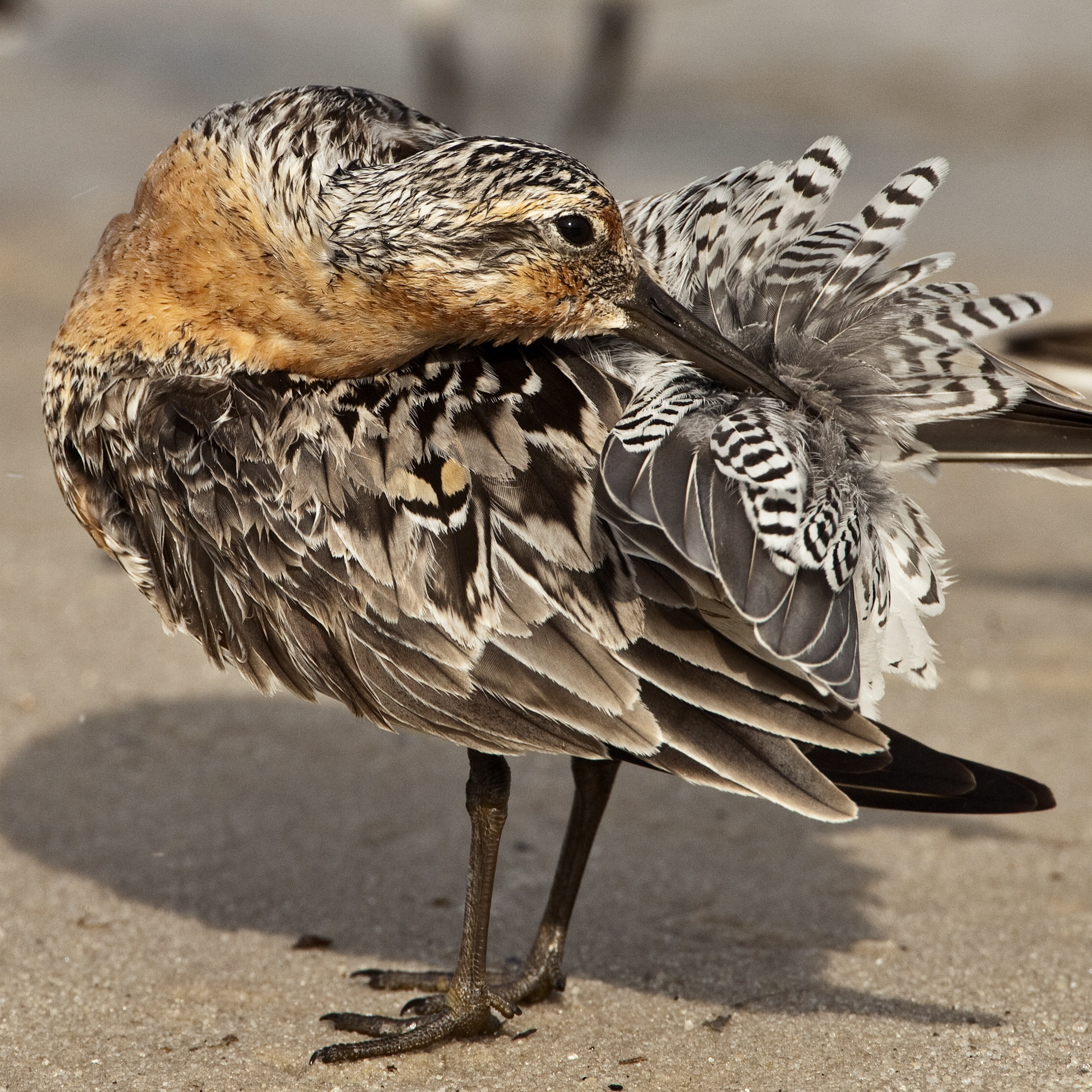
Once again migratory shorebirds, including the NJ endangered red knot, have returned to the Delaware Bay to feed on horseshoe crab eggs. This annual phenomenon brings people from around the world to the Delaware Bay beaches.
Beaches are closed during the migration from May 7th through June 7th to protect the shorebirds from disturbance when feeding. Just as the birds return each year so do volunteer Shorebird Stewards who educate the public about the beach closures , shorebirds and horseshoe crabs on nine beaches in Cape May and Cumberland County. Now is a great to come out to the beaches to view shorebirds and crabs and say “hi” to the stewards.
This year the hot spots for shorebirds in Cape May County are Reed’s , Cook’s and Kimble’s Beaches and Fortescue in Cumberland County.
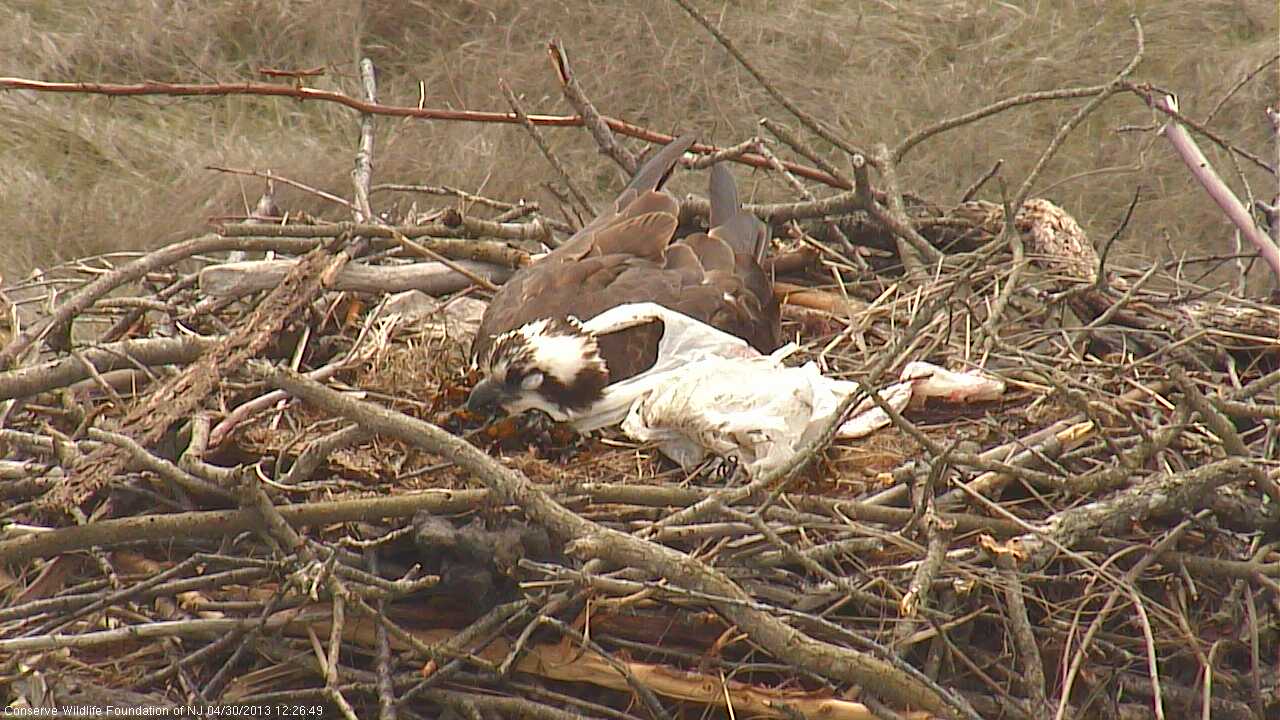
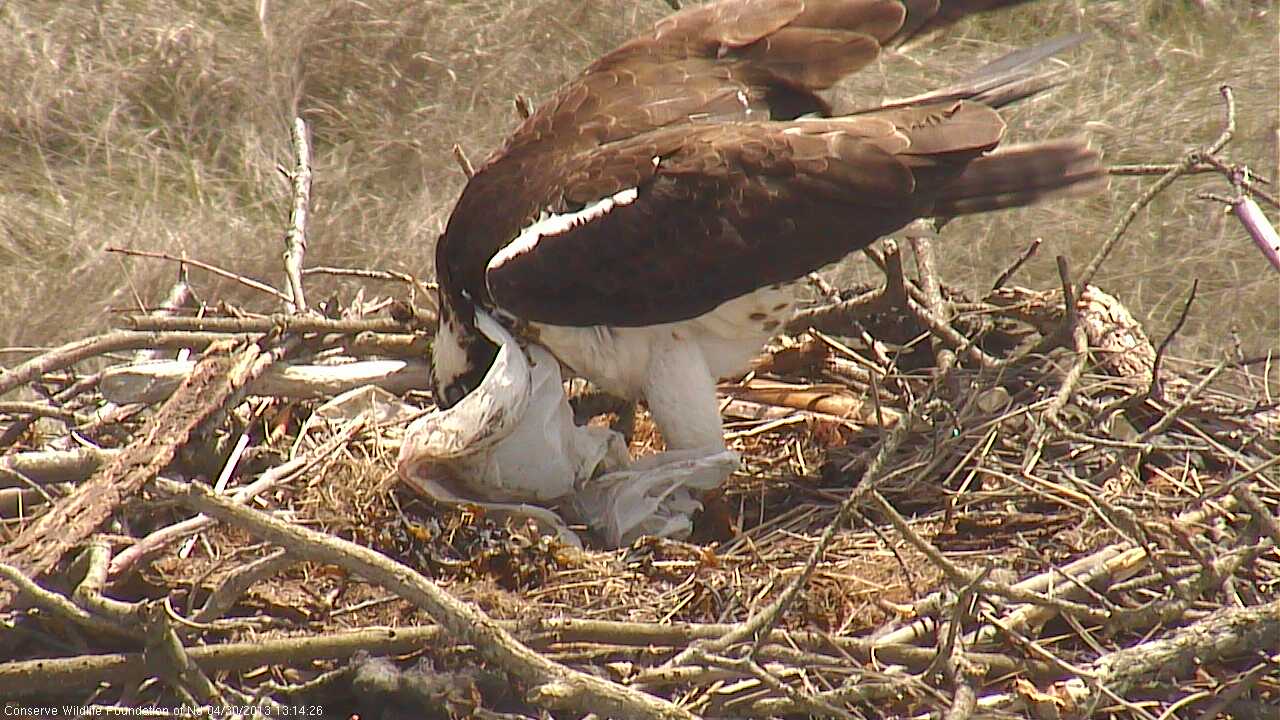
Single use plastic bag wrapped around ospreys neck…
by Ben Wurst, Habitat Program Manager
We had quite a scare last week, on April 30th around 12:30pm, after getting a report from an observer of our Osprey Cam on our Facebook page. A single use plastic shopping bag had gotten wrapped around the neck of the incubating female. After getting the report we started to monitor the situation to see how it would unfold. The bag was loosely wrapped, so we hoped she would be able to free herself…which she did after an hour.
Here you can see the single use plastic bag around her neck.
A lot of viewers and FB fans were asking why we weren’t going out to remove the bag from her neck. We answered each and every question to help make sure people knew that we were doing everything we could to protect her safety. First, we couldn’t just walk out to the nest (which is out in the middle of the salt marsh) without the female reacting to us and flying off the nest (with the plastic bag around her neck). Her flying off the nest with the bag around her neck would have only caused even more harm to her. She could have gotten snagged on a piece of nesting material and in the struggle could have choked to death or she could have fractured one of her eggs… Second, if she would have been tied down to the nest, then we would have enacted a plan to go out to the nest (after a certain amount of time) and released her. Our policy is that we will only intervene if it is a life or death situation. When we enter their nest sites we introduce stress to the birds which can ultimately do more harm than good. Finally, at least we have a camera to monitor the nest! Think of all the other 500+ nests in New Jersey where we only go out to monitor them once or twice during the nesting season. So much plastic winds up in osprey nests that it is a serious concern. People need to be more aware of their surroundings and do their best to make sure waste is properly disposed of.
There are ways you can help make a difference:
Reduce the amount of stuff you buy and the amount of trash you produce
Reuse what you can, recycle what you can’t
Pick up litter when you see it. There is a great movement in Australia called “Take 3” and their message is simple: “Take three pieces of rubbish with you when you leave the beach, waterway or… anywhere and you have made a difference.”
Stop or reduce your dependence on single use plastics
Use reusable shopping bags
Don’t release balloons!
The female struggles to get free of the bag.
Statistics for plastic recycling are dismal… According to the U.S. Environmental Protection Agency “In 2010, the category of plastics which includes bags, sacks, and wraps was recycled at almost 12 percent.” We’re lucky that she was able to free herself. This just proves that ospreys do not have an easy life. There are many threats to ospreys and they have very high mortality rates, which are around 80%.
On the positive side, the female and male continue to incubate three eggs at Edwin B. Forsythe NWR. We should start to watch for hatching around May 19-20th. We have been writing nest news with other life history information on a weekly basis on our Osprey Cam page.