Support New Jersey’s ospreys with donations matching a $12,500 challenge to help Conserve Wildlife Foundation purchase a boat.
by Ben Wurst, Habitat Program Manager
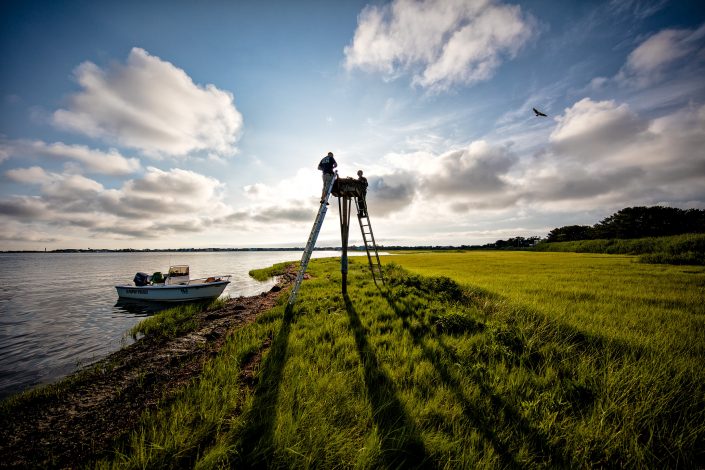
Surveying a nest on Long Beach Island in 2017, the last year we were able to utilize a state owned boat. photo by Northside Jim.
Ospreys are living barometers. They symbolize the resilience of life along the New Jersey coast. As a top tier predator who feeds exclusively on fish, their collective health is a direct link to the health of our coastal waters. Anyone can tell you that a healthy coast is essential to life at the shore. Clean water with abundant and healthy wildlife equals a booming shore economy. We have all benefited from actions and policy that have protected our air, land and water since the 1970s. Ospreys are no exception.
Mercer
County is now home to two pairs of bald eagles and their nests. The discovery
comes nearly three decades after the species nearly vanished from New Jersey.
“Bald eagles in particular were wiped out to
where we only had one nest in all of New Jersey as recently as the 1980s, and
it wasn’t even a successful nest. And now we have over 200 pairs of bald
eagles,” said David Wheeler, executive director of the Conserve Wildlife
Foundation of New Jersey.
Wheeler said pesticides and people led to the
near extinction of bald eagles.
Friday, bird watchers came
equipped with binoculars and cameras to catch a glimpse of one the nests
located at Mercer County Park.
“To
see the nature and the national symbol of the United States all right here
in Mercer Park is pretty neat,” said Flemington resident Graham
MacRitchie.
Nearly 70 people were part of a new educational
walking tour run by the County Parks Commission.
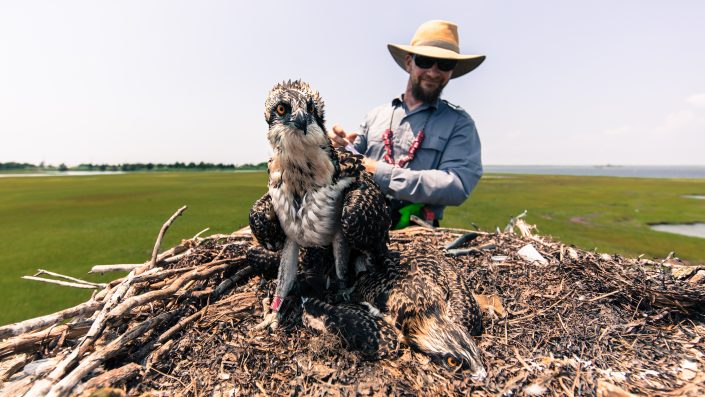
Banding osprey nestlings with red auxiliary bands at a nest off LBI. photo by Northside Jim.
If you live along or visit the coast, then it’s no surprise that ospreys continue to thrive in New Jersey. 2018 was yet another banner year for these coastal nesting raptors. Their large stick nests depict our rivers and estuaries while they indicate that we’re doing a good job of protecting our local environment along the coast. Today we’ve published results from last year’s nesting season in the 2018 New Jersey Osprey Project Report.
…Let’s set aside a few minutes, shall we, and behold all the big birds and their continued resurgence in the Garden State.
Editorial by the (Bergen) Record / NorthJersey.com
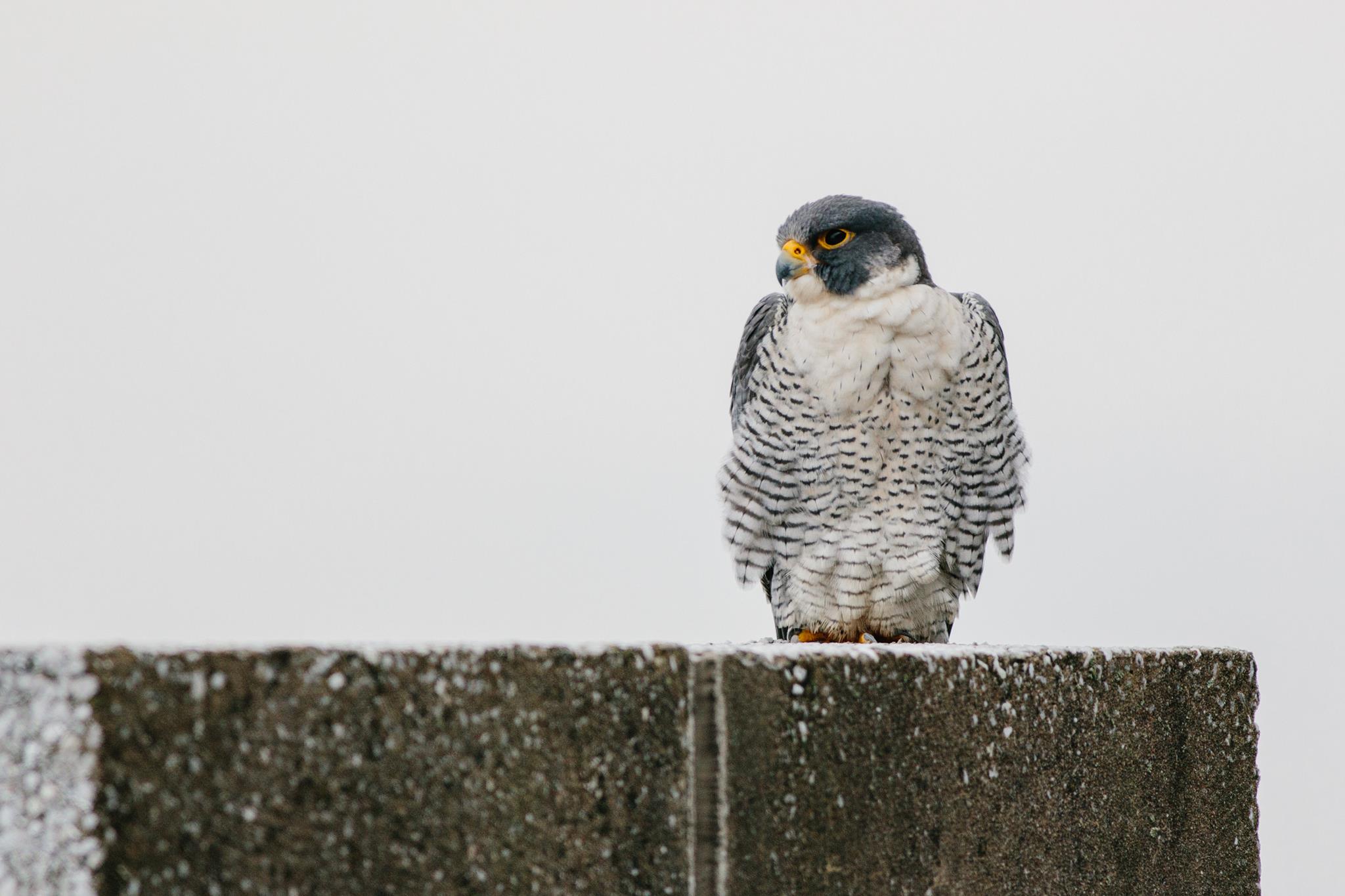
Peregrine falcons have nested in Jersey City since 2000. photo by Ben Wurst
Exhibit One is the peregrine falcon, which in its swooping dive can reach speeds of 240 mph, and whose remarkable comeback was charted by NorthJersey.com and the USA TODAY NETWORK New Jersey environmental reporter Scott Fallon. He wrote of how state researchers and wildlife advocates had documented a record 40 nesting pairs in 2018, a near-miraculous feat considering the species had been all but left for dead in New Jersey beginning in the 1960s….
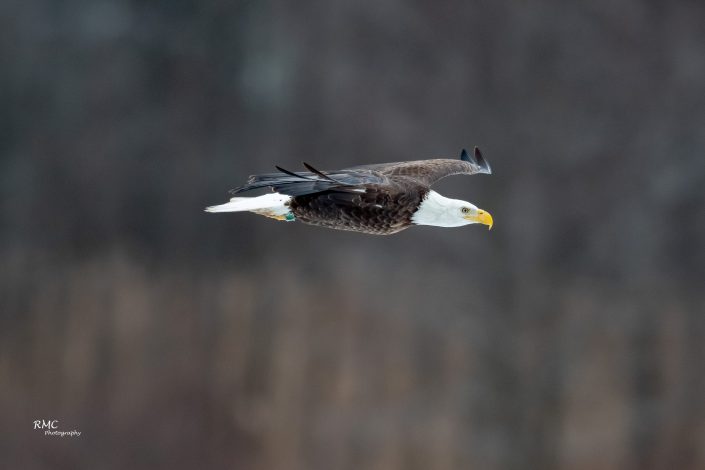
On Sunday January 13th, 2019 photographer, Bob Cook was taking photos of the ~20 eagles at a lake in a Mercer County park. He noticed that one of the eagles had a green tag on it’s right leg. After reviewing the photos it was established that the band was D/99.
D/99;1/13/19@ Bob Cook
D/99 is from the Duke Farms nest located in Somerset County. He and his two siblings grew up as a celebrities their every move being watched by viewers of the Duke Farms eagle camera. The three chicks were banded on May 12th, 2014. Measurements showed that there there were two males and one female, D/99 was the youngest male. All three fledged from the nest in June 2014.
chicks at Duke Farms nest 5/12/14. D/99 is in the middle.
Unfortunately, in August of 2014 we received a report that D/98, the oldest male, was found dead up in Maine. He most likely died of injuries that occurred during a fight with another eagle. This most recent sighting of D/99 is the first report of either of the two remaining chicks. D/99 will be five years old in April and reaching the age where he will be looking for a mate and establishing his own territory. It is always nice to know that a chick has survived to adulthood and most likely has come back to NJ to nest.
The Conserve Wildlife Foundation of NJ in partnership with the NJ Division of Fish and Wildlife, Endangered and Nongame Species Program, has released the 2018 NJ Bald Eagle Project Report.
“Two hundred-four nest sites were monitored during the nesting season, of which 185 were documented to be active (with eggs) and 19 were territorial or housekeeping pairs. Thirty new eagle pairs were found this season, 20 in the south, nine in central and one in the north. One hundred-twenty-one nests (66%) of the 182 known-outcome nests produced 172 young, for a productivity rate of 0.94 young per active/known-outcome nest. The failure rate was well above average with 61 nests (33%) failing to produce. The Delaware Bay region remained the state’s eagle stronghold, with roughly half of nests located in Cumberland and Salem counties and the bayside of Cape May County.”
The number of active nests has increased while the number of young eagles fledged has decreased since a high of 216 young fledged in 2016. During the 2018 eagle nesting season there was an abundance of cold, wet, windy and snowy weather which was the cause for a portion of the nest failures. As the eagle population increases, there are more eagles competing for territories. This can also be a contributing factor in nest failures. NJ is still in the range of 0.9 to 1.1 young per nest which is needed for population maintenance with a productivity rate of 0.94 young per known-outcome/active nest in 2018. The 2018 NJ Eagle Project Report has all the details on the project including telemetry, re-sightings and recoveries.
The success of the eagle project is due to the tremendous dedication of the NJ Eagle Project Volunteers. They monitor the nests in all types of conditions and education people about the eagles with enthusiasm.
Derelict fishing gear continues to plague the depths of Barnegat Bay. Often lost through storm events or due to boat traffic, lost or abandoned crab pots (ghost pots) become an unintentional deathtrap for a variety of marine species and reduce otherwise harvestable resources. CWF and their partners at MATES, Stockton, and ALS have been working to recover lost pots in Barnegat Bay since 2015.
Over the course of the last three field seasons, 1,300 crab pots have been recovered and their bycatch has been extensively documented. Notably, CWF and MATES have been focusing on how to further help northern diamondback terrapins who often find themselves caught in ghost pots. In 2016, one pot contained the remains of 17 terrapins.
As we enter the fourth field season of pot collections, the project hopes to not only recover as may pots as possible, but also to glean further information on how the pots move in a variety of substrates and under a variety conditions. To bring further awareness to the issue, CWF teamed up with the awesome folks at Citizen Racecar to produce a short informational film about ghost fishing and its effects on Barnegat Bay. Visit our Facebook page to view the video: https://www.facebook.com/wildlifenj/
This project is funded primarily by the National Oceanic and Atmospheric Administration, with additional support by the New Jersey Corporate Wetlands Restoration Partnership and New Jersey Department of Environmental Protection. Covanta and Schnitzer Steel also support the project by recycling the metal in the retrieved crab pots.
On a brisk November morning, a couple dedicated NJ Osprey Project volunteers joined myself and CWF Biologist Larissa Smith to install an osprey platform on the coastal saltmarsh of New Jersey. The new platform was installed to replace a very old and unstable platform that fell this summer. The new structure is more than twice the size of the old one and will give the nesting pair, who return in the spring, a much more resilient nest site. As you can see from the video above, it takes a bit of strength to raise up a 16′ tall wood nest platform. We decided to slow it down when WCC Volunteer, Wayne R. gives it a final push. Continue reading “Video from the Field: Osprey Platform Install”
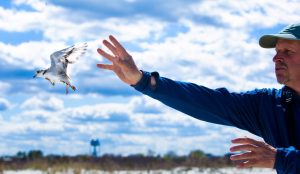
Senior biologist for the Conserve Wildlife Foundation of New Jersey Todd Pover releases a piping plover, a species he has helped monitor for 25 years. (Jim Verhagen)
On October 29, 2012, Hurricane Sandy plowed ashore near Atlantic City, N.J., with sustained winds of 75 miles per hour. In its wake, state officials declared it the most destructive natural disaster in the history of New Jersey. It changed communities dramatically.
Natural features of the coastline underwent significant changes too, but in some cases, those changes presented new conservation opportunities that could protect people and wildlife in the face of future storms.
“We were able to identify places where piping plover habitat had been enhanced by the storm,” explained Todd Pover, a senior biologist for the Conserve Wildlife Foundation of New Jersey who has been involved in monitoring the federally threatened shorebird for 25 years. Places like Edwin B. Forsythe National Wildlife Refuge, where the storm erased the dunes in a three-quarter mile stretch of beach, creating an open expanse from ocean to bay.