Just in time for next week’s Great Backyard Bird Count, The (Bergen) Record’s Jim Wright takes a look at the hairy woodpecker with help from CWF Executive Director David Wheeler. This backyard birdwatching favorite is still a common sight on many New Jersey feeders and tree trunks, but remains vulnerable nationally due to its nesting reliance on old tree snags.
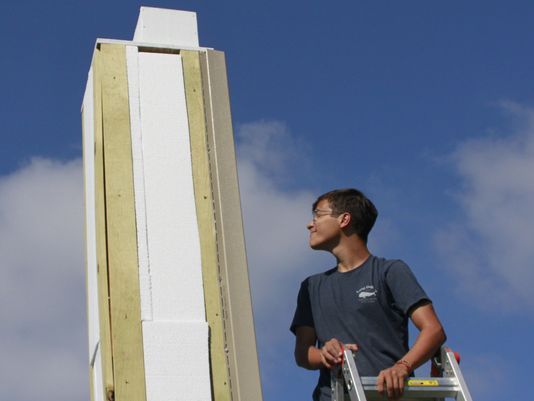
A sign of success. CWF Volunteer Matt T. atop the newly constructed peregrine falcon nesting tower on Bonnet Island, Stafford Twp., NJ. The 16′ tower was built from locally grown white cedar and installed for a pair who formally nested beneath the Route 72 Causeway Bridge. photo by Ben Wurst
Statewide Census Documents over 650 nesting pairs in New Jersey
by Ben Wurst, Habitat Program Manager
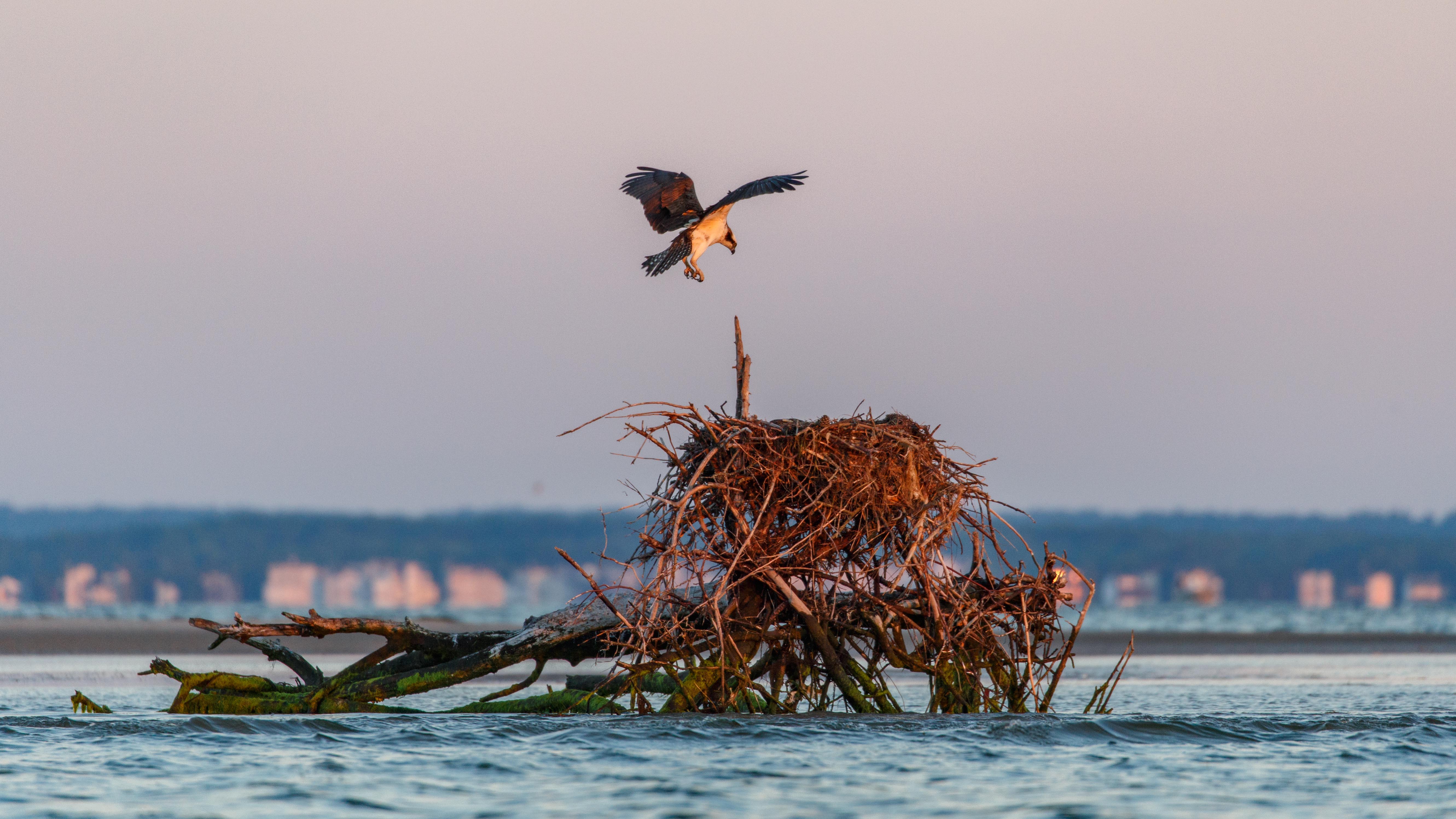
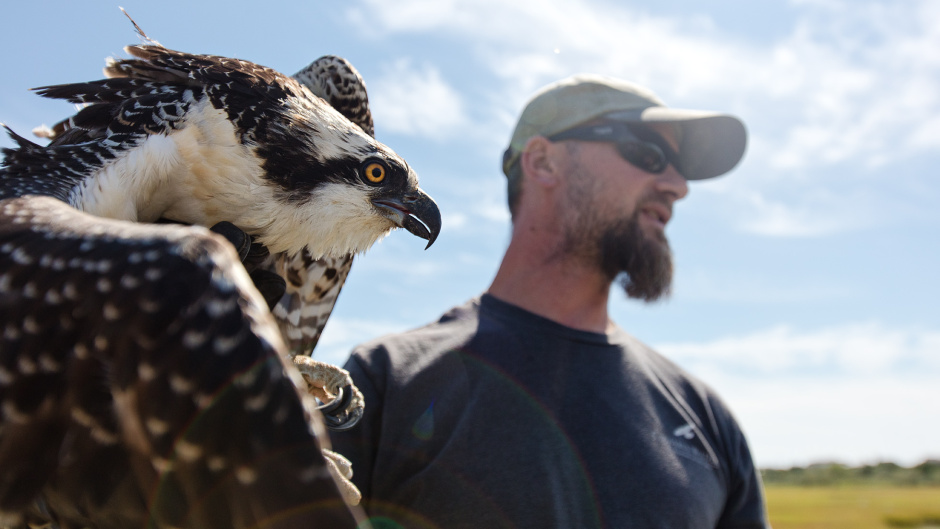
An osprey prepares to land on a natural nest. Barnegat Bay, NJ.
Since we began to work more closely with ospreys in 2006, we have documented the population grow beyond the historic population estimate of 350-450 nesting pairs (Henny 1977) to a new historic milestone. In 2017, a total of 668 active nests were recorded during a statewide census of nesting ospreys, which is well above the post-DDT milestone of 500 nesting pairs, and show that the population continues to grow. This is the second census conducted without the use of manned aircraft since 2009 after all known osprey nests were released and mapped online in 2013. Despite the lack of aircraft, we’re still able to obtain an accurate representation of the size and health of the statewide population, while reducing the overall project cost. Continue reading “Osprey Numbers Surge Above Post-DDT Milestone”
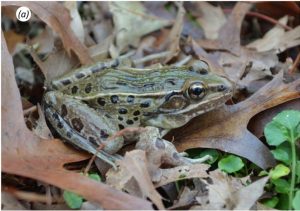
On a Tuesday morning, Conserve Wildlife Foundation of New Jersey biologist Allegra Mitchell and I, GIS Intern Taylor Forster, went to the New Jersey State Museum in Trenton. We were looking at a newly identified species recently found in one of the largest metropolitan areas – New York! I learned that this species was discovered because of its unique “call.” A “call” is the sound a male frog makes to attract a female frog, and each frog species’ call is unique. It seems that this species remained undiscovered for so long because of its similar appearance to other, closely-related leopard frog species. The cryptic nature of this new species meant that the only noticeable distinction between it and other leopard frogs was the sound it makes.
After looking at this newly discovered frog, now known as the mid-Atlantic coast leopard frog, a few defining characteristics came to light that set it apart from the other leopard frogs. These characteristics make it easier to identify other mid-Atlantic coast leopard frogs that have been preserved and categorized as other species for museum collections. With this information in mind, Ms. Mitchell and I were at the New Jersey State Museum to investigate when and where this frog had been found throughout the state before anyone realized its significance.Continue reading “The Atlantic Coast Leopard Frog – Uncovering the past”
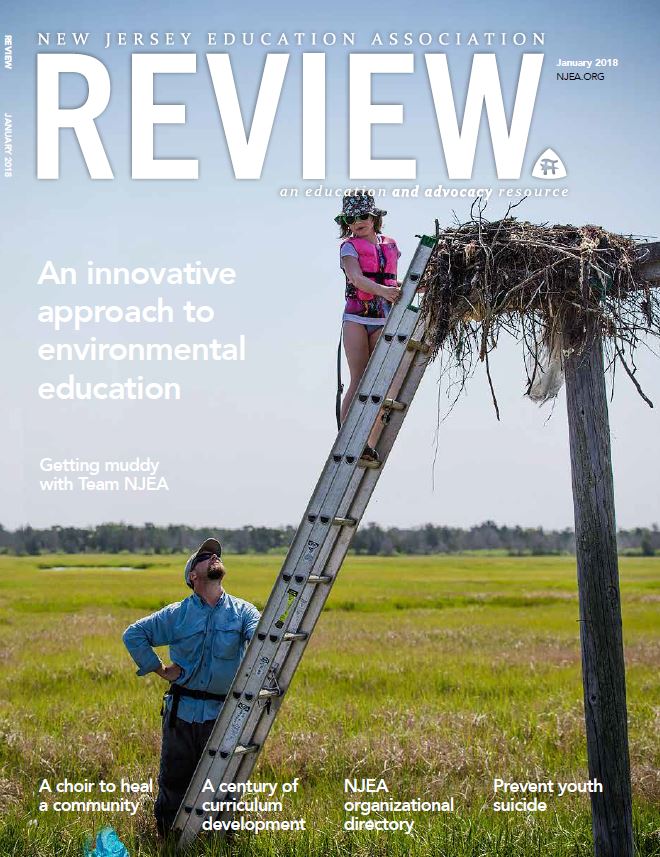
CWF’s innovative environmental education program served as the cover story for the New Jersey Education Association (NJEA) Review, a monthly magazine that reaches over 200,000 subscribers, including every public school teacher in the state. The story, written by education director Stephanie DAlessio and executive director David Wheeler, highlights CWF’s singular approach to environmental education, which meets NGSS standards by melding experiential learning with scientific observation and hypothesis testing about nature’s phenomena via wildlife webcams and other online resources, all based on educational theory. Continue reading “CWF education leadership highlights NJEA Review cover story”
Nests on towers and buildings maintain stability in the state population
by Ben Wurst, Habitat Program Manager
Jersey City tiercel. photo by Ben Wurst
Results from the 2017 nesting season for peregrine falcons was released in a report from New Jersey Fish & Wildlife’s Endangered Species Program, and falcons had a decent year. New Jersey’s population remained stable with 32 active nests (with 34 known pairs) as compared to last years’ results of 30 active nests (35 known pairs). Nest success was slightly better than last year, with 22 pairs producing 52 young as compared to 20 pairs producing 47 young. The productivity rate, which is a measure of the health of the population, was very close to what was observed in 2016 at 1.59 young/active nest. Continue reading “New Jersey Falcons Remain Stable in 2017”
Ready to release Chump. RIP, Chump! photo by Northside Jim.
I thought long and hard about sharing this news, hence the delay in this post. In late October, we received news that a young osprey I banded this summer was re-sighted. It turns out that this bird was not your average young osprey, out of the 892 produced this year. This young bird hatched at a nest behind the Long Beach Island Foundation of the Arts & Sciences, around June 11th, a nest referred to as home to “LBI’s Most Famous Osprey Couple, Jack & Wendy.”He was banded, along with his nestlings, on July 5th. He was tagged with a red auxiliary “field readable” band: 78/D, as part of Project RedBand, which allows fellow biologists and citizen scientists the ability to identify the bird while still alive (most osprey band reports occur during mortality based events). At the time of banding, he was also given the name Chump, by Northside Jim.
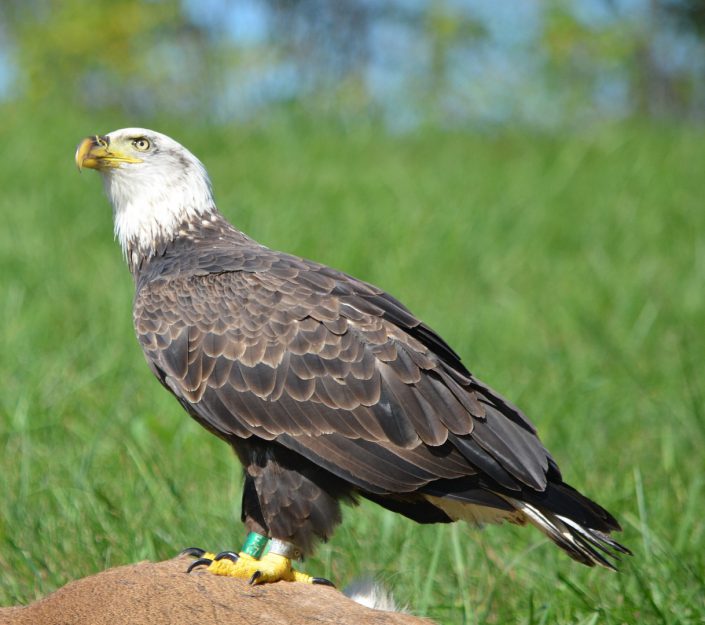
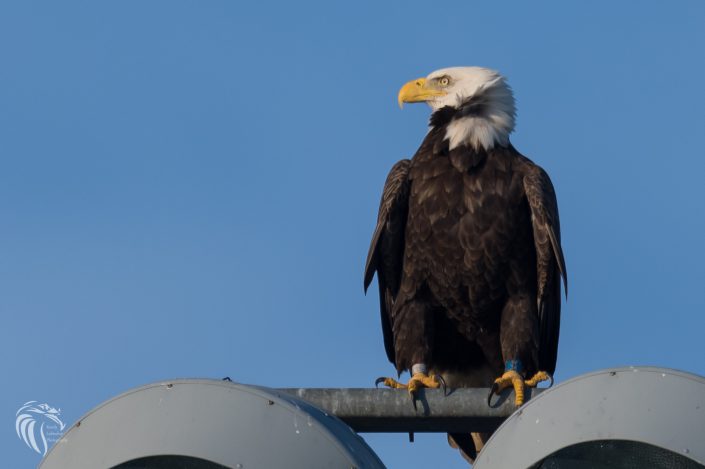
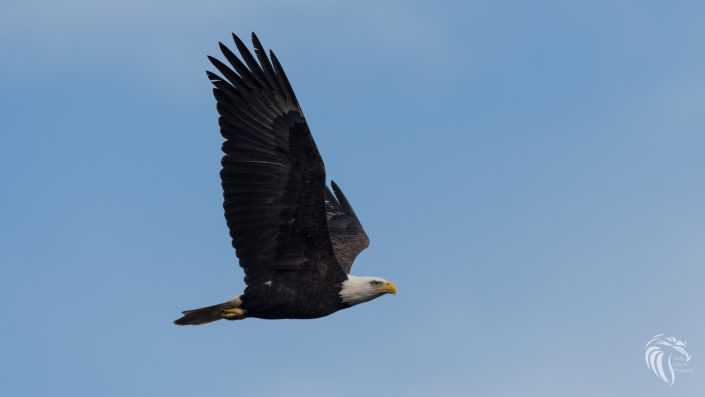
In the end of October, NJ Eagle Project volunteer Randy Lubischer spotted a banded adult bald eagle near his home in Monmouth County. He was able take good photos that showed the bird was banded with a blue (NY) band on the left leg and was able to get a very clear image of the letter and number code on the band. We reached out to the NY Division of Fish, Wildlife and Marine Resources to find out more information on the eagle.
In the fall of 2011, an injured hatch year bird was found on the side of the road in Onondaga County, NY. The bird was rehabbed, banded (NY Blue band W34) and released on October 7, 2011 at the Montezuma NWR. On 11/18/2016, W34 was sighted in Darlington, Maryland and then in in NE Maryland again on 3/1/2017.
W34& mate 11/7/17@Randy Lubischer
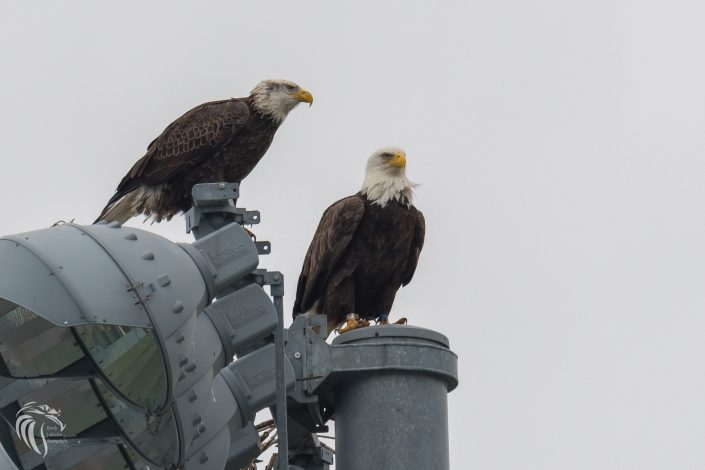
W34 looks to be staying in NJ to nest as he has found a mate, a sub-adult female, who still has dark feathers on her head. They have started to build a nest and have been copulating.
We can’t necessarily assume that W34 was hatched in NY. Since he was found injured and not banded he could well be a NJ bird. We have followed NJ recent fledges outfitted with transmitters, take long flights north after leaving their nest areas. We also know that many NJ banded eagles do return to NJ to nest. So we’ll never know the true origin of W34 but we can piece together some of his story and hopefully have more news about him and his mate in the upcoming nesting season.
“Chimney swifts, which migrate through northern New Jersey by the thousands each September, have fallen on tough times as more and more large chimneys fall into disuse.
These small, insect-devouring birds have abandoned traditional migration roosts like the huge chimney at George Washington Middle School in Ridgewood in recent years. Another popular roost for these fast-flying, bug-eating birds — a chimney at the Berkeley Elementary School in Westwood — may get capped in 2018.”