By: Susan Harrison, NJ Bald Eagle Project Volunteer
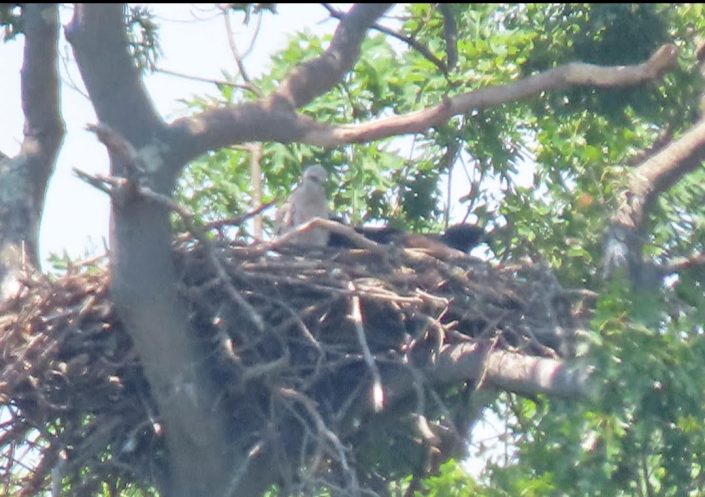
I am a volunteer eagle nest monitor for New Jersey’s Bald Eagle Project. A new nest was discovered in central New Jersey this year by birder Chris Brown. Larissa Smith, the volunteer coordinator for the Bald Eagle Project and Conserve Wildlife Foundation asked me to monitor this nest. I did not know at the beginning of nesting season, what an interesting story would unfold! In mid-April, by watching the behavior of the adult eagles, I could see that eggs had hatched and that the adults were feeding eaglets that were still too small to see. At the beginning of May I caught glimpses of the head of one eaglet peeking up over the top of the nest rails. Too cute! By the end of May, I could see the head of a second chick in the nest. But this chick looked very different! I soon discovered this chick looked different because it was not a Bald Eagle at all! It was a red-tailed hawk chick in the eagles’ nest! I could not believe what I was seeing! I took lots of photos to document this situation, a first for New Jersey! I consulted with two respected birders in the state, Chris Brown, who is a county eBird reviewer and Tim Brown, to help verify and document my observations for CWF and the NJ DEP/ENSP. We observed the adult eagles feeding both the red-tailed hawk chick and the bald eagle chick. It was one big happy family, with both chicks getting along with each other and with the adults quite well.
An empty osprey nest on a sandbar located on Barnegat Bay.
In the coming weeks CWF staff, NJDEP Biologists, and a handful of dedicated volunteers will descend onto the coastal saltmarshes of New Jersey to conduct a census of nesting ospreys. The last census was conducted in 2017 when 668 nesting pairs was recorded. They will survey remote areas of back bays by boat. Nests are surveyed in a variety of methods, with ladders being the traditional method, which allow for closer inspection of nests and banding of young for future tracking. Other nests are surveyed from a distance using optics or cameras with telephoto lenses, a mirror, smartphone or GoPro on an extension pole and a sUAS (when operated by a FAA licensed unmanned pilot). The goal is to recorded the total number of nesting pairs throughout the State.
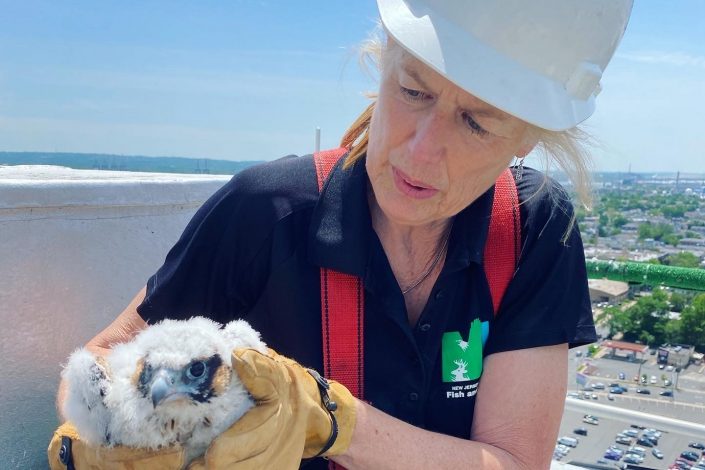
Kathy Clark carefully places a young falcon in a reusable shopping bag.
On May 23, NJDEP Fish & Wildlife Supervisory Zoologist Kathy Clark and myself visited the Union County Courthouse in Elizabeth, NJ to band the three eyases that were produced by the nesting pair of peregrine falcons. We were joined by Union County staff and guests, who assisted with the banding. The nest is located on the roof of the building. As soon as the hatch made a sound, the adults took off and started to defend their nest and flightless young. As we enter their turf, we are dive bombed by the adults — it is clear that the female has become more aggressive — as she flies very close to us on the roof in sweeping dive bomb attacks. As Kathy goes to the nest to grab each young who are placed in reusable shopping bags, I use her trusty feather duster to ward off the adult female. All who enter the roof wear fall arrest harnesses and hard hats. Kathy and I know that the hard hats are not just worn for fall protection, but also from attacks from above. Both of us received bumps from the adult female to our helmets!
Over the past several years, I have worked with LBIF to help guide their efforts to provide habitat for wildlife on their property in Loveladies. We have always wanted to establish another, larger “turtle garden” for nesting female N. diamondback terrapins, since they are a common visitor during summer months. This spring we received a small grant from the Garden Club of Long Beach Island to establish a new turtle garden at LBIF. Late last month we ordered 15 tons of mason sand from a local supplier, which provides excellent nesting habitat, with small grain size and little organic matter. Myself and Jeff Ruemeli, who is the new Director of Sciences at LBIF, worked to install coir logs to hold the sand before spreading it out by hand. I followed up with planting around 30 seaside goldenrod plants at the site to help stabilize sand and provide foraging habitat for pollinators.
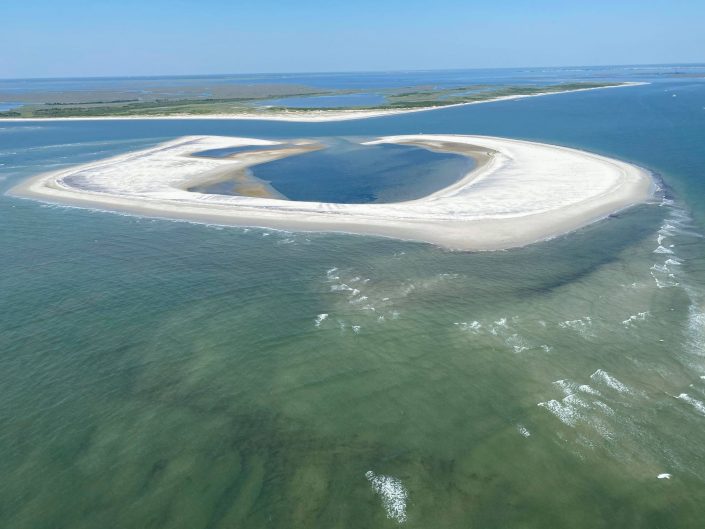
Something unusual and exciting has happened just off the coast of New Jersey; a new island that has become a haven for birds has formed. Located on the southern edge of the Little Egg Inlet, the island is about 1000 feet offshore of Little Beach Island, a Unit of the Edwin B. Forsythe National Wildlife Refuge (Refuge). Of course, it didn’t form overnight, an emergent shoal has been noted in that location since about 2018, and it has slowly been growing, likely as a result of the longshore drift of sand from Long Beach Island. The island, dubbed Horseshoe Island because of its distinctive shape, provides incredibly valuable habitat for nesting and migratory birds, including many at-risk species.
Rainy nights with evening temperatures edging into the mid-40s or above. Seems easy to plan for rescue nights, doesn’t it? Certainly not this year!
CWF’s Amphibian Crossing Project targets the earliest breeders in northern New Jersey, including wood frogs, spotted salamanders, and Jefferson salamanders. These vernal pool obligates must find their way from forested winter habitat to ephemeral wetlands each spring in order to successfully reproduce. Snowmelt and warm, moist air signal individuals to resume activity after a long winter’s brumation (hibernation for ectothermic “cold-blooded” animals) underground. As soon as they emerge, they head to the pools which, in our increasingly fragmented world, often means entering into a real-world game of Frogger. The stakes are incredibly high and many do not make it out alive.
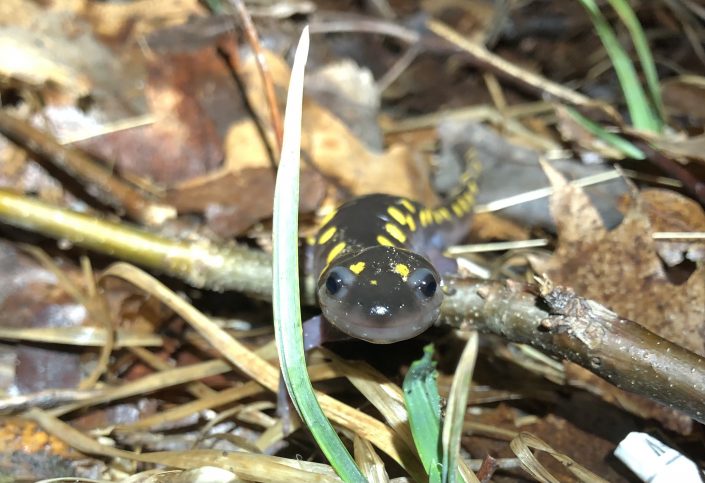
Spotted Salamander (Ambystoma maculatum)
To combat this problem, our team of devoted volunteers has been braving the elements for the last 20 years, ferrying slow moving amphibians across busy roadways during the earliest wave of the annual migration. Their efforts not only increase survivorship and breeding potential, but also raises awareness and contributes valuable data to justify the construction of long-term solutions. This season, 103 participants were involved in the project, working across three CWF managed roads in Byram, Liberty, and Hampton Twps. and one site in Hardwick Twp. organized by Blaine Rothauser, a senior ecologist for GZA GeoEnvironmental and Dennis Briede, stewardship manager at the Land Conservancy of New Jersey. All together, we assisted with the movement of 2,456 amphibians of 9 species, 26% of which represented species of concern.
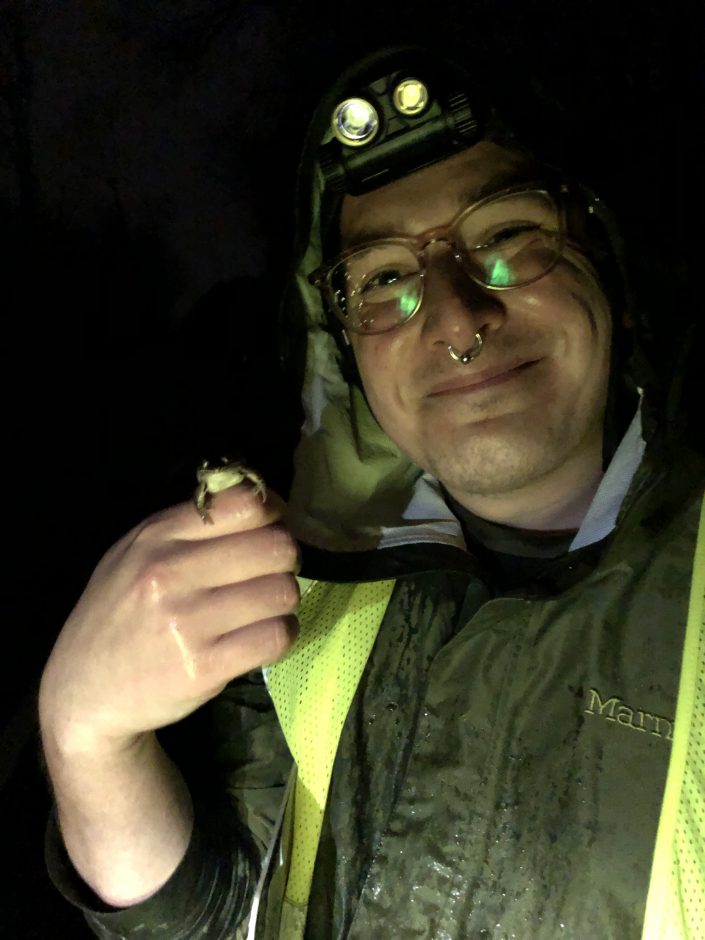
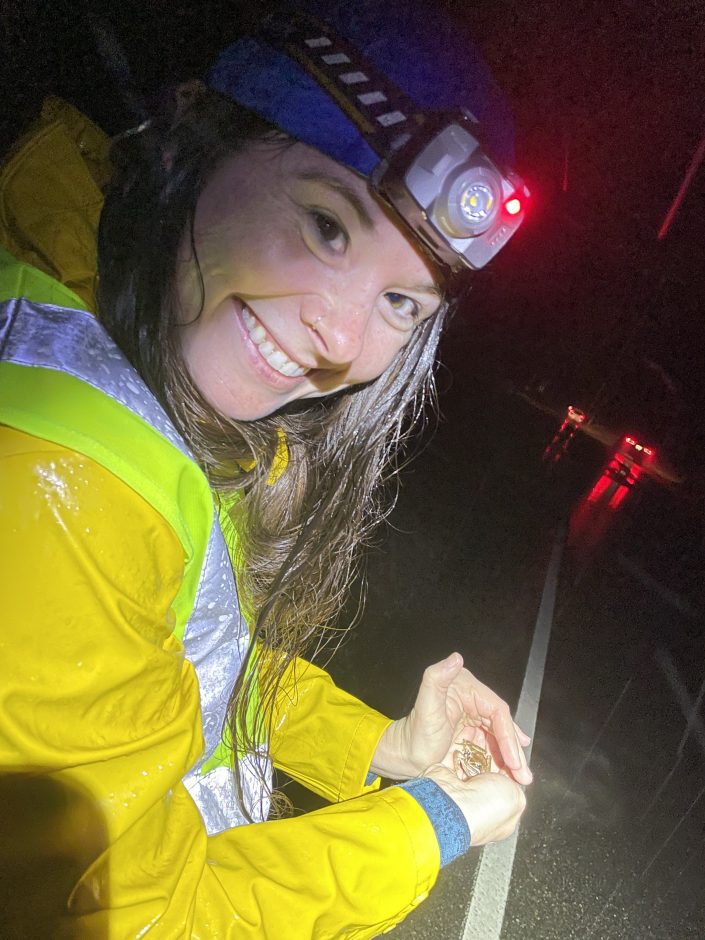
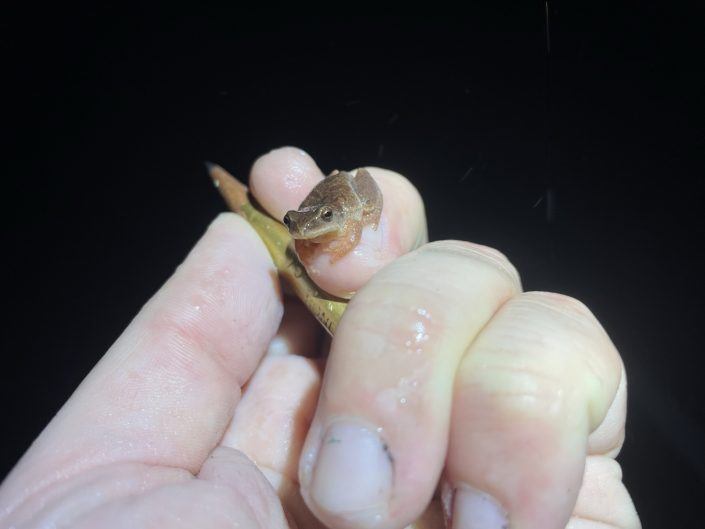
Wildlife Biologist Ethan Gilardi poses with a Wood Frog before helping the frog safely across a busy roadway.Amphibian Crossing Project manager Christine Healy shows off a Wood Frog rescued from the busy roadway.
Without a doubt, these numbers are impressive, however, I can’t help but reflect on this season with agitation. Late February and March featured dramatic temperature swings, characterized by sunny days in the 70s followed by cold snaps with snow and ice. Freezing conditions can damage amphibian egg masses and fluctuating weather may punctuate and elongate the migration, making movement difficult to predict. Lightning storms and heavy wind kept us off the roads during a few of the seasons peak nights, though based on the results of morning mortality surveys, the same cannot be said for drivers…
While amphibian rescue events do localized communities a lot of good, seasons like this one really highlight the need to remove a dependence on humans from the survival equation, especially as global climate change continues to cause deviations from “normal”. We’re anticipating the first frog/salamander-specific wildlife passage in NJ to break ground at our Byram Twp. site in the summer of 2023, after years of planning by the Endangered and Nongame Species program and many partners.
We can’t wait to see the impact this project has on the population of amphibians reliant on New Jersey’s largest vernal pool and how it inspires similar projects in the future.
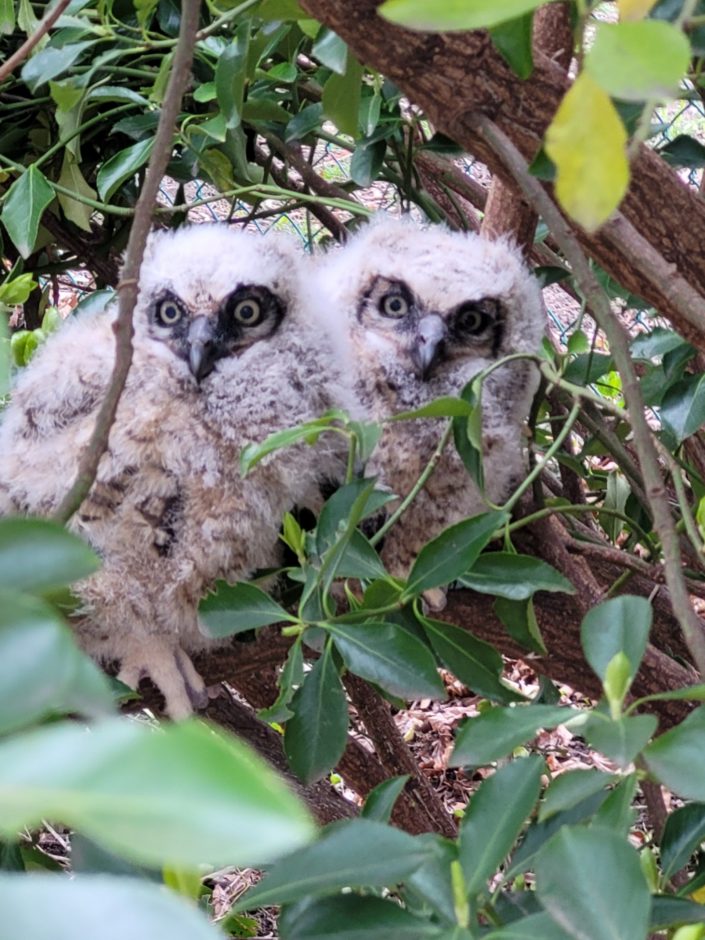
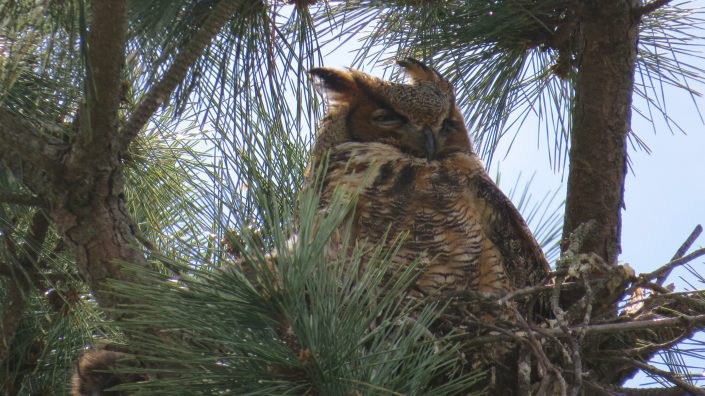
We received a call about a homeowner who found two great horned owlets on the ground. They had fallen out of a nest located in a pine tree in her backyard. The female owl was still sitting in the nest with one chick. Great horned owls use the vacant nests of other bird species and this nest was too small for three growing chicks. At this age the young owls are defenseless from predators, plus a rain/wind storm was predicted for that evening. The plan was to keep the owlets overnight in safe location and renest them the next day.
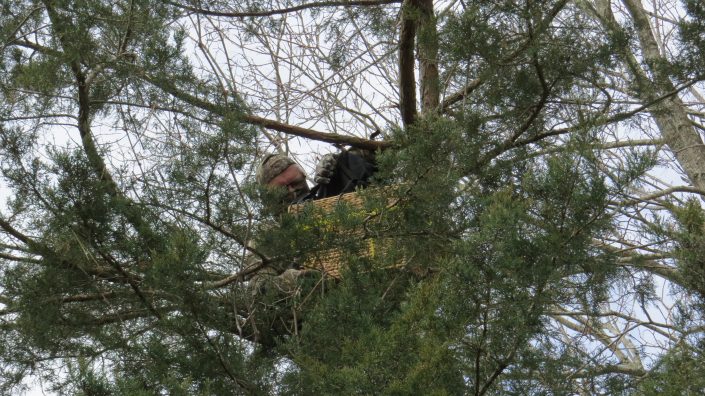
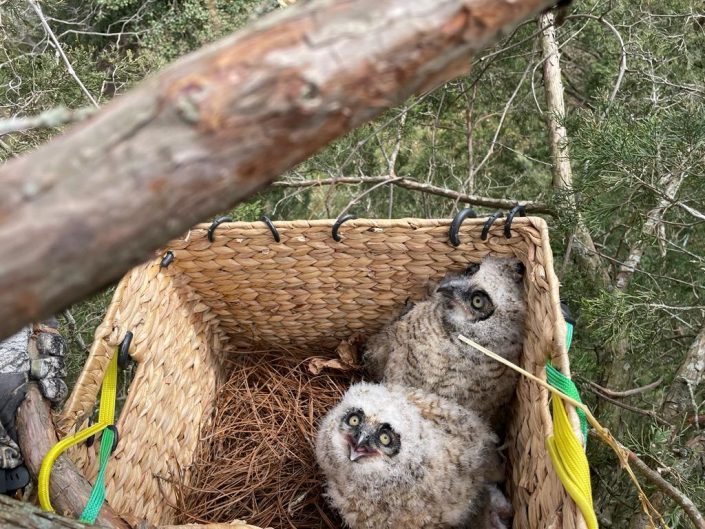
We met Ray Byrant, with Tri-State Rescue & Research, raptor renesting team at the nest site. Due to crowding the owlets would end up on the ground again if placed back in the nest. A basket serving as a substitute nest was secured in a nearby tree that was sturdier than the nest tree. The two nests are close enough that the adults can go back and forth between nests caring for the young. The female owl watched us closely the entire time and the owlets were “clicking” with their bills, so she knew they were there.
The homeowner will keep an eye on the nests to make sure the owlets remain in them until they start to branch. She reports that the adult has been at the basket nest several time since the renest. Thank you to the homeowner for calling to report these owlets, Vicki Schmidt, Matt Tribulski, Ray Byrant and Tri-State Bird Rescue & Research. It takes a team.
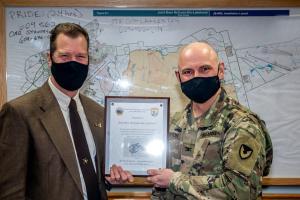
Eric Schrading (left), field supervisor for the U.S. Fish and Wildlife Service’s New Jersey Field Office, presents the award to Colonel Jon Brierton, Deputy Wing Commander JBMDL. Credit: Tech. Sgt. Austin Knox, JBMDL
Recently the service recognized Joint Base McGuire-Dix-Lakehurst (JB MDL) for their collaborative conservation work alongside the New Jersey Field Office and other partners in the region. The Military Conservation Partnership Award was presented to JB MDL on January 21 to acknowledge their efforts in conservation and research.
Through CWFNJ’s partnership with the USFWS New Jersey Field Office, there has been years of effort restoring native grassland habitat for Upland Sandpiper, Bobolink, and Grasshopper Sparrow at the JB MDL. Roughly 400 acres have been restored to date and will continue into future years. Additional work with Northern long-eared bats at JB MDL has been really successful and insightful in recent years.
The service writes, “the JB MDL demonstrates an exceptional commitment to cooperative partnerships, protection of rare species, and provides high value outdoor recreation programs to the public and our veterans, all while achieving military readiness”.
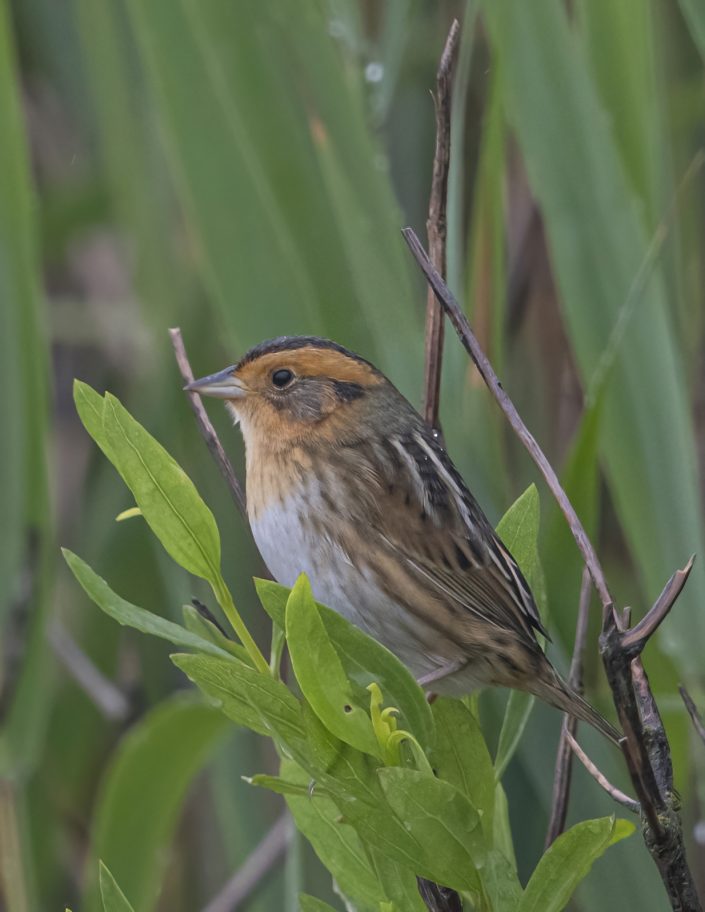
The Conserve Wildlife Foundation of New Jersey is working on a new project starting this winter to restore habitat for two species of imperiled marsh birds, the eastern black rail (Laterallus jamaicensis jamaicensis) and the saltmarsh sparrow (Ammospiza caudacuta). CWFNJ has partnered with the U.S. Fish and Wildlife Service (USFWS) on a three-year project to identify potential habitat restoration sites, conduct outreach to landowners, and implement conservation practices recommended for the target species. Outcomes of the project will include at least three habitat management plans and restoration of at least twenty-five acres of wetland and/or salt marsh habitat utilizing techniques in the Black Rail and/or Saltmarsh Sparrow Conservation Plans developed by the USFWS.
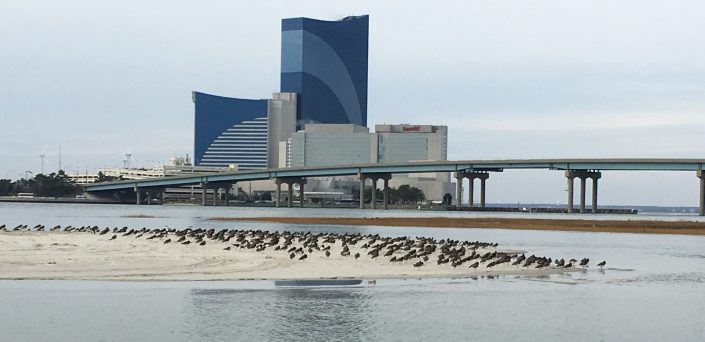
Most people are surprised to hear that American oystercatchers are present in New Jersey in the winter. They usually associate the charismatic shorebird as a breeding species here. Our state’s wintering oystercatchers, a combination of breeders from further north and our own, are at the northern extent of the Atlantic coast wintering range.