20 Years of Conservation

Delaware Bay Shorebird Project Begins 20th Season

By: Dr. Larry Niles, LJ Niles Associates LLC

We begin the 20th year of the Delaware Bay Shorebird Project this year with many of the same team members that helped start the project in 1997. That’s 20 years of studying one of the most intellectually challenging and endlessly fascinating species of wildlife in the world. Few have had the good fortune to do so.
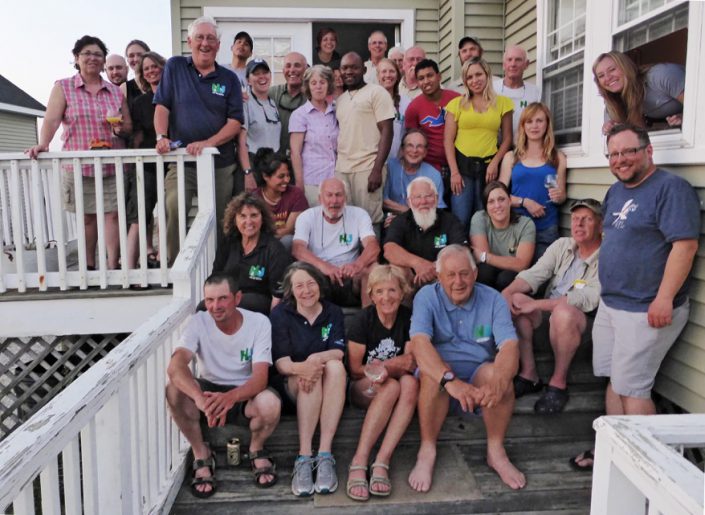
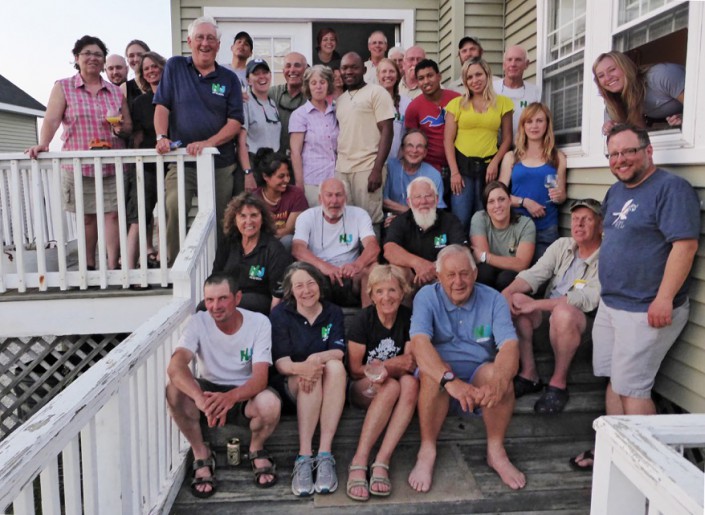
The 2015 Delaware Bay Shorebird Project Team

Unfortunately, we do not start this year with the same shorebird population. In the last twenty years, the Delaware Bay stopover fell precipitously from its once lofty perch as one of the top three stopovers in the world. Where once we counted over 1.5 million shorebirds, we now see less than 400,000, a sweet number but far less than the bay’s heyday. Red knot numbers have crashed from over 90,000 to a low of only 13,000. Ruddy Turnstones, the virtual working man of shorebirds, fell from 135,000 to just over 16,000. In this time, many intrepid shorebirds came to the bay to find succor provided by a once endless bounty of horseshoe crab eggs only to find empty beaches and no way back to their Arctic home.


Much of this was caused by short-sighted decisions made by the commercial fishing industry in the 1990’s, which decided to spend this bay’s natural (and publicly owned) wealth of horseshoe crabs. They needed bait and relentlessly pursued the crabs. Horseshoe crab populations fell to a quarter of their historic number and may have been driven to extinction without the work of the bay’s conservationists who fought bravely and with determination to stop them. Atlantic sturgeon, weakfish, herring, eels, and many of the bay’s once abundant fisheries weren’t so lucky.
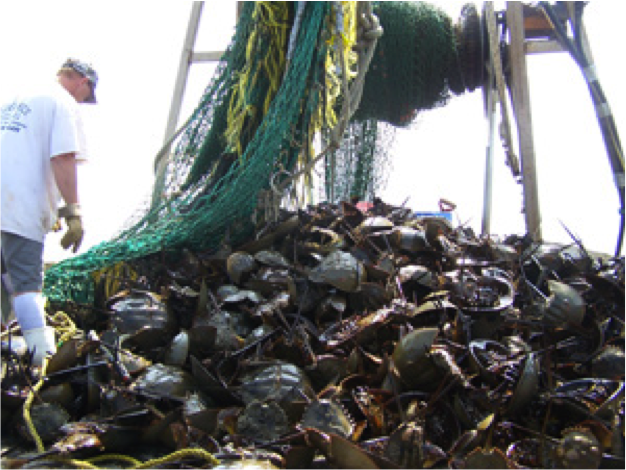
crab harvest

Now a new industry, the oyster aquaculture industry, wants to consume another public natural resource, the bay’s intertidal flats. Cultivating oysters on metal racks placed on the bay’s extensive tidal flats is cheap and easy when you can use public trust lands. The expansion got a vital assist from the state agencies who side lined crucial environmental reviews to determine impact to species like the red knot, and required no public hearing, comment period or the involvement of any shorebird experts. This could have been corrected when the red knot was federally listed.
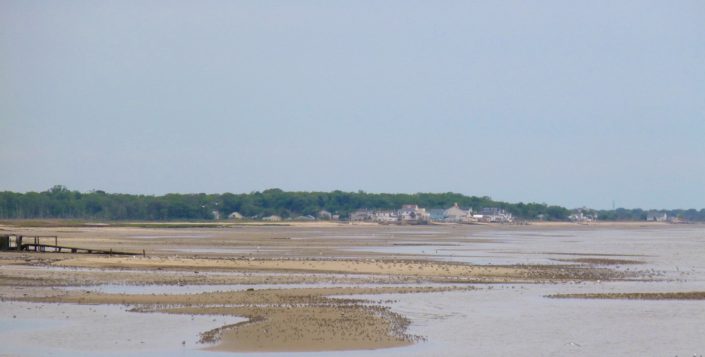
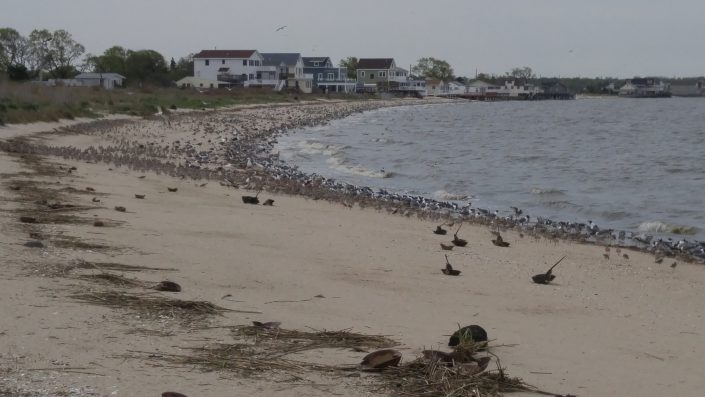
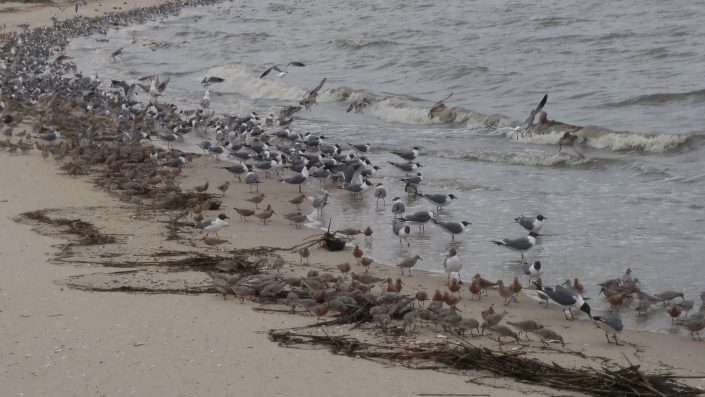
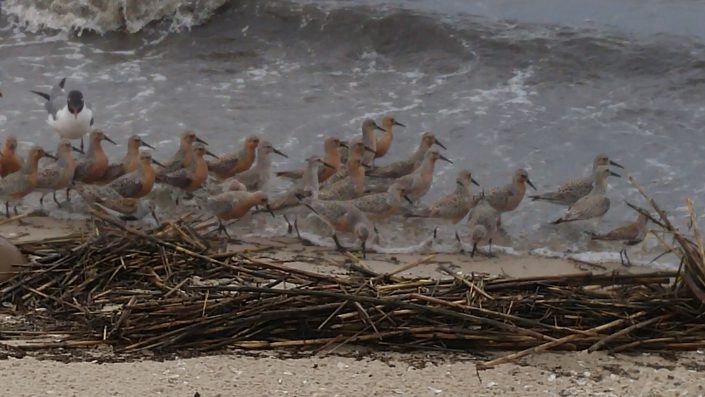
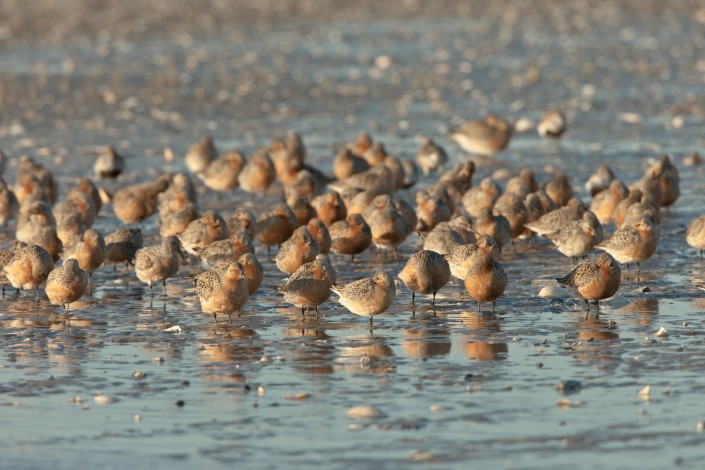
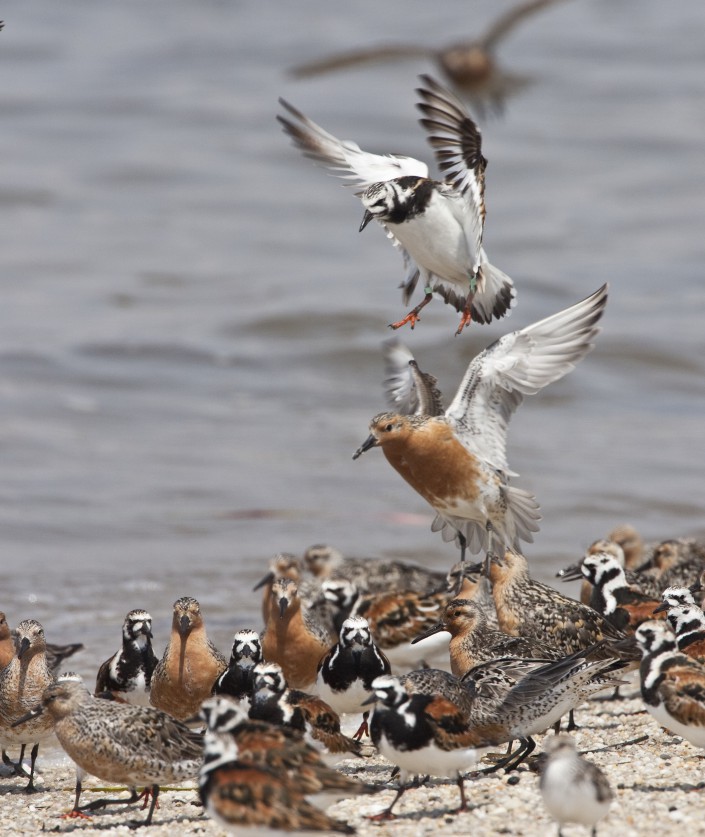
Thousands of red knots, ruddy turnstones sanderling, semi palmated sandpipers use the inter tidal flat near Kimble’s Beach, Delaware Bay. They forage on eggs washed out from the beaches and spread across the flat.
Thousands of red knots, ruddy turnstones, sanderling, semipalmated sandpipers use the inter tidal flat near Kimble’s Beach, Delaware Bay. They forage on eggs washed out from the beaches and spread across the flat.

Unfortunately, the red knot’s federal listing has not helped in this controversial expansion of aquaculture. Instead, it proposed growers should be compensated for economic losses caused by the listing, and allowed the controversial expansion despite the obvious impacts to birds and crabs. Such decisions speak to Desperate Environmentalism, a term coined by Yale School of Forestry’s Joshua Galperin, describing the increasingly fraught position of conservationists who feel they must play ball with politically powerful industries or lose all. This desperate conservation could have been avoided if growers and conservationists worked together to expand aquaculture without significant impacts  because after all everybody loves oysters!
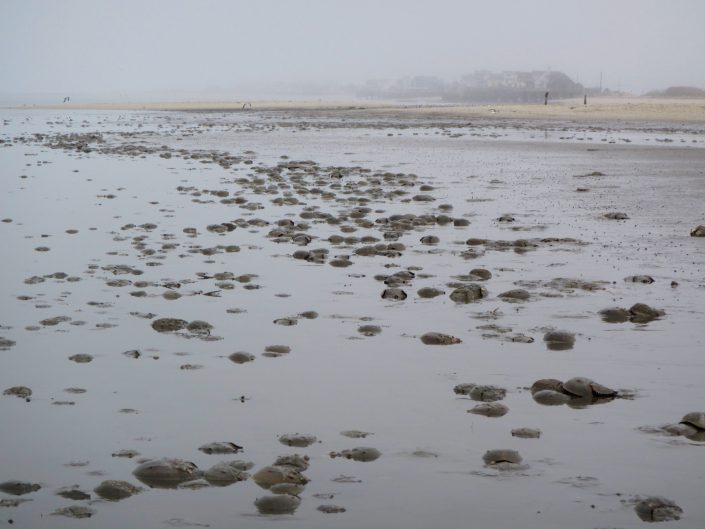
Horseshoe crabs rely on the intertidal flats to forage for marine invertebrate like small clams.

But this dark cloud cannot diminish the progress made by our team and groups like American Littoral Society and Conserve Wildlife Foundation of New Jersey. Just one example is the successful effort to restore horseshoe habitat on 2.7 miles of Delaware Bay horseshoe crab breeding habitat. The effort, funded by National Fish and Wildlife Foundation and the U.S. Fish and Wildlife Service, overcame the damage caused by Hurricane Sandy and prevented what could have been another shorebird disaster. This work has blossomed over the last four years into a network of activities that provides new hope for a long term protection of the bay. This conservation is not desperate but inspirational for hundreds biologists, land managers and volunteers.
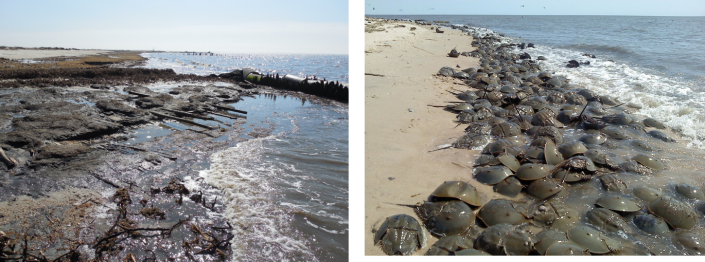
Moore’s Beach before and after restoration by the American Littoral Society and Conserve Wildlife Foundation of New Jersey.

So our 20th year is much like our first year, a group of conservation-minded shorebird scientists and volunteers gathering to help these poor birds find a way to make it home.  As with most conservation stories in this time, it’s a David and Goliath story that hopefully has the same result.
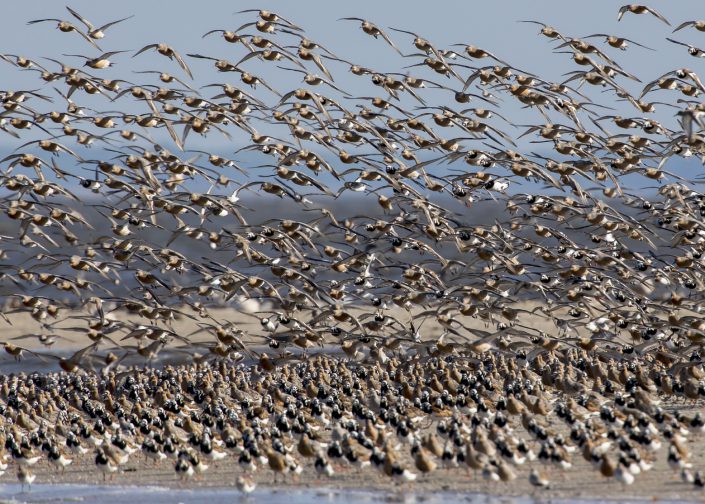
Red Knot photo by Al Janerich.

Dr. Larry Niles has led efforts to protect red knots and horseshoe crabs for over 30 years.
International Migratory Bird Day Series: Red Knot

CWF is Celebrating International Migratory Bird Day all Week Long

by Lindsay McNamara, Communications Manager

CWF’s blog on the red knot is the third in a series of five to be posted this week in celebration of International Migratory Bird Day (IMBD). IMBD 2016 is Saturday, May 14. This #birdyear, we are honoring 100 years of the Migratory Bird Treaty. This landmark treat has protected nearly all migratory bird species in the U.S. and Canada for the last century.

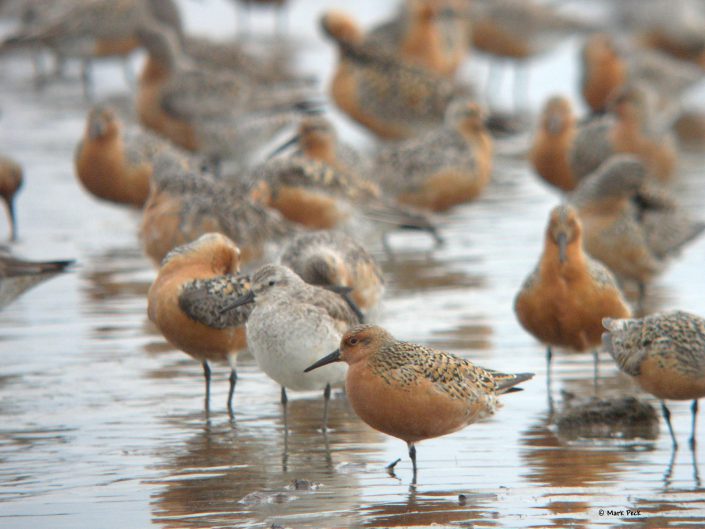
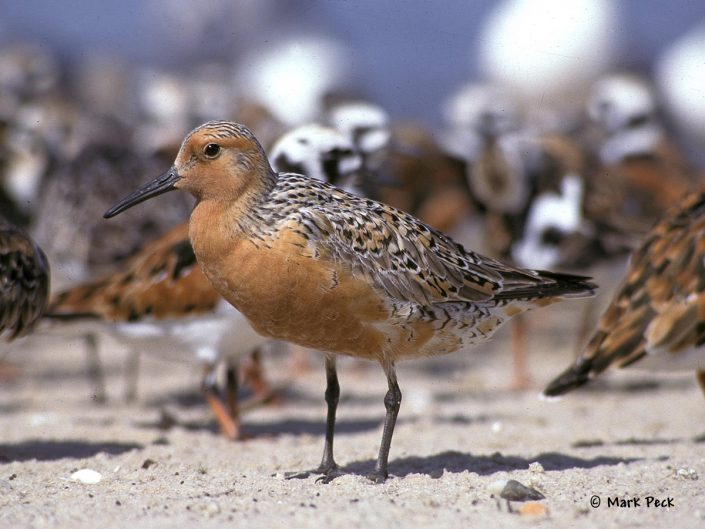
Red Knot photo by Mark Peck.

The iconic red knots have returned to New Jersey! These famous, mid-sized shorebirds are state endangered and now federally threatened — the first bird ever listed under the Endangered Species Act with climate change cited as a “primary threat.”


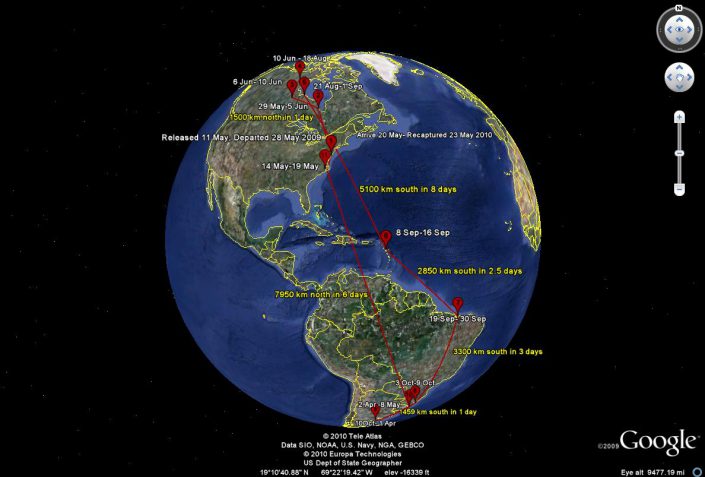
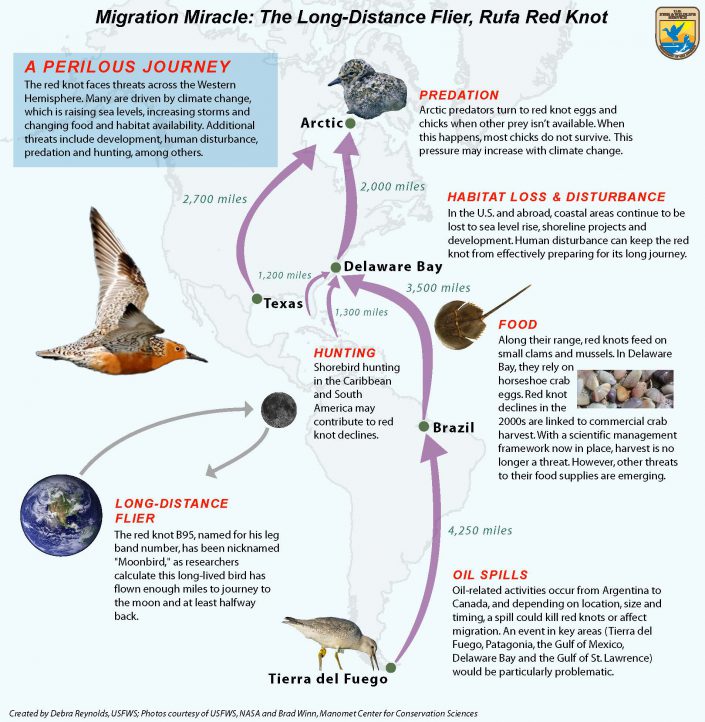
Red knots are only 10 inches long but are among the world’s most extreme long distance flyers  traveling vast distances  some over 18,000 miles in the course of their annual migration from Tierra del Fuego, Argentina all the way up to the Canadian Arctic (and back again). During their trip, the red knots make a vital stop at New Jersey’s Delaware Bay.

This map shows the flight path of a red knot that was banded and fitted with a geolocator along New Jersey's Delaware Bay.
This map shows the flight path of a red knot that was banded and fitted with a geolocator along New Jersey’s Delaware Bay.

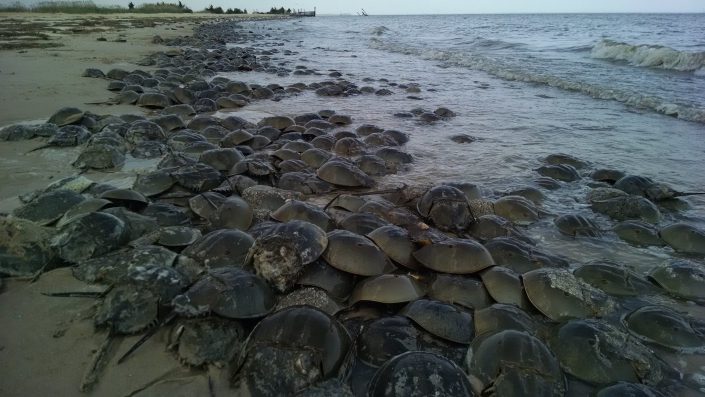
Each spring in Delaware Bay, throughout the month of May, the largest concentration of horseshoe crabs in the world comes onshore to spawn. At the same time, tens of thousands of shorebirds arrive at the Bay, thin and spent from what has been a non-stop, four-day flight from South America. They are en route on a remarkable round-trip journey from southern wintering grounds to Arctic breeding territory, and Delaware Bay is their most critical stopover on this 8,000-mile trip. The shorebirds need to quickly double their weight to complete their migration north and breed successfully. To refuel at such capacities and in only a ten-day window, high-energy horseshoe crab eggs provide essential nourishment. In recent years, countless horseshoe crab eggs have been lost because of the devastating storms that swept away the beaches they depend on.


In the wake of Hurricane Sandy, Conserve Wildlife Foundation and American Littoral Society worked with the U.S. Fish and Wildlife Service, the New Jersey Division of Fish and Wildlife and the New Jersey Recovery Fund to remove 8,000 tons of debris and added 45,000 tons of sand to the beaches just before the annual spring arrival of the red knot in 2013. Additional work after 2012 restored another mile of shoreline, including two new beaches of poor quality even before Sandy. To date, the groups have placed over 85,000 cubic yards of sand and restored seven beaches along New Jersey’s Delaware Bayshore.


To restore one of the beaches, Thompsons Beach, our team removed debris from the area, removed rubble from the road leading to the beach, and placed over 40,000 cubic yards of sand onto the beach. We were delighted to learn that in the spring of 2015, Thompsons Beach had the highest abundance of horseshoe crab egg clusters out of all the beaches that our team monitors on Delaware Bay.

Horseshoe crabs spawning at Thompsons Beach in May 2015. Photo by Joe Smith.

But since the early 1990s, there have been major declines in both the number of adult horseshoe crabs and their eggs. The cause is an exploding crab harvest that grew from only tens of thousands in 1990 to over 2 million in 1996. With the decline of their critical food source, shorebird numbers also plummeted  the Delaware Bay shorebird populations remain around 26% of its historic population size. Over 25,500 red knots were seen in 2015 versus over 90,000 in 1989.


Conserve Wildlife Foundation and the Endangered and Nongame Species Program (ENSP) of the New Jersey Department of Environmental Protection’s Division of Fish & Wildlife have partnered for 20 years, working to conduct research on Delaware Bay shorebirds in order to prevent further decline. Each year, CWF’s Larry Niles and ENSP’s Amanda Dey lead a team of shorebird experts from around the world – from countries as far as Argentina and New Zealand – to conduct research on shorebirds during their stopover. These experts also follow shorebirds to other locations along their migration, including South America and the Arctic. With scientific research and concerted conservation efforts, our hopes are that someday Delaware Bay’s skies will be once again filled with shorebirds.

Red Knot photo by Mark Peck.

Last year, nearly every red knot left the bay in good condition, with over 77% reaching weights exceeding 180 grams, the threshold weight required for a successful flight to the Arctic breeding areas. The improvement in the number of red knots reaching 180 grams is a milestone for our shorebird project. The birds left in the best condition recorded since 1998, just as horseshoe crabs were being overharvested. This good news must be tempered by the continued low numbers of birds and horseshoe crabs. We report no improvement in horseshoe crab numbers, so the improvement in the number of red knots making weight is likely a consequence of the restoration of horseshoe crab habitat on Delaware Bay beaches.


Because shorebirds don’t only spend their time in Delaware Bay, shorebird scientists must study them throughout the Atlantic Flyway to get the best understanding of their unique ecology. This year, shorebird project team was awarded a 2-year grant to create detailed shorebird habitat maps in the states of Maranhão and Pará, Brazil. This project will set the foundation for conservation planning and action for decades to come at a shorebird wintering site of hemispheric importance that has received little conservation and research attention with regard to shorebirds thus far.


Over the last 6 years, CWF also has partnered with the USFWS Monomoy Refuge to develop a better understanding of migratory shorebird use on Cape Cod and at the Refuge. Cape Cod, like Stone Harbor and Brigantine, New Jersey, is an important southbound stopover for red knots. At each location, red knots come from their Arctic breeding areas and either build up weight for a flight to South America, or remain to molt and replace vital primary feathers before moving onto shorter distance wintering areas in Florida and Cuba.

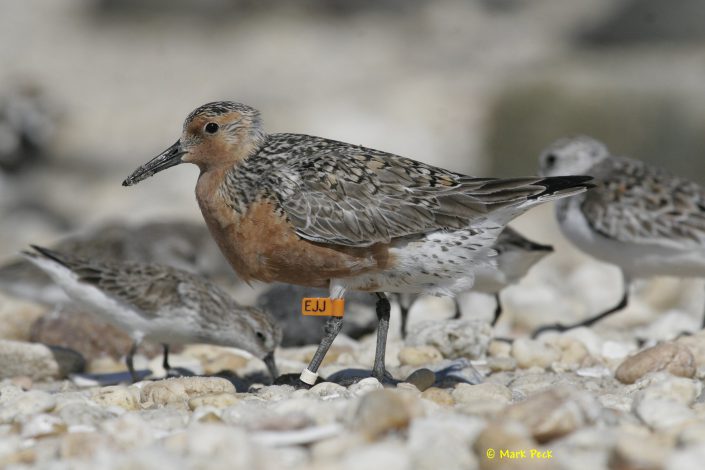
Banded Red Knot photo by Mark Peck.

Another important piece of CWF’s shorebird research has been the attachment and recovery of geolocators, small devices that track movements through one to two years of battery life. The migratory tracks from recovered geolocators have greatly expanded our understanding of red knot migratory behavior. In CWF’s last two years of research, we focused on capturing juveniles, which move through the Cape in early September. Red knot juvenile #254 was a recapture two years after release on Delaware Bay. It first left Cape Cod and wintered in North Carolina. In their first year, juvenile red knots don’t go to the Arctic to breed and so #254 flew back to Cape Cod to summer. The following fall, it flew to Cuba to winter, then to North Carolina, then to the Arctic. This was the first known track of a juvenile red knot and one of only a few of any avian species! CWF is continuing our geolocator project this year, so follow along on our blog and social media channels to receive updates on cutting-edge red knot research!


Learn More:


Lindsay McNamara is the Communications Manager for Conserve Wildlife Foundation of New Jersey.

Shorebirds Arrive in New Jersey’s Delaware Bay

The Birds are Back – Red Knots Arrive Along the Bayshore

by David Wheeler, Executive Director

Photo by David Wheeler.

The 2016 mass shorebird migration is officially underway, with the thrilling spectacle of over 1,100 red knots spotted today at North Reeds Beach in Cape May County, New Jersey. A host of other shorebirds, including ruddy turnstones, dunlins, semipalmated sandpipers, and sanderlings, accompanied the red knots at this Delaware Bay hotspot.


The famished flocks fed on horseshoe crab eggs, while much larger laughing gulls congregated along the shoreline and a few crabs used the incoming waves to flip themselves over and return to the bay.

Photo by David Wheeler.

Researchers began seeing a large number of shorebirds arriving over the weekend, and today’s sightings are high for such an early date. A number of the red knots wear leg bands, with a few indicating departure points as far south as Argentina and Chile. Such lengthy migrations for those individual birds only add to the intrigue of their early-season arrivals in New Jersey.


Some red knots fly over 18,000 miles each year in their migrations from southern South America to the Canadian Arctic, with Delaware Bay serving as an irreplaceable stopover.

Photo by David Wheeler.

Yet these migratory shorebirds have suffered a sharp decline over the past few decades, with red knots dropping by around 75%. The U.S. Fish and Wildlife Service designated the red knot as a federally protected threatened species under the Endangered Species Act in December 2014.


A team of international researchers and trained volunteers, led by Dr. Larry Niles, Conserve Wildlife Foundation, and the State Endangered and Nongame Species Program will spend the next month surveying and studying the at-risk shorebirds during their stay in New Jersey.

Infographic used from http://www.fws.gov/northeast/redknot/.


Learn More:


David Wheeler is Executive Director of Conserve Wildlife Foundation.

Restoration Work Continues Along New Jersey’s Delaware Bayshore, New Oyster Reef Built at Moores Beach

Second Annual “Shell-a-Bration” brings volunteers to strengthen coast’s resiliency and habitat

by Lindsay McNamara, Communications Manager

MooresBeachOysterReef1

Today, conservation organizations leading the efforts to restore New Jersey’s Delaware Bay beaches today organized the Second Annual “Shell-a-Bration” oyster reef building volunteer event.


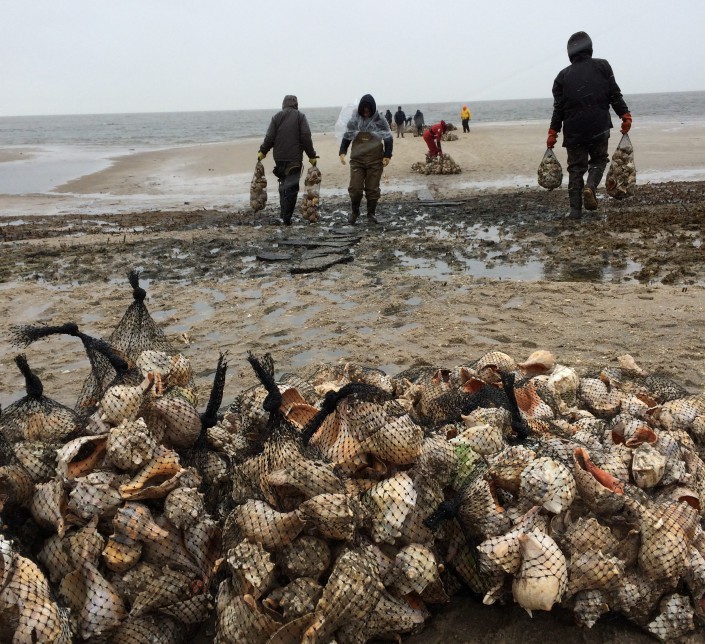
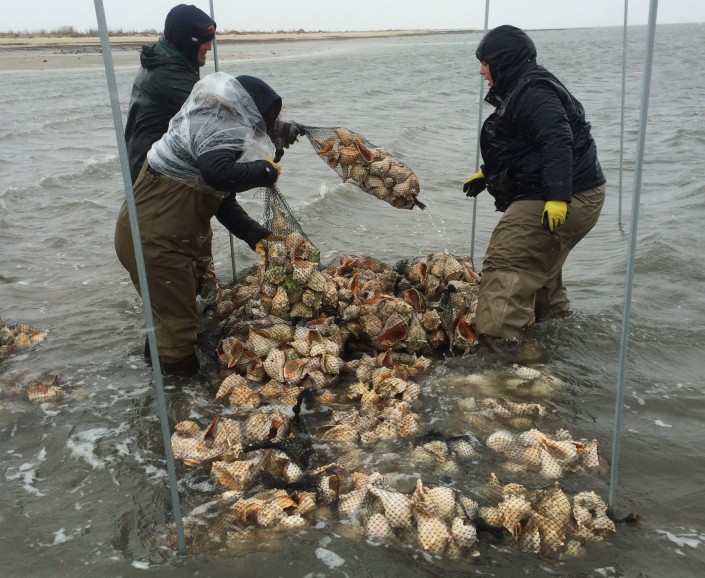
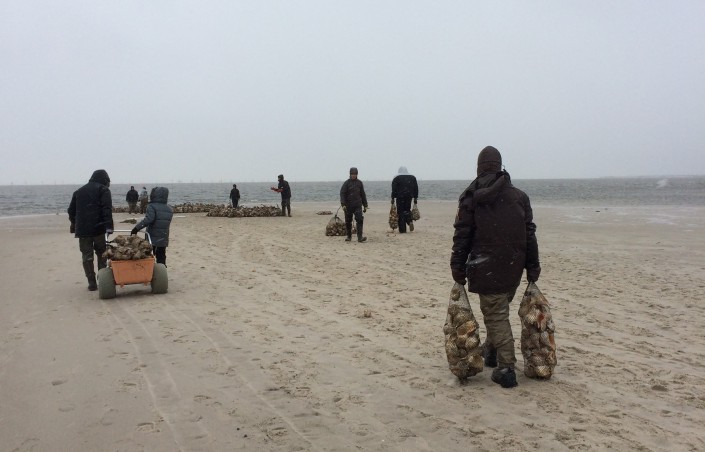
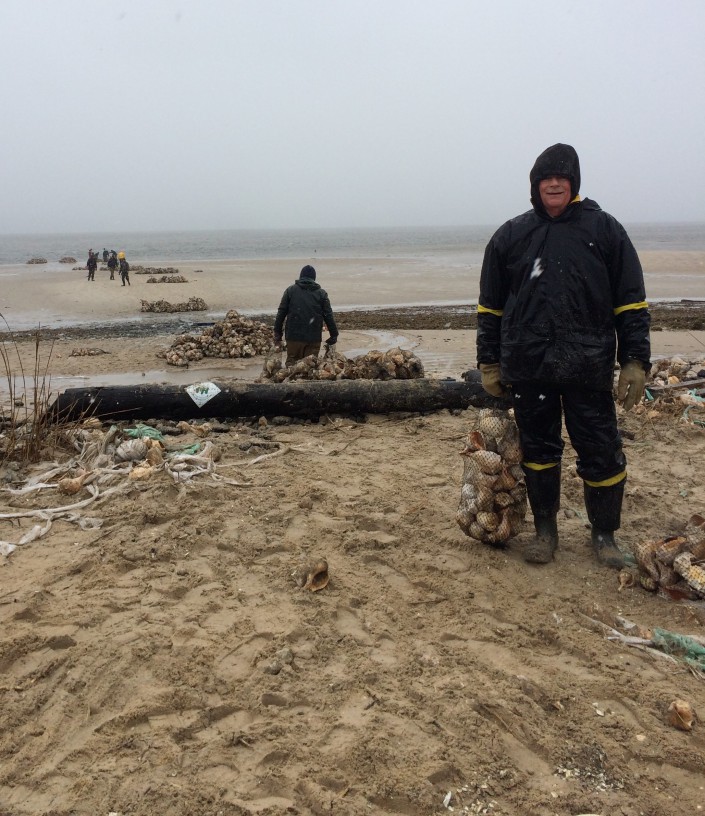
Dedicated volunteers braved the elements and worked alongside American Littoral Society and Conserve Wildlife Foundation of New Jersey to establish a near-shore whelk shell bar at Moores Beach in Maurice River Township along New Jersey’s Delaware Bayshore. The shell bar was built to prevent sand loss from wind-driven waves. An approximately 200-foot oyster reef was constructed offshore to test whether the reef bars help reduce beach erosion and create calmer water for spawning horseshoe crabs.


“The Second Annual Shell-a-Bration truly celebrates the ecology, community, and culture of the Delaware Bayshore,” stated Captain Al Modjeski, Habitat Restoration Program Director, American Littoral Society. “It reinforces the connectivity between the natural and human-built bayshore communities through reef building and celebrates the significance of the Bay’s resources through restoration.”

MooresBeachOysterReef3

“There are many strategies to defend our Delaware Bayshore, but one of the best and most productive are these oyster reefs,” stated Dr. Larry Niles, a biologist with American Littoral Society and Conserve Wildlife Foundation of New Jersey. “They not only replicate a lost but important habitat on Delaware Bay — reefs once covered much of the bayshore — but they provide just enough protection to make a difference in how long our beaches persist against the unrelenting forces of nature. In a way, we are fighting nature with nature.”


Shorebirds, like the federally listed Red Knot, depend on an uninterrupted supply of horseshoe crab eggs when they stopover in Delaware Bay during their migration. In recent years, countless horseshoe crab eggs have been lost because of the devastating storms that swept away the beaches they depend on.

MooresBeachOysterReef2

The new oyster reef will attenuate waves but still allow for horseshoe crab breeding. In existing areas where crabs can breed without interruption, like creek mouths protected by sand shoals or rock jetties, egg densities can exceed ten times the egg densities on unprotected beaches.


“New Jersey’s Delaware Bayshore hosts an annual wildlife spectacle of global significance – the time-honored migration of Red Knots to reach the eggs of these ancient horseshoe crabs,” said David Wheeler, Conserve Wildlife Foundation of New Jersey Executive Director. “Red Knots fly to New Jersey’s Delaware Bay from as far away as Tierra del Fuego in South America to feed on horseshoe crab eggs. Volunteer projects like the Shell-a-bration help connect the people of New Jersey with these endangered shorebirds and the largest population of horseshoe crabs in the world.”


Last year, over 130 volunteers and veterans built the South Reeds Beach oyster at the First Annual Shell-a-Bration. Veterans Day on the Bay 2015 dedicated the South Reeds Beach oyster reef to all veterans and highlighted veteran involvement in the effort to restore New Jersey’s Delaware Bayshore. Event attendees honored their own military veterans by inscribing that special person’s name on a shell and placing that shell on “Veterans Reef.” Guests also helped study the wildlife living in this new reef with hands-on, interactive marine science activities like seining, trapping, trawling, and species identification.

Our "assembly line" of volunteers all working together to build the reef.
Our “assembly line” of volunteers all working together to build the reef.

Veterans Reef and the Moores Beach Oyster Reef are two of the many projects that American Littoral Society and Conserve Wildlife Foundation are working on to restore the ecology and economy of the Delaware Bayshore.


In the wake of Hurricane Sandy, American Littoral Society and Conserve Wildlife Foundation of New Jersey worked with the U.S. Fish and Wildlife Service, the New Jersey Division of Fish and Wildlife and the New Jersey Recovery Fund to remove 8,000 tons of debris and added 45,000 tons of sand to the beaches just before the annual spring arrival of the red knot in 2013.


Additional work after 2012 restored another mile of shoreline, including two new beaches of poor quality even before Sandy. To date, the groups have placed 85,000 cubic yards of sand and restored seven beaches along New Jersey’s Delaware Bayshore. In early 2016, groups began another phase of restoration work at Cook’s Beach and Kimble’s Beach in anticipation of the return of the horseshoe crabs and red knots in May.


The projects are being funded by National Fish and Wildlife Foundation through their Hurricane Sandy Coastal Resiliency Grants Program, and are being developed in partnership with U.S. Fish and Wildlife Service and New Jersey Division of Fish and Wildlife.


Learn More:


Lindsay McNamara is the Communications Manager for Conserve Wildlife Foundation of New Jersey.

Oyster Reef in Delaware Bay Dedicated to New Jersey Veterans

“Veterans Day on the Bay” brings families, volunteers and veterans to South Reeds Beach on New Jersey’s Delaware Bayshore

by: Lindsay McNamara, Communications Manager

[slideshow]

Conservation organizations leading the efforts to restore New Jersey’s Delaware Bay beaches today organized “Veterans Day on the Bay,” a celebration to dedicate the oyster reef at South Reeds Beach in honor of military veterans’ service to our country.


“We want to dedicate this work to our nation’s armed forces veterans to give them well deserved recognition for their service to all Americans,” stated Dr. Larry Niles, a biologist with American Littoral Society and Conserve Wildlife Foundation of New Jersey who has studied federally-listed Red Knots for three decades. “We also hope to give them an intimate experience of successful wildlife conservation to spark their interest and encourage them and their families to take part in future work.”


Veterans Day on the Bay dedicated the South Reeds Beach oyster reef to all veterans and highlighted veteran involvement in the effort to restore New Jersey’s Delaware Bayshore. Event attendees honored their own military veterans by inscribing that special person’s name on a shell and placing that shell on “Veterans Reef.” Guests also helped study the wildlife living in this new reef with hands-on, interactive marine science activities like seining, trapping, trawling, and species identification.


“Delaware Bay has been so vital to this community for generations, and through this project we hope to strengthen the connections that young and old feel to this incredible natural resource that is home to wildlife of global importance,” said David Wheeler, Executive Director for Conserve Wildlife Foundation of New Jersey. “The living construction of Veterans Reef is a small but meaningful embodiment of all that our military veterans have done in building a strong American defense to give us security and protect the many freedoms we hold dear.”


Volunteers and veterans worked alongside American Littoral Society and Conserve Wildlife Foundation of New Jersey to establish a near-shore oyster reef at South Reeds Beach in Cape May Court House on the Delaware Bayshore in April 2015. The reef was built to prevent sand loss from wind-driven waves. Conservation groups will continue to monitor whether the reef bars help reduce beach erosion and create calmer water for spawning horseshoe crabs.


The South Reeds Beach Oyster Reef is one of the many projects that American Littoral Society and Conserve Wildlife Foundation are working on to restore the ecology and economy of the Delaware Bayshore.


“We are rebuilding habitats along Delaware Bay in order to strengthen the ecology, communities and economy of that area. Grants for the project enabled hiring several military veterans, and they continue to play a valuable role in the work. It is in recognition of the service veterans provide to their country and communities, that we are dedicating the reef at Reeds Beach to them,” said Tim Dillingham, Executive Director for American Littoral Society.


“Congratulations to the American Littoral Society, the Conserve Wildlife Foundation of New Jersey, and the veterans who helped build this oyster reef,” said Amanda Bassow, Northeastern Regional Director for the National Fish and Wildlife Foundation, which helped fund the project in partnership with the Department of Interior. “This project will help Reeds Beach be more resilient to the impact of future storms, while also providing important habitat in Delaware Bay.”


Shorebirds, like the federally listed Red Knot, depend on an uninterrupted supply of horseshoe crab eggs when they stopover in Delaware Bay during their migration. In recent years, countless horseshoe crab eggs have been lost because of the devastating storms that swept away the beach habitat they depend on.


“Restoring beach habitat on the Delaware Bay benefits Red Knots because it provides important feeding habitat for a bird threatened with extinction. The restored beach and oyster reef also protects the local community by providing increased resilience to future storms. Projects like these that help fish and wildlife, in addition to supporting local communities, are a priority for the U.S. Fish and Wildlife Service,” explained Eric Schrading, Field Supervisor for the New Jersey Field Office of the U.S. Fish and Wildlife Service.


The new oyster reef will attenuate waves but still allow for horseshoe crab breeding. In existing areas where crabs can breed without interruption, egg densities can exceed ten times the egg densities on unprotected beaches.


Projects like the South Reeds Beach oyster reef are being funded by National Fish and Wildlife Foundation through their Hurricane Sandy Coastal Resiliency Grants Program, and are being developed in partnership with U.S. Fish and Wildlife Service and New Jersey Division of Fish and Wildlife.


Learn More:


Lindsay McNamara is the Communications Manager for Conserve Wildlife Foundation of New Jersey.

Veterans Day on the Bay

Oyster Reef in Delaware Bay to be Dedicated to New Jersey Veterans

by Lindsay McNamara, Communications Manager

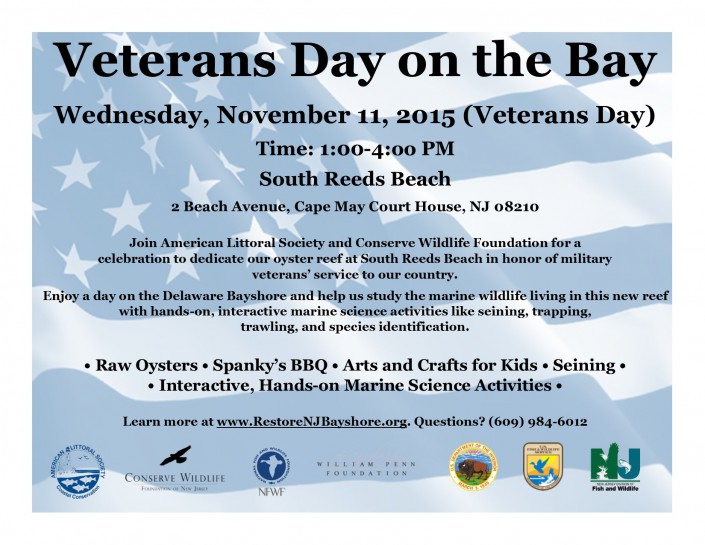
VeteransDayFlyerFinalYou and your family are “whelk-come” to join Conserve Wildlife Foundation and American Littoral Society for our Veterans Day on the Bay on Wednesday, November 11 (Veterans Day) from 1-4 PM at South Reeds Beach on the Delaware Bayshore! In April, we held a Shell-a-Bration where over 100 volunteers helped build an oyster reef at South Reeds Beach. Since its creation, we have been monitoring this living shoreline’s ability to help keep sand on the beach and provide habitat for marine wildlife.


On Veterans Day, Wednesday, November 11, we’d like to mark the progress we’ve made and dedicate the reef to all veterans.
Please join us for Veterans Day on the Bay, which will feature:

  • Raw oysters and fare from Spanky’s BBQ
  • Bonfire on the beach
  • S’mores
  • Arts and crafts for children

Help us study the wildlife living in this new reef with hands-on, interactive marine science activities like seining, trapping, trawling, and species identification!


The highlight of the event will be the dedication of “Veteran’s Reef” in honor of our military veterans. Attendees are invited to honor their own military veterans by inscribing that special person’s name on a shell and placing that shell on Veterans Reef.


This family fun day and volunteer event will be held from 1:00-4:00 PM, with the reef dedication ceremony taking place at 2:30 PM. Veterans Day on the Bay is rain or shine. Please park along Beach Drive, but be mindful of local residents’ driveways. The celebration will be a picnic-style event, so please bring blankets and chairs.


Join us at 2 Beach Avenue, South Reeds Beach, Cape May Court House, New Jersey.


Learn more:


Lindsay McNamara is the Communications Manager for Conserve Wildlife Foundation of New Jersey.

Banding Together: When the Shorebird Met the Biologist

Celebrating World Shorebirds Day, Sunday, September 6

by Lindsay McNamara, Communications Manager

Red Knot Photo by: Jan van der Kam

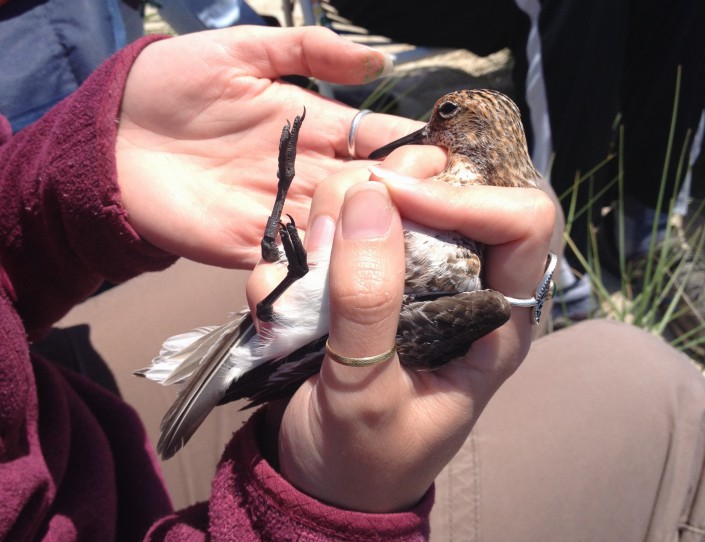
As a bird nerd, I’d often look on enviously at photos of biologists posted online holding shorebirds in their “bander’s grip” – the bird’s head in between their index and middle finger, using their thumb and pinky to steady the bird, while allowing its feet to dangle freely.

 
I always wondered: I wish I could do that! Hold a bird in my hands. Yet I never once thought: Wait, how did the bird end up in their hands in the first place?

 
I certainly hadn’t thought biologists run all over the beach chasing after shorebirds like a farmer chasing chickens – I just never thought the process all the way through.

 
This past summer, I was fortunate enough to become part of that process and learned exactly how a shorebird ends up in a biologist’s bander’s grip. The system may surprise you, but the steps have been mastered over nineteen years of practice, each one with shorebird safety as the top priority.


Conserve Wildlife Foundation (CWF)’s Delaware Bay Shorebird Project celebrated its 19th year this summer. The team members, led by Drs. Larry Niles of CWF working with Amanda Dey of New Jersey Division of Fish and Wildlife, are all extremely passionate about what they do and care deeply for the shorebirds they are studying and protecting.

 
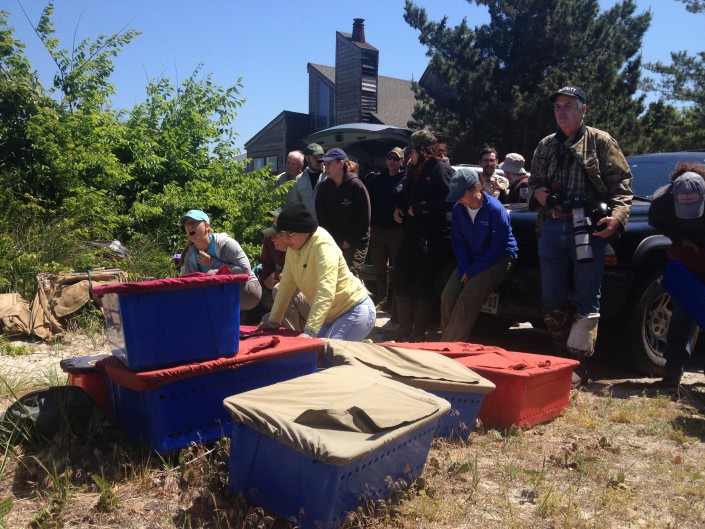
I arrived at the team’s house on Reeds Beach, along the Delaware Bayshore, early in the morning. Dr. Niles was concerned about the wind and had scoped out the safest beach for the banding that day. Our group of scientists, volunteers, supporters, interns and staff caravanned to Villas and joined our partner, American Littoral Society, at the site. We all picked up large, colorful plastic tubs, which had cloth covers that fit securely over the top of the box. The cloth cover had a Velcro pocket. We were told that these boxes would help in the shorebird “catch” that day. Larry and Mandy gave us instructions for how the banding day would go, safety tips and background information on the Delaware Bay Shorebird Project. We all listened intently and couldn’t wait for the day to begin!

The team waiting with our bins. Photo by Lindsay McNamara
The team waiting with our bins. Photo by Lindsay McNamara.

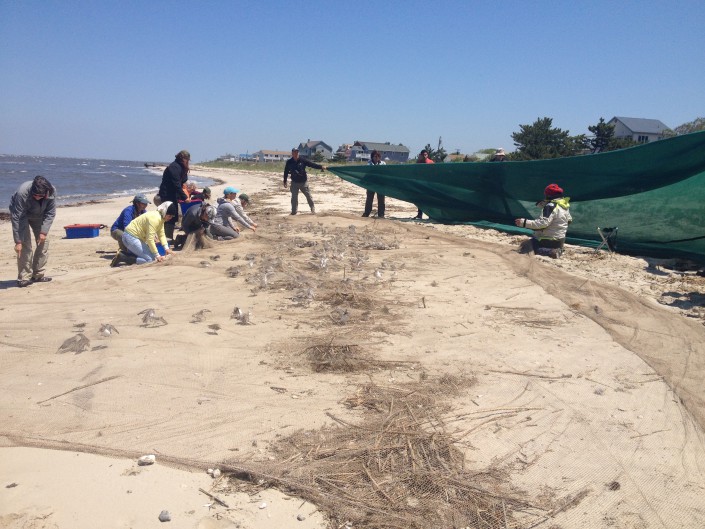
Well, we waited a bit before the day truly started. Dr. Niles and his team had binoculars with them and sat down in the sand, watching the shorebirds from afar for about an hour and a half. We waited by the cars up near the houses along the beach. The reason for the long wait? Dr. Niles and his team were waiting for the perfect moment to fire the net over top of the shorebirds along the coastline.

Biologists rolling away the net to reveal more shorebirds. Photo by Lindsay McNamara.

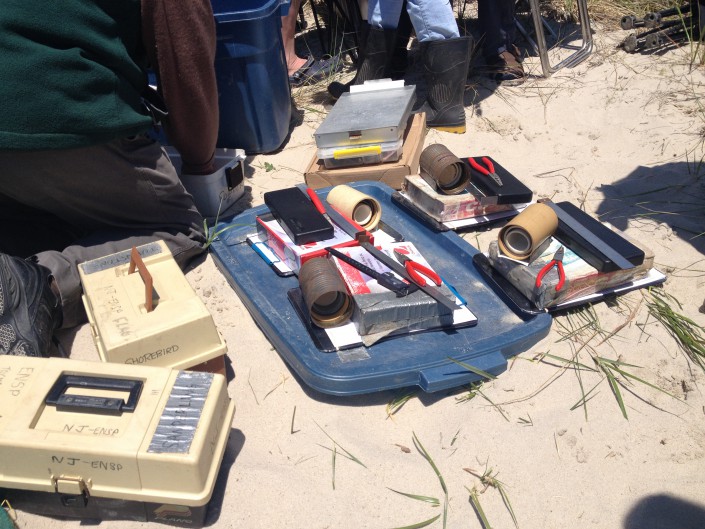
Cannons with gun powder charges fire heavy projectiles that carry the net over the birds only at the perfect moment – when birds are catchable and none in danger. Luckily, it was not a “wet catch,” that day, as the net did not go into the water. As soon as the cannon was shot, we all spirited single file carrying our tubs down the beach, following the biologists. The biologists immediately knelt at the base of the net and started picking up birds and shouting their identification and passing them to us, as they went they rolled the net away to reveal more birds.

 
It was very exciting! The idea was to get the birds out from under the net and into our carrying boxes and sealed in with a Velcro flap, as fast as possible, for the safety of everyone involved.

 
Each bin became devoted to the same bird species, so if the first bird that was handed to us was a sanderling, we kept putting only sanderlings in our bin. Once we had several birds in our bin, our pace completely changed. We walked very slowly away from the net, keeping the bin level at all times, towards the path in the sand at the beginning of the beach, to make the journey as safe for the birds as possible. There, biologists had burlap “keeping cages” for the birds to wait in. Birds were also sorted by species into these cages.

 
When every bird was taken out from under the net, and sitting in their temporary burlap enclosure, we formed “circles.” Each circle was composed of about 6 volunteers led by a core banding team member. Once formed birds were handed to us and finally, I learned how to safely hold a shorebird in my very own bander’s grip!

My very own bander's grip! Lindsay McNamara holding a sanderling.
My very own bander’s grip! Lindsay McNamara holding a sanderling.

Each bird received a metal band with a federal identification number, and a green tag with a three letter code. One person in the circle put the band on the bird and passed the bird to the next person, who placed the green tag on each birds’ leg and glued them shut. A recorder took notes on the band number and tag letters. Next, the birds’ wingspan and other data points were measured by other members in the circle. Lastly, the bird was weighed before it was released. During my trip with the banding team, we caught a large number of sanderlings and a few ruddy turnstones, federally listed red knots, and semipalmated plovers.

Banding team supplies. Photo by Lindsay McNamara.

Holding a shorebird in my bander’s grip was an amazing experience, but what I enjoyed most of all was taking part in the science of shorebird conservation. I placed the green tags on the shorebirds, which will tell other scientists who may recapture the birds that they once traveled to New Jersey. Our circle helped collect valuable data points, which will be combined with the data from the other years of the Shorebird Project, to assess the health of shorebird populations.

 
I wasn’t just holding a bird, I was helping the bird have a brighter future – and that is the best feeling any bird nerd can have.

 
Today is World Shorebirds Day! You can help shorebirds have a brighter future today by participating in the Global Counting Day Program. Join the hundreds of participants at over 93 locations that will count shorebirds and share their sightings online. Register today!


Learn more:


Lindsay McNamara is the Communications Manager for Conserve Wildlife Foundation of New Jersey.

Restoring the “Natural Mosaic” of Thompsons Beach Salt Marsh

Our Team is using Science-based Methods to Elevate the Marsh and Restore the Balance of High and Low Elevation

by Lindsay McNamara, Communications Manager

To restore Thompsons Beach, along New Jersey’s Delaware Bayshore, our team removed debris from the beach, removed rubble from the road leading to the beach, and placed over 40,000 cubic yards of sand (weighing over 9 million pounds) onto the beach. We were filled with pride when we saw sanderlings and ruddy turnstones feeding this August on horseshoe crab larvae on our newly restored beach. We were delighted to learn that this spring, Thompsons Beach had the highest abundance of horseshoe crab egg clusters out of all the beaches that our team monitors on Delaware Bay.

 
How do we keep the momentum going? How do we ensure our restoration work at Thompsons Beach yields long-term, sustainable results? The answer is clear: we protect the backbone that the beach sits on — the salt marsh behind the beach.


Learn more:


Lindsay McNamara is the Communications Manager for Conserve Wildlife Foundation of New Jersey.

Photos from the Field: Successful Year for Bayside State Prison Falcons

Endangered Falcons are Doing Well this Year!

by Ben Wurst, Habitat Program Manager

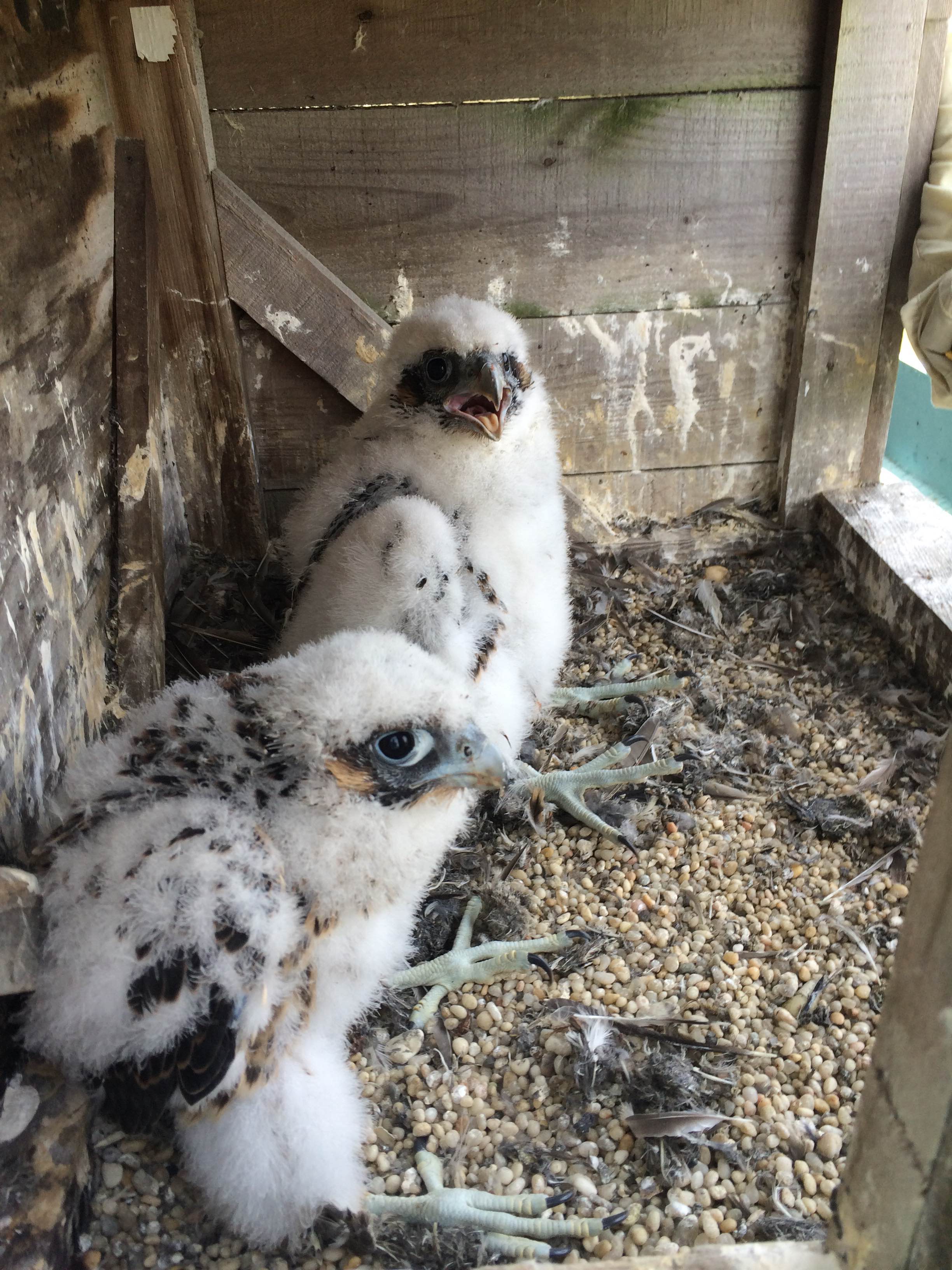
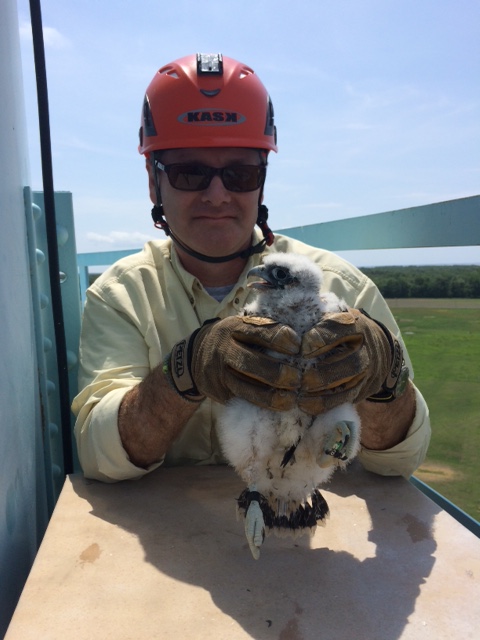
So far this has been a good year for peregrine falcons. Almost all known nest sites have produced young, even the natural nests on the New Jersey Palisades, which are prone to failure from strong winds and driving rain associated with Nor’easters in early spring. One successful site is at Bayside State Prison. The nest there is on top of a 120′ water tower. The pair of falcons nests in a nestbox that was installed several years ago after a old hacking tower was decommissioned on the coastal saltmarshes along the Delaware Bay. For the past two years the site has been active and productive. This year two young eyases were produced (one was produced in 2014). Last week we joined Kathy Clark and John Heilferty with the NJ Fish and Wildlife’s Endangered Species Program to band the two young falcons.

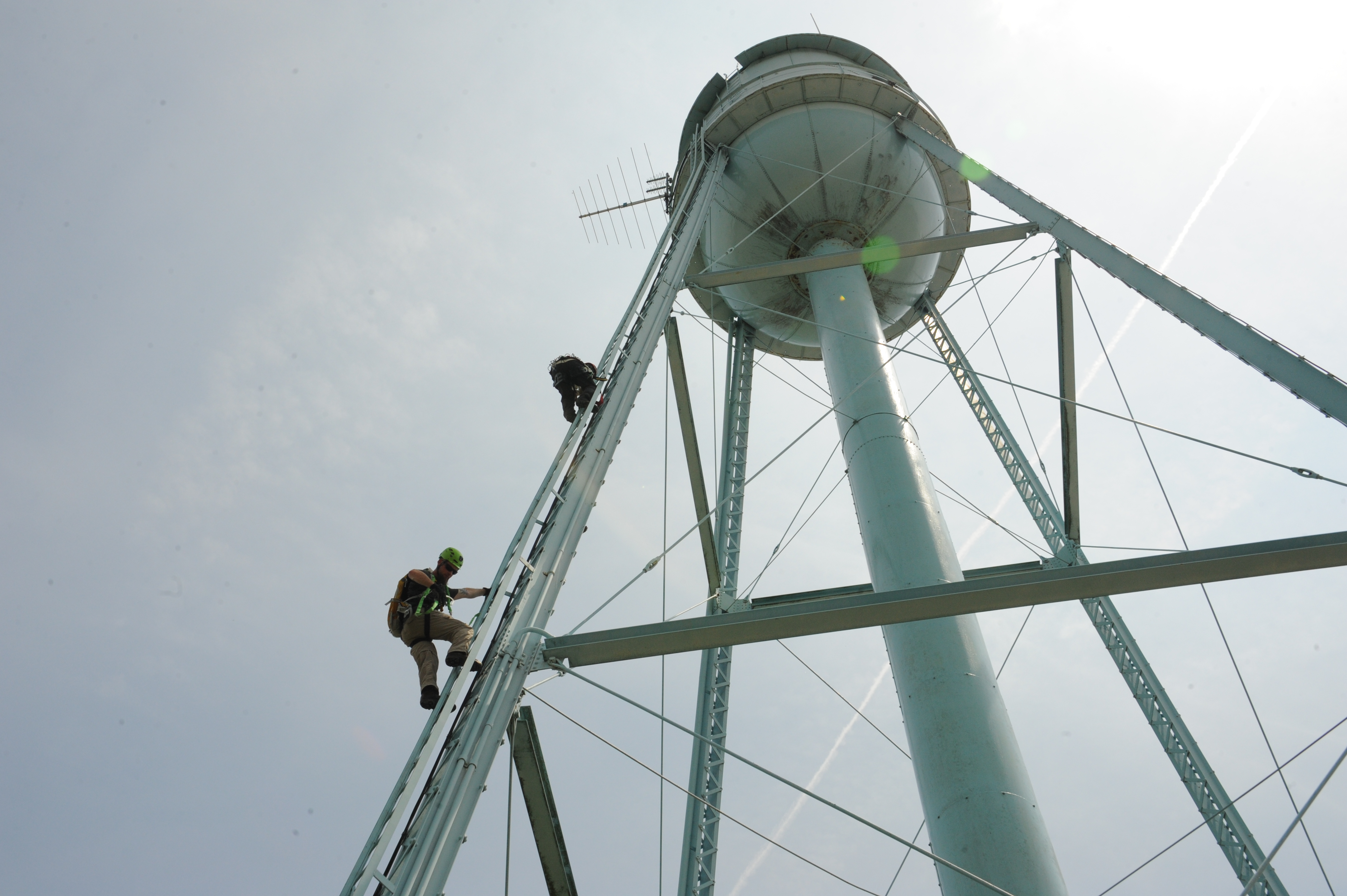
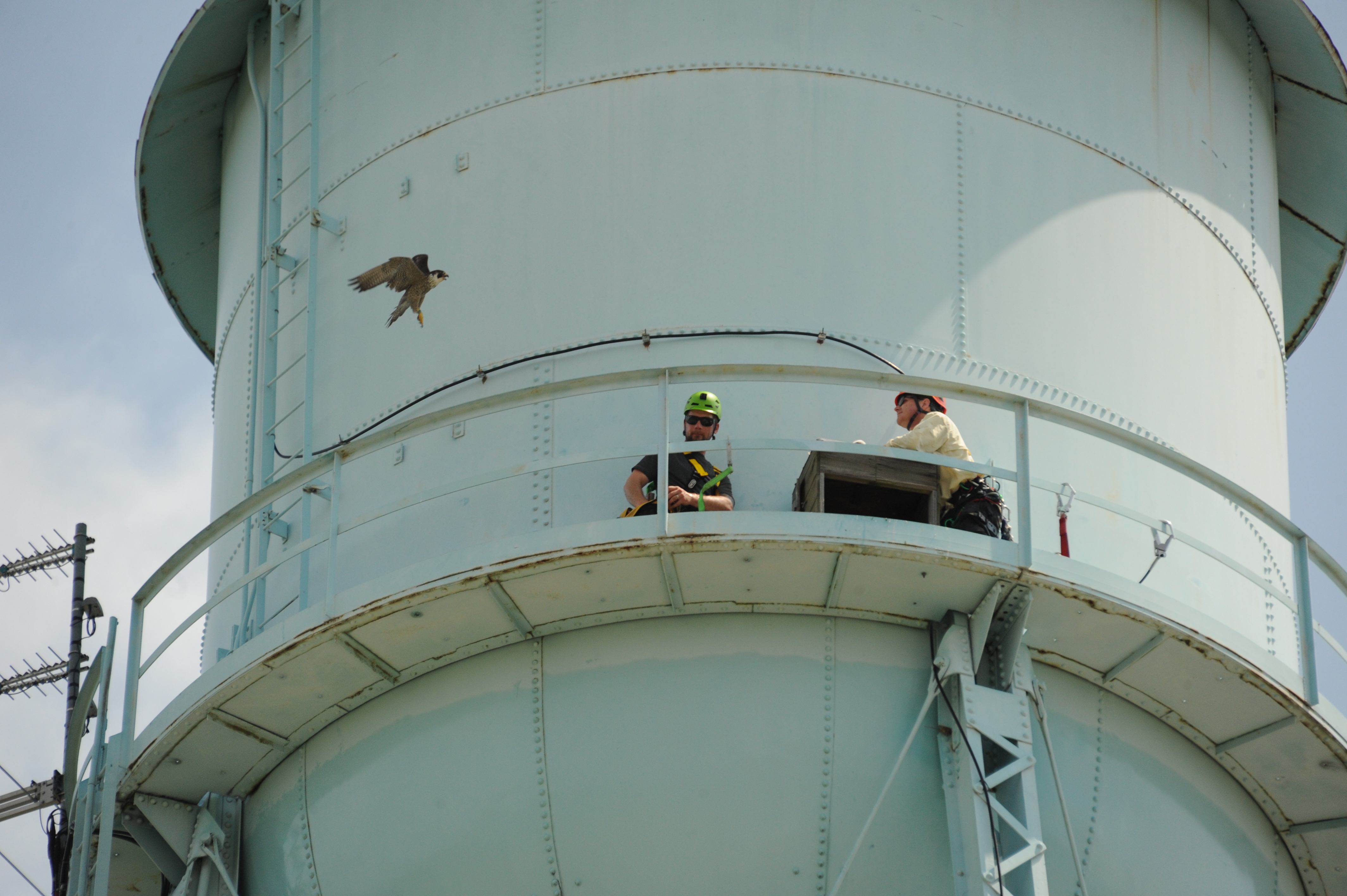
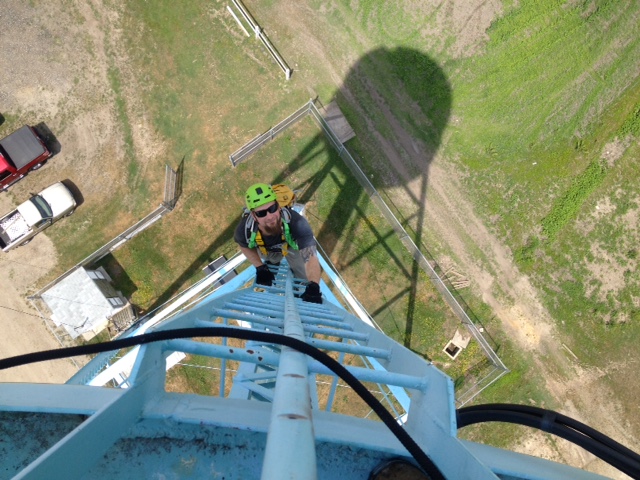
We climbed the 120′ tower to access the nest and band the young. As we climbed the tower the adult female was calm but as we got to the half way point she became aggressive towards us to defend her nest and young. We were wary of her the whole time and spent as little time as possible on the tower while banding the young to minimize the stress to her from constantly flying and dive bombing us, which she did. We were lucky to have a steel railing to protect us (and helmets), as she came very close to us. At times she would perch behind me or John on the railing. Once we were done banding we climbed down and she returned to her nest to find that her young were not harmed.

Banding is a critical tool for avian biologists to learn a lot about birds. For New Jersey falcons we tag them with a black USGS federal band and a bi-color / alpha-numeric band, which allows us to be able to identify each individual bird. It also provides more valuable information including nest success, age, site fidelity, and the turnover rate in the population. At all nest sites in New Jersey, after we have successfully identified the breeding pair, we continually monitor each nest or eyrie until the young are old enough to band (approximately 3-4 weeks old). In 2014 there were 29 active nests in New Jersey (up from 26 in 2013). The core of the population continues to nest on towers and buildings throughout the state.

KEC_7594
Ben W. and John H. climbing the 120′ tower. Photo By Kathy Clark/ENSP
Banding
Ben prepares to band a nestling that John holds. Photo by Kathy Clark/ENSP
Dive bombed!
Dive bombed! Yes, the female came very close to us! Photo by Kathy Clark/ENSP
Two 3.5 week old young. One male; one female. Photo by Ben Wurst
John Heilferty holds a 3.5 week old peregrine falcon as it was banded for future tracking.
John Heilferty, ENSP Biologist holds a 3.5 week old peregrine falcon as it was banded for future tracking.
Ben Wurst climbs down the 150' water tower. Photo by John Heilferty/ENSP.
Ben Wurst climbs down the 120′ water tower. Photo by John Heilferty/ENSP.

Learn more:

2015 Delaware Bay Shorebird Banding Season Comes to a Close

Delaware Bay Shorebird Project Team Finishes 2015 Banding Season

By: Dr. Larry Niles, LJ Niles Associates LLC

All our efforts to help shorebirds on Delaware Bay this year couldn’t have been better rewarded – nearly every red knot left the bay in good condition and in one of the earliest departures in the 19 years of the Project. We counted just over 24,000 knots in our aerial count of the entire Bayshore on May 26th. Just two days later, most had left and we could find only a few hundred, feeding on eggs like human shoppers feed on bargains at a half-price sale. By May 31st, virtually all were gone, along with the ruddy turnstones, sanderlings and semipalmated sandpipers. The beaches had an odd, deserted feel after the frenzy of the preceding days.

Photo by Jan van der Kam from Life on Delaware Bay

A good thing for birds and all those who love birds. The end of the shorebird stopover season also means the end of our shorebird team – at least for another year. All through the week, we lost team members—the North Americans left by car, those from other continents by air. Those who stayed shifted from research to manual labor: cleaning and storing equipment, closing up the rental houses, and reconnecting lost items to their owners.

Photo by Kevin Karlson

Will our project continue? Now in our 19th year of work on the bay, one must recognize the realities of time’s passage. Clive Minton just cleared 80, and the rest of the original team will soon follow. This author, who started at relatively young 44, is now pushing his mid-sixties. Death visited our team this year with the passing of Allan Baker. Surely the rest of us will start “falling off the perch” as Clive is fond of saying.

Allan Baker, the Senior Curator of Ornithology and Head of the Department of Natural History at Toronto’s Royal Ontario Museum suddenly and unexpectedly died in 2014.  His career included many significant achievements including early work that helped build a scientific case that overharvested horseshoe crabs caused the decline of red knot numbers. Photo from Wader Study.
Allan Baker, the Senior Curator of Ornithology and Head of the Department of Natural History at Toronto’s Royal Ontario Museum suddenly and unexpectedly died in 2014. His career included many significant achievements including early work that helped build a scientific case that overharvested horseshoe crabs caused the decline of red knot numbers. Photo from Wader Study.

And yet, all committed to return for a 20th year. I worry over the fundamentals: our funding remains uncertain, the listing of knots as Threatened in the U.S. creates new regulatory hurdles, and N.J. politics seem to get more fractious every minute. Will there be a 20th year of this project?


The answer starts and ends with the willingness of our team to do it again. It starts there because good ideas and projects always seem to find support; I know we will find a way. It ends there because this team provides the best chance of a strong scientific underpinning for protection. Our team includes some of the most important shorebird scientists in the world. At our dinner soirees (generously provided by Jane Galetto’s Citizens United team), Ph.D.’s are as common as empty beer bottles. It’s no surprise that conversation drills deep into conservation biology, behavioral ecology, migration physiology, stopover ecology, virology and many other subjects of interest to all our team, both scientists, old and young, and lovers of good science.


In many ways, the lives of our team members revolve around birds. The Delaware Bay Shorebird Project provides us a meaningful excuse to pull together once more. Our team members love birds, and do everything they can to help them. It’s been that way for 19 years, and it is this commitment that has led to this year’s results.

p180 red knots
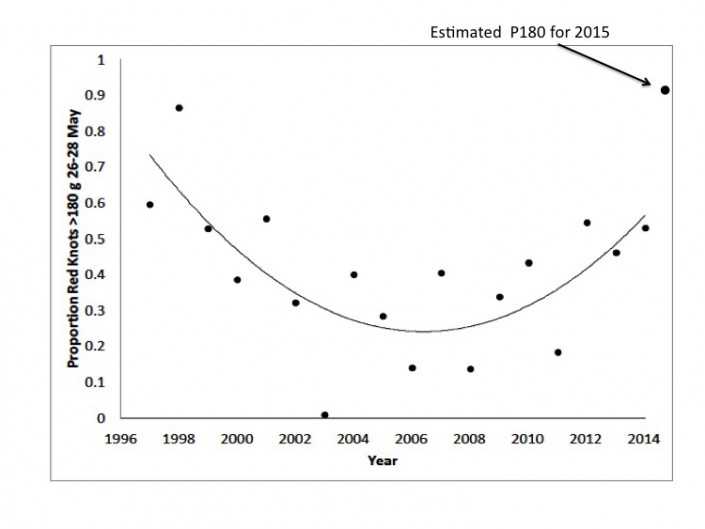
This graph plots the percentage of red knots caught between May 26th and May 28th that have achieved at least 180 grams against the year of the catch. The 2015 result is still an estimate.

For the first time in 19 years, red knots left in a condition similar to the lucky ones migrating through before the fishing industry decimated horseshoe crabs in 1997. After that year, the populations of knots, turnstones, semipalmated sandpipers, and sanderlings fell off a cliff. For the last four years, however, the terribly reduced populations of shorebirds have been in rough balance with equally reduced number of horseshoe crabs breeding on the Bay. Consequently, the percentage of knots reaching the threshold weight of 180 g has climbed. (Knots need at least this weight to reach the Arctic and breed successfully.) From a low of just 5% making weight in 2003, they’ve clawed their way upward 30% in 2010, 50% in 2013 and now this year’s 90%.

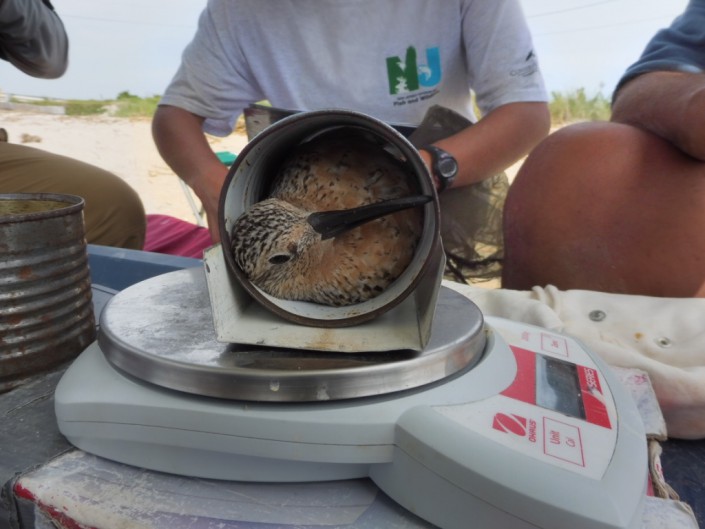
Fat knot on the scale by Philippe Sitters

One must be cautious about the interpretation of this number but the catch of red knots on which it was based were truly fat birds! One weighed 226 grams, nearly 100 grams higher than its fat free weight. Whatever the figure it was a good season for both birds and the people who love them.

Learn more:

Dr. Larry Niles has led efforts to protect red knots and horseshoe crabs for over 30 years.