Piping Plovers and Researchers Return to The Bahamas

PROTECTING PIPING PLOVER HABITAT CRITICAL PART OF CONSERVE WILDLIFE FOUNDATION’S WORK

By: Todd Pover, Beach Nesting Bird Project Manager and Stephanie Egger, Wildlife Biologist

We talk quite a bit about “site fidelity” in connection with our beach nesting bird project. And for good reason, whether it be on the breeding or wintering grounds, these birds, like most wildlife, are strongly connected to specific places and types of habitats. Not just in the general sense; many piping plovers return to the same precise site year after year.

Aerial view of one of several hundred Bahamas islands and cays, with tidal flats, highly suitable piping plover habitat, visible stretching around the island.


We were reminded of this the last several days as we made our way around Abaco, The Bahamas, in search of wintering piping plovers. Having made a number of trips to Abaco since 2011, we have started to narrow down where it is likely we will be able to find them: the Green Turtle Cay Gillam Bay flat at low tide or the adjacent upper beach hummocks at high tide, Casuarina Point to forage at low tide, a number of the main island’s southern oceanfront beaches for roosting, to name a few. We are still finding new sites, not previously surveyed or documented, but we now have a much better idea of what to look for and on what tide or wind condition.


The catch is, this only works if the habitat remains intact and suitable. Back in New Jersey, we know this well, as many of the formerly suitable sites for beach nesting birds are lost forever to development or are highly disturbed by recreational activities so the likelihood of reproductive success is low even if they do choose to nest at those locations. Sadly, our breeding pairs of piping plover are relegated to a limited number of suitable sites, which is not a good recipe for recovery of this endangered shorebird.


With its hundreds of islands and cays, many undeveloped or lightly settled, we may be inclined to think this is less of an issue on the wintering grounds in the Bahamas. And relatively speaking, this might be true to some extent, but it would be unwise to believe this will always be the case. Economic forces are a driving factor there, as in anywhere in the world, so the lure of development and commercial use of resources is strong in the Bahamas as well.
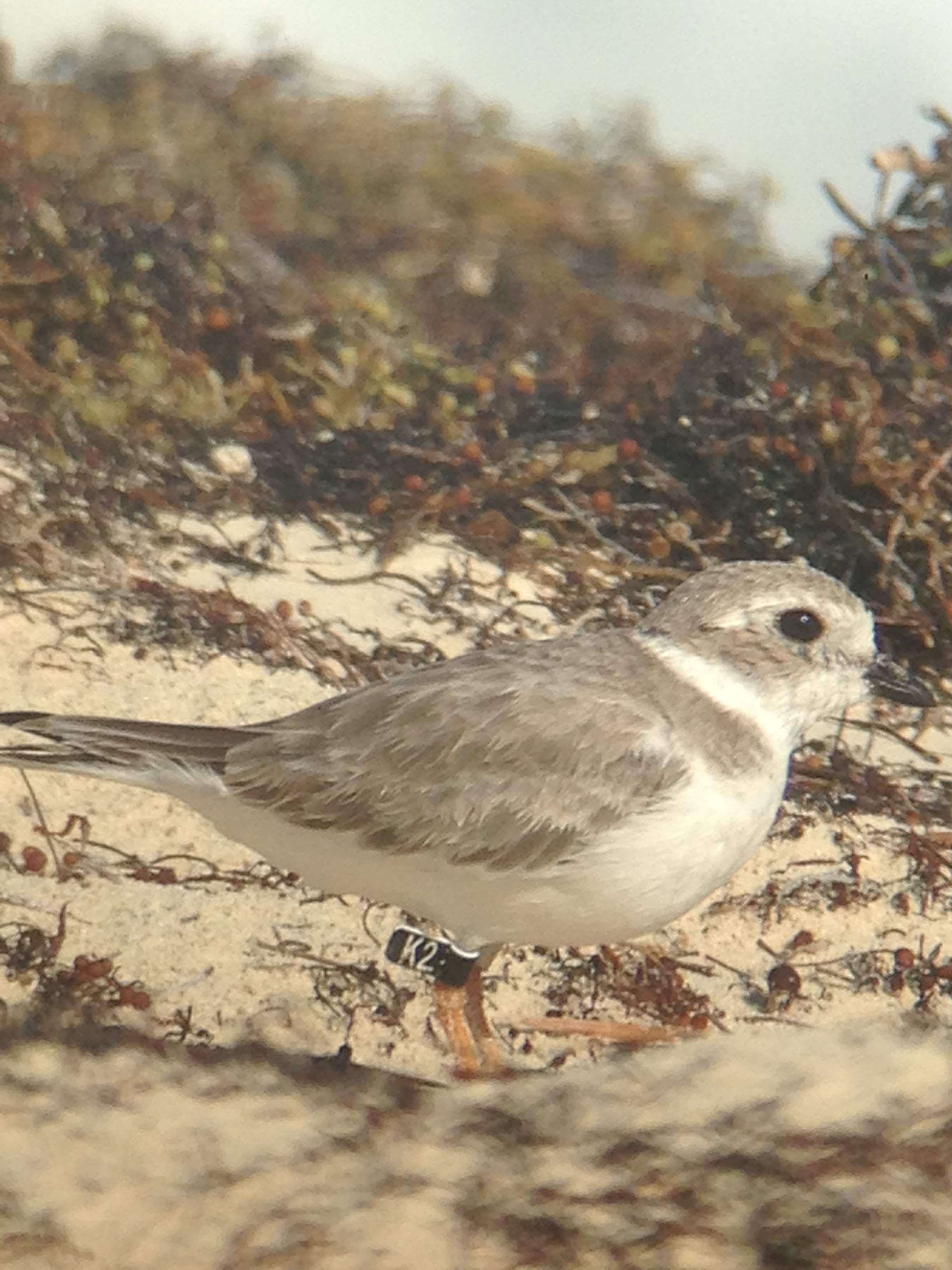
Black Flag "K2", a Canadian breeder and one of six color marked piping plovers observed on wintering grounds on Abaco, The Bahamas, this past week by CWFNJ's Todd Pover and Stephanie Egger.
Black Flag “K2”, a Canadian breeder and one of six color marked piping plovers observed on wintering grounds on Abaco, The Bahamas, this past week by CWFNJ’s Todd Pover and Stephanie Egger.


Fortunately, there is also a strong incentive to protect shorebirds in the Bahamas. The tidal flats and shallow water habitats that shorebirds use are also important for bonefish, conch, and other fisheries that are important to the local economy and provide jobs. Furthermore, birding and wildlife-based activities are increasing an important part of the tourist sector. However, In order to sustain those activities and opportunities, ecosystems must remain intact and pristine.


A number of organizations, local and from abroad, are diligently working to designate more protected areas in the Bahamas. One of the top priorities now, an effort being led by the Bahamas National Trust and National Audubon Society, is to protect the vast flats area in the Joulter Cays, Andros, which are especially important for shorebirds such as the piping plover. On Abaco, where we have been focusing our piping plover work, Friends of the Environment  is strongly advocating for protection of East Abaco Creeks, Cross Harbour, and more recently The Marls.


During a survey this past week on Man-O-War, one of Abaco’s offshore cays, we were able to locate a banded piping plover that had originally been marked on its breeding grounds in Canada. In discussing the bird with a local resident who had first spotted it, she was surprised that the bird was remaining in the same spot ever since she saw it two months ago. This was site fidelity illustrated in its truest sense, and in the same vein, the researchers in Canada are already anticipating it will return to the same site to nest next spring. From what we know about piping plovers that is highly likely…as long as we remain committed to protecting the habitat they use.
 

Why are You Thankful for New Jersey’s Wildlife?

By: Lindsay McNamara, Communications Coordinator

BannerTGiving

This holiday season, Conserve Wildlife Foundation of New Jersey asked our friends, supporters and volunteers, What is special about NJ’s wildlife to you? Why are you thankful for New Jersey’s wildlife? Friends of wildlife shared their thoughts by tweeting us, leaving us a comment on our Facebook page or sending us an email at info@conservewildlifenj.org. We encouraged everyone to use:  #thanksnjwildlife 
Here is a collection of some of the responses we received:

Bill Nigh on Twitter shared that “wildlife gives me perspective.”

Judy Floam wrote over e-mail, “I only spend one week a year in New Jersey (at the beach) but I love to watch the gulls and sandpipers, and go on seine netting expeditions at Island Beach State Park.”

“Why are we thankful for New Jersey’s wildlife? Each and every creature is special to us although the coyote and the bats have a special place in our hearts. We’re grateful to the bats for keeping insect pests at bay and enjoy watching them leave their roost at dusk. Amazing. The coyotes are very musical and we appreciate their part in balancing nature. We’re grateful that the staff and volunteers at Conserve Wildlife work diligently to protect natural habitats. Thank you!”
— Joe & Linda Jedju shared through e-mail.

“Is this really New Jersey? It’s a question I have asked myself numerous times while living in NJ but never so much as over the last three years. It was three years ago that we purchased a small house on a lake in Sussex County. The waters of the lake are pristine and they teem with beavers, herons, numerous waterfowl, and too many different fish to mention. We watch amazing sunsets over the Appalachian Trail. We sit awe struck as foxes and bears routinely traverse our yard. Hummingbirds and beautiful finches occupy our yard and the wildflowers that grow there. We have watched as Bald Eagles circle high above and slowly spiral down to snatch a fish from the surface of the lake. We have sat in the cool evenings and watched the Milky Way appear as a swath of white across a darkening night sky. We watch as some of our endangered friends the bats dance crazy patterns in the night air, feasting on insects. Is this really NJ? Is it the stereotype of landfills, factories, pollution, and exits on the Parkway? Most definitely not! The rich diversity of animal and plant life leave us awe struck on a daily basis. I could also go on and on about our beautiful shoreline, Island Beach State Park, the Pine Barrens, and numerous other ecosystems that make our state so incredible. NJ’s amazing Wildlife is not limited to amusement parks and bars!
—
David Claeys shared his story over e-mail.

Love what you’re reading? Feeling inspired? Consider getting involved with Conserve Wildlife Foundation:

Lindsay McNamara is the Communications Coordinator for Conserve Wildlife Foundation of New Jersey.

Help Northern Long-Eared Bats Become Listed as Endangered Species

By: Lindsay McNamara, Communications Coordinator

Photo Credit: MacKenzie Hall


The U.S. Fish and Wildlife Service has reopened the public comment period on a proposal to list the northern long-eared bat as endangered under the Endangered Species Act (ESA).  Comments will be accepted through Thursday, December 18, 2014.


The public is invited to submit comments one of two ways:

(1)  Electronically:  Go to the Federal eRulemaking Portal: www.regulations.gov.  In the Search box, enter Docket No. FWS–R5–ES–2011–0024. You may submit a comment by clicking on “Comment Now!”

(2)  By hard copy:  Submit by U.S. mail or hand-delivery to:  Public Comments Processing, Attn:  FWS–R5–ES–2011–0024; Division of Policy and Directives Management; U.S. Fish and Wildlife Service, MS: BPHC; 5275 Leesburg Pike, Falls Church, VA 22041-3803.

During the previous comment period, from June 30 to August 29, 2014, USFWS received over 65,800 comments on this issue!


Why is it so important?

The Northern Long Eared Bat, like many other bat species in the United States, is in danger of extinction due to White-Nose Syndrome, impacts to hibernacula, summer habitat loss and wind farm operation. Listing a species as endangered, under the protections of the Act, increases the priority of the species for funds, grants, and recovery opportunities.


How Else Can You Help Protect Northern Long-Eared Bats?
These tips were pulled from U.S. Fish & Wildlife Service’s Northern Long-Eared Bat Fact Sheet:

  • Do Not Disturb Hibernating Bats
  • Leave Dead and Dying Trees Standing: Where possible and not a safety hazard, leave dead or dying trees on your property. Northern long-eared bats and many other animals use these trees.
  • Install a Bat Box: Dead and dying trees are usually not left standing, so trees suitable for roosting may be in short supply and bat boxes can provide additional roost sites.


Learn more:

Lindsay McNamara is the Communications Coordinator for Conserve Wildlife Foundation of New Jersey.

Eagle Battles In New Jersey

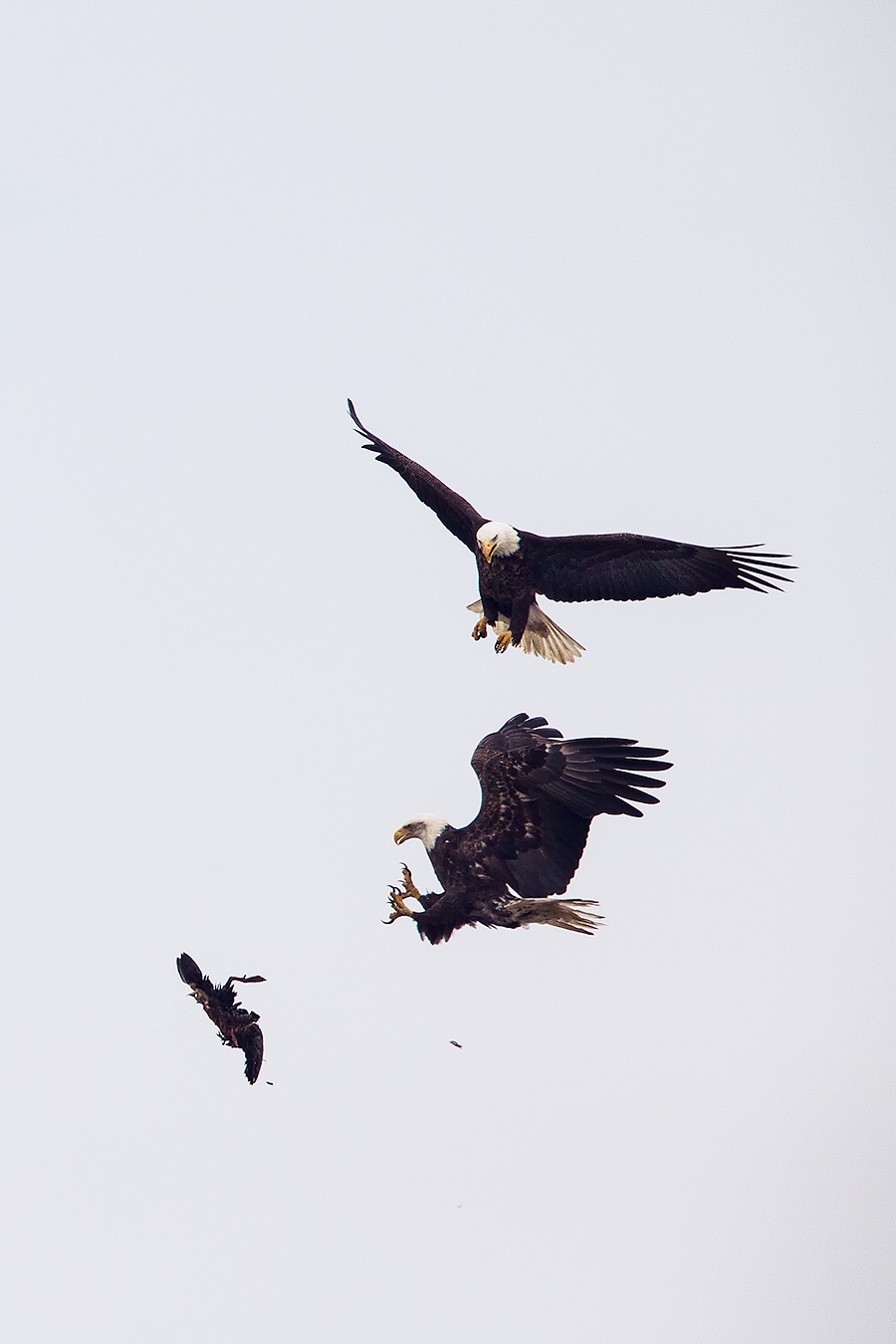
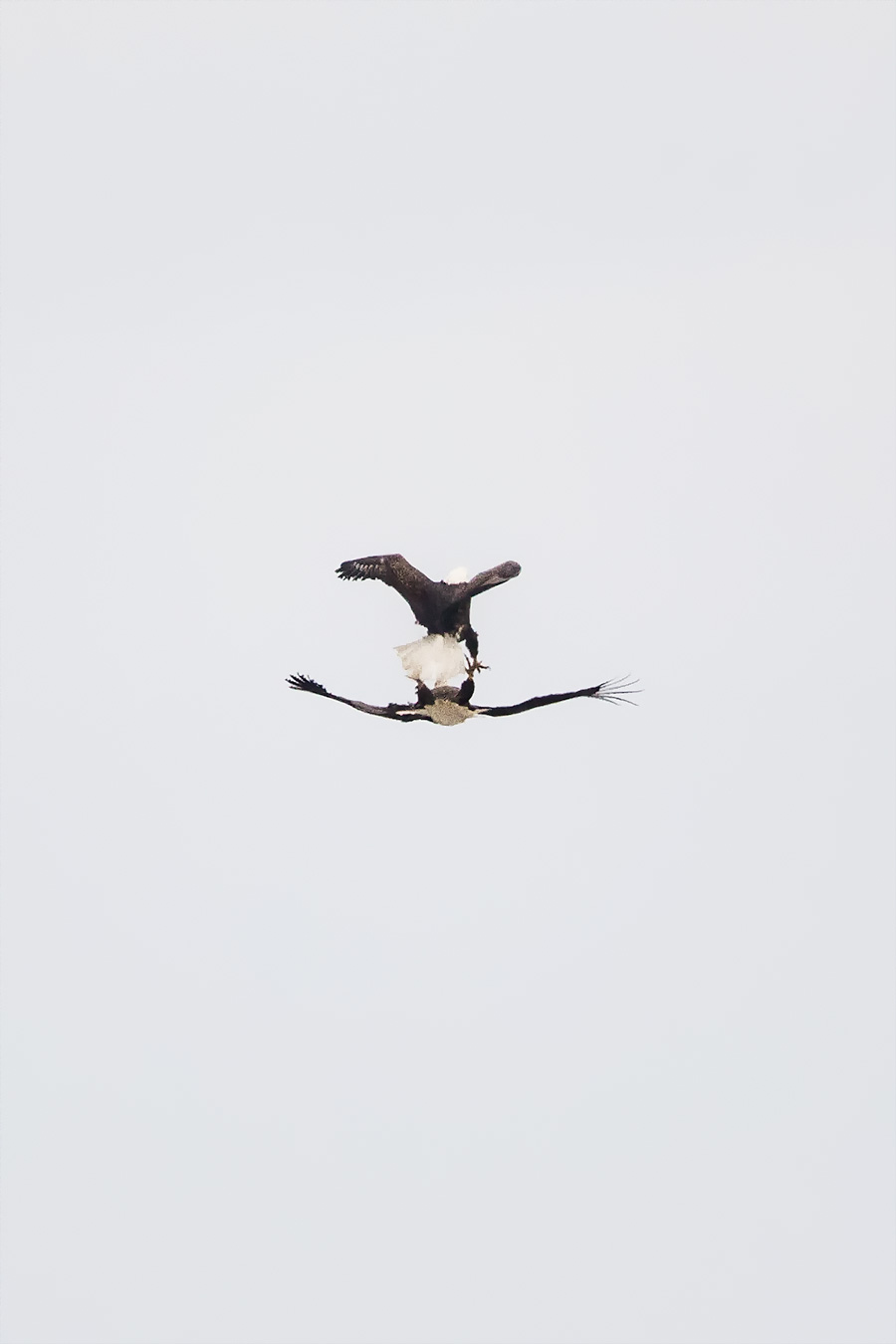
Wildlife Blogger Jim from Readings From The Northside was lucky enough to witness two bald eagles fighting over a deceased duck. He captured their battle on film and describes what he saw on his blog Readings From The Northside.

As the numbers of eagles increase in New Jersey, these type of disputes are becoming more common place. Eagles not only fight over food but territory as well. Several eagles have been found deceased or injured this past year due to conflicts with other eagles.

Learn more about Conserve Wildlife Foundation’s Eagle Project.

Eagles fight over duck at LBI @ Readings From the Northside
Eagles lock talons @ Readings From the Northside

Celebrate GIS Day with Conserve Wildlife Foundation of New Jersey

By: Lindsay McNamara, Communications Coordinator

Data nerds rejoice! Today, Wednesday, November 19 is GIS Day. Geographic information systems (GIS) technology helps our wildlife biologists protect rare species throughout New Jersey. GIS technology is used to create our species range maps and other important tools that show where wildlife occur and what habitat they need to exist.

Conserve Wildlife Foundation is a key player in updating the NJ Endangered and Nongame Species Program’s (ENSP) database of rare wildlife species. The database called “Biotics” is a GIS and Oracle-based system developed by NatureServe, the leading source of information on the precise locations and conditions of rare and threatened species and ecological communities in the Western Hemisphere.

Although CWF and ENSP biologists submit a majority of the data on Biotics, we rely on the help of citizen scientists to fully understand the wildlife picture in New Jersey. Do you want to help biologists monitor certain areas of the state and locate the presence of species of concern? Visit our website to learn how you can get involved.

In addition to the Biotics database, GIS was used to create range maps for all 190 species featured on our online field guide! Check it out.

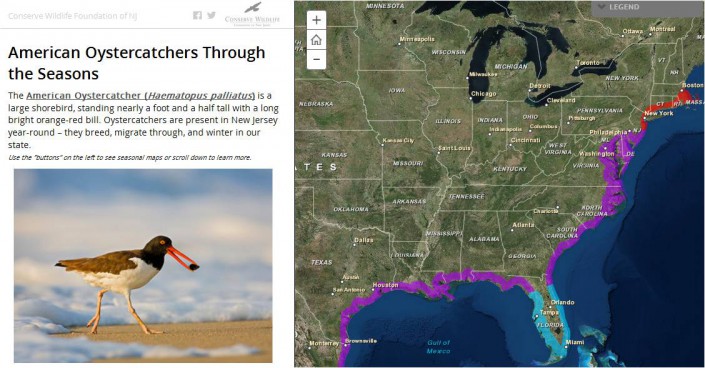
Have you seen our American Oystercatcher Story Map? GIS was used to create that tool as well! A Story Map is a web-based interactive GIS map embedded with all kinds of content, like text, photographs, and video.

storymap
“American Oystercatchers Through the Seasons”
 tells the story about a species of migratory bird, the American Oystercatcher, which spends the summer breeding season along the New Jersey coast, and is present year-round along the southern New Jersey coast. Learn more about our Story Map.

This GIS Day, take a look at all of the maps around you and consider supporting additional Conserve Wildlife Foundation Story Maps!


Lindsay McNamara is the Communications Coordinator for Conserve Wildlife Foundation of New Jersey.

Flying Fish Brewing Company Serves Plover Pale Ale, Highlights Importance of Piping Plover Conservation Programs

“Beer, Birds and The Bahamas” Showcased the International Link
between the U.S. and The Bahamas for Piping Plovers

By: Lindsay McNamara, Communications Coordinator

Todd and Stephanie explaining the Piping Plover Bahamas Project to guests at "Beer, Birds and The Bahamas."
Todd Pover and Stephanie Egger explaining the Piping Plover Bahamas Project to guests at “Beer, Birds and The Bahamas.”

On Thursday, November 6, over 85 guests attended “Beer, Birds and The Bahamas,” a fundraising event organized by Flying Fish Brewing Company and Conserve Wildlife Foundation of New Jersey.

Conserve Wildlife Foundation biologists, Todd Pover and Stephanie Egger educated guests about the Piping Plover “Bahamas Project” and showed the connection between The Bahamas and the U.S. for the endangered beach nesting bird species. One-night-only Plover Pale Ale was served and guests had the opportunity to attend brewery tours and play Plover Quizzo. The winners of Plover Quizzo received prize baskets full of Conserve Wildlife Foundation and Flying Fish Brewing Company merchandise.

“Events like ‘Beer, Birds and The Bahamas’ fulfill the purpose of creating a community space inside the Brewing Company,” said President of Flying Fish Brewing Company Gene Muller. “Our audience and Conserve Wildlife Foundation’s audience go hand in hand. People who appreciate wildlife and the environment also appreciate sustainably produced beer.”

“This innovative project is based on partnerships in both New Jersey and the Bahamas – bringing together distant communities who still share a strong commitment to education and a personal connection to their beaches,” said Conserve Wildlife Foundation Beach Nesting Bird Project Manager Todd Pover. “In the same vein, the event at Flying Fish Brewing was an exciting partner-driven way to promote the project.”

Conserve Wildlife Foundation of New Jersey’s Piping Plover Bahamas Project supports the recovery and long-term survival of Piping Plovers by identifying critical Bahamas wintering habitat for Piping Plovers and other shorebirds of concern on the islands of Abaco and Eleuthera, The Bahamas. Conserve Wildlife Foundation collaborates with a local Bahamas environmental group, Friends of the Environment, to engage the public and increase local awareness of the critical role played by the Bahamas in the full life cycle of the Piping Plover.

The Atlantic Coast population of Piping Plover has been federally listed as threatened in the U.S. since 1986 and endangered in Canada since 1985. Although migration and wintering protection is one of the five main recovery tasks in the U.S. Fish and Wildlife Service’s (USFWS) Piping Plover Recovery Plan (USFWS 1996), until recently protection has primarily been focused on the breeding grounds. Furthermore, population monitoring is well understood on the breeding grounds, but winter use is not as well documented.

Over the past five years the importance of the Bahamas as a major wintering site for Piping Plovers has become increasingly evident.

Conserve Wildlife Foundation of New Jersey and other partners aim to identify critical wintering habitat, provide education and outreach to school children and the public, and build local capacity for future surveys and protection of Piping Plovers in the Bahamas. For more information, please visit our website.

Flying Fish Brewing will donate proceeds from the sale of Plover Pale Ale to the Bahamas Project by Conserve Wildlife Foundation of New Jersey.

Lindsay McNamara is the Communications Coordinator for Conserve Wildlife Foundation of New Jersey.

Identifying with New Jersey’s Fascinating Bats


Hard to believe, but October is already here! And that can only mean one thing – bats! Everyday throughout the month of October, follow CWF on social media and our blog to fly high with these incredible creatures of the night! Each day we will have fun facts, quizzes, and beautiful photos highlighting these amazing animals and the work CWF does to protect them.

Our previous coverage included an overview of bats in New Jersey from our biologist, a look into the threats bats are facing today, a reality check on some myths and legends surrounding bats, and shared some examples in ways you can get involved in our efforts to save bats. This week, for the final week of October, join CWF bat biologist Stephanie Feigin in the field! 

Make sure to follow us everyday on Facebook and Twitter and read our blog every Friday for our #31daysofbats!


by Stephanie Feigin

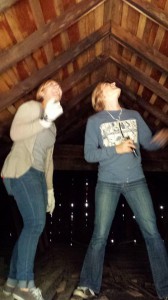
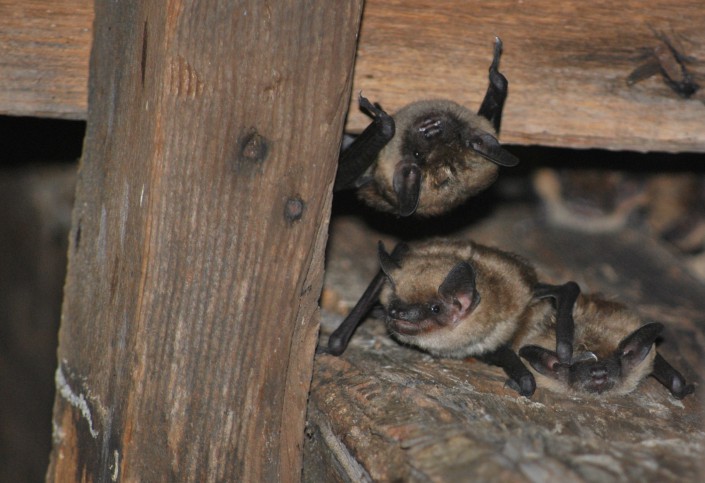
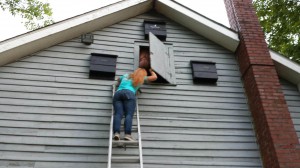
Stephanie Feigin and MacKenzie Hall monitoring a bat roost in an attic

I think it is surprising how little people know about bats considering  how beneficial they are to humans. From eating the bugs that bite us and reducing the need for pesticides on our farms, to helping doctors learn the advantages of echolocation to the blind, knowledge of these important creatures should be at least as common as the sight of them flying overhead. Since I have started working on Conserve Wildlife Foundation’s bat projects, I have noticed just how fascinated people can be with bats, and how excited they are to learn more about these elusive creatures of the night.

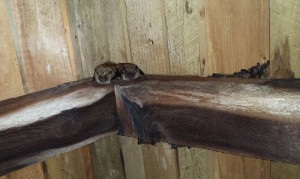
In giving presentations on bats in New Jersey, I realize how many people still believe the myths about bats and generally regard them as spooky or creepy, not beneficial and cute I enjoy sharing my knowledge and experiences in order to correct the many misconceptions.The first time I saw a bat it was hiding behind a beam in the attic of an old church. I was shocked at how adorable and small the bat was, and I still get that same feeling every time I see some tiny bat ears poking out over top of a beam or tiny bat eyes looking back at me.

Every time I go out, whether it is to monitor a site where CWF has installed bat houses and do a bat count, or to assist other researchers in a banding survey of bats getting ready to hibernate, or even just to walk along the canal by my house with the acoustic detector, I have felt a connection to these animals. I love the dynamics of their roosts, the way they snuggle together for warmth, and the little chatter sounds they make when they are getting ready to go out to hunt for the night.

Keeled calcar on Indiana bat (c) MacKenzie Hall

There is so much to learn and understand about bats. One thing I have especially loved learning is the subtle differences between one bat species from the next. Have you ever looked up and seen a bat flying overhead? But instead of just saying, “Hey, that’s a bat!” Have you ever spent time thinking, “I wonder what type of bat that is?” Well I have, and sometimes it is not that easy to decipher. We have nine different bat species in New Jersey. Some of these are easier to identify than others. The hoary bat, for example, is easily identified because it is largest bat in New Jersey, with bodies measuring from 5 to 6 inches and wingspans reaching up to 17 inches. These bats also have a lower frequency of call, making it easy to read on a sonogram.

Some of our other bat species however, possess very subtle and small differences, making them much harder to distinguish from one another. All four of these species are “cousins” and are part of the Myotis genus. In New Jersey, the bats in the Myotis genus are the little brown bat (Myotis lucifugus), the Indiana bat (Myotis sodalist), the long-eared bat (Myotis septentrionalis), and the eastern small-footed bat (Myotis leibii).

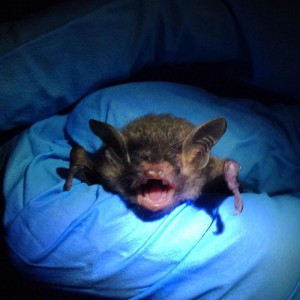
Indiana bat (c) Stephanie Feigin

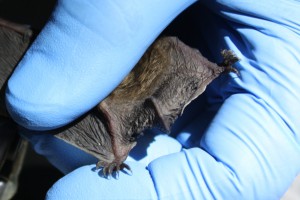
In my opinion, it is the hardest to identify Indiana bats from little brown bats. One way to do this is by the length of their toe hairs. Indiana bats will have smaller toe hairs than the little brown bats, and they will not extend past their toenails. Indiana bats also have a keeled calcar, or a foot spur of cartilage, that supports the membrane between the foot and tail. This looks like a tiny strip of extra skin on the membrane between the bat’s foot and tail.

Another way to identify which bats are in the area is with the use of an acoustic detector. All of the myotis bats have very similar calls, all in the same frequency range, making it very hard to identify one bat from the other on a sonogram. Even the computer program we use will not take a guess as to which myotis it is because their calls are so similar! Since the first time I went out with the acoustic detector, I have been enthralled by the different chatters of the bats, from the feeding buzz to their chatters to each other while flying and hunting for food. I have gained a new perspective on the world of bats and me developed a true connection to these animals.

Big brown bats (c) MacKenzie Hall

It is exciting to be a part of the bat projects at CWF and to have the opportunity to understand bats further, help research and implement ways to protect them, and educate the public about who these animals really are. They are not creepy, scary rodents who will attack you and fly into your hair. They are adorable, helpful mammals that I think everyone can find a way to appreciate, just like I have.

 Stephanie Feigin is a Wildlife Ecologist for the Conserve Wildlife Foundation of New Jersey.

Big brown bats in N.J. thrive as smaller cousins decline

Big Brown Bats (c) Phil Wooldridge

White-nose syndrome continues to kill off little brown bats in New Jersey, but there is hope on the horizon for another species of bat – the big brown bat. Reporter James O’Neill explores the changing fortunes of New Jersey’s bats.

Protecting Bats – What is Being Done and How You Can Help!

Hard to believe, but October is already here! And that can only mean one thing — bats! Everyday throughout the month of October, follow CWF on social media and our blog to fly high with these incredible creatures of the night! Each day we will have fun facts, quizzes, and beautiful photos highlighting these amazing animals and the work CWF does to protect them.

Our previous coverage included an overview of bats in New Jersey from our biologist, a look into the threats facing bats today, and a reality check on the myths and legends surrounding bats! Today we share some examples of ways you can get involved in our efforts to save bats in New Jersey.  Stay tuned next week to join CWF bat biologist Stephanie Feigin in the field!

Make sure to follow us everyday on Facebook and Twitter and read our blog every Friday for our #31daysofbats!


By Julianne Maksym

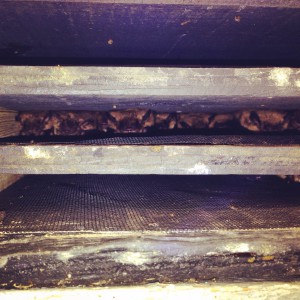
Big brown bats in bat house (c) Stephanie Feigin

With terrifying threats like White Nose Syndrome, bats face a tremendous fight for survival. Populations are declining worldwide at an alarming rate – some species are becoming so rare they are hardly ever seen at all.

Bats need all the help they can get and Conserve Wildlife Foundation (CWF) offers some simple ways to get involved and make a difference:

Building a bat house: This can create a safe and secure home for a colony of bats of up to 80 individuals. These houses provide the opportunity for bats to settle into a new roost before being evicted from a homeowner’s dwelling. The most ideal location to position a bat house is on the side of a building (where bats already roost) or on a pole in open space. The house should be set at a minimum of 12 feet off the ground facing south to southeast with early and direct sunlight. CWF is able to offer free bat houses in cases where bats are being evicted from a building. If interested in setting up a bat house please contact us, as we would like to monitor the process.

Summer Bat Count: During the hot summer months, we ask volunteers to participate in our annual Summer Bat Count. There are a total of four bat counts per summer – two between May 15 and June 21 (before pups can fly) and two more between July 6 and July 31 (when pups are flying and exiting the roost with their mothers). Making sure you do all four bat counts will allow us to best compare data from year to year and between sites. Previous yearly reports and current data sheets can be found at CWF’s ‘Summer Bat Count’ page.

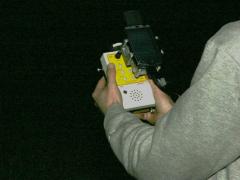
AnaBat acoustic detector. The attached PDA (like a little computer screen) lets us view incoming bat calls instantly. © MacKenzie Hall

Acoustic surveys: To aid in bat research across New Jersey, CWF purchased two AnaBat SD2 acoustic detectors for the purpose of studying echolocation and general bat behavior. Four bat detectors are now in circulation for use; volunteers now do most of our mobile acoustic surveys. Volunteers are assigned a 10-30 mile driving route in their local area to travel twice each summer after dark. Detectors can be mounted on vehicles and activated while driving at night, making them a pretty quick and easy way to get a lot of information – all without having to catch, hold, or even see a single animal. For more details please contact us, as there is currently a waiting list for the acoustic detectors.

Plant a night garden: Love bats and have a green thumb? Plant a night garden! In these sanctuaries, night-scented flowers are grown to attract bugs such as moths, which in effect provides an ample food source for bats. Plants such as white jasmine and evening primrose and herbs such as mint and lemon balm are great to start with. Plant oak or field maple trees to add some shelter and warmth to your garden. To get started on your green project, check out Back to Nature, an artisanal home and garden store located in Basking Ridge, NJ. *Note: 10% discount for CWF members.

Do not disturb bats during hibernation: A huge way in which to help maintain stable bat populations is to stay away from caves, roosts, or trees during hibernation season. It is important to not disturb a hibernating bat as any disruption to its sleep can result in early awakenings. It is estimated that a bat can burn up to a two weeks worth of fat reserves in each awakening which in turn can severely weaken and/or kill the bat. Whether you are outside hiking or just taking a stroll and encounter a roost, leave quickly and quietly!

IMG_1497Adopt a Species Program: Interested in adopting a bat? Check out CWF’s Adopt a Species Program for the Indiana Bat. Your symbolic adoption supports our efforts to protect New Jersey’s rarest animals, restore important habitat, and foster pride in New Jersey’s rich wildlife heritage. Adopting a Species also makes a great gift for a friend or loved one. Give the gift that gives twice!

Bats face an ever-present uphill battle due to both natural and unnatural causes. Populations are in desperate need of help! Whether it is building a bat house or a night garden or anything in between, every action you take in supporting these animals means we are one step closer in providing a stable world for them. Join CWF in volunteering your time, educating the public and most importantly, protecting our amazing bats!

Julianne Maksym is a graduate wildlife intern for Conserve Wildlife Foundation of New Jersey

Spotlight on Meghan Wren, Women and Wildlife Leadership Award Winner

Megan Wren: Founding Director of Bayshore Center at Bivalve Recognized for her Conservation Efforts

By: Lindsay McNamara, Communications Coordinator

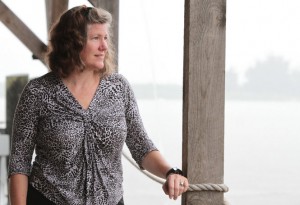
As an iconic protector of the Delaware Bay for over 26 years, 2014 Women & Wildlife Leadership Award Winner Meghan Wren has devoted her life to restoring the region through hard work, dedication and leading by example.

Megan Wren, inspiration award winner
Megan Wren Leadership Award Winner

At 23 years old, Meghan led a restoration effort for the 1928 oyster schooner A.J. Meerwald. Through a variety of volunteer and community-based fundraising activities, along with major grant support, A.J. Meerwald was brilliantly restored and is now New Jersey’s official Tall Ship, serving as a sailing classroom. Meghan founded Bayshore Center at Bivalve in 1988 to motivate people to take care of the history, culture and environment of the Bayshore region. More than 20 years later, Meghan has continued to transform Bivalve through a number of restoration and conservation projects, as well as, the opening of the Delaware Bay Museum & Folklife Center.

Join us as we honor Meghan and the three other 2014 Women & Wildlife Award Winners this Thursday, October 23rd beginning at 6pm. Purchase events tickets and find more information.


CWF asked Meghan a few questions about what working in wildlife conservation means to her:

What motivates you to get out of bed each morning and go to work?

“I go to work each morning to do what I can to raise the level of concern for and participation in the stewardship of New Jersey’s Bayshore.”

What is your favorite thing about your job?
“My favorite thing about my job is the diversity of opportunities. While focusing on Delaware Bay, I have had the opportunity to learn about a broad range of scientific issues, conduct historic research and collect first hand stories, meet and work with amazing people and experience the magical, seasonal phenomenon of the Bayshore’s flora and fauna.”

Name one thing you can’t live without.

“I can’t live happily without my daily fix of Bayshore vistas across wide expanses of marsh and water.”

Do you have a New Jersey wildlife species that you like best? Why?

“I’ve had a long personal history with Diamondback Terrapins, helping hatchlings find the water for as long as I can remember. I love the first warm days of spring, when I can find them emerging from my garden in search of the water. They are so different from one another in color, tone and markings. I love to see the heads of females pop out of the water unexpectedly as they scan the shoreline for a place to come up to lay their eggs.”

What interests you the most about New Jersey’s wildlife?

“I am particularly interested in learning more about the life cycle and stories of the Bayshore region species.”

Name one piece of advice you would give to someone who wants to change the world.

“Perseverance.”

What wildlife “lives” in your office? At your home?

“My office, in Bivalve, on the Maurice River just two bends before Delaware Bay, has daily eagle visits. The historic roof over the wharves entices shorebirds, skimmers and seagulls depending on the season; mute swans, fiddler crabs and occasional otters cavort in the mud and water between the docks. There is a mini-oyster reef just off the dock with oysters, gobys and a plethora of unseen marine life. The 4,000 acres of wetlands contiguous to the property host countless species of birds, mammals and fish.

“My home in Money Island on the Nantuxent Creek also hosts abundant eagles, ospreys and marsh hawks overhead and speedy peregrines over the water. Purple martins, barn and tree swallows, great horned owls often call at night from the surrounding trees and orioles. Wrens and mourning doves nest in the yard. Along the road, I find muskrats, raccoons, opossums, skunk, mink, otters, weasels, rats, meadow voles, coyotes, and an occasional deer. All the usual suspects including raptors, warblers, shorebirds and songbirds in the skies, trees and marshes; and the ever present clapper rails, willets and great blue herons can be heard clacking and squawking from the wetlands.”

What do you find most challenging about your profession?

“I find it very difficult to juggle competing priorities, especially when all of them seem incredibly urgent.”

What is your favorite thing to do when you aren’t working?

“I enjoy spending time outdoors with my family, walking along the Bay beaches, kayaking its tributaries and hiking through its woodlands.”

Please join us this Thursday, October 23, 2014, from 6:00 – 8:30 p.m. at the Trenton Country Club to honor the contributions that Meghan Wren, Brooke Maslo, Cathy Malok and Jeanne McArthur-Heuser have made to wildlife in New Jersey.

We are excited to recognize the leadership and inspiration they provide for those working to protect wildlife in New Jersey. Women & Wildlife will also celebrate the timeless and inspiring journeys of wildlife migration in New Jersey and beyond.

Lindsay McNamara is the Communications Coordinator for Conserve Wildlife Foundation of New Jersey.