The Coastal Barn Owl Project team is gearing up for another round of nest box installations in coastal southern New Jersey. After a successful fundraising appeal, we can now thank our donors by adding more potential nesting opportunities for barn owls, a species in population decline.
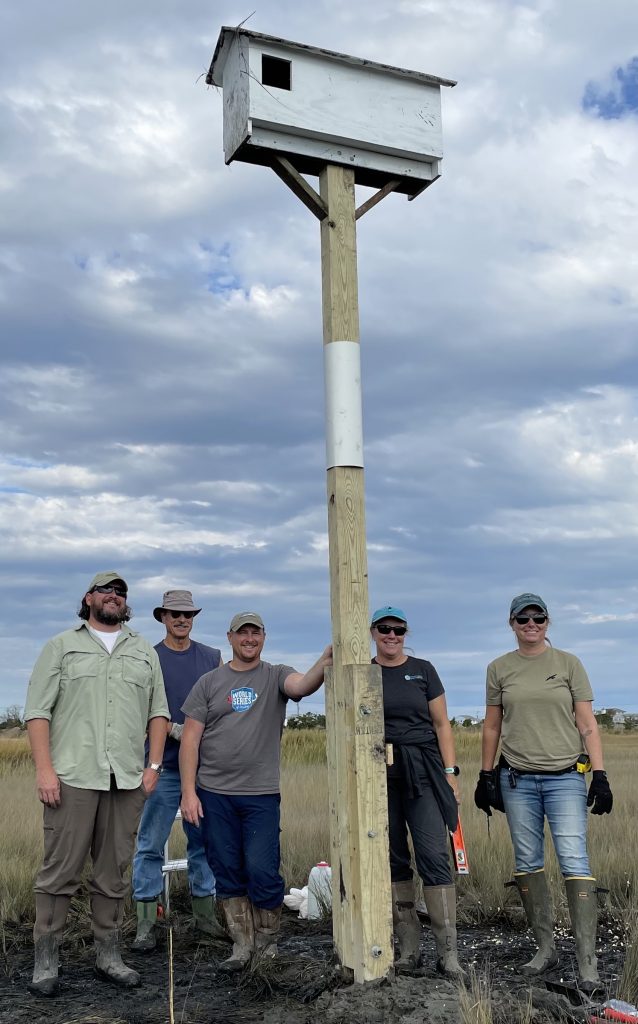
Our fourth and most recent box was just installed on October 22 in the saltmarshes of Cape May County. With each install, the team is becoming more efficient, and we hope to get several more boxes up in key locations before early spring when the owls begin their search for suitable nesting sites.
The newest barn owl nest box with volunteers Kevin Knutsen, Steve Eisenhauer and Mike Lanzone on left. Team leaders Tricia Miller and Meghan Kolk on right. Photo by Lisa Ferguson.
Coverboards are typically placed along ecotones, where species diversity is expected to be greatest. The corrugated tin board, pictured above, was positioned along a forest edge where larger deciduous trees meet a more open, sandy landscape.
How do you survey for animals that spend most of their time hidden under leaf litter or wedged between fallen tree limbs and rocks?
In the case of reptiles and amphibians, the answer is to use coverboards!
Coverboards are materials that are intentionally placed within a potential habitat, often along ecotones (where different habitat types- e.g., wetland and forest, field and forest, etc. come together) that trap moisture and retain heat, creating favorable conditions for our “cold-blooded” (ectothermic) friends. Researchers often arrange coverboards in long transects or arrays and collect data on the diversity of the community underneath the boards as compared to the surrounding environment. This technique was used by NJDEP Division of Fish and Wildlife to survey for herptiles in 17 wildlife management areas in the early 2000s (Golden, 2004). A total of 30 species were recorded during the first year of the study, including long-tailed salamanders, pine barrens tree frogs, and northern pine snakes, all of which are listed as threatened in New Jersey.
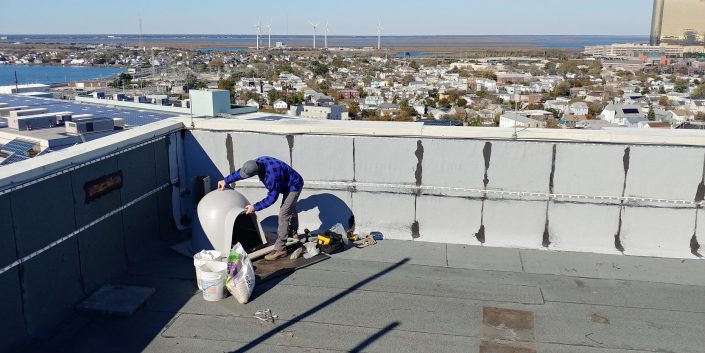
Putting the final touches on a new nestbox for peregrine falcons in Atlantic City, NJ. photo by Kathy Clark/ENSP
This past week I had the pleasure of assisting Supervising Zoologist, Kathy Clark with NJ Fish & Wildlife’s Endangered and Nongame Species Program to install a new nestbox for state endangered peregrine falcons. The new nestbox was installed atop the Sheraton Atlantic City Convention Center Hotel. Peregrine falcons are not new to Atlantic City. They have nested in A.C. since 1987, where the first pair nested on the 23rd floor of the Hilton/Atlantic Club. Since then new pairs have established nests on other tall buildings and structures, like the Hard Rock Casino and A.C. water tower.
The 2021 New Jersey eagle nesting season was another good year for NJ’s eagle population. The final numbers and details will be available in the 2021 Annual Bald Eagle report published in December. There are over 100 eagle project volunteers who monitor eagle nests/s during the season. They are an extremely dedicated group who not only monitor eagle nests but help to protect the nests. Volunteers become familiar with their pairs and get to witness all kinds of eagle (and other wildlife) activity. I asked the volunteers to send me their one favorite photo from this season.
A season of change and hope at the Barnegat Light Osprey Cam.
by Ben Wurst, Habitat Program Manager
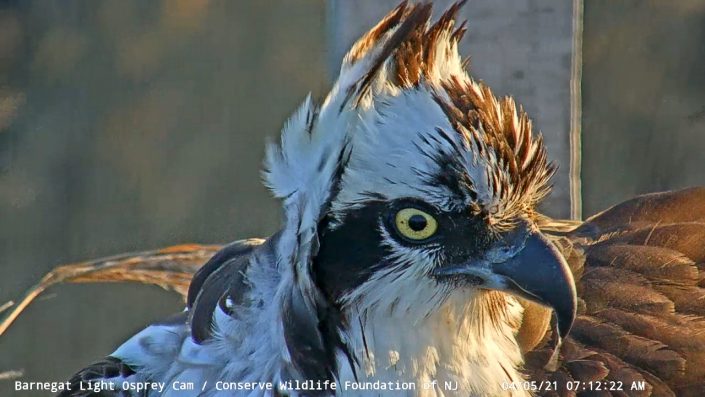
The “new” female at the BL Osprey Cam. April 5, 2021. Note the small dark fleck on her right iris.
By far, this was the most viewed season of the Barnegat Light Osprey Cam, with over 360,000 views and 111,000 hours watched! It was a season of change. Viewers throughout the world watched as the mated pair successfully fledged two healthy young. We witnessed the trials and tribulations of a new pair, especially the female, who we believe attempted reproduction for the first time in her life. We saw that life as a young osprey was not always guaranteed, which is something we rarely get to witness but know is quite common at many nests throughout the world; however, with an experienced male and plentiful prey, the surviving young thrived. As we work on a season long highlight video, here is a brief summary of their nesting season.
A couple weeks ago colleagues with NJ Fish & Wildlife shared a video clip of a dark osprey who landed on a nest platform along the Maurice River near Leesburg, NJ. “Looks like an oiled bird” the text read. Indeed it looked like the bird was exposed to some form of petroleum product, which stained its feathers a dark color. At the time, there was no oil spill reported to NJDEP (this was on May 10) and the video shows that the bird was observed on the nest on May 1, 2021.
Eagle Scout candidate Kyle Agudo and Boy Scout Troop 61 give ospreys a boost in the new year
Ben Wurst, Habitat Program Manager
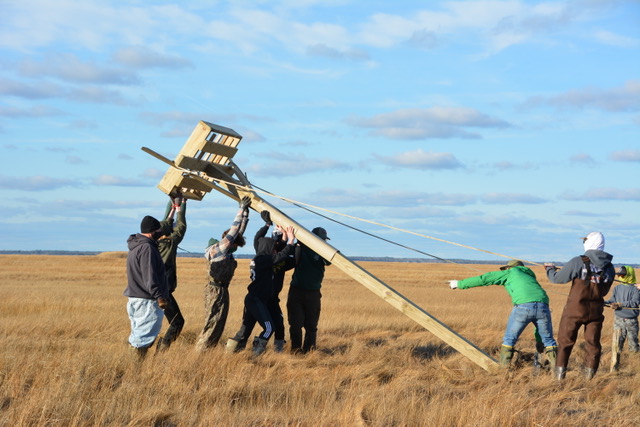
Troop 61 lift an osprey nest platform into place on the coastal saltmarsh. photo by Kathy Agudo.
Humans have played a key role in the recovery and stability of nesting ospreys throughout New Jersey and beyond. Today around 75% of the population, close to 500 pairs, rely on nest platforms designed specifically for them. They provide a stable nest platform, adequate perches, and protection from potential ground predators, aka raccoons. Many platforms are located in very close proximity to people, which make for excellent viewing and educational opportunities. Ospreys are a symbol of a healthy coast and resiliency in a dynamic region.
Summer is here. As we reach the peak of the osprey nesting season in New Jersey, we conduct surveys to monitor their overall nest success and health of the state wide population. These surveys are conducted by specially trained volunteers who devote much time to ensure ospreys have a future in New Jersey. These surveys have been conducted every year since the early 1970s and are crucial to track any possible downturn in a colony, watershed or region of the state. Ospreys are a very important indicator of the health of the environment in which they live. This is especially important in coastal areas where they support a booming shore economy that is built around clean water and abundant marine/estuarine ecosystems.
CWF biologist Ben Wurst (above), and all our staff and volunteers are practicing social distancing and following all state and CDC guidelines while in the field to prevent the spread of COVID-19.
With the COVID-19 pandemic causing global shutdowns, how has wildlife reacted to the absence of humans in New Jersey – and across the world? What impacts are we seeing so far, and what should we expect in the long-term?
COVID-19 has changed our lives in virtually every possible way over the last few months. Our relationship to wildlife is no different. This three-part series explores the impacts of the COVID-19 pandemic and shutdown on wildlife in New Jersey and across the world. Read Part 1 and Part 2 and check out our podcast on COVID-19 and wildlife.
Part 3 The Threat of COVID-19
No discussion of COVID-19’s impact on wildlife would be complete with its fated beginning and its long-term threats posed by the global economic shutdown. As a zoonotic disease, COVID-19 likely was triggered by a virus in bats that got into a pangolin in a wet market that was then consumed by people, chance encounters made much more likely by a number of destructive human activities.
Clearing primal forests bring people into contact with remote wildlife for the first time, while also changing wildlife behaviors to increase the likelihood of their interaction with humans. Live animal markets offer ideal opportunities for viruses like COVID-19 to emerge. Illegal trafficking incentivizes further habitat clearing and poaching. Trading in exotic wildlife creates a host of problems both to the species themselves and to their ecosystems. (Though underexplored in the popular Tiger King series, the impacts of the exotic wildlife trade could make a fascinating series in its own right).